EHR, stop, look, and listen

handyman copyYou’ve probably figured out that I am never going to be asked to substitute host any of the home improvement shows.  I wasn’t blessed with a mechanical mind, and I have the attention span bordering on the half-life of a gnat.

I’ve noticed that projects involving me and the house have a way of taking on a life of their own.  It’s not the big projects that get me in over my head—that’s why God invented phones, so we can outsource—it’s the little ones, those fifteen minute jobs meant to be accomplished during half-time, between pizza slices.

Case in point—trim touch ups.  Can, brush, paint can opener tool (screwdriver).  Head to the basement where all the leftover paint is stored.  You know exactly where I mean, yours is probably in the same place.  Directions:  grab the can with the dry white paint stuck to the side, open it, give a quick stir with the screwdriver, apply paint, and affix the lid using the other end of the screwdriver.  Back in the chair before the microwave beeps.

That’s how it should have worked.  It doesn’t, does it?  For some reason, you get extra motivated, figure you’ll go for the bonus points, and take a quick spin around the house, dabbing the trim paint on any damaged surface—window and doorframes, baseboards, stair spindles, and other white “things”.  Those of us who are innovators even go so far as to paint over finger prints, crayon marks, and things which otherwise simply needed a wipe down with 409.

This is when it happens, just as you reach for that slice of pizza.  “What are all of those white spots all over the house?”  She asks—you determine who your she is, or, I can let you borrow mine.  You explain that it looks like that simply because the paint is still wet—good response.  To which she tells you the paint is dry—a better response.

“Why is the other paint shiny, and the spots are flat?”

You pause.  I pause, like when I’m trying to come up with a good bluff in Trivial Pursuit.  She knows the look.  She sees my bluff and raises the ante.  Thirty minutes later the game I’m watching is a distant memory.  I’ve returned from the paint store.  I am moving furniture, placing drop cloths, raising ladders, filling paint trays, all under the supervision of my personal chimera.  My fifteen-minute exercise has resulted in a multi-weekend amercement.

This is what usually happens when the plan isn’t tested or isn’t validated.  My plan was to be done by the end of halftime.  Poor planning often results in a lot of rework.  There’s a saying something along the lines of it takes twice as long to do something over as it does to do it right the first time—the DIRT-FIT rule.  And costs twice as much.  Can you really afford either of those outcomes?  Can you really afford to scrimp on the planning part of EHR?  The exercise of obtaining HER champions and believers is difficult.  If you don’t come out of the gate correctly, it will be impossible.

Back to my project.  Would you believe me if I said I deliberately messed up?  Maybe I did, maybe I didn’t, but the one think I know with certainty is that I now have half-times all to myself.


Gumby1

EHR Groundswell

1wagonEHR, there’s a new groundswell against meaningful use. How do I know? I’m starting it now.
After lunch, if I’m in the right mood, I may start one against certification.

health_care_czar_tshirt-p2356674952502689842uw8q_210

EHR–What if GM built it? I’m serious.

eat_more_chickensizedDo you ever think about the origination of some of your ideas?  For me, the good and the bad just seem to materialize.  Like the time a friend and I were hiking a peak in the Sangre de Cristo range in Colorado.  It had taken the better part of six hours of circuitous climbing to reach the summit.  It was late in the fall, and the temperatures were around freezing.  Roiling storm clouds were racing towards us from the west.

If we returned by the same route we knew we’d be caught up in a storm that we were neither prepared nor dressed to handle.  I spotted our car about six thousand feet below us.  If we headed straight to it, I thought we could cut our descent time by about an hour.  To do this though required that we make our own trail via a hunt and peck route of whatever the terrain permitted.  We dropped the first fifteen hundred feet in a matter of twenty minutes using a glissade.  This technique allows you to moonwalk and slide down a scree field, using your ice ax as a break.

After an hour we reached a point about two thousand feet above our car.  It was sleeting, and the wind was whipping around the face of the mountain.  There in the middle of nowhere stood a sign from the sheriff that read, “Devil’s Gulch, turn back.”  Our choice was to reclimb the mountain or to ignore the sign and press on.  I hate do-overs.  How tough can this be, I goaded him?  Be smart, kick it into high gear, and we’ll be done.

We pressed forward.  Fifteen minutes later, we reached a four hundred foot limestone cliff.  Between us and the next semi-reasonable terrain was a rather deadly looking wall of rock and scrub pine.  My pack made me feel like it was forcing me forward, so I removed it and tossed it over, thinking I’d retrieve it later.  Watching my pack bound from rock to rock for what seemed like more than a minute did nothing for putting me at ease.

We spent more time discussing each step than we spent taking it.  Those four hundred feet took us two hours.  Not my best idea, but it didn’t kill us.

So, during my run today, I had another idea.  This one is about OnStar, the GM tracking system.  I typed in to Google, “How does OnStar Work?”  Lots of hits.  The more I read, the more I began to feel like if one ignored the technology and focused on the concept a real argument could be made for pairing the idea, and a few others, and seeing what type of EHR network might be possible using a similar set of tools.

The OnStar concept is termed telematics, a combination of telecommunications and informatics.  Telematics is the integration of computing, wireless communications, and GPS.  It provides information to a mobile service like a phone, PDA, or laptop.  It is used for sending, receiving, and storing information over very large networks.  So, why is nobody having the conversation that says what if we image a similar network with added security that works from a healthcare provider’s office rather than a car.

OnStar doesn’t need Rhios.  OnStar has a single set of standards.  Now, instead of arguing why something like this can’t work in healthcare, isn’t there argument is seeing if it can?

SaintLogo

EHR vs EMR – What’s the Difference?

leadershipThe question was raised on the blog Software Advice.

I think the very question reinforces the magnitude of the issue. Providers have budgets for products whose cost they do not understand. They have implementation teams who have never implemented one. They are aiming at targets for certification and meaningful use, which from my perspective could just as well be written on an Etch-A-Sketch. Hundreds of committees work towards standards, a requirement forced upon them by hundreds of vendor applications and hundreds of Rhios.

The output of the recent HIT policy meeting shows just how befuddled the process is.

This is a mandated national roll out of EHR without half the required sources and almost none of the required leadership. Who is the decider?

The current failure rate for EHRs is understated due to the large number of small systems. The failure rate for those over $10 million will exceed the rate for large IT systems which is close to 80%.

A hospital CEO with who I met last month told me his peers are uniquely ill equipped to make these decisions. Decisions are based on what their friends did, what they read in a journal. They plan implementations based on meeting gossamer standards and tests. They do not base them on requirements.

Watch the dates move backwards. I think in 6-8 years the rolled out EHR will more closely resemble a single, national, browser-based open EHR.

This problem is not unsolvable, however it remains unsolved.
istock_small_man-on-couch

googlehostedservice.html

googleffffffffba769e4a

HIT Policy Committee–that was helpful

health_care_czar_tshirt-p2356674952502689842uw8q_210Several have written suggesting I toss my hat into the ring to serve as the EHR Strategy wonk or czar.  I was in the process of thinking it through when I was awakened from my fuegue state by a loud noise–my ego crashing to the floor.

Some have suggested that a camel is a horse designed by a committee.  Their point in saying that has something to do with how committees function less well than individuals–the problem with “group thinking.”  Personally, I think the camel design seems rather functional.

Some have asked, what is it about the EHR universe that has you dehorting the EHR process as though you are some sort of savant–nobody really asked that, but I wanted a segue and that’s all I came up with.

It’s the committees.  I feel a little like Quasimodo repining about the bells.  Raise your hand if you are on an EHR committee.  See?  Now, if you think that not only has the committee not accomplished much, but believe that it may never accomplish much, lower your hand.  Now look around.  Not many hands still up.

Please take a look at this for a moment.  Don’t try to understand it–it will only make your teeth hurt.

2011 requirements

  • For hospitals, 10% of all orders (medication, laboratory, procedure, diagnostic imaging, immunization, referral) directly entered by an authorizing physician must be made through a computerized physician order entry process. Individual physicians still must use CPOE for all orders, even if electronic interfaces with receiving entities are not available. The initial draft did not specify the required percentage for hospitals and did not address the electronic interface issue.
  • Physicians must be able to check insurance eligibility electronically from public and private payers, when possible, and submit claims electronically. This was not in the initial draft.
  • Patients must receive timely electronic access to their health information, including lab results, medication and problem lists, and allergies. The initial draft did not include the word “timely.”
  • Physicians must implement one clinical decision rule relevant to specialty or high clinical priority. This was not in the initial draft.
  • Physicians must record patient smoking status and advance directives. This was not in the initial draft.
  • Physicians must report ambulatory quality measures to CMS. This was not in the initial draft.
  • Physicians must maintain an up-to-date list of current and active diagnoses based on ICD-9 or SNOMED. The initial draft did not specify use of the two classification sets.

2013 requirements

  • Specialists must report to relevant external disease or device registries that are approved by CMS. This was not in the initial draft.
  • Hospitals must conduct closed-loop medication management, including computer-assisted administration. This was not in the initial draft.
  • All patients must have access to a personal health record populated in real time with health data. This was moved up from 2015 in the initial draft.

Additional provisions

  • Patients’ access to EHRs may be provided via a number of secure electronic methods, such as personal health records, patient portals, CDs or USB drives.
  • CMS will determine how submitting electronic data to immunization registries applies to Medicare and Medicaid meaningful-use requirements.
  • CMS may withhold federal stimulus payments from any entity that has a confirmed privacy or security violation of the Health Insurance Portability and Accountability Act, but it may reinstate payments once the breach has been resolved.

Source: Health IT Policy Committee

See?  Take a few minutes and work this into your EHR task time-line for processes, work flows, change management, training.  Need more time?  I’d need more time than I have, and when I finished I guarantee I couldn’t explain it to anyone.  This is what happens when people get into a room, have a charter, and try to do something helpful.  I am sure they are all nice people.  But be honest, does this make your day, or does it make you want to punish your neighbor’s cat–you may have to buy them a cat if they don’t already have one.

What to do?  Here’s my take on it.  Plan.  Evaluate the plan.  Test the plan.  Know before you start that the plan can handle anything any committee tosses your way.  Let people who know how to run large projects into the room.  Seek their counsel, depend on them for their leadership.  If the plan is solid, the result has a better chnace of surviving the next committee meeting.

drevil

The Migratory Patterns of Coconuts

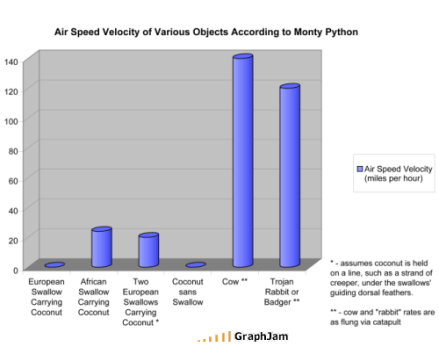
128Are you suggesting that coconuts migrate? (Not at all, but a swallow could grip it by its husk.)

Sometimes I get reactions from my clients which suggest that my ideas have people questioning if I just fell out of the stupid tree and hit every branch on the way down, especially when what we’re discussing seems to move from the theoretical and towards the heretical. However, there was a presentation I made to one of my clients where I had the entire room believing that i might as well have been suggesting that coconuts migrate.

Allow me to set the stage. I presented to the CIO of one of the largest providers in Europe a vision for what their IT strategy should be. This was an 0.2 firm requiring a 2.0 solution.  As you can guess, it was fairly easy to suggest that better alternatives were available to them, but if you’re a member of the Flat Earth Socitey you’re not going to believe anything until someone is able to literally change your perspective.

During my presentation I wrote on the white board that I would help them choose between three alternatives. At this point, a British colleague and good friend, came to the front of the room—uninvited, removed the marker from my hand, erased the word ‘between’, and penned the word ‘amongst’. “We choose between two things, and amongst three or more,” he said with a grin and then returned to his seat. I suggested that since English was not the native language of our client that his point was probably lost on them, to which he stated that his point was directed at me whose native language was supposed to be English. God save the queen. He also tried to make the point on more than one occasion that the American War of Aggression with England did not end in 1783 with a victory for America, but with a British retreat.

Anyway, we were choosing between three alternatives, at least I was. After about ten minutes of explaining what could be achieved and how it might be structured, I was interrupted again, this time by the CIO. He too took my marker, concluding that I was a coconut. It took me about thirty minutes to convince him that everything I’d presented was not only achievable, but already operational in a number of their competitors.

So, as we head down the EHR path with our Project Management Executive, the person who will be spearheading the internal effort to affect change, we must find a way to make sure the executive is properly equipped. For starters, the executive needs to have, and to be able to communicate a vision, a vision for the change, for how it will impact the organization, and an ability to communicate it.

eddiesmal

EHR, where’s my hammer?

hammerThose of you who’ve visited previously may have caught on to the fact that my wife likes to keep me away from bright shiny objects such as tools.  Let me tell you about my first house, a two-story stucco building in Denver, built in 1902.  My favorite part of the home was the brick wall.  That is had a brick wall was not apparent when I purchased it.

I came home from work to find that my dog had eaten through the lath and plaster in the living room and there was the brick.  I had to decide what to do.  I knew nothing about lathing—I know that’s not really a word—or plastering.  What to do.  My only tool was a hammer, so I began to hammer.  For those who haven’t done this, hundred year old plaster being pounded with a hammer makes a lot of dust.  This process proved to be very slow.

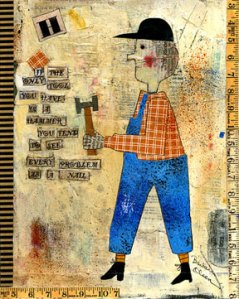
What did I do?  I bought a bigger hammer—such a guy approach to a problem, isn’t it?  It took three hammers to get down to just bare brick.  What would you have done?  When your only tool is a hammer every problem looks like a nail.

As you go through the EHR planning process in your war room—you do have a war room, don’t you?  (Try Sam’s Club, after all, they sell EHRs.)  Get out the really big piece of paper, the one with your EHR design—you do have a really big piece of paper, don’t you?  (Back to Sam’s.)

Next to the box on the paper labeled “Shiny New EHR” should be lots of empty space so you can draw in all of the other systems with which your EHR will have to interface.  One of the readers of this blog wrote recently that his EHR had more than 400 interfaces.

EHR, if done correctly, will do much for patients, doctors, and administrators.  It’s not a panacea.  It won’t reach its potential unless you also integrate it with those systems that unlock its potential.  Improving your efficiency and effectiveness takes more than merely an EHR system.

When your only tool is a hammer, you’d better hope every problem is a nail.  What other tools are you using?  Please share your ideas about what works well.

pastedGraphic.tiff.converted

EHR 2 a-days

footballIt’s hot and muggy; a hazy pall seems to levitate before me.  We call it Pennsylvania in summer.  Chest pain yesterday, nitro in gym bag.  Intervals today.  I hate running intervals as much now as I did in high school, but they’re better for the heart than just running distance.  Twenty-four 110’s.  Did I mention it was hot?


I am on the high school track.  The football team is/are—where are all the English majors when you need them—going through their drills.  Running and thinking.  That’s a good combination for me.  After two laps I’m glistening, after three I’m soaked through.  That’s when it hits me.

Practice.  Offensive and defensive drills.  Blocking and tackling.  Run the option.  Block the punt.  Come back tomorrow and do it again.  Do it until you get it right.  Do it until you can get it right in the game.  Pretty neat idea all this practicing.

Some adults get to practice.  I refer to what I do as my consulting practice—my father still has no idea what idea what I do for a living but I’m okay with that.  He was a spy and he still won’t tell me what he did.  Lawyers and doctors practice—I hope it means something other than they are still trying to get it right.

Know where this is headed?  See, that wasn’t too difficult—remember, the desk is hard, the task is difficult. (My one takeaway from eighth grade English.)  Who doesn’t get to practice, doesn’t even have a coach?  Bingo, the EHR Project Management Executive.  It would be better if they did.  Imagine this conversation:

“Sorry Charlie, hit the showers.”

“Why Coach?”

“Your change management isn’t working for you today.  You’re leaving processes untouched.”

“It was the docs’ fault.  They just toy with me.  Treat me like a wonk and tell IT jokes behind my back.”

“Your game plan is coming apart.”

“But I didn’t get to practice, we didn’t even get to warm up.  I’ll do better next time.”

“Which next time is that Charlie?  With whose money?  These are The Bigs, Charlie.  Only grownups play here.  I’m afraid I’m going to have to send you back down to Single A.”

“Private practice.?”

“Sorry Charlie”—sounds like the tuna commercial.

You’ve got one shot at this, no warmups, no practicesm there are no do-overs, and you are gambling millions.  DIRT-FIT  Do It Right The FIrst Time

pastedGraphic.tiff.converted

This is not a trick question

12456Okay, so today was going to be one of those days when I wasn’t going to allow myself to be stupified–at least no more than was really required.

Then it sneaks up smack dab in the middle of a call, and from what I’ve been able to determine, people find it annoying if you burst out laughing on the call.  (They are not annoyed at all if you simply write about them provided they don’t read it.)

What got me going is this statement, “We’ve budgeted $X for EHR.”

Really?  You did this all by yourself?

The facts as I understood them are as follows:

  • Never bought an EHR
  • Don’t know how big they are, if they are blue or green, come gift-wrapped, or if you need two people to carry it
  • No input from vendors about EHR
  • no discussions with others abot what an EHR system costs

So, with absolutely no information how does one determine how much they need to spend?  This is not like going to the supermarket for a gallon of Soy Milk–not that anyone would want to do that.

saintlogo2