Healthcare IT Strategy

September 13, 2009

EHR: How to purchase an EHR

Filed under: Rants & Musings,Strategy,Who's Running the Show? — Paul Roemer @ 6:57 pm
Tags: ,

shoppinggirlAre you really going to where that?  Do these pants really make my…

Did you ever have one of those non-halcyon days when you felt the need to ask someone “Did a house fall on your sister?”  Try to stay with me, it will come to you.  Enough about falling houses Toto.

I sought the counsel of a friend before heading down this path, and I’ve decided to choose the road less traveled anyway.

I may have written that I have observed differences between men and women.  You too?  Here are a few examples from my side of the gated compound.

  • We are willing to make mistakes as long as someone else is willing to learn from them
  • A good excuse is almost as good as getting it right
  • Good intuition will often make up for a lack of any facts
  • We refine our personality flaws, for without them we may not have a personality
  • Peter the Great heard the voices too

I regret that I am unable to share my list about women, for I am a coward.

While shopping the other day, I noticed that women shop for clothing differently from men.  For women, shop is a participatory verb—whatever that is—involving all twelve senses, for men it’s something we’d rather do online while watching the game.  From what I’ve observed, in fostering the she-conomy women:

  • Do their homework—what’s in, what’s not, what’s on sale
  • View shopping as a competitive sport, for some, a blood sport
  • Try on things, often more than once
  • Buy something they may need in case they someday find some other thing they may need that may go with it
  • There is no rule about having too many shoes—buy in volume
  • There is no rule about having too many black shoes

So, let’s see if we can segue beyond this jingoistic tractate on one to something more in line with the lofty subscription fee you paid for this site.

Permit me to employ two definitions which help me keep my ideas cogent.

  • IntraEHR—EHR statements that relate mostly to the healthcare provider
  • InterEHR—EHR statements that relate mostly to the movement  or transport of the EHR record from point A to point B

EHR and shopping.  Can one be at one with this duality?  How can one not be?  From having spoken with a number of healthcare providers about their IntraEHR selection, my take on a lot of the process is that more often than not there is no process.  It’s a lot like watching men shop.  It’s over and done with without much reasoned or substantiable—I was afraid I’d have to invent this word but I found it on Google—thought.  Over and done with, now back to the game.

Maybe EHR scholars will one day be able to trace speed buying of IntraEHRs back to that whole Neanderthal hunter gatherer thing in the Pleistocene epoch.  Sort of a think fast on your feet or you’ll be eaten approach to software selection—an awful metaphor, however CNN ran a feature with that title, so it has some legitimacy.  Maybe the hospital’s executive committee will be able to trace the hastily made IntraEHR purchase back to a lack of a plan, the lack of business requirements, and the lack of an adequate request for proposal RFP.  Maybe your successor will figure it out.

For those who haven’t contracted for their IntraEHR, it may be better to approach this like a woman.  To those who are women—you should know who you are—you are probably already approaching it that way.

Now, where did I leave my black pumps?  And no, I am not going to finish my thought about the pants.

pastedGraphic.tiff.converted

How large is the reform effort?

Filed under: change management,reform,Strategy,Who's Running the Show? — Paul Roemer @ 3:39 pm

dr_evil_one_million_dollarsA trillion dollars.

What does a trillion look like?  A dollar bill is about six inches long.  Stacked end to end, a trillion dollars would go from the earth to the sun, and back, twice.

Healthcare is one fifth of our economy.

One fifth of our GDP is larger than the GDP of five of the G8 countries, including France and the UK.  Would we try to reform the entire economy of the UK?  Would we succeed?

We have about six million miles of paved roads in the US.  How long do you think it would take the government to repave twenty percent of them, 1.2 million miles?  Could they do it?

Maybe we really should have a plan before we write a check.

pastedGraphic.tiff.converted

Public option dead? Let’s lead with a solution


Who Will Lead

Who Will Lead

Dirk Stanley posted this link from the NY Times about the death of the public option.


http://www.nytimes.com/2009/09/13/health/policy/13plan.html?_r=1

Now, we can either bemoan this or we can try to lead.  Here’s my take on how to strat the discussion.

To insure the uninsured we don’t need a public option.  When poor people were denied access to banking and credit, the government did not create a public bank.  It regulated the banking organizations and made it illegal for them to redline the poor.

Can we not regulate the payors in the same fashion, requiring them to insure the uninsured?  Were not Medicaid and Medicare created in part because payors relined the elderly?

The government requires everyone to have automobile insurance, placing the onus on the individual.  Why not flip it?  If the goal of reform is to get people access to healthcare, which under the existing business model implies insurance, require the payors to provide it.  The government can subsidize the payors, or pay it in full, and it can do so without adding to the bureaucracy of further entitlements via a public option.

To me, two other ideas make much more sense, one of which I’ve previously offered.  Large groups of people are without insurance or are under insured.  The government wants them to have access to medical care.  As stated above, the government already created two agencies to address this problem, Medicaid and Medicare.  Why create a third?  Can’t those people be added to the two existing agencies?

The other idea may be the same, but if implemented differently, could streamline the processes and the cost.  Make the cost of the coverage to those groups an offset against whatever tax they would owe.  If it costs ten thousand dollar to insure a family of five, offset it against their income tax obligation.  Net net its’ the same cost whether you collect it and refund it or simply don’t collect it.  Give these families so sort of smart healthcare debit card, the government owns the account, and all healthcare providers can accept it for payment.

Sure, there is unlimited fraud potential, just like there is under any other option.

SaintLogo

EHR: Impact on DR Patient Relationship

Filed under: change management,Work Flows — Paul Roemer @ 8:20 am
Tags: , ,

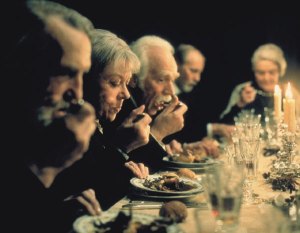
feastI’m a fan of foreign films, but since I don’t speak the language for me to really enjoy the movie, the visual story must be really compelling.  I also love to cook, not from recipes, but creatively, making it up as I go along.  Fortunately for purposes of this blog, there is a film which does both—Babette’s Feast.
The Danish film is set in France in the early eighteen hundreds.  The story centers around a group of pious sisters who receive a visitor who offers to spend her lottery winnings by preparing a feast for them.  The visitor, Babette, happens to be a very skilled chef.  There are those who may think the movie’s plot has more to do with the interplay among the participants.  However, as I am not a professional movie critic, we can skip the interplay and fast forward to the parts I find most relevant, the feast.

(This paragraph comes from Wikipedia.)  The sisters agree to accept Babette’s meal, and her offer to pay for the creation of a “real French dinner”. She leaves the island for a few days in order to return to Paris, as she must personally arrange for supplies to be sent to Jutland. The ingredients are plentiful, sumptuous and exotic, and their arrival causes much discussion amongst the clan. As the various never-before-seen ingredients arrive, and preparations commence, the sisters begin to worry that the meal will be, at best, a great sin of sensual luxury, and at worst some form of devilry or witchcraft. In a hasty conference, the sisters and the congregation agree to eat the meal, but to forego any pleasure in it, and to make no mention of the food during the entire dinner.  The last and most relevant part of the film is the preparation and the serving of an extraordinary banquet of royal dimensions, lavishly deployed in the unpainted austerity of the sisters’ rustic home.

The denouement—I thought it appropriate to use a French word—is whether or not the piety of the guests will prevent them from participating in the feast. It wouldn’t have made for much of a movie if the guests never came and the food sat there getting cold, but what if?  What if there was all of this preparation and no guests?  What if she prepared the feast, and in her haste forgot all about the guests?  Indeed.

Has anyone felt that something is missing in the discussion on EHR?  There’s plenty of talk of Washington and payors.  ARRA and money.  Stimulus and penalties.  Where are the guests?  Are we all responsible for not inviting the EHR dialog to include the patients?  I know it’s there, tucked away somewhere.

We’ve discussed on several occasions the notion that EHR should not be about the EHR.  It should be about the users and the patients.  Nevertheless, how is it being viewed by those groups?  Is it seen as a success?

Let’s make it a little more personal—my recent trip to my cardiologist at a superb teaching hospital in Philadelphia, Pennsylvania.  I usually get about an hour with the doctor—face time—clinical, examination.  Important time to a heart patient, eye contact that communicates you are doing all the right things, your test scores are all off the charts in the right direction, and you are healthier today than most people twenty years younger than you who haven’t had a heart attack.

That’s the real reason I go for the annual checkup, not to find out what I should be doing—I know I’m doing those things, not to find out if I am sick because I know I’m not.  I am there to reap the comfort that comes from having this specific person tell me things that help me believe that if I continue to play an active part in my recovery I will be there to raise my children.

During my last visit, we had about ten to fifteen minutes of eye contact, and the rest of the hour was spent with me watching him enter data into the EHR system.  It wouldn’t have been his choice, and it wasn’t mine.  Other than the first ten minutes, my entire checkup could have been done on WebEx.

I wonder if they offer an EHR?

 Paul Roemer Business Card

Theme: Rubric. Blog at WordPress.com.

Follow

Get every new post delivered to your Inbox.

Join 33 other followers