What may be driving the Meaningful Use announcement

I often write not because I have something that needs to be said, but to try to explain something to myself.  If I get to a point where I think I understand an issue, I’ll make it public to see if the comments reflect my understanding, or to see if I need to have another go at my own thought process.  Which leads me to this—

Let’s back up the horses for a minute and return from whence we came.  EHR.  The idea was simple.  Two groups; patients and doctors.  Create a way to transport securely the medical records of any patient (P) to any doctor (D).

For the time being, let’s keep this at the level that can be understood by a third grader.  What two things do I need to satisfy this P:D relationship?  Data standards and a method of transport.

Do we have them?  We do not.  That being the case, what fury hath the ONC wrought?  (1 Roemer 9:17)  if you don’t have what you need, and you don’t have either the authority or a plan to get what you need, you must facilitate (fund) the creation of workarounds to fill the void.

At some point, the conversation must have quickly shifted from, “We need standards and transport”, to, “Since we don’t have standards and a means of transport, we must come up with other ways to try to make this work.”  Now, I don’t believe this is literally what happened, but I think one could see how it might have evolved.

Other ways.  What other ways?  The ONC loves me; it loves me not.  HITECH.  ARRA.  Take the monkey off our back and put it on the backs of the providers.  Pay doctors to implement EHR.  Smote them if they don’t.  Write checks.  Big checks.  Lots of big checks.  Instead of coming up with a single transport plan and one set of standards, provide guidelines.  Make pronouncements.  Fund RHIOs and make them responsible for creating hundreds of unique transport plans and ask the RHIOs what progress they are making towards a single set of standards.  Get the monkey off your back.

Create artificial goalposts that get the HIT world all a twitter every time the ONC makes a proclamation.  What goalposts?  Meaningful Use and Certification.  Just so there is no misinterpretation of what I think the issue is permit me to spell it out—Meaningful Use and Certification exist because there are no standards and there is no means of transport.  Conversely, had the ONC developed standards and transport, there would be no discussion of Meaningful Use and no Certification.  Standards would have forced vendors to self-certify.

The other activity could be viewed as a feint.  Not one developed out of malice, rather one that came about from the void that resulted from the lack of a viable plan.  Meaningful Use and Certification are expensive workarounds for a failed or nonexistent national EHR rollout plan.  As are RHIOs and RECs, the six million dollars, and the forty billion dollars.

The HIT world grinds to a halt at the very mention of an announcement from the ONC.  Their missives are available in PDF or stone tablets.  Imagine someone robs a bank, and as they exit the bank, they jaywalk on their way to their getaway car.  The police missed the robbery, and focus all their efforts on the secondary issue, the jaywalking.

The chain of events has caused the focus to move away from the primary issues of no standards and no plan, and towards a plethora of secondary issues, issues for which hundreds of people are responsible and no single person has authority.

I think that by the end of 2013 pronouncements on Meaningful Use and Certification won’t be able to buy time on MTV.

If any of this is close to being correct, what are the implications for a hospital looking to select and implement an EHR?  Find the EHR that is best for your hospital.  Not the one most likely to earn ARRA money.  Not the one which will pass today’s Meaningful Use test.  Define your requirements.  What requirements?  The ones you believe will most closely align with how the healthcare industry will look in 2015 and beyond.  Meaningful Use will change.  Reform will change.  Funds will change.  Reform will change again.  Will your EHR be able to change?

The ONC’s recent Meaningful Use proclamation required 556 pages.  If you occupy the C-suite of your hospital, I hope you don’t let those pages define your selection of an EHR.  Some would argue that with so many pages that there must be a pony in there somewhere.  From what I read, I’m in no hurry to rush out and buy a saddle.

How measuring Brittan can improve your EHR success

So, last night I am watching NOVA.  The episode discussed fractal geometry and aired the same time as the Viking Bears game.  Admittedly, not a typical Y chromosome choice, but interesting none-the-less.

A fractal is a fragmented geometric shape that can be split into parts, each of which is a reduced-size copy of the whole.  Simple enough.  Common examples of fractals include the branching of trees, lightning, the branching of blood vessels, and snowflakes.  In the seventies the mathematician Benoît Mandelbrot discovered that fractals could be described mathematically.

It turns out that a shoreline is another example of a fractal.  For example, let’s say you wanted to determine the length of the coast of Brittan by measuring it instead of just using Google.  The coastline paradox says the measured length of the coastline depends on the scale of measurement.  The smaller the scale of measurement, the longer the measurement becomes.  Thus, you would get a longer measurement if you measured the coastline with a ruler than with a yardstick.  This paradox can be extrapolated to show that the measured length increases without limit as the unit of measures tends towards zero.  In the first picture, using a 200 km ruler, the coastline measures 2,400 km.

In this photo, using a 50 km ruler, the coastline measures 3,200 km.

I’m not sure why this idea needed to be discovered, it seems a little obvious—more information yields more informed results.

A few years ago I was hired by a firm to report to their board on their vendor selection process.  The firm was about to issue a two-page RFP to two vendors.  I convinced the firm to redo the process.  They ultimately issued an RFP of more than a thousand requirements and selected a vendor who was not on their original list.

Again it seems obvious, but being obvious doesn’t always result in smart behavior.  If you’re getting ready to spend seven to nine figures on and EHR, wouldn’t you like some degree of confidence that you selected the best one for your hospital?

What is wrong with the ONC’s 2010 budget?

Some comments I wrote to ahier.blogspot.com’s posting of the ONC’s 2010 budget.

Their mission, “ONC leads, coordinates, and stimulates public and private sector activities that promote the development, adoption, and use of health information technologies to achieve a healthier Nation” although offering nice sentiments, for $61 million, ought there not be a way to measure whether or not they achieved the mission? How does one know if they led, coordinated, and stimulated, and if so to what degree?

Who certifies their work? Who determines if their work resulted in Meaningful Use? Before anyone gets excited by what they plan to do in 2010, let’s look at what they did in 2009.

1. What did the ONC accomplish, complete, put to bed?

2. What did they complete that facilitated the HIT work required of the providers?

There are no standards. There is no believable plan to obtain standards anytime soon. There is no viable national roll-out plan for EHR.

Instead of HIT/ARRA handouts, and HIE’s designed by hundreds of independent groups, and RECs designed by inexperienced appointed committees, why not use the $61 million to state that by such-and-such a date there will be a written and executable plan stating when we will have standards and a workable and believable roll-out plan?

They continue to promise funds to support an ill-conceived plan trying to get everyone on board, an approach that yields to the notion that “There must be a pony in there somewhere.” Ladies and gentlemen–there is no pony.

An idea for improving Patient Relationship Management

This won’t solve all of your problems, but it’s a good start–sort of like 1,000 lawyers on the bottom of the ocean.
www.nophonetrees.com

Who knows, perhaps your organization is included.

EHR: Is your scope wrong? I bet it is.

The hand-written note, scrawled in the best penmanship of my nine-year-old daughter, lay next to the plate of sugar cookies and the warm glass of milk.  It was eleven PM.  Three kids lay in their sleeping bags, asleep on the floor of the play room—cameras ready to capture images of the annual intruder.

Illuminated by the glimmering lights from the tree, I scanned her note.  Two pages.  Itemized.  Fifty-three lines, fifty-three items.  Requests.  The letter begins, “Dear Santa.  I wrote this list today.  I know you already got my letter.  These are other things you could give me.  Please leave them under the tree with the rest of my presents.”

There are a number of ways to view her letter.  It certainly is cute—it’s probably cuter if you’re not her parents.  You know what occurred to me at 11 PM as I stood there in my slippers eating the cookies and drinking the warm milk to reinforce the message to my children that Santa exists?  Two words.  Scope Change.  Plain and simple.

Weeks of thoughtful planning, buying, and wrapping possibly shattered by the scratchings of a number 2 pencil.

Make no mistake; this will happen to you on your EHR project.  Scope change.  Where will it come from?  Users, vendors, the CFO, reform.  Most projects fear change.  Change is feared because the project team never quite got their arms around the original scope.  Most change means more dollars and more time.

Scope change can be healthy.  Why?  I bet most EHR projects are under-scoped.  Did you read that correctly?  Yes.  I bet if an independent party assessed your scope document and work-plan you will find you are under scope in these three areas:

  • Change management
  • Work flow improvement
  • Training

If that’s the case, you will have spent tens of millions of dollars building something slightly more functional than a rather intricate Xerox machine.

Does ego get in the way of making change an imperative?

My friends who have nicknamed me Dr. Knowledge or the Voice of Reason have seen me on those rare moments when the synapses were firing on all cylinders. There are others who have seen me in my less than knowledgeable moments.

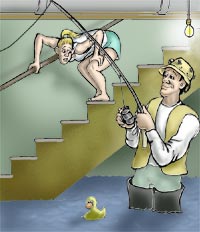
For instance. There was the time I took my three young children to the movies. Upon returning home we heard the calming sound of water flowing; only it wasn’t calming since our home was not built with a stream running through it. After looking in the basement and seeing water streaming through the ceiling, I called our builder’s hot-line. I was furious at them and so told the handyman as he looked at the exposed rafters.

Undaunted, and convinced that the pipes were fine, he proceeded to the first floor to source the leak. I saw water coming through the wall and ceiling of the conservatory and gave him another piece of my mind—something my mother had always cautioned against so as to ensure I still had some left in case I needed it. We headed upstairs, through a bedroom, into my son’s bathroom. By this time we were wading. The sink faucet was in the on position, the drain was in the closed position, and I was in no position to blame the builder.

I learned that my son had been doing a ‘speriment with the soap. He told me it was my fault he didn’t turn off the faucet before we left because I told him, “come down stairs right now.” He no longer does ‘speriments in the sink and most of the waviness in the wallboard has subsided.

I hate being wrong, especially in front of an audience. Once I have an opinion about something, the planet has to shift on its axis before I’m likely to reconsider. I’ve found that to be true with building strategy to support a business that is undergoing radical change, especially when people are asked to consider not doing something, or are asked to consider doing something differently. There’s way too much, “That’s the way we’ve always done it,” and, “That’s the way corporate told us to do it.” What in your strategy would benefit if someone considered doing something differently?

Should HIT make the Top 10 list for medical advances for 2009?

Below is a reply I made to a report that HIT was one of the top medical advances for 2009.  It came from community.advanceweb.com.
Great point.  An advance requires movement.  I do not think an 8% penetration with a 60% failure rate and high churn is the type of movement that would qualify.  If anything, it appears more like a retreat or stagnation.
User acceptance is so low that the feds are offering $40 billion in incentives and penalties if that doesn’t work.
Acceptance will not be enhanced by the addition of regional extension centers (RECs); appointed committees with no more HIT expertise than the folks at K-Mart.
It will be hindered further  by similarly provisioned RHIOs building HIEs that are as different from one another as snowflakes, 400 vendors with no standards, and no incentives to create any.
Then there is the N-HIN, Meaningful Use, and Certification, all of which exacerbate the national roll out of EHR to the point where it the current plan will fail.
My take?  Meaningful Use and Certification will not exist in 3 years and firms like Apple, MS, and Google will be the N-HIN.

EHR Thought Leadership Summit Slides

This presentation was delivered 12.10.09 in NJ.

http://www.slideshare.net/paulroemer/em-rgemcy-medicine-event-121009-joint-ppt-final

What’s the ROI from Social Media for a hospital?

Did you know there’s a hospital in the US whose web site gets 2,000,000 hits a month?

Did you know that same hospital tracks how patients made the decision to use their services?

Did you know that more than $2,400,000 dollars in fees came about as a direct result of the web site?

I’d bet the ROI on that exceeds everything else in the hospital.

Now being carried by stanford.wellsphere.com

How cool is that?

http://stanford.wellsphere.com/general-medicine-article/in-the-beginning-there-was-an-it-incentive/900843