 Some things in this universe will confound me until the day we are sucked into a black hole. I can’t explain why my wife, an intelligent person by anyone’s standards, reads People Magazine, or why some people like to listen to Celine Deon. Exchanging ideas with you about how to go about using EHR to help transform healthcare seems much simpler.
Sometimes I have an idea and I start to noodle on it. The Brits call it “Having a think.” It’s the kind of idea that makes me wonder where I left my crayons because I like to doodle while I noodle—I should mention that I find value in being someone who colors outside the lines. It’s the type of idea that I know will be made better by the insight of others.
Here’s today’s crayon-induced idea. We all know there is no bespoke business model for healthcare. Each service provider’s business model is different, a difference mostly attributable to varied business processes. If we’re in general agreement that there is no bespoke model, then we should be even more convinced that there is no bespoke EHR application—it goes without saying that vendors will try to convince you otherwise.
For those who thought healthcare was complex, look where it’s headed. It’s going to get even uglier before it gets better. Complexity can be measured a number of ways. To keep it simple, let’s assign a value of ‘1’ to represent the complexity of a single healthcare provider. So, how might we measure the additional marginal complexity created by having a national network of interoperable healthcare providers? One way is to take the number of providers and multiply them by the number of relationships in the network—X number of providers times Y number of RHIOs equals the added degree of complexity.
It doesn’t matter what the real complexity is. Whatever the actual complexity, it’s greater than ‘1’, and since your institution will be part of the connected network, your organization’s complexity has also increased.
Is there a way to manage the complexity? To lower it? To lower the risk to your organization? Let’s discuss that in the next few iterations of this blog. I look forward to hearing how you are managing it.

 Is Ahab’s search for the great white whale a metaphor for the pursuit of knowledge and his quest for answers? (Just how far can a former mathematician press his luck when it comes to interpreting classical English literature? Evidently, not very.) As Ahab continues to scan the surface of the ocean, the ocean’s surface becomes a metaphor for a search for revelation—I think we’ve milked this as far as we can. Are we in turn able to adapt that metaphor to the quest for revelation for the best EHR for your organization—before answering, it may be helpful to recall that the odyssey undertaken by Melville’s Ahab became apocalyptic–he first lost his leg and then his life to the whale—not encouraging for all of us who may be part-time whalers.
 One of these days when I ask myself if it’s just me, somebody’s going to shout back, “Of course it’s just you!” It seems I do well until I am forced to interact with someone. Nobody ever suggested I take a job of receptionist. Did I just say ‘receptionist’? (Here’s the segue.)
 If a blog fell in the woods and nobody commented on it is it still a blog? It’s a little like talking to myself, or singing in the shower–it always sounds better..It would be even better if you add your thoughts.
 Talk about overcoming my own competancy–I should be kept far away from code. My day would have been easier had I tried to install EHR in Aramaic.
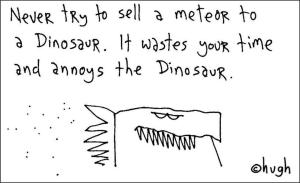

 If you’re looking to add to the complexity you may want to follow in the footsteps of what some hospitals have done. I don’t know if their approach was part of an overall strategy, or a result born out of necessity, one conscripted by the strictures of the self-imposed autonomy of the organization. The only unifying element among the autonomous units is the brand. The hospital executive I spoke with yesterday indicated that his hospital’s dilemma was the result of not having an EHR strategy. Their radiology practice implemented an EHR, surgical another, oncology yet another, and so forth and so on.
 “The time has come,” the Walrus said, “To talk of many things: Of shoes–and ships–and sealing-wax–Of cabbages–and kings–And why the sea is boiling hot– And whether pigs have wings.”
 Pale Rhino Consulting