Labor Day cookout. America, God blesses us.
Five of our neighborhood’s Wisteria Lane wives—wildebeests—pitched a ten-dollar K-Mart tarp to provide a modicum of shade for the BBQ guests—see prior posts to understand the wildebeest reference. I should have You-Tubed their struggle. I had less difficulty pitching my tent by myself on side of a volcano at 2 AM at nineteen thousand feet in a blizzard. To those who would question why I wasn’t helping them it’s because they didn’t seem to be a Y-chromosome friendly group.
American food—burgers, dogs, sausages, beans, chips. Then there’s the side dishes brought by the neighbors; salads that require a team of forensics to ferret out the ingredients, and cookies that look so goofy that not even the kids will try them. Oreos, never mess with perfection.
Okay, down to business. I’m looking for someone to tell me whether this idea makes sense or if it is all wet.
Premise one: Most of the reason reform being discussed is to solve or improve the healthcare “business model”. Most of the clinical side is not up for debate, that is, we are not discussing the need to revamp dermatology or pediatrics.
Premise two: About half of healthcare is government run—the VA, Medicare, Medicaid, and government employee health.
Question one: Which business model are the reformers trying to address?
- Private—if a good portion of what’s broken with the healthcare business model can be attributed to the private sector, why are they not leading the discussion?
- Federal—if some portion of the business model problem lies with the government, and this is the same organization who broke it and are trying to fix it, isn’t that a conflict?
- Both—why are legislators drafting any portion of this? What large business problems have any of them resolved?
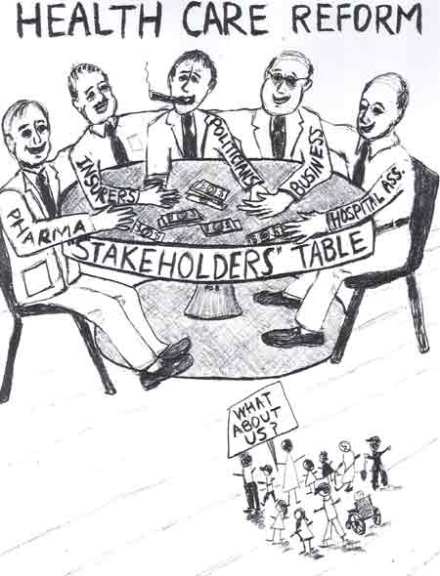
Question two: Which group of people should be at the forefront of defining what’s broken, how to solve the business problems, determining what it will cost, and how to pay for it? Pelosi, Ried, et al? Or a group of business people headed by someone like Jack Welch?
Question three: Whose plans are Americans more likely to believe, one coming out of DC, or one coming from a non-partisan group of business leaders?
Question four: How many committees and firms are developing standards? How many standards committees would a “Jack Welch” led reform effort have? That’s right, one.
Question five: Federal led reform requires teams to confirm that billions spent by healthcare providers on electronic health records will yield systems that actually work (certification and meaningful use). Would a “Jack Welch” led effort require the same, or would they know the systems would work simply because they had one set of standards and a viable plan for interoperability?
Question six: Who are the reformers? What are the names and experience of the people who drafted the 1,000 pages? Why aren’t they on the talk shows?
Question seven: Who should draft the reform document?
I recommend a bi-partisan committee of business leaders, no current politicians—something akin to the committee which studied the Challenger disaster. If we’re talking a trillion dollars, let’s invest six months or so to define a plan, one that can be presented to the country—Ross Perot with one of his PowerPoint presentations, then let’s figure out some way for the people to comment and “vote”.
If reform is going to impact everyone, shouldn’t everyone at least understand it and be free to comment? Doesn’t a trillion dollar spend deserve some form of popular vote? Congress has a favorability rating in twenties. If four in five people have lost confidence in their ability to do anything in everyone’s best interest, are we willing to let them make this decision for all of us? It’s “We the people”, not “They the elected”.
My closing thought—no charge. Have you noticed when our elected representatives soapbox this issue, they speak of us in term of, “the citizens” or “Americans”, seemingly excluding or elevating themselves from the fray. They need help understanding this is a square and rectangle issue, not every rectangle gets to be a square, but every square is a rectangle. We need the squares to start listening and stop talking.
Be it enacted by the Senate and House of Representatives of the United States of America in Congress assembled offer comment on the Healthcare Reform Act of 2009. Acknowleding that we do not have a clear plan, hereby turn the task of planning back to the people.

 Pale Rhino Consulting