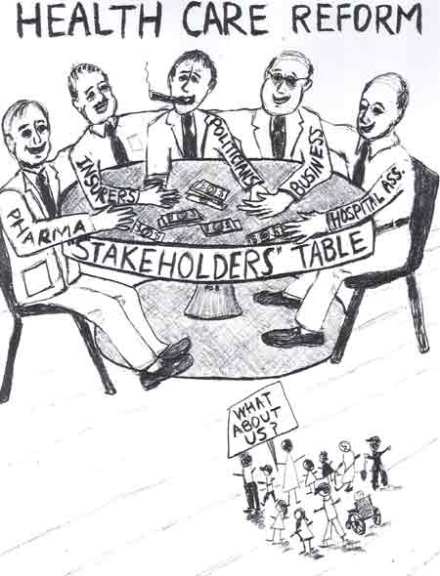
How does the healthcare business mix with the business of healthcare?

Remember when using language correctly while speaking and writing provided a common ground for understanding?  I write what I mean.  Nothing I ever wrote will be used as eleventh grade English Lit class assignment to ferret out my intent.  A few responded to the my discussion questioning if I felt involving business people in reform meant giving them carte blanche to mess in areas where they have no expertise.  I wouldn’t recommend that any more than I would recommend involving its reverse.

I am not a clinician or medical professional, don’t intent to be, don’t play one on TV.  I have not offered, nor will I offer my opinion on anything medical.  There will be no critiquing of who should be seen, what procedure should be performed, how to perform them better, or is entitled to what.  That’s all outside my pay grade.  If I cross that boundary, do us both a favor and take away my crayons.

That said; let met share what I think is being left out of the discussion about EHR and reform, a topic some treat as an unspoken side issue.  It’s almost as though this is the black sheep of reform, the part of the rug we want to sweep under the carpet—how’s that for mixing a metaphor?  There are those who think of healthcare as a business, those who begrudgingly think of it as a business, and those who never will.

Those at both extremes have contributed to healthcare’s present circumstances and an ill-managed rush to change.  Those in the business only camp, instead of making healthcare more effective have opted to make it more efficient, cutting costs by cutting jobs, and services.  The payors have added to the ineffectiveness by managing to the price of their stock instead of the public trust—these need not be mutually exclusive.

Effectiveness is all about quality, efficiency is all about speed.  Poor business leadership has helped some hospitals do a lot of ineffective things very quickly, but not well.  I’ve never met an executive who didn’t know how to cut costs—it doesn’t take a village to raise a cost slasher.  I, like you, have met very few who know how to increase revenues or increase quality.

Then there are those who will never see healthcare as a business, yet some of them hold senior business positions, positions which call upon expertise they do not have or do not find particularly necessary.  Just as business people shouldn’t perform open heart surgery, there are some better suited to medicine than to IT or P&Ls.  Curiously, those words are not mine; they were told to me by healthcare executives, some with MDs and PhDs.

The healthcare business is uniquely intertwined with the healthcare mission.  Should it be subservient?  That is a question better answered by the ethicists than by me.  I conclude that there are ways to make the business better that will make the mission.  That’s what I look to uncover.

Can EHR be used to improve healthcare?  It depends.  If properly planned and executed, yes.  If done simply in the belief that all things automated are better than those that are manual, no.

Think about a hospital you know well.  How many human resource departments does it have?  Registration?  Payroll?  IT?  What else is duplicated?  How many duplicate departments are required?  Can duplication be removed without simultaneously harming the business or clinical side?  If done correctly.

I think much can be done to improve the healthcare business without impeding the business of healthcare.  To me, that is the part of the mission with which reform should come to grips.

saint

A different approach to reform

BurgerStakeholdersTable1

Labor Day cookout.  America, God blesses us.

Five of our neighborhood’s Wisteria Lane wives—wildebeests—pitched a ten-dollar K-Mart tarp to provide a modicum of shade for the BBQ guests—see prior posts to understand the wildebeest reference.  I should have You-Tubed their struggle.  I had less difficulty pitching my tent by myself on side of a volcano at 2 AM at nineteen thousand feet in a blizzard.  To those who would question why I wasn’t helping them it’s because they didn’t seem to be a Y-chromosome friendly group.

American food—burgers, dogs, sausages, beans, chips.  Then there’s the side dishes brought by the neighbors; salads that require a team of forensics to ferret out the ingredients, and cookies that look so goofy that not even the kids will try them.  Oreos, never mess with perfection.

Okay, down to business.  I’m looking for someone to tell me whether this idea makes sense or if it is all wet.

Premise one:  Most of the reason reform being discussed is to solve or improve the healthcare “business model”.  Most of the clinical side is not up for debate, that is, we are not discussing the need to revamp dermatology or pediatrics.

Premise two:  About half of healthcare is government run—the VA, Medicare, Medicaid, and government employee health.

Question one:  Which business model are the reformers trying to address?

  • Private—if a good portion of what’s broken with the healthcare business model can be attributed to the private sector, why are they not leading the discussion?
  • Federal—if some portion of the business model problem lies with the government, and this is the same organization who broke it and are trying to fix it, isn’t that a conflict?
  • Both—why are legislators drafting any portion of this?  What large business problems have any of them resolved?

Question two:  Which group of people should be at the forefront of defining what’s broken, how to solve the business problems, determining what it will cost, and how to pay for it?  Pelosi, Ried, et al?  Or a group of business people headed by someone like Jack Welch?

Question three:  Whose plans are Americans more likely to believe, one coming out of DC, or one coming from a non-partisan group of business leaders?

Question four:  How many committees and firms are developing standards?  How many standards committees would a “Jack Welch” led reform effort have?  That’s right, one.

Question five:  Federal led reform requires teams to confirm that billions spent by healthcare providers on electronic health records will yield systems that actually work (certification and meaningful use).  Would a “Jack Welch” led effort require the same, or would they know the systems would work simply because they had one set of standards and a viable plan for interoperability?

Question six:  Who are the reformers?  What are the names and experience of the people who drafted the 1,000 pages?  Why aren’t they on the talk shows?

Question seven:  Who should draft the reform document?

I recommend a bi-partisan committee of business leaders, no current politicians—something akin to the committee which studied the Challenger disaster.  If we’re talking a trillion dollars, let’s invest six months or so to define a plan, one that can be presented to the country—Ross Perot with one of his PowerPoint presentations, then let’s figure out some way for the people to comment and “vote”.

If reform is going to impact everyone, shouldn’t everyone at least understand it and be free to comment? Doesn’t a trillion dollar spend deserve some form of popular vote?  Congress has a favorability rating in twenties. If four in five people have lost confidence in their ability to do anything in everyone’s best interest, are we willing to let them make this decision for all of us?  It’s “We the people”, not “They the elected”.

My closing thought—no charge.  Have you noticed when our elected representatives soapbox this issue, they speak of us in term of, “the citizens” or “Americans”, seemingly excluding or elevating themselves from the fray.  They need help understanding this is a square and rectangle issue, not every rectangle gets to be a square, but every square is a rectangle.  We need the squares to start listening and stop talking.

Be it enacted by the Senate and House of Representatives of the United States of America in Congress assembled offer comment on the Healthcare Reform Act of 2009.  Acknowleding that we do not have a clear plan, hereby turn the task of planning back to the people.

pastedGraphic.tiff.converted

EHR Strategy, a call to action

EHR Strategy, What I Do & How I Can Improve Your Efforts

Several people have told me that I need to come right out and state the role I play in the Electronic Healthcare Records (EHR) space, and how my consulting firm will add value to your efforts.  Spell out your services, and state a call to action.  This writing will address that topic, and will be the only time I use your time to try to sell you on me.  If you’ll bear with me for a few minutes, I will explain why I write with such self-assurance that most organizations (Hospitals, clinics, IPAs, and providers) have the wrong EHR Strategy—or no recognizable strategy—and my equally self-assured belief that working together we will mitigate that problem.

Here are the facts around EHR:

  • Most large EHR projects have a high probability of failing—the larger the project, the higher the probability
  • Large EHRs may cost more than a new hospital wing—a number of people know of one truly outstanding hospital who spent more than $300,000,000 on their EHR
  • Hospitals are much more knowledgeable about the requirements of a hospital wing and what it will do for them than they are about their EHR strategy
  • All healthcare providers who have entered the EHR space have done so trying to hit the trifecta of moving Gossamer targets;
    • Certification
    • Meaningful use
    • Interoperability
    • Hundreds of vendors who have their own agenda at heart
    • So many individual, disparate, committees are working on standards…do we need to even go there?  Doesn’t each committee create its own standards—if so, where is the standardization?
    • If one removes DC from the loop, many providers can’t articulate the business problem they want the EHR to solve, nor can they articulate an ROI
    • Providers have budgets without requirements, budgets without any knowledge of what an EHR system should cost
    • An EHR should have a greater impact on patients, providers, and payors than any other single program, yet who is in charge?  What skill set to they have to do this?
    • Most providers do not have a plan, a qualified planner, a decider.  Who is reviewing and approving the plan?  What makes them credible?

Those are the reasons we are here.  Our job is to reposition those facts such that they improve your chances of being successful with your EHR selection and implementation.

You know what?  It’s not about the EHR.  It never should be.  The EHR system only accounts for about 20% of the projects success or failure.  It’s code.  The other 80% comes down to planning, conversion, change management, training, user acceptance (patient, doctors, nurses, and administrators), and workflow improvement.

You know what?  It’s about breaking down kingdoms between intra-hospital departments.

It’s about knowing that you can walk into the EHR war room and know that somebody is the decider.  That somebody is able to say, “This is what we are going to do first, second, and third, because that’s the only way we can improve your chances of having a successful EHR program.

That’s what we do.  Most people, given the opportunity, will fail 100% of the time performing open-heart surgery.  A mere handful will avert failing.  Most people will fail 100% of the time who are leading an EHR program will fail.  A mere handful will not.

We are the ERHPMO (Program Management Office).  We are your advocate in managing the EHR vendor to benefit you.  Needless to say, most vendors do not like having us on board.  We are vendor neutral, provider advocates.

We are the anti-Accenture business model.  We do not back up the bus and drop off the children.  We will not try to put 30 people on your project.  You do that—clinicians, and IT.  We pull up in a Prius, drop off a few grownups who’ve been there, done that, got the T-shirt.

We work hand in hand with Hospitals, IPAs, clinical providers, and doctors to help you successfully address some or all of the following;

  • understand the EHR landscape
  • create your EHR strategy, in-house versus SaaS
  • eliminate wasteful redundant costs via shared services analyses
  • define your requirements
  • issue an RFP
  • evaluate vendors
  • negotiate contracts with the vendors
  • plan and execute the change management
  • rationalize your EHR with other which may exist within your walls
  • define and rebuild workflows
  • develop and execute a training program for user acceptance

This is not the time to experiment, or hope you get it right.  To minimize the probability of failure, this is the time to bring in the adults.

That’s what we do.  Sorry for the sales pitch.  Please let me know how we can help.

paulroemer@healthcareitstrategy.com

021_18A

Dumber than a box of hair

fix_02Me again.  Back to school 12-step recovery program.  I feel like I’m on the step ‘square root of negative one’—and to think I used to know what that meant.  It’s like herding cats.  Heard of cats?  Sure, a bunch just got on the school bus.  Sorry, sometimes I have trouble getting all of the synapses to fire in order.

This is dedicated to those moms and dads who spent more years in school that America has been a country.  Each year the start of school sort of hits me in the face, like the ice swimmers in Vladivostok—how could I possibly have spelled that correctly—during their New Year ’s Day plunge in to whatever sea is nearby. My gang often looks at me like I am dumber than a box of hair.

They do not care that when the airlines finally decide to board planes by IQ, that I will be in the front of the line—don’t get pithy with me, for you frequent fliers, don’t tell me you haven’t thought of this.  That I regularly advise—albeit recently a little less regularly that I’d like—industry stalwarts they are uniquely unimpressed.  They have other issues; why do I have to wear socks; a bag of Oreos and a bag of Doritos are two different things for lunch.  And so on.  Sometimes they think I am an idiot.  Sometimes I find myself agreeing with them.

The mind is a terrible thing.  The children look to us provide direction.  Some days we have difficulty just providing matching socks.  Is it that we lost control or that we never had it, control, that is?  My nine-year-old daughter winks, says “Oh daddy” to anything I say, and I melt.  That is sooooooooo unfair.

The great thing is the ability to realize how ill-equipped, how unprepared I am to deal with these short people who moved in when my wife and I didn’t understand the consequences of deciding to stay home that rainy night.  Still with me?  I’m not sure I am either, but perhaps we can find comfort in that I really am working to a point.  My children listen to me in the same way I read email—provide me with a summary statement because the rest is superfluous.

I believe that’s what is missing in the ‘reform debate’.  That’s what they call it on TV, but we all know, there is no debate.  To debate, one must define the issues.  They have failed to do that, and I argue their failure is deliberate.

Next Wednesday should be fun.  Mark my words, they still won’t be able to present it on a single PowerPoint slide.

Austin Powers

At what point do we decide this will not work?

We haven't tried this approach yet

We haven't tried this approach yet

What is your natural reaction when you are faced with something that you know doesn’t make sense?  Most people respond with silence, or they join the majority, whatever the issue.  I’ve never been good at being most people–the shoes are too tight.

For your edification and consideration.

State CIOs Get ‘To-Do’ List

HDM Breaking News, August 25, 2009

The National Association of State Chief Information Officers has published a report giving guidance to CIOs as their states implement health information technology provisions of the HITECH Act within American Recovery and Reinvestment Act.

The act requires state leadership in two primary areas: oversight for the planning and deployment of health information exchanges and management of the Medicaid incentive payments for meaningful use of electronic health records, the report notes.

“The passage of the HITECH Act essentially merged health policy with technology policy across state government and state CIOs must play a key role in HIE development and implementation,” according to the report.

The report includes a list of upcoming deadlines for specific federal regulatory actions, including those most affecting states and their CIOs. The report also details four broad areas where CIOs can have a major impact on HIE initiatives: planning, governance, financing/sustainability and policy.

“The HITECH Act placed a significant amount of new responsibilities on states in regards to state oversight for HIE and the planning and implementation grants for preparing for HIE,” the report states. “During this initial planning period, state CIOs must secure a seat at the table to establish themselves as key stakeholders and also to recognize strengths and identify weaker points that require resolution within their own offices relating to statewide HIT/HIE planning. They must ask themselves what they, with their unique enterprise view, can do to support and contribute to each of these areas.”

That was simple.  I’m thinking that if we can tie the IRS into this system of HIE, HITECH, ARRA, Rhoi, CIO, MOUSE we may be on to something useful.  Did you ever think that acronyms are used as a means of obfuscation, or to hide the identities of the people making these decisions?  I am much more likly to lend my avatar to a group of State This & Thats than I am to have someone write, Paul Roemer is the brainchild behind this I^(*&^%%!.  I like committees of three, especially when the other two don’t know for what time I scheduled the meeting.

English 101.  The desk is hard, the task is difficult, and the task described above is impossible or at least out of the realm of mortals.  Does someone think checking off the items on the list will easily allow my doctor to follow me on business or vacation across the country?  We are all smarter than that and we need to stand up and lead.  The time to follow has ended.

MyHero

Be very afraid

white_high_heelsI remember two things from my lone sociology class in college.  Somebody name Emile Durkheim—given that I cut almost every lecture, I continue to amaze myself that I spelled his name correctly—he did something about suicide rates, and one thing about inherent fear—we are born with knowledge of two types of fear; heights and loud noises.  I was born with a third, the fear that comes from thinking that one day I might slip out the door wearing white shoes after Labor day—see how timely this is?

There’s been a common thread for the last few days among the social media-ites—sometimes you are forced to make up a word or two.  The thread of which I write is fear, a fear that started in anticipation, and has been building since last week.  Muculent palms, jitters, slight schizophrenia.  The anticipation of the voices, “And he did hear a sound rising over the snow. It started in low… then it started to grow.”  Sorry for the Grinch reference, I’m trying to work through this.

It starts with notifications; emails, letters.  Doctor’s name and phone number.  Emergency contact information.  Write it three times in case we lose the first two.  Then comes the demand for tools—don’t dare go to sleep without completing this; pencils, scissors, crayons…Backpacks.  Lunch boxes.  I can’t wake them up.  They open one, look at me, and roll over.  They say things like, “This is what all the kids are wearing.”  They look you in the eye and lie, “I brushed my teeth.”  “If you don’t fill out the forms I can’t go back tomorrow.”

They fail to recognize that we have multiple degrees.  And if they did realize it, they would not care.  You may be a big shot between 8 and 5, but right now you’re just dad, and why don’t we have any fruit roll-ups for my lunch.

So, how was your day?  For me the voices have subsided, but the sweaty palms will return just prior to the school buses.

I look at healthcare reform and EHR and think, the only thing to fear is reform itself.

I’ve been asking friends for their input about our conversations here, and somebody whose opinion I value highly suggested I write what my audience wants to hear.  I can’t do that—that’s what the other bloggers do—feel good, but this, but that, cheerleaders.

This is difficult, at least if you want it to work.  There’s no shame in asking for help.

drevil

Healthcare social media

SpyvsSpywithoutbombs775529When I run I tend to let my mind go blank–some of you who have been regular readers might suggest this is a steady-state for me. It’s during those runs after I’ve released all the clutter that I’m able to work on my book or come up with new ideas. Today was one of those days. It usually doesn’t make much sense where the ideas come from. There aren’t any segues. A bunch of stuff just floats around and all of a sudden, I have an indication of something I want to say. It’s a little like dreaming with your eyes open, except it’s sweaty.

So as I’m pounding the pavement today, an idea surfaces. I’m reminded of a book I read several years ago entitled, Inside the Aquarium. It’s a book about the secret Soviet military intelligence agency the GRU. The GRU’s headquarters was a building named the Aquarium.

Its author describes his first memory as a member of Soviet Military Intelligence: watching a film of an execution of a would-be defector. The defector in question was strapped into a coffin with an open lid, elevated slightly so he could see what was coming, and then traversed slowly down a conveyor belt into a blast furnace, screaming all the way. The author, along with the other recruits, was getting an extraordinary indoctrination into the concept of social networking. Although I have no evidence to support this, I would assume that he and his fellow recruits did a very good job of relaying the message of what happens to traitors.

Social networking isn’t new. The only new thing about it is that it has a label which means consultants can charge to help firms to figure out how to deal with it. It’s been around for long time. I remember in high school when kids would argue, who made the better car, Ford or Chevrolet. It came down to which of the two cars your family owned. If you owned a Chevrolet, you said Ford stood for Fix Or Repair Daily. If your family owned a Ford, you referred to Chevrolet as Chevy-let-lay. It sounds silly, but I still remember that and it probably has something to with with why I buy foreign cars.

If properly designed, the social networking message has legs. It doesn’t require a computer. It probably doesn’t even have to be based in fact. If I recall, there was even some discussion in the book as to whether or not the execution ever took place. Even if the execution was only mythical, the GRU certainly communicated the message. Customers communicate many messages; some based in fact, some purely mythical. Once the message gets out, it’s difficult to put it back in the box. Even if there is empirical evidence that the GRU never executed anybody, chances are that their agents behaved as though they had.

Bringing this discussion back around to a business focus, there are two perspectives to consider. How much damage are your patients causing by the messages they let out-of-the-box? And second, how much damage is the organization causing by not proactively getting their messages out-of-the-box? It’s time to start sweeping the rug under the carpet.

eddiesmal

Conversations with a Wildebeest

my neighbors

my neighbors

Today’s narrative follows directly from yesterday’s tale of the wildebeest, so it may be helpful to revisit to prior post.  Suffice it to say that the Neiman’s set wasn’t thrilled to learned I  compared them to our cloven friends.

One rule of the Kalahari is that the pursuer must approach the prey stealthily. Picture if you will a David Attenborough looking and sounding chap, more suitably attired to attend a formal tea than a desert trek, inching towards that same Baobab tree we discussed in a prior narration. Bands of perspiration rim his pith helmet, darkening it. He pats his forehead with a freshly pressed linen handkerchief and returns it to the breast pocket of his Khaki shirt. The wildebeest have moved from the shade of the tree to the nearby watering hole. While some stand guard, he notices that a few at a time quench their thirst. For protection the youngest of the wildebeest ensconce themselves in the middle of the circle. The narrator moves the boom of his microphone towards the herd.

“Did you see the Greatest Looser last night?”  Inquired the group’s leader.

“I TIVO’d it.”

“Can I come over and watch it with you?” asked a third as she quenched her thirst with a half-caf, mocha frappachino iced latte. “I totally spaced.”

The circle of soccer moms seemed to tighten as they saw me approach. “Still blogging?” coyly asked the wildebeest—cum soccer mom–wearing the Lilly Pulitzer capris.

All wildebeest aside, here’s the deal. I want to have a conversation with you. I need your help. Here’s my premise. Somewhere along the way we lost our edge, our hunger for excellence. There was a big push twenty years ago, a lot of attention was paid to the topic, and a lot of people cleaned up writing books and giving seminars. I want your help in understanding what brought about the loss of excellence and what can be done to turn it around. I’d like to learn what you’ve seen and heard. You don’t have to name the organization. I won’t name names, yours or the organization. You can send me a message, a private email, or post it for everyone.

Some ideas for comments include but aren’t limited to:

1. What’s broken
2. Why isn’t it being fixed
3. Where does the breakdown for excellence occur
4. Why patients leave
5. What makes them mad
6. Why do they hate a given provider
7. Do patients think they matter
8. Who has the power to solve the problems
9. Do providers want to be excellent business people
10. Is excellence profitable
11. What 3-5 things can a provider do to get on the right path
Thanks in advance.

How does this impact EHR?  It has everything to do with it.  If you only remember one thing, let it be this: It’s not about the EHR.  The EHR is a vehicle.  It can either be a vehicle for change, or it can be used to hamper change.  All the EHR really does it automate certain things.  It’s easier to automated inefficient and ineffective things than it is to automate efficient and effective things.  Why?  Because the bulk of the work lies in making them efficient and effective.  That’s where the change management and workflow efforts come into play.

My best- Pauleddiesmal