Social Media: Learn from Patients

mixer


Ever notice how the computer can shave about fifteen years off your looks? This is especially true when you post old photos of yourself. High School friends, which you know you will never see again, find you on Facebook and comment as to how good you look. That’ll show ‘em.

So, how’s your day going? Mine’s fine—thanks for asking. I’ve been meaning to write about a few customer care experiences I liked, and then see who we can apply the idea to healthcare and Patient Relationship Management (PRM), so here goes.

It recently occurred to me that very few of today’s children know how freshly baked bread smells, so I decided I would learn how to bake. For those who know me, I’m neither big on details nor on taking direction—not a big detail when it comes to mowing the lawn, but rather significant in baking since it’s almost all chemistry. I like sourdough, so I thought I’d start with that.  It turns out you can’t.  You can start to start, but you can’t actually bake any until you’ve created a ‘starter’.  The starter is somewhat akin to creating life where there was none.  From a concoction of flour, water, sugar, and salt (basically the recipe for Play-dough) wild yeasts will infest the mix and begin to grow.

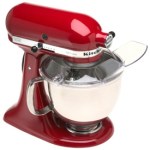
With my science project growing in a Ball jar on my counter, and after several rather impressive attempts at white bread, I decided to whip up a rather large batch of pizza dough.  Since I was in a hurry I ignored the admonition to slowly add the remaining three cups of flour, and dumped it into the mixing bowl.  Thwump!  As the bright red mixer ground loudly to a halt I learned why they’d included that little warning. A faint smell of burnt ozone wafted through the kitchen as the cloud of flour settled slowly on the granite counter top.

The KitchenAid mixer was dead. The last thing I fixed was the bell on my tricycle when I was four, so I don’t know what made me thing I could fix this. I went to Kitchenaid’s web site, typed in the model number, and hit enter. Nothing. I searched their site. Nothing. Went to Google. Typed in, “repair Kitchenaid mixer.” Within two minutes I found a web site that matched exactly my problem. I clicked the link. There was a step-by-step set of instructions and photos instructing how to disassemble the mixer right down to the broken part, the worm gear. The author also provided a link to a parts supplier, the price of the part, and an estimate for how long it takes for it to arrive.

Painless. Within a week my mixer was working although I did have one screw left over. I didn’t have to box it, ship it, pay for it; nothing. Some kind soul had taken it upon himself to make my day by posting his success on the internet. Could KitchenAid have done the same thing? Yes, for almost no cost. Another example of a firm who hasn’t learned to color outside the lines. Thank goodness one of the customers had.

Chances are good that your patients have posted more information about how to help their fellow patients than your hospital has posted.  It’s worth a look.  Chances are that they’ve also posted information that is wrong, things you would like to correct, but if you don’t know about it, you can’t correct it.  Want to know a good place to start a social media strategy?  Learn from your patients.

saint

Patient Relationship Management (PRM)

orienteering1A few weeks back I fly to San Diego. Having forgone the luxury of paying two dollars for a cup of lukewarm burnt coffee I gaze out the window through the haze to the landscape below—below is one of those redundant words since if I’m gazing at the landscape above we must be flying inverted, in which case I should be assuming the crash position. It’s amazing how clear everything becomes from 30,000’. I can see clearly where I want to go. Looking at the highways, one would think it difficult to ever get lost; follow the white line, turn right at the lake, then follow the next white line.

Lost is a lot easier when you are on the ground. I got a GPS for Christmas because in Philly, I am the king of lost. I’ve lived here 13 years and driven to the city on my own three times, and I don’t anticipate a fourth. I’ve traveled the world without a map, but put me in my own backyard and it’s an instant panic attack. That wasn’t the case when I lived in Denver, Colorado. Colorado was easy; there were three cities of note and a mountain range, so I always knew where I was.

Or, almost always. The first time I lived in Colorado my room and meals were free, courtesy of the US Air Force Academy—so were the haircuts. Basic training is an exercise one must experience to fully comprehend. We had about a thousand Alpha eighteen year-olds being yelled at by a thousand Alphas two years older. I learned early on that the best way to excel was to turn the entire experience into a competition, us against them—outthink, outwit, outlast—sort of like Survivor in uniforms. Several weeks into basic, we left the relative comforts of the academy and moved en-mass to a camp ground called Jack’s Valley—KOA on steroids. We did all sorts of fun things at camp; shined boots, raked dirt, learned how to kill with a bayonet.

And since the Air Force knew that wars weren’t always fought during the day, we did a number of nighttime activities. One such activity involved a compass, a partner, and a very dark forest. I think the idea of the exercise was to teach us how to find our way home if we were shot down. We’d been up since five, so naturally I was looking for a way to shorten the exercise while still scoring the maximum number of points. We were given our first compass bearing and we headed into the night in search of our next bearing. About an hour into the exercise I did an extrapolation based on the azimuth of the sun and the number of pieces of bubble gum it would take to fix a flat tire, and I told my partner I had a pretty good idea about where we were supposed to wind up the exercise. I argued that if I was right we could save ourselves more than an hour. He argued that were I wrong, we would finish last. I must have swayed him. We took a bearing on a light we could see from out spot in the forest. The light was from the city of Colorado Springs. We dashed through the forest, every hundred yards or so, stopping only long enough to recalibrate our bearing. We were making great time.

There’s a funny thing about lights. Sometimes they’re on. And sometimes, when you’re dashing through a forest with a compass in the middle of the night, someone turns them off. For those not familiar with the sport of orienteering, if that is the only fixed point you have to determine your position relative to everything on the planet, having the light go out will hinder your score. It did ours. There’s last, and then there’s so last that people have to come and find you in the very dark forest. This meant that the people whose job it was to yell at me during the day were going to miss their sleep all on account of my bright idea. They were highly motivated yellers the next day.

So much for my visionary idea. We were discussing that one of the basic requirements of the patient experience champion is their ability to visualize. In addition to being able visualize the end game, the vision must be credible. One can’t say follow me into the forest without knowing how to get to the other side. That said, the point of the exercise is that the first thing the champion must do is to define the vision. The roadmap will follow, but you have to know what the future will entail. We call that your “to be” state. Today is your “as is”, and the difference between the two is your Gap. If it sounds simplistic, that’s because we haven’t done anything yet. If you want to see how many people you have in your camp, start kicking around your notion of your “to be” model.

saint

Patient Relationship Management (PRM)

georgeIf you watch too much television your brain will fry. Sometimes I feel like mine is in a crepe pan that was left sitting on the stove too long. Two nights ago I’m watching Nova or some comparable show on PBS. The topic of the show was to outline all the events that took place that helped Einstein discover that the energy of an object is equal to its mass times the speed of light squared, better known as E=mc². It was presented to the audience at a level that might best be described as physics for librarians, which was exactly the level at which I needed to hear it. It’s physics at a level that is suitable for conversation at Starbucks or any blog such as this.

So here’s what I think I understood from the show. It tracked the developments of math and physics in 100 years prior to Einstein’s discovery. The dénouement appeared to occur when Einstein and his fiancée were riding in the bow of the small boat. Apparently, he was leaning over the side of the boat and noticed that the waves generated by the front of the boat moved at the same speed as the boat. He then noted that fact only held true for those persons in the boat, who were in fact, traveling at the same rate of speed. However for those persons watching from the shore, that same wave was not only moving slower than the boat it got further behind over time. Some other things occurred, yada, yada, yada, and there you have it. Clearly, the details are in the yada, yadas.

So here’s what happens when you watch too much television. As I’m running this morning somehow my mind takes pieces from that show and staples them together to yield the following. Let’s go back to the equation E=mc². For purposes of this discussion I’ll redefine the variables, so that:


E = the percentage of Patient Complaints/Inquiries.
m = Patient in-bound calls.
c = number of Patients


If this were true–this is an illustration, not an axiom–the percentage of complaints in the call centers of an healthcare provider is equal to the number of in-bound calls times the square of the number of patients. So as the number of calls increases the number of complaints/questions increases and as the number of patients increases the number of complaints increases exponentially. Of course this is made up, but there appears to be a grain of truth to it. As a number of calls increase the percentage of complaints is likely to increase, and as the number of patients increases there will probably be an even greater increase in the percentage of complaints incurred. I think we can agree that a reasonable goal for a healthcare provider is to decrease the percentage of complaints and perhaps to shift a hefty percentage of inquiries to some form of internet self-service vehicle. 

I think sometimes the way providers like to assess the issue of Patient Relationship Management  (PRM) is by looking at how much money providers throw at the problem. I think some people think that if one provider has 2 call centers, and another provider has 3 call centers, that the provider with 3 must be more interested in taking care of the their patients, and might even be better at PRM.  I don’t support that belief. I think it can be demonstrated that the provider with the most call centers, and most Patient Service Representatives, and the most toys deployed probably has the most problems with their patients. I don’t think it’s a chicken and egg argument. If expenditures increase year after year, and resources are deployed continuously to solve the same types of problems, I think it’s a sign that the provider and its patients are growing more and more dysfunctional.

How does this tie to Einstein and his boat? Perhaps the Einsteins are those who work with the provider; those who are moving at the same speed, those in lockstep. From their vantage point, the waves and the boat, like the provider and its patients, are all moving forward at the same speed. Perhaps only the people standing along the shore are able to see what is actually occurring; the waves distance themselves from the boat in much the same way that the patients distance themselves from the provider.

PRM is such an easy way to see large improvements accrue to the provider, especially using social media.

pastedGraphic.tiff.converted

What does it take to be the best hospital?

Below is a reply I wrote to a question raised on Hospital Impact, “What does it take to be the best hospital on the planet?”

http://bit.ly/v4pr6

I’d like to hear what you think it would take.

Great question and one that needs to be asked with much regularity.  I target my comments at the healthcare business as opposed to the business of healthcare—the clinical part.

May I begin with a statement that may have many readers reaching for their delete keys?  As one who has consulted to many industries, to me the healthcare business appears to be stuck in a 0.2 business model and is being forced to rapidly reinvent itself in a 2.0 model—my use of the term 2.0 does not imply the Internet.

My comments are based on observations, conversation, and inference.  My executives have told me privately that world-class physicians do not necessarily become world-class business executives.  Many lack the depth of experience that is needed to know what aspects of the healthcare business is broken, duplicative, wasteful, or in need of repair.  While discussing EHR, I was told recently by a former CEO of a large hospital that his peers were making multi-multi-million dollar decisions without any sense of the data needed to support those decisions, basing them on what a friend had decided, what they read in an in-flight magazine, or a conversation they had at a convention.

There seems to be significant faith placed in the notion of, “That’s the way we’ve always done it.”  That expression surfaces often when one raises the issue of why a hospital has multiple IT departments, multiple HR groups, payroll, registration, and so forth.  Why do something once if you can do it less well five times.

There seems to be enough waste that for some hospitals looking at moving forward with EHR, my first piece of advice is instead of aiming for best practices, let’s aim for a single practice.  Evaluate how to implement a shared service or managed services approach to business functions that are not part of your core business model.

I close with the notion of what other businesses call customer relationship management (CRM).  For a hospital, patient relationship management (PRM) is one of the unspoken wins waiting for someone to lead the charge.  Add a social media effort to it, and all of a sudden it’s like the hospital gave itself a facelift, at least from the perspective of the patients.

pastedGraphic.tiff.converted

Controlling the patient dialog

pigsRemember when there were 200 firms in the Fortune 100?

How long ago was that? I think it was around the same time when people still thought you shouldn’t wear white after Labor Day. Time to drop-kick those white pumps to the back of the closet. What made me think of that bit of nonsense was a meeting I had recently with one of the sharpest people I’ve had the pleasure to meet professionally, and a classmate of mine from grad school. She happens to be the founder and president of one of the country’s go-to firms for dealing with business ethics. Having served as a board member for several publicly-traded firms, as well as chairing their audit committees, when the Andersen and Enron scandals hit she went looking for professionals who could help her help her firms. When she couldn’t find the help, she created it.

That conversation got me thinking and made me wonder why there were no longer 200 firms in the Fortune 100. Was it; is it, a matter of business ethics? How often do unethical practices come up when firms interact with their customers? A couple of takeaways from the meeting—for board members to be able to meet their obligation, they ought to do more than reply on the meeting book pulled together by the firm they serve. Simply relying on the book presumes ethical behavior, a presumption not always supported by fact—how much should one believe if the information is being provided by someone who purchased a $900 shower curtain?

What can they do? Due diligence is being reinvented, and the Social Network is leading the charge. One example is to go to Yahoo Chat to see what’s really being said about your organization. Other things I’ve done to obtain facts and opinions, things which particularly gauge how customers and employees feel about the firm include Google Reader, Facebook, Twitter, and YouTube, to name just a few. You don’t need patient focus groups to learn what’s being said, or to learn how good a job your hospital is doing. The patients already have a laser focus. In many instances the group lacking the focus is the healthcare provider.

Firms should focus on maintaining a strong Reputation Bank, one strong enough to be able to handle withdrawals, because you never know when there might be a run on the bank. Might be a good time to look at your own bank deposit slips.  Deposits can be made easily through the social media network.  You can’t stop patients from talking about you but you can shape what they say.

saint

Who was supposed to be watching the customer?

customer_relationsSometimes it’s easier if I simply shoot myself in the foot rather than having to wait around for others to do it.  Permit me to begin with a disclaimer; my comments and questions almost always pertain to the non-clinical side of healthcare.

We’ve spent time discussing how we take an industry that in many respects functions on a 0.2 business model and transform it rather quickly to one comfortable operating in a 2.0 model—effective and efficient.

So, while that’s going on, what other things are underway which will impact that transformation?  Reform is one.  What will be the impact?  Nobody knows, but it may not be pretty.  One of the largest implications of reform is that the industry is being forced to integrate.  For example, it’s one thing to build a phone company.  There is a whole new order of magnitude of difficulty when one phone company has to integrate seamlessly with all of the other phone companies.

That integration is being driven by hundreds of different teams of vendors, standards setters, certifiers, and networkers, each having its own goals and working in their own vacuum chamber.

As I’ve studied this business problem for the past few years it becomes more and more apparent that something has been overlooked.  It gets it share of lip service, however unless it is addressed concurrently with reform and EHR, EHR will prove to be of such low value as to stymie people who later have to justify the expenditure.

It’s the missing link, the customer.  I know customer is not the politically correct term in healthcare because it sort of blemishes the notion that nobody is in this for the money.  We’d rather talk about patients.  Patients are on the clinical side, customers are on the business side.  Healthcare needs systems that work for both.

Where does customer care, customer relationship management (CRM), and customer equity management (CEM) fit within the realm of EHR?  The wrong answer to this question could set your EHR effort back years and millions.

The following link takes you to a presentation of mine on CRM and discusses the merits of looking at treating customers via CEM.

 http://www.slideshare.net/paulroemer/good-CEM-deck

I am curious to learn how you are incorporating the customer into your transition.

021_18A