Patient Relationship Management (PRM)-why men can’t boil water

poker_head_pic

There was a meeting last week of the scions of the Philadelphia business community. The business leaders began to arrive at the suburban enclave at the appointed hour. The industries they represented included medical devices, automotive, retail, pharmaceutical, chemicals, and management consulting. No one at their respective organizations was aware of the clandestine meeting. These men were responsible for managing millions of dollars of assets, overseeing thousands of employees, and the fiduciary responsibility of international conglomerates. Within their ranks they had managed mergers and acquisitions and divestitures. They were group with which to be reckoned and their skills were the envy of many.

They arrived singularly, each bearing gifts. Keenly aware of the etiquette, they removed their shoes and placed them neatly by the door.

The pharmaceutical executive was escorted to the kitchen.

“Did your wife make you bring that?” I asked.

He glanced quickly at the cellophane wrapped cheese ball, and sheepishly nodded. “What are we supposed to do with those?” He asked as he eyeballed the brightly wrapped toothpicks that looked banderillas, the short barbed sticks a matador would use..

“My wife made me put them out,” I replied. “She said we should use these with the hors d’oeuvres.”

He nodded sympathetically; he too had seen it too many times. I went to the front door to admit the next guest. He stood there holding two boxes of wafer thin, whole wheat crackers. Our eyes met, knowingly, as if to say, “Et Tu Brutus”. The gentleman following him was a senior executive in the automotive industry. He carried a plate of freshly baked chocolate chip cookies. And so it went for the next 15 to 20 minutes, industry giants made to look small by the gifts they were forced to carry.

The granite countertop was lined with the accoutrements for the party. “It’s just poker,” I had tried to explain. My explanation had fallen on deaf ears. There is a right way and a wrong way to entertain, I had been informed. Plates, utensils, and napkins were lined up at one end of the counter, followed in quick succession by the crock pot of chili that had been brewing for some eight hours, the cheese tray, a nicely arrayed platter of crackers, assorted fruits, a selection of anti-pastas, cups, ice, and a selection of beverages. In their mind, independent of what we did for a living and the amount of power and responsibility we each wielded, we were incapable of making it through a four hour card game without their intervention.

I deftly stabbed a gherkin with my tooth pick. “Hey,” I hollered “put a coaster under that glass. Are you trying to get us all in trouble? And you,” I said to Pharmacy Boy, “Get a napkin and wipe up the chili you spilled. She’ll be back here in four hours, and we have to have this place looking just as good as when she left.”  I thought I was having the neighborhood guys over for poker; I was wrong. So was each of the other guys. We had been outwitted by our controllers, our spouses. Nothing is ever as simple as it first appears. We didn’t even recognize we were being managed until they made themselves known.
Who’s managing the show at your shop, you or the patients?  The answer to that question depends on who owns the relationship, who controls the dialog.  If most of the conversation about your organization originates with them, the best you are doing is reacting to them as they initiate the social media spin, or try to respond once the phone started ringing.  It’s a pretty ineffective way of managing.  It’s as though they dealt the cards, and they know ahead of time that your holding nothing.
There are times when my manager isn’t home, times when I wear my shoes inside the house—however, I wear little cloth booties over them to make certain I don’t mar the floor.  One time when I decided to push the envelope, I didn’t even separate the darks from the whites when I did the laundry.  We got in an hour of poker before I broke out the mop and vacuum.  One friend tried to light a cigar—he will be out of the cast in a few weeks.

Be afraid. Be very, very afraid.

saint

EHR: there’s a difference between finished and done

complicated127

The phone rang last fall. It was the school nurse asking me if I would come pick up my seven year-old son. When I inquired as to the reason she informed me he exhibited the classic symptoms of the crud; tummy-ache, non-responsive, crying. She’s the nurse, so without better information, who was I to question her diagnosis?

We got into the car and the tears started to come again. “Do you feel like you’re going to be sick?” I asked as I looked at the leather upholstery. He didn’t answer me other than to whimper. He didn’t seem sick at breakfast. I remembered that he was crying last night, but that had nothing to do with his stomach. At first I thought it was related to the thunder. Nope. He was hugging his favorite dog, a five year-old Bichon.

We had learned a few weeks prior that the Bichon is ill and won’t ever be a six year-old Bichon. The person having the most difficulty with it is my youngest. I asked him if that was why he was crying in class and he confirmed that it was. Dads know everything, at least some times.

So, here’s the deal. The school nurse had done all the right things to diagnose my son’s problem, but she stopped short of determining what was wrong. Let’s try a more relevant situation from the perspective of an EHR implementation.  The word implementation sort of suggests that when you reach the point of having implemented that there’s nothing left to do.

There’s finished and then there’s complete.  Finished doesn’t mean the task is over until the system does what it was supposed to do.  If you didn’t do a good job of defining it up front you may never know the breadth of what was intended for the EHR.  In the case of EHR, done includes change management, work flow engineering, training, and user acceptance.
The point is, if it looks like you finished the EHR implementation, double check that you have before you take a bow. Technology alone will not an EHR implementation make, it is simply a part of the overall task.

saint

Work Flows–learn to color outside the lines

munch_scream

Somewhere out there is the person or persons who invented Chuck e Cheese. I am convinced that whoever deserves the credit either does not have children, or if they do, does not take their children to Chuck e Cheese under any circumstances. If you’ve never been, it’s one of those places whose true cacophony must be experienced first-hand. The FDA should conduct clinical trials of blood pressure medicines there. The formula is simple; machines that make noise plus kids that make noise equals happy kids. Some parents are immune to the noise. I’m not some parents–never have been, don’t see it happening any time soon. I could feel the pressure build, the parents around me were coping the best they could. One father whose eyes looked like those in Edvard Munch’s painting “The Scream” was popping Xanax like they were jellybeans.

I collected a group of parents and we sequestered ourselves behind the skeet-ball. “We’ve got to come up with something to ensure we never have to do this again,” I whispered, trying to rally my charges.

“I can’t do this anymore,” replied a frail-looking man who had developed a nervous tick.

I paused and pondered as an idea flittered past my id. Then I started a smile which soon covered my face.

“What?” asked Tick man.

“Yes, tell us,” implored The Scream.

It was a coloring outside the lines idea if there ever was one. “WebEx,” I barked as the idea began to take shape. “We do virtual birthday parties on WebEx. We each login our children from the comfort of our home. No screaming kids, no cold pizza, no spilled soda. It’s perfect. While they’re doing that, we can be in another room watching football.”

The idea had legs right up until the point where my wife overheard it. “You old Grinch. Get back over here with your son.” I caved, but I’m holding the idea in reserve.

Thinking outside the box. In creating the vision for re-engineering your work flows, why start there? That’s where everyone starts. Remember, if everyone’s thinking outside the box, all that means is that the box has moved and everyone is back in it. Why not create a vision that includes something like re-engineering all non-clinical patient-facing activities? A stretch goal is not trying to reduce billing calling by fifty percent. That’s what world class providers are trying to do. Other stretch goals might be asking questions like;

1. What would have to happen to the practice to be able eliminate eighty percent of all patient complaints?
2. What would it take to move half of all patient contacts to the web?
3. What would happen to first patient satisfaction if you set a goal to use social media to explain how to resolve claims problems?

So, where are we? We need a project champion, who has executive sponsorship, and who is willing to create a vision that has some legs.

Oh, I forgot to mention that after we left Chuck e Cheese we had all the seven year-olds over to our house for a sleep over.  I should have stayed at Chuck e Cheese; it was quieter.

sainttop5

Why is change management so important?

If  EHR is about anything it’s about change.  So much of what exists today has to do with creating and moving documents.  Did you know?

  • Of all documents handled each day in the average office,
    90% are merely shuffled
  • Currently, 90% of corporate memory exists on paper
  • There are over four trillion documents in the U.S. alone,
    growing at a rate of 22% per year
  • Professionals spend 5-15% of their time reading information,
    but they spend up to 50% looking for it
  • Corporate paper-based documents are growing at the rate of
    200% per year
  • 19 copies are made from each paper document
  • 22% of all documents are lost
  • 7.5% of paper documents are lost completely
  • 3% of the remainder get misfiled
  • $20.00 is spent on labor to file a document
  • $120.00 is spent on labor searching for the misfiled paper documents
  • $250.00 is spent on labor to search for lost files

From Price Waterhouse

black saint 2

What should you budget for change management and work flows?

fruitflyhumor

They came in waves from just over the horizon, each wave approaching from different elevations, and different points on the compass. They were legion; too many to count, too many for which to be able to set a winning defense. We marshaled our forces, knowing we were helpless. As I sat there awaiting the final assault I was reminded of some of the great World War II black and white movies; Midway, Twelve O’clock High, Tora, Tora, Tora. Wave after wave of Japanese and German fighters attacking the apparently helpless US forces.


Our defense perimeter established, we waited and watched. The first wave circled twice above the cellophane covered bowl. Tiny holes were cut into the cellophane allowing the fumes from the apple cider vinegar to waft upwards. The lead fruit-fly banked left and made his assault on the target. He bounced off the cellophane, as did most of the initial flight. One by one, they recovered and made their way through the pin-prick holes. The second and third waves approached the half-covered Tupperware that held the pineapple slices. After several minutes passed we slapped the lid onto the container, trapping scores of them.

“It’s those Concord grapes,” my wife asserted, implicating the helpless grapes.

“Don’t blame the fruit,” I replied. “They’re just fruit.”  Here’s the segue, try to stay with me.

If you’ve ever flown into Chicago’s O’Hare airport you may have witnessed scores of planes stacked in the air space awaiting permission to land.  I recently made reservations for a trip to Chicago. I used Southwest’s web site to make my flight to Midway—they don’t fly into O’Hare but the illustration still works. I’m the type of person who is more suited to using a well-functioning online service to complete my business. Even so, it would not be unusual for me to be having an animated one-way conversation with my computer. I started talking to the website after having to enter the same data time after time. Don’t get me wrong; I got a great deal on the airfare—three tickets for less than I paid for one last time. The site’s design allowed me to book a hotel. I entered data to reserve three rooms to coincide with the dates of my flights. A nanosecond later, I had a confirmation code for one non-refundable, no cancellation allowed room for the night before my plane even went to Chicago. By now I was speaking to my computer in tongues.

Like with the fruit, don’t blame the computer. The software did as it was programmed.  A lot of healthcare providers are going to be amazed by what they do and don’t see from their EHR system.  The system will do exactly what it programmed to do.  That’s great news if your organization’s work flows are an exact match for those built into the code.  We both know they aren’t.  That when it becomes necessary to build work arounds.  Unfortunately, you’re building them to match your work flows to their code.  For those new to the process, you are now designing your organization to move even further away from how it presently runs.  The further away you move, the more you will require change management.  Unless you budgeted correctly months earlier, you have probably already run out of funds for work arounds and change management.  If that’s the case, your EHR system is approaching its do-over point.   For each dollar of IT spend, it probably makes sense to budget at least two dollars for these tasks.  I guess you can budget those dollars for EHR 2.0, but it may be someone else whose running the implementation.

black saint 2

EHR-step away from the scalpel

So, I lunched today with a friend who is an executive at a healthcare consultancy.  She recently spent four days in a hospital, entering via the trauma center.  The purists among us would think, “If she only had a personal health record (PHR).”

As it turns out, she did.  From what I understood form our chat, the people in the hospital did not welcome her understanding of healthcare.  She handed someone on the trauma team her PHR from Google Health Vault.  According to her, she had downloaded enough data on her jump drive to where MRI’s were dripping from the USB.

At some point they determined she needed to have surgery because of something that appeared on her CAT scan.  Moments before seeing how well she could count backwards from 100, she was able to convince the surgeon that she did not require an operation because what they saw was a pre-existing condition which was documented on her PHR.  Step away from the scalpels.

I think the scalpel thing only served to spur her on.  After leaving the hospital, she requested a copy of her bill—all forty-three pages.  She read it, line by line.  They hate it when patients do that.  Her insurance covered everything, so it’s not like she was minding her pennies.  She was minding her sanity.  Seven hundred and some dollars for Tylenol.  She never took any Tylenol.  Somehow the billing system was tied to the fact that Tylenol was prescribed, independent of whether she actually took it.

Seventy-nine hundred dollars for a CT-scan.  Only ten times higher than the national average.

Where were the failure points?  People.  IT.  Process.  It’s a good thing she knew what she was doing or right now she’d be missing a thing-a-ma-jig—and they would have billed her for another Tylenol to manage that pain.

Without change management and work flow improvement, EHR will only make things worse.  There is a term of art for the intersection of work flows, people, and data—it’s called a mess.  To minimize the mess, to have any shot at an ROI, the sooner you employ adults to run the Program Management Office (PMO) for your EHR, the better your chances.

sainttop5

Pay attention to patients even when they’re not at your office.

human-hamster-wheel-300x300

The wheel’s still turning, but the hamster is dead. One Brady short of a bunch. I like the ocean one because it reminds me of a bit done by the comic Ron White. In the bit he talks about the time he met a woman who was wearing a bathing suit made of sea shells which he held to his ear to find out if he could hear the ocean. Maybe you had to be there.

All day I’ve been operating as though I was one Brady short of a bunch—I actually have cufflinks with Marcia Brady’s picture on them, but we’ll save that for another day. The day’s highlight revolved around my daughter’s doubleheader field hockey matches–third and fourth grade girls. Their opponents looked better, older. In fact, I thought I saw one or two of them drive themselves to the field. Forty-eight degrees, first game at 8 AM. Not enough time to grab breakfast and get to the game on time. I dropped my daughter at the field and headed to a nearby convenience store to buy her a donut. As I pulled into the parking lot I noticed that I needed gas, so I figured why not multi-task it. I inserted the nozzle in the tank, went into the store, purchased a donut, and proceeded to drive away.

For the metrics lovers, those who like order over chaos, those whose desk is always neat, have you discovered my Brady moment? My purpose in going to the store was to buy a donut, not gas. My mind was focused on the donut, not on the gas. Once the donut was resting safely on the passenger’s seat my mission was over, or so I thought. Something was gnawing at me as I pulled away from the pump, something that flared at me in my rearview mirror. I knew what it was a full second before my body got the message to react to it. “Hit the break,” my mind screamed. I could see what remained of the black gas pump hose as it pirouetted helplessly behind my car. I fully expected the entire gas station to be consumed by a giant fireball like the one at the conclusion of the movie Rambo. Once I was convinced that neither I nor–it turns out that neither nor does not violate the rule of using a double negative in a sentence–anyone else in the vicinity was in mortal danger, I exited my car and walked to the pump.

My first reaction, and I don’t know why, was to see if the pump was still charging my credit card. Selfish? That means that subconsciously I had already made the decision to flee, but that I didn’t want to flee if my charge card was still open. I retrieved the severed hose from the ground and inserted it in the pump, thereby closing out the sale on my credit card. I looked around. There wasn’t anyone who had witnessed my little AARP moment. Since they hadn’t, I figured why bother anyone. Kismet; my turn on the hamster wheel.

I’m convinced it’s the little things that determine whether your initiatives succeed or fail. It’s usually nothing tricky, nothing that requires two commas worth of new technology. It’s being focused and being committed to excellence in the menial tasks which comprise each patient interaction, especially those that occur outside of the office. What little things are being overlooked in your practice?  Could social media solve some of these?  In a heartbeat, and for a cost that would surprise you.

Oh, and don’t forget to hang up the hose when you’re done.

black saint 2

EHR: the cost savings can be tremendous

shrekthefifth

I was at the beach with my family for the week.  There’s something magical about hanging out at the shore with three children ten and under.  There was so much sand in the house that we could have made a laudable entry in any sand castle contest.

For some reason, there is an unspoken understanding that Dad will unload the car, wash of the toys and hand the beach towels while everyone else showers.  By the time I reached the shower the hot water was long gone and enough grains of sand were embedded in the bar of soap that it felt like I was washing with pumice.  I toweled off from my shower with the only remaining dry towel, a pint-sized piece of linen bearing the likeness of Shrek–standing in your-all-in-all face-to-face with the green faced ogre sort of makes one a little less pompous.

My Shrek fan club was watching SpongeBob for the umpteenth time. I pretended to be interested and made the mistake of asking a question about the show. “I don’t get it,” I offered. “It seems like every show is about the same thing, it has something to do with SpongeBob making Krabby Patties for the Krusty Krab.” To which my youngest replied, “They keep making them until they get it right.”

No excuses. Do it until you get it right.  A single line job description for EHR?  I hope not.  There’s not enough money to do it until you get it right.  There is however, plenty of money to do it right the first time.  I call that the DIRT-FIT principle.  That’s where the saving are.

I’d better go; my kids are eating all of my Twizzlers.

021_18A

How large is the reform effort?

dr_evil_one_million_dollarsA trillion dollars.

What does a trillion look like?  A dollar bill is about six inches long.  Stacked end to end, a trillion dollars would go from the earth to the sun, and back, twice.

Healthcare is one fifth of our economy.

One fifth of our GDP is larger than the GDP of five of the G8 countries, including France and the UK.  Would we try to reform the entire economy of the UK?  Would we succeed?

We have about six million miles of paved roads in the US.  How long do you think it would take the government to repave twenty percent of them, 1.2 million miles?  Could they do it?

Maybe we really should have a plan before we write a check.

pastedGraphic.tiff.converted

EHR: Impact on DR Patient Relationship

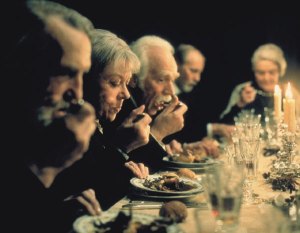
feastI’m a fan of foreign films, but since I don’t speak the language for me to really enjoy the movie, the visual story must be really compelling.  I also love to cook, not from recipes, but creatively, making it up as I go along.  Fortunately for purposes of this blog, there is a film which does both—Babette’s Feast.
The Danish film is set in France in the early eighteen hundreds.  The story centers around a group of pious sisters who receive a visitor who offers to spend her lottery winnings by preparing a feast for them.  The visitor, Babette, happens to be a very skilled chef.  There are those who may think the movie’s plot has more to do with the interplay among the participants.  However, as I am not a professional movie critic, we can skip the interplay and fast forward to the parts I find most relevant, the feast.

(This paragraph comes from Wikipedia.)  The sisters agree to accept Babette’s meal, and her offer to pay for the creation of a “real French dinner”. She leaves the island for a few days in order to return to Paris, as she must personally arrange for supplies to be sent to Jutland. The ingredients are plentiful, sumptuous and exotic, and their arrival causes much discussion amongst the clan. As the various never-before-seen ingredients arrive, and preparations commence, the sisters begin to worry that the meal will be, at best, a great sin of sensual luxury, and at worst some form of devilry or witchcraft. In a hasty conference, the sisters and the congregation agree to eat the meal, but to forego any pleasure in it, and to make no mention of the food during the entire dinner.  The last and most relevant part of the film is the preparation and the serving of an extraordinary banquet of royal dimensions, lavishly deployed in the unpainted austerity of the sisters’ rustic home.

The denouement—I thought it appropriate to use a French word—is whether or not the piety of the guests will prevent them from participating in the feast. It wouldn’t have made for much of a movie if the guests never came and the food sat there getting cold, but what if?  What if there was all of this preparation and no guests?  What if she prepared the feast, and in her haste forgot all about the guests?  Indeed.

Has anyone felt that something is missing in the discussion on EHR?  There’s plenty of talk of Washington and payors.  ARRA and money.  Stimulus and penalties.  Where are the guests?  Are we all responsible for not inviting the EHR dialog to include the patients?  I know it’s there, tucked away somewhere.

We’ve discussed on several occasions the notion that EHR should not be about the EHR.  It should be about the users and the patients.  Nevertheless, how is it being viewed by those groups?  Is it seen as a success?

Let’s make it a little more personal—my recent trip to my cardiologist at a superb teaching hospital in Philadelphia, Pennsylvania.  I usually get about an hour with the doctor—face time—clinical, examination.  Important time to a heart patient, eye contact that communicates you are doing all the right things, your test scores are all off the charts in the right direction, and you are healthier today than most people twenty years younger than you who haven’t had a heart attack.

That’s the real reason I go for the annual checkup, not to find out what I should be doing—I know I’m doing those things, not to find out if I am sick because I know I’m not.  I am there to reap the comfort that comes from having this specific person tell me things that help me believe that if I continue to play an active part in my recovery I will be there to raise my children.

During my last visit, we had about ten to fifteen minutes of eye contact, and the rest of the hour was spent with me watching him enter data into the EHR system.  It wouldn’t have been his choice, and it wasn’t mine.  Other than the first ten minutes, my entire checkup could have been done on WebEx.

I wonder if they offer an EHR?

 Paul Roemer Business Card