EHR Thought Leadership Summit Slides

This presentation was delivered 12.10.09 in NJ.

http://www.slideshare.net/paulroemer/em-rgemcy-medicine-event-121009-joint-ppt-final

The impact of Moses on EHR

Does anyone remember how many of each type of animal God told Moses to put on the ark? Are you sure? For those who missed it, Noah built the Ark, Charlton Heston built the stone tablets.

One word can make the difference between right and wrong, especially if the question is big enough. Who is asking the questions that are shaping your firm’s EHR strategy? Do you know the name of the person? What question are they asking? Is it the right one?

Interoperability-this is the problem

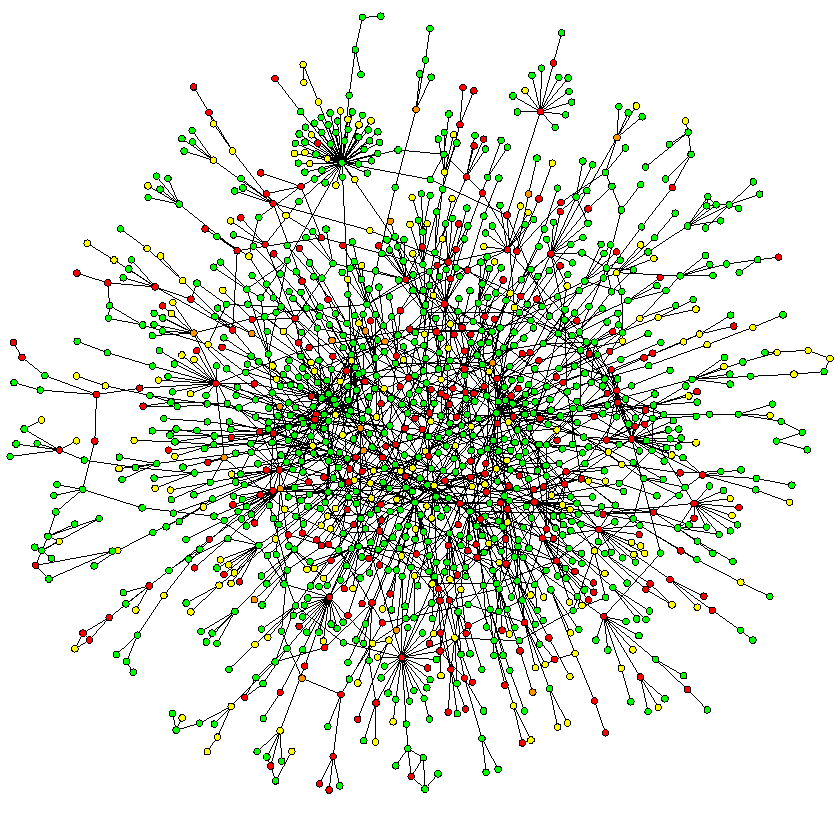
How does one depict the complexity of the mess being presented as the national roll out plan of electronic health records (EHR) via the national health information network (N-HIN) using Health Information Exchanges (HIEs) designed by Regional Health Information Organizations (RHIOs), with the help of regional extension centers (RECs) without Standards (Standards) and with N too many vendors?

Class?  Ideas?  Class?

If this looks dumb, undo-able, unimplementable, uninteroperable–it’s because it is.  your vision is fine.

Remember the idea behind all this is to get your health record from point A to point B, any point B.  It’s that little word ‘any’ that turns the problem into a bit of a bugger.

Find yourself in the picture below, pic a dot, any dot (Point A).  Now, find your doctor, any doctor (Point B).  Now figure out how to get from A to B–it’s okay to use a pen on your monitor the help plot your course.   That was difficult. Now do it for every patient and every doctor in the country.

Now, do you really think the DC RHIO-NHIN plan will work?  If EHR were a Disney park, who’s playing the Mouse?

Should you hire a swim coach?

Swimming with guppies

Got the new bike, got the new bike shoes, got the uni (uniform-not unitard).  I’ve written about my desire to compete in a triathlon.  Actually, I miswrote.  My desire is not to compete, it’s more accurately a desire not to make a fool of myself during the swim, more specifically not to drown.

The swimming is one of those events where having the coolest outfit doesn’t help, as there are no coolest swimming outfits (men do not let men wear Speedos).  There aren’t enough North Face labels for me to wear to make me look like I know what I’m doing in a pool.

What to do?  Here’s my thinking.  I made a new friend, and as a bonus, she happens to be pretty sharp on the pharma side of healthcare.  She swims—fast.  She swims—a lot.  Did I mention she swims?  Longtime readers know I like to color outside the lines.  Maybe I could hire her to take my place during that part of the race.  Then we get back to the issue of the uni.  One way or another that becomes an issue for one of us.

She offered to teach me.  Lesson one was today.  Lesson two will begin right after the EMTs finish their CPR on me.  Rule one, no matter how cool you think you are, you can’t breathe under water.  That took a few laps to master.  More breathing, stroke, legs.  Lots to learn.

“Let’s get a pool boy to help you not drag your legs,” she suggested.

I have difficulty passing up the opportunity to comment.  She could see I had the broccoli in the headlights look in my eyes.  “You hold it between your legs and it helps you float.”

I scanned the pool.  There we the two of us…and the lifeguard.  “It looks like he’s busy,” I offered somewhat sheepishly.  “Besides, if that’s what it takes, I think we’re both better off if I drag my legs.” (A little un-PC pool humor, but why not, I was already wet and being out swum.

So, what does this have to do with why we’re here?  Here’s the take away.  Sometimes, no matter how smart, no matter how big your ego, you need help.  Sometimes it makes a huge difference to have someone on your side who’s been there, done that, got the T-shirt.

Not with me yet?  A guy (man or woman guy—send me an email and let me know when we can let go of this PC thing and just write) is walking down the road, not watching where he’s going, and he/we/she/it falls into a deep hole.

An engineer walks by.  “Help me,” shouts Hole Person.

The engineer thinks for a moment, writes some ideas on a piece of paper and tosses them into the hole.

Several hours later, a finance guy walks by.  “Help me out (literally)” yells Hole Person.  The CFO tosses down a cheque (I use the Canadian spelling to distinguish it from someone from the Eastern Bloc as it would make no sense to toss another person into the hole.)

Days later, Hole Boy (not the same as Pool Boy in case anyone is still reading) is at the end of his rope.  The work plan failed. The Check bounced.

A consultant passed, saw the man, and hopped into the hole.

“Why did you do that?  Now we’re both stuck.”

The consultant smiled in a Grinch-like fashion—please see prior blog for the segue.  “I’ve been down here before, and I know the way out.”

Kind’ a like a swim coach.

EHR projects have more zeros than you can count.  What if you could hire someone who knew the way out?

I may know someone who can help.

How the Grinch stole healthcare

(n.b. Pelosi, Reid, and the term Payor may be changed to the names of your favorite vilans without materially altering the story.)

Every Congressman
Down in Congress-ville
Liked Health reform a lot…

But the Payors,
Who lived just North of Congress-ville,
Did NOT!

The Payors hated Health Reform! The Congressional reform season!
And as everyone’s heard there is more than one reason.
Was it the fear of losing their monopoly right.
Worried, perhaps, that Congress might indict.
But I think that the most likely reason of all
May have been that the uninsured took them all to the wall.

Staring down from their man-caves with indemnifier frowns
At the warm lighted windows below in the town.
For they knew every Congressman down in Congress-ville beneath,
Canted an ear to hear them gnashing their teeth.

“If this passes, they’ll kill our careers!”
“Healthcare reform! It’s practically here!”
Then they growled, the ideologues nervously drumming,
“We MUST find a way to keep Reform from coming!”
For, tomorrow, they knew…

…Stumbling home from the tavern at a quarter past two                                                                                                                 What each Congressman, intern, and page might just do

And then all the milieu. Oh the milieu, the milieu
The thing the Payor hated more than mom’s Mulligan stew.

Then all the Congressmen, the left and the right, would sit down and meet.
And they’d meet! And they’d meet!
And they’d MEET! MEET! MEET! MEET!
Implement full provision; cover pre-existing…how sweet
Which was something the Payors couldn’t stand in the least!

And THEN
They’d do something Payors liked least of all!
Every Congressman down in Congress-ville, the tall and the small,
Would stand close together, their Healthcare bells ringing.
With Blackberrys-in-hand, the Congress would start pinging!

They’d ping! And they’d ping!
AND they’d PING! PING! PING! PING!
And the more the Obligators thought of the Congressman-Health-Ping
The more they each thought, “I must stop reform-ing!
“Why for all of these years we’ve put up with it now!
We MUST stop health Reform from coming!
…But HOW?”

Then they got an idea!
An awful idea!
THE Indemnifiers
GOT A WONDERFULLY, AWFUL IDEA!

“I know what to do!” The CEO Payor laughed in his throat.
And he made a quick Congressional hat and a coat.
And he chuckled, and clucked, “What a great Payor raucous!
“With this coat and this hat, I’ll look just like Saint Bacchus!”

“All I need is a pass…”
The Payor looked around.
Since Congressional passes are scarce, there was none to be found.
Did that stop the old Payor…?
No! The Payor simply said,
“If I can’t find a pass, I’ll make one instead!”
So he called his aide Max. Then he took some red paper
And he dummied up the pass and he started this caper.

THEN
He loaded some bags
And some old empty sacks
On a Benz 550
And he rode with old Max.

Then the Payor called, “Dude!”
And the Benz started down
To the offices where the Congressmen
Lay a-snooze in their town.

All their windows were dark. Quiet snow filled the air.
All the Congressmen were dreaming sweet dreams of healthcare
When the Payor came to the first office in the square.
“This is stop number one,” The old Warrantist – a winner
And he slipped passed the guard, like sneaking to a State Dinner.

Then he slid down the hallway, Harry Reid was in sight.
Reid was chumming Pelosi, he planned quite a night.
He got nervous only once, for a moment or two.
Then he realized that the leadership hadn’t a clue
Then he found the Congressional stimuli all hung in a row.
“These Stimuli,” he grinned, “are the first things to go!”

The Payor slithered and slunk, with a smile somewhat mordant,
Around the old Cloakroom, and looking discordant!
There were copies of the bill stuffed in jackets and on chairs,  He even found a copy tucked under the stairs
And he stuffed them in bags. Then the Payor, very neatly,
Started humming a tune from Blue Cross rather Cheeky!

Then he slunk to the Senate Chamber, the one facing East
He took the Senators’-copies! … didn’t mind in the least!
He cleaned out that Chamber and almost slipped on the floor.
Saw an Internet router, and thought of Al Gore

Then he stuffed all the copies in the trunk of his Benz.
And he thought to himself, “Why don’t I have friends?”                                                                                                                    “There’s always TW,” he said with no jest                                                                                                                                                    But TW’s being chased by reporters, those pests.

The Payor spotted the Grinch having trouble with his sacks
And he lent him a hand—he offered him Max                                                                                                                                           Max was quite pleased, for he knew this December,
That the Grinch would become the Payor’s board member.

The Grinch was all smiles–he’d made quite a killing
Offering to help pillage if the Payor was willing.
He stared at the Payor and asked, “New glasses?”
The Payor simply smiled, saying “These people are such (You did that to yourself, not me.)

And, you know, that old Payor was so smart and so conniving
When he next saw Pelosi he found himself smiling!
“Why, my dear little Nanc’,” the Bacchus look-alike stiffened,
“Botox in this light makes you look like a Griffin.
“I’m taking these home,” he said pointing to the copies.
“There’s a comma on one page that looks way too sloppy.”

And his fib fooled the Griffin. Then he patted her head
And he gave her a wink, and he sent her to bed
And as Speaker Pelosi shuffled off to her army,
HE said to himself, “What a waste of Armani!”

Then the last thing he needed
Was to mess up HITECH.
Then he went to HHS, the DOD and the VA,
Stuffed mint jelly in their servers so that they would not play

And the one EHR
That still worked in the DC
Was the one bought from CostCo and tucked under the tree.


Then
He did some more damage
To HIEs, and the N-HIN

Leaving PHRs
Far too trashed
For a doctor who did knee-shins!

It was quarter past dawn…
None in Congress were his friends
All the Congressmen, still a-snooze
When he packed up his Benz,
Packed it up with their copies of reform in those bags! Stacked to the leather ceiling,
Manila envelopes with name tags!

Three miles away were the banks of the river,
He was poised with the bags all set to deliver!
“Pooh-pooh to the Congressmen!” he was Payor-ish-ly humming.
“They’re finding out now that no Reform is coming!
“They’re just waking up! I know just what they’ll do!
“Their mouths will hang open a minute or two
“The all the Congressman down in Congress-ville will all cry BOO-HOO!”

“That’s a noise,” grinned the Payor,
“That I simply must hear!”
So he paused and the Payor put a hand to his ear.
And he did hear a sound rising over the snow.
It started in low. Then it started to grow…

But the sound wasn’t sad!
Why, this sound sounded merry!
It couldn’t be so!
But it WAS merry! VERY!

He stared down at Congress-ville!
The Payor popped his eyes!
Then he shook!
What he saw was a shocking surprise!

Every Congressman down in Congress-ville, the tall and the small,
Was singing! Without any health reform at all!
The Congress didn’t care, a few were disgraces,
All they wanted, it seemed, was TV with their faces

And the Payor, with his Payor-feet knee deep in the muck,
Stood puzzling and puzzling: “Man, there goes my bucks.
It could be about healthcare! It could be global warming!
“It could be Al Qaeda, Afghanistan and desert storming”
And he puzzled three hours, `till his puzzler was sore.
Then the Payor thought of something he hadn’t before!
“Maybe Congress,” he thought, “simply needs a free ride.
“Maybe Congress…just needs to look like they tried.

And what happened then…?
Well…in Congress-ville they say
That the Payor’s small wallet
Grew three sizes that day!
And the minute his wallet didn’t feel quite so tight,
He whizzed in his Benz passing through a red light
And he brought back the copies of the bill for reform!
And he…

…HE HIMSELF…!
The Payor calmed the whole storm!

‘Twas the night before reform when all in the House…

‘Twas the night before reform when all in the House

Were Tweeting and blogging and squawking like grouse

Their bill filled with zeroes and commas and flair

In hopes that the Senate would soon be there

The voters were restless, and in need of good care,

And they whined and they pleaded and they yelled ‘don’t you dare’

“Don’t sidestep this issue, don’t do it for votes”

“Don’t kowtow to payors or we’ll be at your throats.”

With Pelosi and her Botox and while Reid took his nap

Didn’t care if the people put up with their (you rhyme it, I’m pretending to be neutral)

The docs sat on the sidelines, bemoaning their fate,

While payors dressed like succubi caroled “ain’t this great?”

On the lawn of the White House there arose such disdain

As the public fought reform from ‘Frisco to Maine.

MSNBC, neigh now Comcast, buttressed their base,

And Fox, aka Rupert, said it was all a disgrace.

The words on the pages of the newly printed bill,

Hid nuance, erudition, obfuscation, and skill,

Do not read the details, adjectives and signs,

Do not worry how it impacts your bottom line.

We are here to pretend we did that of import,

To Hell with Medicare, Medicaid and the sort

It’s voters we want, It’s our doxology, our mantra,

And this year silly people, this year WE are Santa

On Boxer, on Biden on Fienstein they came,

And we chortled, berated, and chided by name.

“What about seniors, and sick people” we cried?

“What about uninsured, don’t you care if they died”

“This is about people you meet on the street.

People who must choose between their meds and to eat

It’s about Lipitor, Xanax, Prozac and Viagra,

It’s about doing what’s right, do what’s right or we’ll bag ‘ya”

And then in a twinkling I heard in my head,

The gnawing and chiding of Congress, who said,

We cavorted and sucked up, the best we knew how,

We spent bucks, made payoffs, and said the time is now.

Festooned all in new regs from NHS to VA

There were those who suggested, this is not going to play,

HITECH and ARRA are not making it fun,

RHIOs and RECs will soon come undone,

We’re paying the hospitals to do EHR

We know it seems silly, like we lowered the bar

If that doesn’t work we will tax them instead,

Make them spend gobs of money, make their budgets bleed red.

Spend it, refund it, and print new money now,

Buying Canada would be cheaper and easier but wow

They want to sign something, sign it soon, sign it fast,

But don’t assume that they’ve read it from first page to last,

We could’a been more like France, like the Swiss or the British

Make us more European, make our rich people skittish,

The tall socialist exclaimed as the dems shifted right,

Will Obamacare fail, have I lost all my might?

EHR: Is your plan aiming far enough out?

Can being an early adopter save your hospital millions of dollars?  We both know the answer depends on what one happens to adopt.  Suppose we are discussing the adoption of an idea?  Can that be analogous to not adopting another idea?  I think it can.  Allow me to explain.

Many providers are in the process of making a very expensive, highly complex, and wide-ranging decision regarding their healthcare information technology strategy (HIT) for their electronic healthcare records system (EHR).

A non-trivial moment.  Careers will be made and lost as a result—I’m betting more will be lost.  Why?  By making a bad choice on the EHR, on how to implement it, and on how to modify your organization.

I think the choices will be bad not from lack of effort but from lack of understanding of the complete issue.  What is the part of the issue that is lacking?  It’s the part which requires clairvoyance.  Whew, that was easy.

Defining your requirements does not pass the test of necessity and sufficiency.   It’s like playing darts while blindfolded.  The plan to select, implement, and deploy an EHR must account for a number of risky unknowns, including:

  • How will healthcare reform impact my organization
    • What constraints will it produce
    • What demand will it create for new HIT systems
    • What new major operating processes will result
    • When will reform really be implemented
    • How will reform be reformed
    • How will payors, suppliers, and people react to reform
    • How will you offset a resource shortage of fifty percent
    • What will change as a result of
      • Interoperability
      • Certification
      • Meaningful Use
      • Mergers and acquisitions

We don’t know what we don’t know.  That is not a throw-away line.  By definition, we never know what we don’t know.   However, the downstream success of your EHR will be highly dependent on these unknowns.

So, where does your need to be clairvoyant come into play?  One word—flexibility.  Every part of the plan must be built with that requirement in mind.  What will the system need to do in three years?  How will the landscape have changed?

If you aren’t convinced your EHR is either flexible or disposable, you’d benefit by rethinking your plan.  The idea for which I think we need early adopters is to spend time building to what will be, not what is.

Why is EHR too much for normal brains?

So, I’m watching the Alabama Auburn game and it suddenly strikes me, there are probably a lot of people trying to understand what it is a consultant does that we can’t do for ourselves.

For those who have a life, those who missed the game, Alabama entered the game undefeated and had a good chance to play for the national title.  Auburn opens the game with the best scripted opening plays I’ve ever witnessed—touchdown, onside kick, trick plays, touchdown.  14-0.

Their first however many offensive plays were brilliant.  They were planned perfectly.  The next time they had the ball it was apparent that they had not planned the however many and first play.  The plan failed to go beyond what they’d already accomplished.

How does that apply to what you do, what I do, and why I think I can help you?  It is best described by comparing your brain to a consultant’s brain.  Your work brain functions exactly as it should.  It’s comprised of little boxes of integrated work activities, one for admissions and registration, one for diagnosis, another for care.  There’s probably another box for whatever it is that the newsletter stated IT was doing three months ago and how that impacts what you do.  That’s your job.

Your boxes interface in some form or fashion with the boxes of the person next to you in the hospital’s basement cafeteria who is paying for her chicken, broccoli, and rice dish that reminds you of what you ate at crazy Uncle Bob’s wedding reception.  That interface is the glue that makes the hospital work.  It’s also the synapse, the connective tissue—I know it’s a weak metaphor, but it’s a holiday weekend—give me some slack—that tries to keep healthcare functioning in an 0.2 business model.

There are names for the connective tissue, you know it and I know it.  It’s called politics.  It’s derived from antiquated notions like, “this is how we’ve always done it”, “that’s radiology’s problem”, “nobody asked me”,

At some point over the next week or two the inevitable happens; the need arises for you to add some tidbit of information.  Do you add it to an existing box, put it in an empty box, or ignore it?  This is where you must separate the wheat from the albumen—just checking to see how closely you’re following.

Your personal warehouse of boxes looks like the final scene in Raiders of the Lost Ark—acre after acre of dusty, full boxes, no Dewy-decimal filing system, and no empty box.  There are two rules at the hospital; one, bits of information must go somewhere, and two, nobody can change rule one.

The difference, and it’s a big one, is that consultants have an empty box.  It’s our Al Gore lockbox.  We were born that way.  It’s like having a cleft chin.  We also have no connective tissue to your organization.  No groupthink.  No Stepford Wives. No Invasion of the Body Snatchers to turn us into mindless pods moments.  Consultants may be the only people who don’t care.  Let me rephrase that.  We don’t care about the politics.  We don’t care that the reason the hospital has four IT departments is because the hospital’s leadership was afraid to tell the siloed docs that they couldn’t buy or build whatever they wanted.

Sometimes it comes down to your WWOD (what would Oprah do) moment.  Not, what do they want me to do, not what would they do, not what is the least disruptive, not what goes best with what the other hospital did.

At some point it comes down to, what is the right thing to do; what should we do.

Big, hairy healthcare IT projects come out of the shoot looking like Auburn did against Alabama.  The first however many moves are scripted perfectly.  Heck, you can download them off Google.  Worse yet, you can get your EHR vendor to print them for you.

The wheat from the albumen moment comes when you have to come up with an answer to the question, “What do we do next?”

That’s why consultants have an open box.  You know what we are doing when our brain takes us to the open box?  Thinking.  No company politics to sidetrack us.  Everybody knows the expected answers, but often the expected answer is not the best answer.  Almost everybody knows what comes after A, B, C, and D.

Sometimes…E is not the right answer or the best answer.

May I have a receipt for the EHR in case I need to return it?

rman1560lThe hospital we use just dedicated a new wing.  For months the job site was a maze of people, duct, and tools.  It cost $145 million.  There’s a plaque displaying the name of the architect, the contractor, the mayor, and the rest of the adults who made it happen.  While it was being built there were numerous permits, certifications, and sign-offs taped to the building.  Their purpose was to ensure the public that the adults were keeping an eye on things.  A phase of work couldn’t be started until the prior phase had all the requisite sign-offs.

Those in authority had to be licensed.  Had to be certified as qualified.

They have another project underway.  One that costs more than the new wing and impacts more people.  This one doesn’t have a blueprint.  There are no building permits.  No certifications.  No licensed professionals.  You can’t even see it.  There are no hard-hatted workers.  No foreman.  You know who’s in charge of the project?  A hospital executive—prior experience—zero.  Has he ever built one before?  No.  Does he know what to do when he encounters risks, pitfalls?  No.  There is one other person running the show—a vendor—that should let everyone get a good night’s sleep.

Would anyone let this same executive be in charge of building a new wing?  Of course not.  Why then do we not employ the same standards for what will turn out to be the most expensive and far reaching non-capital project that the hospital will ever undertake?  If you think you know, please share your answer.

By the way, I asked one of those executives how it was that he happened to be selected to lead the EHR project.  “I forgot to duck,” he quipped.  I guess that’s as good a reason as any.

pastedGraphic.tiff.converted

Cast, Blast, and Gin Rummy

duckSeveral years ago I was invited to go on the ultimate boys’ toys, weekend getaway. A dozen of us flew from Denver to Utah, and then drove to a point somewhere west of Bozeman Montana. It was to be a weekend of sport, a weekend of competition, and a more than occasional libation. To say that the people who organized the trip came from money would be a major understatement. They were in the oil bid’ ness. The father of one of the guys was the CEO of the second or third largest petroleum company in North America. We stayed at his ranch, a 12 bedroom log cabin in the middle of Nowhere, Montana, which is about 20 miles west of Next to Nowhere, Montana.

The weekend’s activities included fly fishing, duck hunting, and Gin Rummy. Each participant was given a handicap rating in each event. The idea behind the rating was that if you are weak in one event, you were paired with an individual who is skilled in that event. In theory, that would level the playing field among the teams. Since I have never fly-fished or hunted I was odd man out. But I was game, and it’s amazing how good one can become at something when one has to fight their way through it.

Let the games begin. We started the competition with a full day of fly-fishing. Our destination was the Madison River, an impressive, fast running, expanse of snow melt. The stretch we would finish was about 150 feet wide, and its average depth was somewhere between waist and chest high. As I would soon learn the bottom was covered with what appeared to be the equivalent of moss covered bowling balls. I was instructed by one of the more experienced fishermen to tie a nymph to the end of the tippet. For those of you who are as novice to the sport as I was, a nymph is an artificial lure which mimics an insect larva. It is designed to lure fish who feed along the bottom, not the nubile young woman referenced in Greek mythology.

We fished for several hours. My legs ached from trying to maintain my balance in the strong current. I was about ready to admit defeat when the tip of my rod bent sharply into the water. Standing perpendicular to the current, I could see as the brightly speckled back of a large rainbow trout turned upstream. Naturally, I turned upstream with it and began to try to reel him in. First mistake. It was at that point that I first realized that the height of the water was now about level with my chest waders. Second mistake. The guys on the other part of the river and along the bank were yelling at me. I thought it was words of encouragement. Final mistake. As it turns out, they were trying to convince me not to turn upstream. At the exact moment that I faced stream head on, was the exact moment my feet lost purchase with those moss covered bowling balls of which I wrote. Turning yet again to my physics, I quickly recalled the equation; force equals mass times acceleration. Instantaneously, I was swept downstream, still clutching my fly rod in my right hand.

Wayne Newton’s first law of fluid mechanics took over; waders, no matter how good they are, if positioned in a plane that is horizontal to the river will fill rapidly with water, just as mine did. The choice with which I was faced was do I save myself and lose the fish, or do I try and land the fish? One of the shortcomings of maleness—I was going to use maledom until I Googled it—is that we rarely have actual choices, especially when we are around other males or for that matter, females. Naturally, I opted to land the fish. My reel had become dislocated from my rod. I remember grabbing the reel and stuffing it down my waders, and as I tried to float my body as though it was a raft without a rudder towards the river’s nearest bank, I began to reel in the monofilament with a hand over hand motion. After several minutes I was standing dripping wet and proudly displaying a 19 inch rainbow trout.

We cooked the fish and played Rummy until about three in the morning, awoke at four, grabbed our shotguns and headed out into the darkness without so much as a cup of coffee. Round three of the competition was to be duck hunting. To this day I’m still unclear as to why we had to hunt ducks while it was still dark. Weren’t there any ducks who needed shooting at brunch time, I inquired? Twelve guys, who collectively smelled like a distillery, and who are operating on an hour of sleep, armed with loaded shotguns, trod through a willow thicket as dawn approached. As I neared the river bank, a startled duck shot skyward. I raised my over and under twelve-gauge shotgun, sort of took aim, and fired a volley. The duck seemed to pause in midair, and then fell like a rock into the racing water. I watched helplessly as my quarry floated away from me. I looked downstream and was pleased to see two men fishing from a rowboat. The duck floated right towards them. A man reached down, retrieved my duck, and dropped it in his boat. He then waved to me. Thinking he was being friendly I returned his wave. He then rowed away with my duck.

It was a great three days. Part of what made the weekend fun with not having to excel at each event. It helped knowing that in areas where my skills weren’t as good, I could count on the skills of others and vice versa. The idea behind this approach was to build competitive and level teams. That approach works well in mano y mano events like those I described. It works much less well in EHR, HIT and healthcare reform in general.  I’m trying to recall if I wrote previsouly about a meeting I attended with a former hospital CEO.  His take on EHR was the total inability of his peers to have any precience regarding their approach to EHR.  According to him, very intelligent people were making very unintelligent decisions, committing their entire institution to strategies made with almost no data.  Some people can give a better explanation for why they bought their car than they can for why they selected their EHR.   That’s the wrong way to handicap this event.

saintlogo2