Who was that woman who put in our first EHR system?

vacuum_cleaner

The first home I bought was in Denver.  Built in 1898, it lacked so many amenities that it seemed better suited as a log cabin.  There was not a single closet, perhaps because that was a time when Americans were more focused on hunting than gathering.  Compared to today’s McMansions, it was doll-house sized.

It needed work—things like electricity, water—did I mention closets?  I stripped seven costs of paint from the stairs.  Hand-built a fireplace mantel and a deck.  I arrived home to find my dog had eaten through the lathe and plaster wall of the space which served as my foyer/family room/ living room-cum-hallway.  I discovered the plaster and lathe hid a fabulous brick wall.

My choice was to patch the small hole, or remove the rest of the plaster.  Within an hour I had purchased man-tools; two mauls, chisels, and a sledge hammer.  I worked through dinner and through the night.  The only scary moment came as the steel chisel I was using connected to the wiring of two sconces which were embedded in the plaster.  On cold nights I can still feel the tingling in my left shoulder.

As the first rays of dawn carved their way through the frosted beveled glass of the front door, I wondered why I never before had noticed that the glass was frosted.  I wiped two fingers along the frost.  A fine coating of white powder came off the glass leaving two parallel tracks resembling a cross-country ski trail.  I surveyed the room only to see that the air made it look like I was standing inside of a cloud.  The fine white powder was everywhere—my Salvation Army sofa and semi-matching machine-loomed Oriental rug from the Far East (of Nebraska), a two-ton Sony television, and a component stereo system that had consumed most of much earnings.

Bachelor living can be entertaining.  One of my climbing buddies moved in with me.  The idea was I’d keep the rent low, and he’d help me by maintaining the house.  He didn’t help.  I made a list of duties; he didn’t help.  I left the vacuum in the middle of the floor, for two weeks; he didn’t help.  I made him move out, and advertised for a female roommate—an idea I now wish I’d marketed.  A girl from church came over to see the place.  I turned my back on her, only to find when I returned that she was on her hands and knees cleaning the bathroom.  I was in love.  It was like having a big sister and mother.  She even asked if it was okay if since she was doing her laundry if she did mine at the same time.  Life was oh so good.

Sometimes when one approach isn’t working it’s real easy to try something else.  And sometimes the something else gives you a solution in the form of a water-walker.  Healthcare IT and EHR aren’t ever going to be one of those sometimes.  There will be no water-walkers, no easy do-overs.  There won’t be anyone walking your hallways talking about their first wildly unsuccessful EHR implementation.  Nobody gets to wear an EHR 2.0 team hat.  Those who fail will become the detritus of holiday party conversations.  Who will be the topic of future holiday parties?  I’m just guessing, but I’m betting it will be those who failed to develop a viable Healthcare IT plan, whoever selected the EHR without developing an RFP, the persons who decided Patient Relationship Management (PRM) was a waste of money.  The good news is that with all of those people leaving your organization, it costs less to have the party.

I’d better go.  Somebody left the vacuum in the middle of the floor so I need to get cracking before my wife advertises for a female roommate.

saint

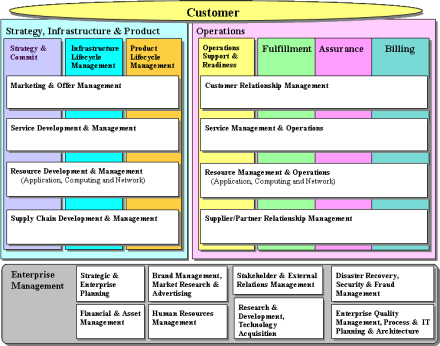
Can we build an Enhanced Healthcare Operations Map; e-HOM

Can we build an Enhanced Healthcare Operations Map–e-HOM to create a standards for processes within the healthcare industry?

Without such a map, knowing which processes are involved with which systems and knowing where to apply change management is like shooting in the dark. I’ve asked and searched, and there does not appear to be anything like e-HOM.

The telecommunications industry has such a model, e-TOM, a global standard.

ETOM (1)

I think that with the gray matter we have in this group, we could make a good stab at building our own healthcare operations map. Please take a look at the diagram and let me know your thoughts as to how we can edit that diagram to create our own. What word would you change, what would you add, what relationships would you add or delete? For example, we would change “customer” to patient. Where would you add “EHR”, registration, etc?

I’ll take point on pulling it together.  Please email me your ideas paulroemer@healthcareitstrategy.com

Thanks.

pastedGraphic.tiff.converted

What are the voices telling you?

voices

My favorite thing about healthcare is having witnessed it up close and personal both as a cancer patient in the 80’s and as the survivor of a heart attack seven years ago.

I was fortunate enough to have testicular cancer before Lance Armstrong made it seem kind of stylish.  Caught early, it’s one of the most curable cancers.  As those who’ve undergone the chemo will attest, the cure is almost potent enough to kill you.

I self-diagnosed while watching a local news cast in Amarillo where I was stationed on one of my consulting engagements.  As we were having dinner, my fellow consultants voted to change the channel—I however had lost my appetite.  I went to my room, looked in Yellow Pages—see how times have changed—and called the first doctor I found.  This is one of those times when Never Wrong Roemer hated being right.

So, yada, yada, yada; my hair falls out in less time than it took to shower.  A few more rounds of chemo, the cancer’s gone and I start my see America recovery Tour, my wig and I visiting friends throughout the southeast.  If I had it to do over, I would go without the wig, but at twenty-seven the wig was my security blanket.  I don’t think it ever fooled anyone or anything—even my house plants snickered when I wore it around them.

I owned a TR-7 convertible—apparently it never lived up to its billing as the shape of things to come, more like the shape of things that never were.  My wig blew out of the convertible as I made my way through Smokey Mountain National Park.  I spent twenty minutes walking along the highway until I spotted what looked like a squirrel laying lifelessly on the shoulder—my wig.

The last stop on my tour was at a friend’s apartment in Raleigh.  Overheated from the long drive and the August sun, I decided to take a few laps in her pool.  I dove in the shallow end, swam the length of the pool, performed a near-flawless kick-turn and eased in to the Australian Crawl.  As I turned to gasp for air, I noticed I was about to lap my hair.  I also noticed a small boy, his legs dangling in the water, with a look of astonishment on his face.

My ego had reached rock bottom and had started to dig.  I had one of those “know when to hold ‘em, know when to fold ‘em moments” and never again wore the wig after learning it was such a poor swimmer.

Do you get those moments, or get the little voice telling you that your EHR strategy isn’t fooling anyone?  It’s okay to acknowledge the voices as long as you don’t audibly reply to them during meetings—I Twitter mine.

Sometimes the voices ask why we didn’t evaluate the EHR vendors with a detailed RFP.  Other times they want to know how that correspondence course in project management is coming along.  It’s okay.  As long as you’re hearing the voices you still have a shot at recovery.  It’s only when they quit talking that you should start to worry.  Either that, or try wearing a wig.

pastedGraphic.tiff.converted