How to handicap selecting your EHR

Several years ago I was invited to go on the ultimate boys’ toys, weekend getaway. A dozen of us flew from Denver to Utah, and then drove to a point somewhere west of Bozeman Montana. It was to be a weekend of sport, a weekend of competition, and a more than occasional libation. To say that the people who organized the trip came from money would be a major understatement. They were in the oil bid’ ness. The father of one of the guys was the CEO of the second or third largest petroleum company in North America. We stayed at his ranch, a 12 bedroom log cabin in the middle of Nowhere, Montana, which is about 20 miles west of Next to Nowhere, Montana.

The weekend’s activities included fly fishing, duck hunting, and Gin Rummy. Each participant was given a handicap rating in each event. The idea behind the rating was that if you are weak in one event, you were paired with an individual who is skilled in that event. In theory, that would level the playing field among the teams. Since I have never fly-fished or hunted I was odd man out. But I was game, and it’s amazing how good one can become at something when one has to fight their way through it.

Let the games begin. We started the competition with a full day of fly-fishing. Our destination was the Madison River, an impressive, fast running, expanse of snow melt. The stretch we would finish was about 150 feet wide, and its average depth was somewhere between waist and chest high. As I would soon learn the bottom was covered with what appeared to be the equivalent of moss covered bowling balls. I was instructed by one of the more experienced fishermen to tie a nymph to the end of the tippet. For those of you who are as novice to the sport as I was, a nymph is an artificial lure which mimics an insect larva. It is designed to lure fish who feed along the bottom, not the nubile young woman referenced in Greek mythology.

We fished for several hours. My legs ached from trying to maintain my balance in the strong current. I was about ready to admit defeat when the tip of my rod bent sharply into the water. Standing perpendicular to the current, I could see as the brightly speckled back of a large rainbow trout turned upstream. Naturally, I turned upstream with it and began to try to reel him in. First mistake. It was at that point that I first realized that the height of the water was now about level with my chest waders. Second mistake. The guys on the other part of the river and along the bank were yelling at me. I thought it was words of encouragement. Final mistake. As it turns out, they were trying to convince me not to turn upstream. At the exact moment that I faced stream head on, was the exact moment my feet lost purchase with those moss covered bowling balls of which I wrote. Turning yet again to my physics, I quickly recalled the equation; force equals mass times acceleration. Instantaneously, I was swept downstream, still clutching my fly rod in my right hand.

Wayne Newton’s first law of fluid mechanics took over; waders, no matter how good they are, if positioned in a plane that is horizontal to the river will fill rapidly with water, just as mine did. The choice with which I was faced was do I save myself and lose the fish, or do I try and land the fish? One of the shortcomings of maleness—I was going to use maledom until I Googled it—is that we rarely have actual choices, especially when we are around other males or for that matter, females. Naturally, I opted to land the fish. My reel had become dislocated from my rod. I remember grabbing the reel and stuffing it down my waders, and as I tried to float my body as though it was a raft without a rudder towards the river’s nearest bank, I began to reel in the monofilament with a hand over hand motion. After several minutes I was standing dripping wet and proudly displaying a 19 inch rainbow trout.

We cooked the fish and played Rummy until about three in the morning, awoke at four, grabbed our shotguns and headed out into the darkness without so much as a cup of coffee. Round three of the competition was to be duck hunting. To this day I’m still unclear as to why we had to hunt ducks while it was still dark. Weren’t there any ducks who needed shooting at brunch time, I inquired? Twelve guys, who collectively smelled like a distillery, and who are operating on an hour of sleep, armed with loaded shotguns, trod through a willow thicket as dawn approached. As I neared the river bank, a startled duck shot skyward. I raised my over and under twelve-gauge shotgun, sort of took aim, and fired a volley. The duck seemed to pause in midair, and then fell like a rock into the racing water. I watched helplessly as my quarry floated away from me. I looked downstream and was pleased to see two men fishing from a rowboat. The duck floated right towards them. A man reached down, retrieved my duck, and dropped it in his boat. He then waved to me. Thinking he was being friendly I returned his wave. He then rowed away with my duck.

It was a great three days. Part of what made the weekend fun with not having to excel at each event. It helped knowing that in areas where my skills were not as good, I could count on the skills of others and vice versa. The idea behind this approach was to build competitive and level teams. That approach works well in mano y mano events like those I described. It works much less well in EHR, HIT and healthcare reform in general.  I’m trying to recall if I wrote previsouly about a meeting I attended with a former hospital CEO.  His take on EHR was the total inability of his peers to have any precience regarding their approach to EHR.  According to him, very intelligent people were making very unintelligent decisions, committing their entire institution to strategies made with almost no data.  Some people can give a better explanation for why they bought their car than they can for why they selected their EHR.   That’s the wrong way to handicap this event.

There are two ways to handicap your EHR.  One way is to look at the program from the perspective of risk assessment and assess–handicap–the risks.  The other way to to be a detriment to the program’s success.  One of these is bad.

EHR: Puppy Training Your Vendor

To ensure we take an accurate look at the provider-vendor relationship, we must be willing to acknowledge that healthcare providers are from Mercury and the EHR vendors are from Pluto.  They exist in different orbits, and their business models are very far apart—they never intersect; not in space, and not on your project.

1. Have your own inside expert. Don’t rely on the vendor to tell you what you should be doing.  Never.  Ever.  Unless of course you think the vendor knows more about how you want to run your hospital than you do.  Remember, you select them—not the other way around.

Bringing a vendor into your hospital is a lot like bringing home a new puppy. Both need to know who runs the show. Don’t roll over.  They may not be looking to be led, but if you don’t lead them they will lead you.

You should have the expert on board at the outset, before you select the EHR vendor.  The expert should be your advocate.

2. Establish a specific executive liaison with your vendor.  This is not your new tennis partner.  This should be the person who has the authority to ensure your quantifiable wishes are being met, and whose responsibility it is to deliver the message to his troops, and marshal the resources necessary to get the job done.

3. Specify your contractual objectives. Ensure that the contract is aligned with the clinical and business objectives of the healthcare organization, not the vendor.  Before you can accomplish this, you have a lot of work to do with your team.  You must define your clinical and business objectives.  Often these two groups also have a Mercury and Pluto relationship.  Once you have these, your next task is to deliver these objectives to the vendor and have the vendor tell you in writing what they will meet, what they might meet, and what they can’t meet.  It would be nice to know these before you sign their contract.

4. Involve more people than just the IT staff. Need a rule of thumb, involve as many users as IT people—Mercury and Pluto.  You will need new processes, not just to squeeze an ROI from the EHR, but because many of your old ones have probably been around since the invention Band-Aid.

Each of these recommendations will actually help you and help your vendor be successful.  It will not be an adversarial relationship as long as you manage it.  If you don’t manage the relationship, you won’t have to worry about meeting Meaningful Use—you’ll be too busy selecting a replacement vendor.

One final thought, don’t let the vendor loose unsupervised on the oriental rugs.


What do processes have to do with EHR success?

As a parent I’ve learned there are two types of tasks–those my children won’t do the first time I ask them, and those they won’t do no matter how many times I ask them.  Here’s the segue.

Let’s agree for the moment that workflows can be parsed into two groups—Easily Repeatable Processes (ERPs) and Barely Repeatable Processes (BRPs). (I read about this concept online via Sigurd Rinde.)

An example of an ERP industry is manufacturing. Healthcare, in many respects, is a BRP industry. BRPs are characterized by collaborative events, exception handling, ad-hoc activities, extensive loss of information, little knowledge acquired and reused, and untrustworthy processes. They involve unplanned events, knowledge work, and creative work.

ERPs are the easy ones to map, model, and structure. They are perfect for large enterprise software vendors like Oracle and SAP whose products include offerings like ERP, SCM, PLM, SRM, CRM.

How can you tell what type of process you are trying to incorporate in your EHR? Here’s one way. If the person standing next to you at Starbucks could watch you work and accurately describe the process, it’s probably an ERP.

So, why discuss ERP and BRP in the same sentence with EHR? The reason is simple. The taxonomy of most, if not all EHR systems, is that they are designed to support an ERP business model. Healthcare providers are faced with the quintessential square peg in a round hole conundrum; trying to get BRPs into an ERP type system. Since much of the ROI in the EHR comes from being able to redesign the workflows, I think either the “R” will be sacrificed, or the “I” will be much higher than planned.

What do you think?


EHR: This is not a trick question

Okay, so today was going to be one of those days when I wasn’t going to allow myself to be stupified–at least no more than was really required.
Then it sneaks up smack dab in the middle of a call, and from what I’ve been able to determine, people find it annoying if you burst out laughing on the call.  (They are not annoyed at all if you simply write about them provided they don’t read it.)

What got me going is this statement, “We’ve budgeted $X for EHR.”

Really?  You did this all by yourself?

The facts as I understood them are as follows:

  • Never bought an EHR
  • Don’t know how big they are, if they are blue or green, come gift-wrapped, or if you need two people to carry it
  • No input from vendors about EHR
  • No discussions with others abot what an EHR system costs

So, with absolutely no information, how does one determine how much they need to spend for an EHR?  This is not like going to the supermarket for a gallon of Soy Milk–not that anyone would want to do that.

EHR: where’s my hammer?

Those of you who’ve visited previously may have caught on to the fact that my wife likes to keep me away from bright shiny objects such as tools.  Let me tell you about my first house, a two-story stucco building in Denver, built in 1902.  My favorite part of the home was the brick wall.  That it had a brick wall was not apparent when I purchased the home.
I came home from work to find that my dog had eaten through the lath and plaster in the living room and there was the brick.  I had to decide what to do.  I knew nothing about lathing—I know that’s not really a word—or plastering.  What to do.  My only tool was a hammer, so I began to hammer.  For those who haven’t done this, hundred-year-old plaster being pounded with a hammer makes a lot of dust.  This process proved to be very slow.

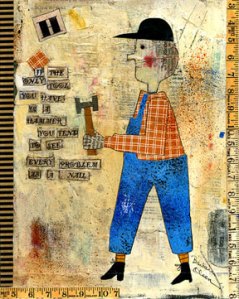
What did I do?  I bought a bigger hammer—such a guy approach to a problem, isn’t it?  It took three hammers to get down to just bare brick.  What would you have done?  When your only tool is a hammer every problem looks like a nail–or a wall.

As you go through the EHR planning process in your war room—you do have a war room, don’t you?  (Try Sam’s Club, after all, they sell EHRs.)  Get out the really big piece of paper, the one with your EHR design—you do have a really big piece of paper, don’t you?  (Back to Sam’s.)

Next to the box on the paper labeled “Shiny New EHR” should be lots of empty space so you can draw in all of the other systems with which your EHR will have to interface.  One of the readers of this blog wrote recently that his EHR had more than 400 interfaces.

EHR, if done correctly, will do much for patients, doctors, and administrators.  It’s not a panacea.  It won’t reach its potential unless you also integrate it with those systems that unlock its potential.  Improving your efficiency and effectiveness takes more than merely an EHR system.

When your only tool is a hammer, you’d better hope every problem is a nail.  What other tools are you using?  Please share your ideas about what works well.

EHR: The Migratory Patterns of Coconuts

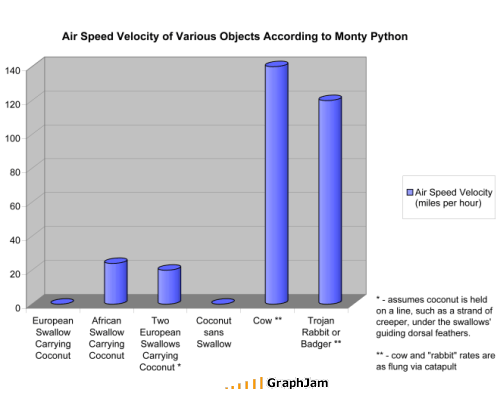
Are you suggesting coconuts migrate? (Not at all, but a swallow could grip it by its husk.)
Sometimes I get reactions from my clients which suggest that my ideas have people questioning if I just fell out of the stupid tree and hit every branch on the way down, especially when what we’re discussing seems to move from the theoretical and towards the heretical. However, there was a presentation I made to one of my clients where I had the entire room believing that i might as well have been suggesting that coconuts migrate.

Allow me to set the stage. I presented to the CIO of one of the largest providers in Europe a vision for what their IT strategy should be. This was an 0.2 firm requiring a 2.0 solution.  As you can guess, it was fairly easy to suggest that better alternatives were available to them, but if you’re a member of the Flat Earth Socitey you’re not going to believe anything until someone is able to literally change your perspective.

During my presentation I wrote on the white board that I would help them choose between three alternatives. At this point, a British colleague and good friend, came to the front of the room—uninvited, removed the marker from my hand, erased the word ‘between’, and penned the word ‘amongst’. “We choose between two things, and amongst three or more,” he said with a grin and then returned to his seat. I suggested that since English was not the native language of our client that his point was probably lost on them, to which he stated that his point was directed at me whose native language was supposed to be English. God save the queen. He also tried to make the point on more than one occasion that the American War of Aggression with England did not end in 1783 with a victory for America, but with a British retreat.

Anyway, we were choosing between three alternatives, at least I was. After about ten minutes of explaining what could be achieved and how it might be structured, I was interrupted again, this time by the CIO. He too took my marker, concluding that I was a coconut. It took me about thirty minutes to convince him that everything I’d presented was not only achievable, but already operational in a number of their competitors.

So, as we head down the EHR path with our Project Management Executive, the person who will be spearheading the internal effort to affect change, we must find a way to make sure the executive is properly equipped. For starters, the executive needs to have, and to be able to communicate a vision, a vision for the change, for how it will impact the organization, and an ability to communicate it.


EHR, the wisdom of crowds

According to National Geographic, a single ant or bee isn’t smart, but their colonies are. The study of swarm intelligence is providing insights that can help humans manage complex systems. The ability of animal groups—such as this flock of starlings—to shift shape as one, even when they have no leader, reflects the genius of collective behavior—something scientists are now tapping to solve human problems.  Two monumental achievements happened this week; someone from MIT developed a mathematical model that mimics the seemingly random behavior of a flight of starlings, and I reached the halfway point in counting backwards from infinity–the number–infinity/2.

Swarm theory. The wisdom of crowds. Contrast that with the ignorance of many to listen to those crowds. In the eighties it took Coca-Cola many months before they heard what the crowd was saying about New Coke. Where does healthcare EHR fit with all of this? I’ll argue that the authors of the public option felt that wisdom.  If you remember the movie Network, towards the end of the movie the anchorman–in this case it was a man, not an anchor person–besides, in the eighties, nobody felt the need it add he/she or it as some morphed politically correct collection of pronouns.  Whoops, I digress.  Where were we?  Oh yes, the anchor-person.  He/she or it went to the window and exhorted everyone to yell, “I’m mad as hell, and I’m not going to take it anymore.”  Pretty soon, his entire audience had followed his lead.

So, starting today, I begin my search for starlings.  A group whose collective wisdom may be able to help shape the healthcare EHR debate.  The requirements for membership is a willingness to leave the path shaped by so few and trodden by so many, to come to a fork in the road and take it. Fly in a new flock.  A flock that says before we get five years down the road and discover that we have created such an unbelievable mess that not only can we not use it, but that we have to write-off the entire effort and redo it, let us at least evaluate whether a strategic change is warranted.  The mess does not lie at the provider level.  It lies in the belief that hundreds of sets of different standards can be married to hundreds of different applications, and then to hundreds of different Rhios.

Where are the starlings headed?  Great question, as it is not sufficient simply to say, “you’re going the wrong way”.  I will write about some of my ideas on that later today.  Please share yours.

Now, when somebody asks you why you strayed from the pack, it would be good to offer a reasoned response.  It’s important to be able to stay on message.  Reform couldn’t do that and look where it is. Here’s a bullet points you can write on a little card, print, laminate, and keep in your wallet if you are challenged.

  • Different standards
  • Different vendors
  • Different Rhios
  • No EHR Czar

Different Standards + Different Vendors + Different Rhios + No Decider = Failure

You know this, I know this.

To know whether your ready to fly in a new direction, ask yourself this question.  Do you believe that under the present framework you will be able to walk into any ER in the country and know with certainty that they can quickly and accurately retrieve all the medical information they need about you?  If you do, keep drinking the Kool Aid.  If your a starling, come fly with us and get the word out.  Now return your seat backs and tray tables to their upright and most uncomfortable positions.


EHR Milestones, should that read Millstones?

If you like adventure, here’s a site to check,http://www.jfk50mile.org/.  This is an annual event whose origin came about during the cold war.  Fortunately for both of us, the entry date has already passed.  The thought behind the JFK fifty-mile hike/run was that because of the possibility of a nuclear attack, each American should be in good enough shape to cover fifty miles in a day.

I participated in the event twice—I wrote participated because to state that I ran the entire way would be misleading— and I can state with certainty that almost no Americans are close to being able to complete this.  The event is run in the fall starting in Boonsboro, Maryland.  It takes place along the Appalachian Trail and the C&O Canal and various other cold, rain soaked, and ice and leaf covered treacherous terrains.

We ran it in our late teens or early twenties, the time in your life when you are indestructible and too dumb to know any better.  One of my most vivid memories of the event was that on the dozen or so miles along the mountain trail, leaves covered the ground.  By default that meant they also covered the rocks along the trail, thus hiding them.  That we were running at elevation—isn’t everyone since you can’t not run at at least some elevation, (that may be the worst sentence every written) but you know what I mean—meant the prior night’s rain resulted in the leaf covered rocks being sheathed in black ice.  That provided a nice diversion, making us look like cows on roller skates—roller blades had yet to catch on outside of California.

There were several places along the trail where the trail seemed to fork—I’m not going to say and I took it—and it wasn’t clearly marked.  Runners could easily take the wrong fork (or should that be Tine?).  I think it would have been helpful had the race organizers installed signs like, “If you are here, you are lost.”  Hold on to that thought, as we may need it later.

Some number of hours after we began we reached the C&O Canal, twenty-six miles of flat terrain along the foot path.  It’s difficult to know how well I was doing in the fifty-mile race, in part because I had never run this distance and because there we no obvious mile markers, at least so I thought.  Then we noticed that about every five and a half to six minutes we would pass a numbered white marbled marker that was embedded along the towpath.  Mile stones.  At the pace we were running, we anticipated we would finish high in the rankings.  As fast as we were running, we were constantly being passed, something that made no sense.  That meant that a number of people were running five minute miles, which we knew they couldn’t do after running through the mountains, or…Or what?

The only thing we knew with any certainty at the end of the day was that the markers with which we used to determine our pace and measure how far we’d run were not mile markers.  We never figured out why they were there or how far apart they were, but we greatly underestimated their distance and hence our progress.

It doesn’t really matter whether you call them mile stones or milestones.  What matters is whether they serve a valid purpose.  If they don’t, milestones become millstones.  Milestones are only useful if they are valid, and if they are met.  Otherwise, they are should’ a, could’ a, would’ a—failure markers, cairns of missed goals and deliverables.

How are your milestones?  Are they valid?  What makes them valid?  Are they yours, or the vendors’?  All things to think about as you move forward.


May I have receipt for my EHR in case I return it?

A hospital in our area just dedicated a new wing.

For months the job site was a maze of people, duct, and tools.  It cost $145 million.  Affixed to the new wing is a plaque displaying the name of the architect, the contractor, the mayor, and the rest of the adults who made it happen.  While it was being built there were numerous permits, certifications, and sign-offs taped to the building.  Their purpose was to ensure the public that the adults were keeping an eye on things.  A phase of work couldn’t be started until the prior phase had all the requisite sign-offs.

Those in authority had to be licensed.  Had to be certified as qualified.

They have another project underway.  One that costs more than the new wing and impacts more people.  This one doesn’t have a blueprint.  There are no building permits.  No certifications.  No licensed professionals.  You can’t even see it.  There are no hard-hatted workers.  No foreman.  You know who’s in charge of the project?  A hospital executive—prior experience—zero.  Has he ever built one before?  No.  Does he know what to do when he encounters risks, pitfalls?  No.  There is one other person running the show—a vendor—that should let everyone get a good night’s sleep.

Would anyone let this same executive be in charge of building a new wing?  Of course not.  Why then do we not employ the same standards for what will turn out to be the most expensive and far reaching non-capital project that the hospital will ever undertake?  If you think you know, please share your answer.

By the way, I asked one of those executives how it was that he happened to be selected to lead the EHR project.  “I forgot to duck,” he quipped.  I guess that’s as good a reason as any.


Modern Healthcare: Not enough time for PCAST goals?

Below are the comments I submitted to their recent article–http://www.modernhealthcare.com/article/20101222/BLOGS02/312229999&newCommentId=4948192#comments

It is difficult being the lone duck screaming “the sky is falling,” but, I feel someone has to be the schismatist before we all wind up drowning in the Kool-Aid.

It is not that I do not think ideas like a universal exchange language are not important; I think the fact this discussion even exists is because we have kidded ourselves for so long about how well EHR and interoperability are working that we have hung ourselves on our own petard.

Have we put the cart so far ahead of the horse that we have caught the horse from behind?  The discussion seems to be about walking before most have learned to crawl.  Lest we forget the issues, here are some observations we must keep at the forefront—what most hospital executives and CIOs face daily.

  • EHRs are not standard
  • Many EHR implementations have failed
  • More will fail Meaningful Use
  • Some hospitals are on EHR 2.0, switching from Vendor A to Vendor B, while others are switching from Vendor B to Vendor A—what does that tell us?
  • The current hospital business model is dysfunctional; as compared to other industries, hospitals are run more like a 0.2 model than a 2.0 model
  • EHRs were built to support a dysfunctional model, and those EHRs are built using outdated architectures
  • An ACO business model is not compatible with the present crop of EHRs—EHRs were not built with ACOs in mind—they are mutually exclusive concepts, at least with regard to today’s EHRs
  • For and ACO to be of value, to be effective to an organization, they must be joined to a different business model

Before we worry ourselves with future issues like compatibility with the EU and a universal exchange language, ought we not come up with a plan to make EHR viable one hospital at a time?