Why the N-HIN will be owned by public firms

Here are a few more thoughts just to Emerilize the discussion—to kick it up a notch.  Not only do I think the national EHR market is ripe for the taking by a big three like Microsoft, Google, and Oracle, I’ll go so far to suggest that when the dust settles in 5-7 years, the N-HIN, the National Health Information Network, will be a regulated combination of a handful of those firms.

As for the other firms offering or planning to offer PHRs, permit me to suggest the following scenario.  Let’s say I am in charge of Google’s so far somewhat nonexistent healthcare line of business.  One of my goals would be to have more users of my PHR than any other firm.

Why does this model make sense?  Two ways, both of which come from the cable/telco business model.  Rule number one, content is king.  In cable, it is shows like HBO and Discovery.  In healthcare it is data; patient data, effectiveness data, disease data.

Reason number two, the cable/telco model values the businesses based on the number of assets.  What are the assets?  Subscribers.  You and me.  Each body adds somewhere between five and ten thousand dollars to the valuation model of a Comcast or Verizon.  Downstream, some valuation will be placed on each PHR subscriber.

So, back to the example of me running Google’s healthcare offering—if you don’t like Google as an example, insert your favorite firm.  If I’m Google, am I troubled by the fact that other firms are building their own solutions?  No, and here’s why.  The difficult part of the business model is adding users, adding subscribers.  Why not let a bunch of firms do the business development work for me, do the dirty work to get the users, and then just devour those firms?  Once I own them, I convert them to my platform.  Do I then get some ‘ownership’ or right to use the data?  That would certainly be the business goal.

One million users valued at five thousand dollars adds five billion in valuation.  Ten million adds fifty billion.  Ten billion is about 2.5% of the US market.  Do I stop at the border?  Of course not.

By the way, while all this is going on, Google, MS, or whoever will also be creating standards and be building or buying up EHR firms.

The Dark Side versus the Blind Side

My take on this is probably far-afield from the mainstream. I think the Dark-Side, firms like Google, Microsoft, and Oracle look at the confusion and lack of planning in terms of what the final EHR/PHR platform will look like and they simply drool. With hundreds of EHR vendors and RHIOs and RECs and standards groups all operating independently, all aiming at an undefined target, which group is best positioned to solve this platform problem, the Dark Side, or the Blind Side?

The Dark Side’s plans are underway and visible through their PHRs. Like the tip of an iceberg, I bet that most of what they are doing to own this space is presently unseen. Practice Fusion, if their product attracts enough customers will be devoured, or they will be ignored. RECs, RHIOs, Meaningful Use, Certification, a lack of standards, and no network are large red flags from the government saying “we don’t know where we’re going, but we’re making real good time.”

Here’s a reply I drafted at the request of Brian Ahier to his blog, http://radar.oreilly.com/2009/11/getting-personal-with-health-t.html

The Dark Side knows exactly where they’re going. They don’t need a network; they have one. The Internet. There are those who argue HIPAA and security. HIPAA and security can be more readily handled on a network that’s been up and running for twenty years and was built by the military than they would be under anything developed off the cuff under Washington’s leadership.

Now for the Deathstar issue–ownership of the data. The question is are ownership and possession one in the same? I bet they will not be. I’d also bet that five years from now somehow that Dark Side will have at least access to it. I can’t prove any of this, but I’d love to sit in on the strategic planning committees of the Dark Side. I bet some or all of this is underway. The Blind Side may be blind-sided.

HIT/EHR: A little adult supervision can’t hurt

Among other things, EHR requires adult supervision like parenting.  My morning was moving along swimmingly.  Kids were almost out the door and I thought I’d get a batch of bread underway before heading out for my run.  I was at the step where you gradually add three cups of flour—I was in a hurry and dumped it all in at once.  This is when the eight-year-old hopped on the counter and turned on the mixer.  He didn’t just turn it on, he turned it ON—power level 10.

If you’ve ever been in a blizzard, you are probably familiar with the term whiteout.   On either side of the mixer sat two of my children, the dog was on the floor.  In an instant the three of them looked like they had been flocked—like the white stuff sprayed on Christmas trees—I guess we could call them evergreens—to make them look snow-covered.  (I just em-dashed and em-dash, wonder how the AP Style Book likes that.)  So, the point I was going for is that sometimes, adult supervision is required.

What exactly is Health IT, or HIT?  I may be easier asking what HIT isn’t.  One way to look at it is to consider the iPhone.  For the most part the iPhone is a phone, an email client, a camera, a web browser, and an MP3 player.  The other 85,000 things are other things that happen to interact with or reside on the device.

In order for us to implement correctly (it sounds better when you spilt the infinitive) HIT and EHR a little focus on blocking and tackling are in order.  Some write that EHR may be used to help with everything from preventing hip fractures to diagnosing the flu—you know what, so can doctor’s.  There are probably things EHR can be made to do, but that’s not what they were designed to do, not why you want one, and not why Washington wants you to want one.  No Meaningful Use bonus point will be awarded to providers who get ancillary benefits from their EHR especially if they don’t get it to do what it is supposed to do.

EHR, if done correctly, will be the most difficult, expensive, and far reaching project undertaken by a hospital.  It should prove to be at least as complicated as building a new hospital wing.  If it doesn’t, you’ve done something wrong.

EHR is not one of those efforts where one can apply tidbits of knowledge gleaned from bubblegum wrapper MBA advice like “Mongolian Horde Management” and “Everything I needed to know I learned playing dodge ball”.

There’s an expression in football that says when you pass the ball there are three possible outcomes and only one of them is good—a completion.  EHR sort of works the same, except the range of bad outcomes is much larger.

RECs, HIEs, & EHRs: Curiouser and Curiouser

Here’s a response I wrote for a very interesting conversation started by Andy Oram, though a posting, http://radar.oreilly.com/2009/11/converting-to-electronic-healt.html

I think the very existence of the Regional Extension Centers (RECS)is but another sign that there is no workable plan for a national rollout of EHR. There is a plan, a word I use reluctantly—there may be several. Several things surrounding the rollout exist that reinforce the idea that the plan is not operational—Meaningful Use, Certification, RECs—and these things exist as a series of band-aids in the hope they will enable the plan. These band-aids have been cobbled together over time and by different parties.
There is no EHR Czar.

There is no roll out czar. I defy anyone to present their work plan for how this ties together and show where these add-ons are on the plan.

Back to RECs. Similar format to Healthcare Information Exchanges (HIEs). Political in their origin and format. Carte blanche in terms of how they are built, what they will deliver, how they relate to HIEs and standards, and how the quality of their output will be measured. Five hundred and ninety-eight hope this helps million dollars. Has anyone sought out the credentials of those running the hope-this-works RECs? Does anyone doubt that they don’t have the experience to make these of any value? Where’s the national REC work plan? The individual work plans?

Who likes the REC idea? The payors. Regionally deployed and state authorized, the payors have more than a vested interest in helping the healthcare providers in their region with their EHR efforts.

This is another lipstick on the pig effort. By now, the pig is just about covered with lipstick. Does it make it a better pig? Of course not, it just makes it red.

saintlogo2

EHR: work plans are necessary but not sufficient

114454101_a0f39220a7


I wonder about things, little things, things I see on Nova or on Bizarre Foods.  Take water, more specifically, ice.  It floats.  The only solid that floats in its liquid state.  Most solids sink, not ice.  For those of you thinking boats float, they’re not considered to be solids—does that make them liquids?

It turns out that as water goes from four degrees centigrade, its densest point, and towards freezing, it becomes less dense and floats.  It’s volume increases by 9%, and part of that 9% is trapped air.  That air, even though you can’t see it, exists between the two H’s and the O.  which takes us to the following.

Have you spent much time studying work plans?  While there are more interesting ways to spend your time, there are times meant for writing them, and times meant for studying them.

Having a work plan can be a little like having a bike; nice, practical for some things, impractical for others.  Like with most things, there are work plans and there are work plans.  Some may not be worth the paper on which they are written.

Just like not everyone can write a book worth reading, not everyone can write a work plan worth implementing.  Lines on paper don’t necessarily yield a project of much value.  Remember how with the ice there are things between the H’s and O’s?  Well, with a lot of healthcare IT and EHR work plans, there are things between the tasks on the work plan, or at least there should be.  Can’t see them either.  Those things?  The missing tasks, the tasks that should have been in the plan, the tasks that would have given the plan a fighting chance to succeed.

Some gaps are good, like with ice.  Others can leave you hanging.

saint

Some EHRs are better than others

The health club offers a boot camp course—see how this ties into healthcare?  I used to make fun of it until I decided to try it.  The spandex factor is about 9.8 on the spandex/Richter scale.  Thirty-something women whose color coordinated apparel makes it worth the sweat.  (Permit me a brief segue.  Some fashionista recently discovered that it was possible to convince women that instead of wearing one shirt, that it would be more fashionable to wear multiple shirts with coordinated colors.  So, the women in the boot camp course wear an array of clothes such that their headbands match their fingernail polish.)

On most days I am the lone male in the class.  I’ve summited 50 (years, for those wondering the use of the word).  Most of the women in the class are unable to have an intelligent conversation over a latte about Viet Nam.  Trying to be gentle, I attribute that to their age rather than the fact that they were waitlisted on the most recent Mensa membership drive.  Despite their inability to go mano y mano with the former secretary of defense, Robert McNamara, they look darn good in spandex.

I try not to look like I covet their fawning, but as a seven year survivor of the White Male RCA Stent Award, I accept it with a degree of grace.  (For the male readers who wish to make light of Boot Camp, try it before you tease.)

So, there I am, I am there.  It’s my Green Eggs and Ham moment.  Prior to the class I’d run five miles, and completed 33 pull-ups without stopping.  Did I mention I like being the lone male in the class?   There’s a certain adulation that goes with the title.  Some would covet the position, but as an adult, I take it in stride.

However…today another male comes to the class.  I do not mind having another male.  I do however look unfavorably having another male in the class who looks like he trains navy SEALS in his spare time.  The class had the usual amount of male gawking, albeit at the wrong person.

What does this have to do with healthcare information technology?  Not much other than it goes to show you that there are those whose efforts may have superseded your own.  It doesn’t mean much when the item in question is pushups, it means a lot more when you’re trying to determine who did the best job spending one hundred million dollars on an electronic records system.

sainttop5

Pigeon Project Management Office (PMO)

1906_Whittling_Webster_adx

I just finished stacking two cords of wood, much like a squirrel getting ready for a long cold winter. My feet were doing the “Boy is it cold dance” in an effort to keep the blood circulating.  As I was picking up the scraps, my eldest picked up a piece and placed it in his backpack. When I asked him what he would do with it he told me he was going to carve it after school. His statement brought back boyhood memories of hours of whittling, an activity done if for no other reason than to get from one minute to the next. Grab a stick and whittle it away until there was nothing left.  What next? Grab another. The weight of the pocketknife felt equally good in my hand as it did in my pocket.
When is the last time the thought of whittling crossed your mind? Probably been a long time. It’s an activity meant for idle minds and hands, or minds that should be idle. There are times I find myself questioning what value so and so brings to the party. Do you do that?  “Why is she in this meeting?”  You know who I mean.  You’re sitting there trying to get your work done and all of a sudden, some Mensa wannabe with more idle time on their hands than a Lipitor salesman at a BBQ cook-off, makes an aerial assault on your cubicle like a pigeon on a Rodin bronze.  Drops in and changes the rules of the universe, at least your universe.

This happens more often than is documented on large healthcare IT projects.  People set new courses and define programs rules that may have nothing whatsoever to do with the project’s charter or scope.  You do have a written charter and scope in the project office, don’t you?  If not, it’s easy to see how new directions and rules can be given a certain specious authority.

What’s the best way to handle this situation? Often these management Mensas are nervous about a lack of visible results and they need to report on something.  They may feel the need to be doing something, something resembling leading.  They don’t mean to interfere, and they believe that their little forays into the world of super PMO (Program Management Officer) will actually add value. You tell me, are they adding value, or are they preventing the team from sticking to the scope? There’s that irritating scope word again.  The next time you see one wandering aimlessly through the rows of cubicles, hand that person a pocketknife and a nice piece of balsa wood.  Although their efforts won’t add any value to what you’re trying to accomplish, at least it will get them out of the way for a little while.

saint

Who was that woman who put in our first EHR system?

vacuum_cleaner

The first home I bought was in Denver.  Built in 1898, it lacked so many amenities that it seemed better suited as a log cabin.  There was not a single closet, perhaps because that was a time when Americans were more focused on hunting than gathering.  Compared to today’s McMansions, it was doll-house sized.

It needed work—things like electricity, water—did I mention closets?  I stripped seven costs of paint from the stairs.  Hand-built a fireplace mantel and a deck.  I arrived home to find my dog had eaten through the lathe and plaster wall of the space which served as my foyer/family room/ living room-cum-hallway.  I discovered the plaster and lathe hid a fabulous brick wall.

My choice was to patch the small hole, or remove the rest of the plaster.  Within an hour I had purchased man-tools; two mauls, chisels, and a sledge hammer.  I worked through dinner and through the night.  The only scary moment came as the steel chisel I was using connected to the wiring of two sconces which were embedded in the plaster.  On cold nights I can still feel the tingling in my left shoulder.

As the first rays of dawn carved their way through the frosted beveled glass of the front door, I wondered why I never before had noticed that the glass was frosted.  I wiped two fingers along the frost.  A fine coating of white powder came off the glass leaving two parallel tracks resembling a cross-country ski trail.  I surveyed the room only to see that the air made it look like I was standing inside of a cloud.  The fine white powder was everywhere—my Salvation Army sofa and semi-matching machine-loomed Oriental rug from the Far East (of Nebraska), a two-ton Sony television, and a component stereo system that had consumed most of much earnings.

Bachelor living can be entertaining.  One of my climbing buddies moved in with me.  The idea was I’d keep the rent low, and he’d help me by maintaining the house.  He didn’t help.  I made a list of duties; he didn’t help.  I left the vacuum in the middle of the floor, for two weeks; he didn’t help.  I made him move out, and advertised for a female roommate—an idea I now wish I’d marketed.  A girl from church came over to see the place.  I turned my back on her, only to find when I returned that she was on her hands and knees cleaning the bathroom.  I was in love.  It was like having a big sister and mother.  She even asked if it was okay if since she was doing her laundry if she did mine at the same time.  Life was oh so good.

Sometimes when one approach isn’t working it’s real easy to try something else.  And sometimes the something else gives you a solution in the form of a water-walker.  Healthcare IT and EHR aren’t ever going to be one of those sometimes.  There will be no water-walkers, no easy do-overs.  There won’t be anyone walking your hallways talking about their first wildly unsuccessful EHR implementation.  Nobody gets to wear an EHR 2.0 team hat.  Those who fail will become the detritus of holiday party conversations.  Who will be the topic of future holiday parties?  I’m just guessing, but I’m betting it will be those who failed to develop a viable Healthcare IT plan, whoever selected the EHR without developing an RFP, the persons who decided Patient Relationship Management (PRM) was a waste of money.  The good news is that with all of those people leaving your organization, it costs less to have the party.

I’d better go.  Somebody left the vacuum in the middle of the floor so I need to get cracking before my wife advertises for a female roommate.

saint

Can we build an Enhanced Healthcare Operations Map; e-HOM

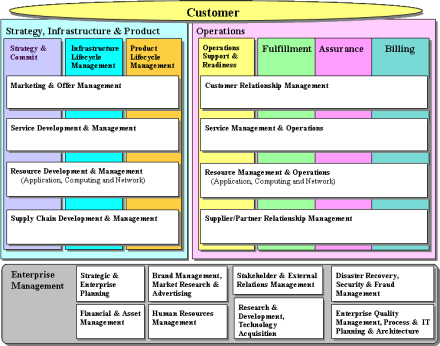
Can we build an Enhanced Healthcare Operations Map–e-HOM to create a standards for processes within the healthcare industry?

Without such a map, knowing which processes are involved with which systems and knowing where to apply change management is like shooting in the dark. I’ve asked and searched, and there does not appear to be anything like e-HOM.

The telecommunications industry has such a model, e-TOM, a global standard.

ETOM (1)

I think that with the gray matter we have in this group, we could make a good stab at building our own healthcare operations map. Please take a look at the diagram and let me know your thoughts as to how we can edit that diagram to create our own. What word would you change, what would you add, what relationships would you add or delete? For example, we would change “customer” to patient. Where would you add “EHR”, registration, etc?

I’ll take point on pulling it together.  Please email me your ideas paulroemer@healthcareitstrategy.com

Thanks.

pastedGraphic.tiff.converted

What are the voices telling you?

voices

My favorite thing about healthcare is having witnessed it up close and personal both as a cancer patient in the 80’s and as the survivor of a heart attack seven years ago.

I was fortunate enough to have testicular cancer before Lance Armstrong made it seem kind of stylish.  Caught early, it’s one of the most curable cancers.  As those who’ve undergone the chemo will attest, the cure is almost potent enough to kill you.

I self-diagnosed while watching a local news cast in Amarillo where I was stationed on one of my consulting engagements.  As we were having dinner, my fellow consultants voted to change the channel—I however had lost my appetite.  I went to my room, looked in Yellow Pages—see how times have changed—and called the first doctor I found.  This is one of those times when Never Wrong Roemer hated being right.

So, yada, yada, yada; my hair falls out in less time than it took to shower.  A few more rounds of chemo, the cancer’s gone and I start my see America recovery Tour, my wig and I visiting friends throughout the southeast.  If I had it to do over, I would go without the wig, but at twenty-seven the wig was my security blanket.  I don’t think it ever fooled anyone or anything—even my house plants snickered when I wore it around them.

I owned a TR-7 convertible—apparently it never lived up to its billing as the shape of things to come, more like the shape of things that never were.  My wig blew out of the convertible as I made my way through Smokey Mountain National Park.  I spent twenty minutes walking along the highway until I spotted what looked like a squirrel laying lifelessly on the shoulder—my wig.

The last stop on my tour was at a friend’s apartment in Raleigh.  Overheated from the long drive and the August sun, I decided to take a few laps in her pool.  I dove in the shallow end, swam the length of the pool, performed a near-flawless kick-turn and eased in to the Australian Crawl.  As I turned to gasp for air, I noticed I was about to lap my hair.  I also noticed a small boy, his legs dangling in the water, with a look of astonishment on his face.

My ego had reached rock bottom and had started to dig.  I had one of those “know when to hold ‘em, know when to fold ‘em moments” and never again wore the wig after learning it was such a poor swimmer.

Do you get those moments, or get the little voice telling you that your EHR strategy isn’t fooling anyone?  It’s okay to acknowledge the voices as long as you don’t audibly reply to them during meetings—I Twitter mine.

Sometimes the voices ask why we didn’t evaluate the EHR vendors with a detailed RFP.  Other times they want to know how that correspondence course in project management is coming along.  It’s okay.  As long as you’re hearing the voices you still have a shot at recovery.  It’s only when they quit talking that you should start to worry.  Either that, or try wearing a wig.

pastedGraphic.tiff.converted