Why don’t we all have an epidural?

Ben & Jerrys Pints Chunky MonkeyEver start feeling that way in the middle of a meeting?  Is somebody trying to sell you something in the meeting?

Ever have a meeting that went something like this?

“Sure, you could go ahead and define your requirements and pay a big firm hundreds of thousands of dollars to write and RFP, but after all that time and money, you’d still come back to us.”

Or…

“We are implementing the exact same EHR system at OLPIH (Our Lady of Perpetual Implementation Hospital), and we didn’t have to change a single workflow.”

Or…

“That’s why we’re here, so you don’t have to learn about all that technical stuff.”

Is there a ‘best’ EHR for you?  Quite possibly.  You’ve looked at a lot of the ongoing discussions.  I’ve repeatedly asked the question as to which solution is the best.  Asked it in open forums—vendors and healthcare providers—people not known for being reluctant to share their opinion.

Know what the response was?  Nothing.  Nada.  Zip.  Ignore who’s sold the most.  Nothing bubbles to the top.  There’s nothing that can even claim to be the flavor of the month.  (Ben & Jerry’s Chunky Monkey.)

So, where does that leave you?  Actually, you’re in an okay position.  Since the target is ill-defined, you have the luxury of figuring out which solution best fits your business problems.  Once you’ve done that, have some ice cream.

saint

You can lead a blog to water…

leadhorseI feel like I’ve contributed something any time I google a phrase and get zero hits.  I’m trying to recall if we’ve conjugated Google yet—I google, you google, he/she or it googles.  Failing to recognize it in its verb form, Word wants me to use a capital ‘G’.


Where were we?  I was asked to share my thoughts about all of the healthcare certifications, especially those that are used within healthcare IT, and to offer my opinion as to whether they add value or cost.  This is the type of open-ended question that can get less grounded consultants all a twitter.

Most of you can answer this for me, but I’ll push forward.  Remember, what follows is the opinion of a trained professional—don’t try this at home.

Clearly, certifications are of value, but not necessarily in the way one might think.  It depends in part on where they lay.  For the provider to go through the exercise of being certified in one realm or another probably means they’ve tightened their ship—a good thing.  Can you have too much of a good thing?  Probably—that’s a rather milquetoast answer.  Maybe it’s just me, but healthcare seems to attract or collect tiny alphabetical collections of letters like others collect fine wines—the thrill is in the collection, not necessarily in how utilitarian they are.

If we’re honest, healthcare has not been noted as an industry viewed as being on the leading edge of IT—if you happen to be an exception, that’s great, this isn’t meant to be all encompassing.  That being the case, since we are looking at a five year stretch where healthcare and healthcare IT are going to transform themselves one way or another from version 0.2 to version 2.0, I think there’s plenty to pay attention to without worrying about what certificates are stapled to everyone’s cubical.

Ask, what is it your organization must have in place to transform?  What IT skills?  What project management skills?  Everything that lays under the umbrella of HIT is the most visible, costly, and risky undertaking the organization has faced.  Do you need someone to lead it who has a certificate?  Maybe.  Do you need someone with ninja project management skills?  Absolutely.

On the non-provider side, certifications will always cost you more.  Nobody gives them away for free.  Be careful what you pay for.

What’s the most valuable certificate?  Thanks for asking.  I think it’s the one that certifies that you’re not drinking the Kool Aid.

pastedGraphic.tiff.converted

What did I miss?

112806I was looking at a job posting for a CMIO.  The first requirement is that the person must be a physician and a degree in healthcare infomatics.  Good start.  All of the other requirements read more like those one would expect to find in a receptionist–works and plays well with others, is kind to small animals.


You want someone whose name nobody will remember in five years–sort of like the umpire of a baseball game.  If they do their job right, nobody will know they were even there.

So what’s missing?  This is a been there done that job.  Battle hardened.  At what?  EHR?  I don’t think that has to be the case.  There aren’t many of those, and even fewer who have been successful.  Does it need to be a doctor?  I don’t think so.  There are plenty of docs, and there are enough medical infomatics.  I think it’s worth looking at a solution whereby you staff the project with those skills, but as far as having someone lead the charge, I respectfully suggest considering finding someone with big project experience.021_18A

Pass me that wrench

Watching some work with EHR is a lot like watching a chimp trying to use tools for the first time.

2

How’s your day looking?

notwannaworkOther than adding a wing to a hospital, properly implementing an Electronic Records System is undoubtedly the most complex, expensive, and far reaching undertaking with which you will be faced.


You have a “Pick me, pick me,” vendor mentalities—pay no attention to your requirements, they’ll only add to your confusion.

You have nobody making the rules; no decider—where’s George when you need him?

The targets are all fluid—don’t believe for a minute those selling meaningful use, certification, and interoperability.

There are a few hundred networks with their own standards hoping theirs will be the one chosen to drive the NHIN.

If you have more than one EHR at your facility—about half the hospitals do—by default you are building your own Rhio.

You have duplicate and dysfunctional workflows that are so far from best practices that it may not even be worth the effort to get to “best”—getting to a single practice may be more than sufficient.

And finally—let’s all take a collective sigh of relief—you are expected to transform an industry from version 0.2 to version 2.0.

So, what’s on tap for tomorrow?

pastedGraphic.tiff.converted

Could be worse, could be raining…

If healthcare reform doesn’t work we have the luxury of calling it version 1.0

3

Woodchucks

RickLondon_WoodchuckPhysicsAre the standards for meaningful use and certification real? Maybe. Will they be changed? Likely. Do they mean much until we have a concrete reform package, have somebody who is the decider, and have absolutes on interoperability? I think not–others disagree.  Does interoperability throw everything out the window?  Count on it.

Should healthcare providers wait? No. Here’s what I recommend.

1. Work to define a precise and quantifiable set of business problems you want to solve with an EHR.
2. Make those requirements a part of a detailed functional RFP.
3. And so forth…

Make a decision on what it will do for you, not based on how well it fits a moving target.

After all, how much wood could a woodchuck chuck if a woodchuck could chuck?

saint

EHR for Dummies–the Mensa line forms to the left

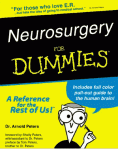
DumCoverTo those of you wondering if I should be writing this piece or reading it, that makes 3 of us.


I’m the sort of fellow who when confronted with a fork in the road takes it.

There are a lot of people drinking the EHR Kool Aid.  It would be easier to take the conventional approach, rally around them, wave the flag, and take the Alfred E. Newman perspective of, “What, me worry?”

It’s not just that I think this is complex, it’s that I am convinced it’s orders of magnitude more complex and more expensive than anything healthcare providers have done.

I know it can be done to your advantage, but it depnds on who is steering the ship.

SaintLogo

EHR–the ‘E’ is silent


Triva-what are the names of Macbeth's witches?

Triva-what are the names of Macbeth's witches?


Listen for a second.  the sound you here is the vaccuum created by the docs as they run from their EHR.  

 
There are a number of stats showing EHR adoption rates, and there are stats showing defections, but nobody seems to be publishing ‘net gains’ which by the way is a pretty small number.

You can’t walk along the internet these days without tripping over someone with an opinion about EHR.  Most of those opining are cheerleaders.  If you look closely, the loudest cheering is being done with people  who are trying to get you to buy the product.

When I asked him his opinion the other day, Macbeth offered, “I will not be afraid of death and bane,
Till Birnam forest come to Dunsinane.”

Not very helpful, but he’s dead–and make believe.  For the rest of us, be afraid, be very afraid.  Sort of a buyer beware on steroids.

SaintLogo

EHR fantasy camp

Just so you know, I'm making fun of me.

Just so you know, I'm making fun of me.

I’ve been a runner since high school except for the twenty year break I took to as a precursor to my heart attack six years ago.  Anyway, today I was running intervals on a local track.  During one sprint, I caught and passed another runner—that brought about an immediate flashback to a race I ran in high school.

I was anchoring our mile relay team, the last event of the day.  The runner in the lane next to me was fast, very fast.  He got the baton before I did and was ten to fifteen yards ahead of me as I began to run.  Defying all explanation, by the time we reached the first turn I had made up the entire distance and we were side by side.  I was having the race of my life, my fantasy come true.  Even the fans knew something was up.

I remember him glancing at me only long enough to notice me.  Stay with me here.  For those who have watched Star Trek you may recall the scene when the Enterprise shifts into warp speed.  The way they convey that on screen is the image jumps from that of their ship to a mere blur of light.  So there I was, living out my fantasy, 110 yards into a 440 yard race.  Something happened and he began to accelerate—I knew in two seconds that my fantasy had ended.  He was gaining speed at a rate where it was enjoyable to watch.  I lost by fifty yards.  (Four years later I learned that he was an alternate in the 440 on the US Olympic team.)

Here’s the segue in case you’re not paying close attention.  My sense is that a lot of the hospitals that have been engaged in the EHR process have been at EHR fantasy camp.  What on earth could he mean?  Well, let’s see if we can sort that out.  What’s the fantasy?  It’s probably a combination of several things, some of which are system related, some of which are tied to the healthcare provider.  The fantasy can include the belief that you:

  • Knew what business problem you were trying to solve
  • Selected a system capable of solving that problem
  • Implemented it correctly
  • Designed the workflows correctly
  • Obtained user buy-in
  • Have a solid training program
  • Can deal with a massive change management effort
  • Have selected a system and implemented it in a way that will meet the tests of certification, meaningful use, and interoperability even though those tests are not defined

I think if we listen very carefully we can hear a collected sigh of relief when a hospital goes live with their EHR, and the systems don’t collapse on themselves like a dying star forming a black hole.  That belief, believing that victory came early, is comparable to me thinking I had the race won at the first turn.  There’s plenty that can destroy the success fantasy after the system is live.  Some of those things are based on the choices you made, some are based on how you implemented it, and some are based on what you did after implementation.

The good news, if there is any, is that none of those things are immutable.

pastedGraphic.tiff.converted