Am I just wasting air?

su_dokuIt’s that languid time of summer when even rebroadcasts of last year’s college football games are starting to look good.

I’m incapable of walking into a store without making a mental list of how they could perform better.  I guess I’m just naturally curious.  Every now and then I get a good idea; other times I’m just wasting air.  I’ll let you be the judge of this one.

The value of a national network (EHRs to Rhios to NHIN) is the exchange of information.  If the Rhio neither adds, changes, or deletes any information and simply passes it upstream, is there an argument to be made about whether the Rhio adds any value to the process?  Can Rhios be eliminated without decreasing the value of the national network?

What do you think?

pastedGraphic.tiff.converted

Think outside the litter box

beijing-olympic-delusional-syndromeI’ve learned there’s a certain freedom generating ideas when you’re delusional; enough to allow me to overcome any degree of competency I may have had.

For instance, let’s think outside the littler box.  Can we compare the future EHR healthcare model to the current ATM model?  Clearly the healthcare version of my “ATM” card will require much more functionality, and the providers would need the ability to read and update my card, but it seems that once the additional data conversion was complete, the approach would be less costly and much simpler to standardize.

Are there good reasons why this can’t work?

saint

What if in five years? Ten years?

crystal-ballAs if we don’t have enough problems already.

Just curious to hear if you think any of these are viable. What happens to the notion of a national EHR if we see this type of vertical or horizontal integration?

* Payors buy hospitals then “outsource” the care back to the hospitals
* Hospitals buy payors
* Hospitals buy other hospitals way outside of their network and create a “branch healthcare” model similar to that of branch banking.

What do you think?

saint

“FaceBook” EHR –Visionary, or is it time for me to take a nap?

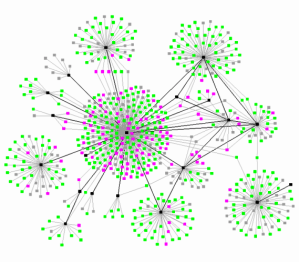
simple_social_networkThis is what happens when my mind is allowed to free-associate when I run. I was watching a show on the science channel on the mathematics behind the principle of “6 degrees of separation and Small World”. The show demonstrated that very simple networks can be developed to get person A to any other person or entity, B.

This got me thinking–always a dangerous proposition–why couldn’t this be done with EHR on a national level?  One Super EHR. Cradle to grave healthcare records, one person (patient) and at time via a Small World network. Super EMRs, patient owned, to a single, repeatable, standardized EHR.  Eliminate the Rhios with their multiplicitous standards, eliminate hospital’s mini-EHRs.  Document the functionality that is required of the specialist practices and enable that data to be captured at the EMR level.

What do you think?

pastedGraphic.tiff.converted

A nickel for your thoughts…

revised workflow

revised workflow

As a parent I’ve learned there are two types of tasks–those my children won’t do the first time I ask them, and those they won’t do no matter how many times I ask them.  Here’s the segue.

Let’s agree for the moment that workflows can be parsed into two groups—Easily Repeatable Processes (ERPs) and Barely Repeatable Processes (BRPs). (I read about this concept online via Sigurd Rinde.)

An example of an ERP industry is manufacturing. Healthcare, in many respects, is a BRP industry. BRPs are characterized by collaborative events, exception handling, ad-hoc activities, extensive loss of information, little knowledge acquired and reused, and untrustworthy processes. They involve unplanned events, knowledge work, and creative work.

ERPs are the easy ones to map, model, and structure. They are perfect for large enterprise software vendors like Oracle and SAP whose products include offerings like ERP, SCM, PLM, SRM, CRM.

How can you tell what type of process you are trying to incorporate in your EHR? Here’s one way. If the person standing next to you at Starbucks could watch you work and accurately describe the process, it’s probably an ERP.

So, why discuss ERP and BRP in the same sentence with EHR? The reason is simple. The taxonomy of most, if not all EHR systems, is that they are designed to support an ERP business model. Healthcare providers are faced with the quintessential square peg in a round hole conundrum; trying to get BRPs into an ERP type system. Since much of the ROI in the EHR comes from being able to redesign the workflows, I think either the “R” will be sacrificed, or the “I” will be much higher than planned.

What do you think?

SaintLogo

EHR—do you need a Mulligan?

old-yeller-DVDcoverWere it was that easy.  Like Groundhog Day, only without Bill Murray.  Do overs.  Remember how with each do over he got further than the prior time, and nobody was the wiser.  Some things are predictable—like when you’re watching an action movie and there’s a chase scene that ends up by the water next to a bunch of speedboats.  Before the actors are aware of it, you know that two of the speedboats will have their keys left in them, and that the protagonist and the antagonist will both happen to be expert boat drivers.

Other things don’t always turn out the way you expect.  Like when you’re working in another city and you discover that you missed The NEWSHOUR with Jim Lehrer because it comes on at 6:00 p.m. instead of at 7:00.  In the space time warp continuum that won’t amount to a hill of beans.  Other things will.

All organizations do forecasts.  Forecasts are not foreknowledge.  You can’t forecast the success of your EHR; you can merely put a plan in place and hope it works.  The purpose of a forecast is not to predict the future, it’s to define the target the organization wants to hit and to develop tactical plan to hit the target.  Forecasts however, have nothing to do with an organization’s ability to see the future, simply their ability to arrive at the forecasted outcome within the selected time horizon.

What if there was a reliable way to know now how a future event will impact your continuum?  Like knowing which horse will win before you bet?  On a scale of one to three, what is your organization’s comfort level of the future outcome of a major event, the EHR?  Is it:

  • Prescient, having foreknowledge,
  • Parviscient, having a little knowledge
  • Nescient, lacking knowledge

What happens if your EHR doesn’t turn out the way you require?  Do you request a Mulligan?  Do you give it the Old Yeller treatment?  You can try multiplying by negative one, but I don’t think that’s going to work this time.  Clearly, having a negative outcome two years out is ruinous—at least for some of the people.

What can you do today to improve your foreknowledge of the outcome?  If you can improve your knowledge of the outcome, you may be able to change your tactics enough to positively affect the outcome.

saint

Lamentations of A Drive By Mind

My twelfth grade organic chem class notes

My twelfth grade organic chem class notes

I’m afraid this one is a little long, so you may wish to grab a sandwich.

You know what they say, and ideal mind is the devil’s playground.  (I know the correct word is ‘idle’.)  In my day job, I play a savant, but I manage to hide it well, and I make it a point never to count my chickens until I can see the whites of their eyes.  I didn’t use to be like this, but I seem to be getting worse.

We all know that objectively measuring the degree of success you are having with ERH is very subjective; it’s like trying to measure the color purple.  Contrary to the beliefs of some, the intent of this blog is not to vitiate the efforts of those who’ve worked for feverishly on EHR.  Rather, it’s to see how we might reposition the effort to enable healthcare providers to crank up the ROI and their chances for success on their EHR investment.

If you and I agreed on everything, one of us wouldn’t be needed and I’d hate to be thought of as superfluous.  That is why I tend to write from a vantage point of one who is not drinking the Kool Aid.  This next idea will ensure I won’t be invited to speak at the next HIT-related convention—it sort of puts a damper on the program when one person stands in the hotel lobby yelling, “The sky is falling.”

Anyway, there are a lot of organizations publishing statistics stating that all is well with regard to the number of healthcare providers who have implemented HER, and how far along those providers are with regard to the HIMSS Analytics Seven Stage Adoption Model.  If I recall correctly, their survey data show slightly in excess of 60% of the providers indicated that they had completed Stages 1-3.

The stages are predominantly IT stages, which is to be expected.  As I wrote previously, there are some very well informed professionals among us who believe that the IT implementation (applications and technology) only account for about twenty percent of the total effort, complexity, and risk.  So, if we wanted to score the nation-wide effort to date, what shape are the ‘we’ really in?  (This is a different form of ‘we’ than when my wife uses the word, because her ‘we’ usually only refers to half a ‘we’, me.  As in, are ‘we’ going to mow the lawn today?  You too?)  Sorry, my mind wandered.

If a hospital places a checkmark by a stage does that mean the stage is complete and one hundred percent functional?  Alternatively, does it mean the team did the best they could with what they had and moved on?  Remember, stages have been completed without interoperability, without end-game certification and meaningful use sign-offs, and without agreed upon standards.  What if because of that, the best any provider can achieve for any given stage is to get the functionality ninety percent correct?  Can the argument then be made that the total functionality at the completion of stage 7 can be no better than the combined product of the functionalities?  I honestly don’t know.

What about the detrimental impact of additional major gotchas interjected by getting the EHR to operate outside of the hospital’s four walls, the mountains of workflows that must be redesigned, tested, and implemented, the change management effort, and the issue of user training and acceptance?

To me, stages four through seven seem to be the most difficult stages.  For example, a successful completion of Stage 7 means hospitals can deliver patient care without paper charts, share standardized summaries of patient records with other providers, use their clinical databases to drive performance improvement efforts, including outcomes research, and offer examples of “best practices” in EHR implementation and clinician engagement with their IT systems.  Now that’s worth losing sleep over.

I am usually a staunch advocate of best practices.  In this case, I recommend going for standardized practices, which in itself will prove to be more work than has been envisioned and provisioned.  Place all best practices efforts on hold until the rest of the task is visible in the rear-view mirror.

By the way, how do you measure purple?

sainttop5

So, Yoda wasn’t Luke’s father?

yodaMy Yoda is a practicing physician and CMIO.  We were reviewing observations from the implementation of his EHR.  His first observation was that only about 20% of the effort/risk/complexity had to do with the EHR technology.  The other 80%–people, process, and things (change management, politics, training, user acceptance).

His mantra… “It’s not just taking the paper and putting it on the screen” and “You *REALLY* need to understand your workflows before you come to bargain workflow changes” and so on…

It’s great to have words, but without believers, the words are foundless.  How did he get believers?  He created the Jedi Council, comprised of Clinical Jedis.  Used with his permission, the following is their ‘job description.’

“Clinical Jedis” :
1. Work clinically at least 50% of the time
2. Are PASSIONATE about understanding the workflows of their little niches.
3. Are devoted to intellectual purity.
4. Are devoted to political purity.
5. Believe in the importance of political negotiation.
6. Each serve a master: Their own clinical specialty.
7. See “Jedi Activities” as something separate than their general clinical work.
8. Embrace technology.
9. Understand the importance of workflow bargaining, and how it impacts the harmony of the universe (hospital) all together.
10. Meet every two weeks, OUTSIDE of the hospital, in an apolitical manner
11. Bring clinical issues to the IT table.
12. Bring IT issues back to their clinical tables.
13. Have a few “weapons” at their disposal, which they should only use when political negotiations have broken down:
a. The “Jedi Mind Trick” – Sales pitch to their clinical/IT colleagues, e.g. “You WILL use this order set”
b. The “Blaster” – Going back to their department directors and saying “We need to exert political muscle to get this change done”
c. The “Lightsaber” – Through me, I have direct relationship with the hospital administration, and if we need the CEO to say “This is how it’s going be”, we can do it like that.
14. Act as a resource for clinical department directors to figure out “How do we do things?”
15. Act as a resource for IT directors to figure out “If we change this, what is it going to do in other departments?”
16. Help hospital administrators understand how their hospital is run.
17. Are well-respected by their clinical peers (So far, each department director LOVES having a “Jedi” protecting their clinical niches… This is the secret key to getting “buy-in” – Directors are MUCH MORE WILLING to change when their own personal Jedi says, “This is how we have to do things”)
18. Own and design their own order sets.
19. Own and design their own workflows.
20. By design, the workgroup has no FORMAL reporting responsibility to any part of the hospital, so that it doesn’t get shot down in formation : “Hey, you do education? Not if I can help it! *I* do education!!”

Are you doing anything like this?

saint

The Tail of the White Hare

whiterabbitOr is it the Tale of the White Hair?  I’ve been going through a period of reinvention, Paul 2.0.  Trying to redefine myself; bon vivant, self expressive—a right-wing Alan Alda with spurs.

Part of the 2.0 image was the rebirth of my moustache, right up to the point when my nine-year-old daughter, who’s turning sixteen in December, asked why some of the hairs were white.  When she commented that my upper lip looked like a ferret, I found myself wishing I was at the Mad Hatter’s tea party—don’t follow this too closely or you might wind up hurting yourself.

It’s been one of those Through the Looking Glass kinds of mornings. The kind when my seven-year-old writes down the toll-free number from a commercial advertising a product that promises to grow hair, chiding me with, “No, really dad, it really does work.”

It was time for me to get out of Dodge, so I went for a run, my MP3 cranked way up. Midway through the run I caught myself singing, and then looked around quickly, not because I didn’t want anyone to hear me singing, but because I didn’t want anyone to know I knew the words to anything written by Tom Jones.

While running I began thinking about all the different and differing opinions about EHR, meaningful use, and the stimulus—I know, I need to get a life.  Providers are paying a lot of money trying to understand those aspects of their business; they are hiring consultants, buying technology, and realigning their processes.  Everybody’s involved; IT, sales, marketing, operations. Well, almost everybody.

Who’s often missing?  The doctors.  The people with the most insight, the most contact with the actual business requirements, the one group in the organization that has the most value to offer. One process I’ve found to be very effective, especially in light of the fact that studies are showing that the doctors aren’t buying into the implemented EHR, is to involve them early and often.  Run an open forum for their input; total cost—about $30 for coffee and bagels.  They won’t be short on ideas for improving the process.

Lesson to be learned; the ROI on coffee and bagels can be pretty high.

saint

If only the doctors were meerly apathetic

HawkeyePierceFor those who remember the television show M.A.S.H., this brief bit of dialogue was from Henry Blake to Hawkeye after one of Hawkeye’s patients died.

“There’s two rules about war.  Rule 1–in war young men die.  Rule 2–doctors can’t change Rule 1.”

There’s a similar way to apply that logic when it comes to EHR, HIT, and new IT systems.

Rule 1.  If doctors don’t use them, the systems will die.

Rule 2. Simply having an EHR doesn’t change Rule 1.

A survey by Nuance Communications shows that 90% of doctors are concerned about the usability of EHR.  Those results underscore the importance of process and changemanagement and training.

As I wrote previously, it’s not about the EHR, it’s about what you can do with it.

My person struggle with usability–We have a piano in our home even though nobody plays it.  For some reason I’m not permitted to understand, we pay to have it tuned twice a year.

SaintLogo