EHR Leadership–Who’s in charge?


Nicely written.  I look at the need from the perspective of the path not traveled.  For most, the task of selecting the correct EHR and managing the effort would be like me buying a spaceship–never been there, never done that.
Providers are well-staffed on the clinical side, and on the IT side.  The problem is that none of them has the high cost, high risk, high visibility PMO (project management officer) skills that are required to buy something that can cost more than a new hospital wing.
So what do they do? They pull someone out of IT or clinical and hand her the keys.  Most large IT projects will fail.  MOre EHR projects will fail.


anonymous-leadership-5000373Here’s a nicely written piece by Elyse of AntiClue.  http://www.anticlue.net/archives/000970.htm 

I look at the need from the perspective of the path not traveled. For most, the task of selecting the correct EHR and managing the effort would be like me buying a spaceship–never been there, never done that.

Providers are well-staffed on the clinical side, and on the IT side. The problem is that none of them has the high cost, high risk, high visibility PMO (project management officer) skills that are required to buy something that can cost more than a new hospital wing.

So what do they do? They pull someone out of IT or clinical and hand her the keys. Most large IT projects will fail. MOre EHR projects will fail.

That’s my opinion, but nobody has talked me out of it.

021_18A

2011 lost it’s relevancy

It’s time to quit tiptoeing around 2011 and HIT and Meaningful Use and Certification, acting like they are relevant. Since the unspoken general consensus is that their relevancy has passed shouldn’t we be using our efforts to formulate a plan to make them relevant?

EHR Integration-A good read

Robert Connely in the HIE blog makes some bery sound points about how the enite EHR intergration could and should work.  Note, could and should are not closely aligned at this point.

http://infosite.medicity.com/thehieblog/post/The-Practical-Reality-of-Hospital-and-EHR-Integration-Challenges-in-the-Trenches.aspx#comment

He writes, :This is not to say that the “standards and stimulus” approach isn’t a good thing – it’s just that the day-to-day problems we really deal with may not be adequately addressed by the current approach.”

I think he’s being generous to the extent of the words, “may not be adequaltely addressed.”  I can’t prove my statement, however I think that the mere fact that more than one group are working on standards is not standard.

How much more difficult will interoperability be, my guess is at least one more order of magnitude that what’s planned.

And as for interfaces?  I think Jimmy Weeks recently wrote having 400 he needed to meet.

My best – Paul

saint

Solutions for individual doctors

A nice piece by Mark McGraw regarding the move by large firms to build and deploy EHR systems and potentially deploy them on-line.

I think individual practitioners have little to lose by waiting for someone to shrink wrap the application.

sainttop5

Fantasy Healthcare

Fantasy-Football-Draft-Board-2009_2What if we create fantasy-healthcare.com?  Annual registration fees must be paid prior to the fantasy draft, and may be paid at healthcarefantasy@paypal.com. Participants will have to participate in the annual draft from the pool of available doctors and specialists, and will be limited to two specialists per person, five for a family.  The same process will apply for selecting a hospital.  If your choice is no longer available when it’s your turn to draft, you may submit another bid, or offer to trade with another member.  Each trade will cost you one thousand Healthcare Points.  Additional points may be purchased at the Public Option web site, www.we’vegotyoucovered.com .

You may purchase fantasy insurance to protect your fantasy-healthcare investment.  In the event your doctor is sued or retires, you have the right to pick one of the doctors provided they are in the same or lower price category. For those who are concerned about the possibility of disputes, we have created www.fantasyhealthcaredisputes.com.  You and your provider submit your arguments online, and the winner will be notified on-line.  Additionally, we’ve added a new feature this year to help you understand your medical costs and bills, www.fantasyhealthcaremath.com.  Join now, or take the chance that there may not be any doctors left within a three-hour drive from your house.  Good luck

021_18A

A solution to the problem of EHR standards

I borrowed the following paragraph from the August 31 post of the Healthcare Blog.

August 20th, HHS Secretary Kathleen Sebelius and ONC head David Blumenthal announced $598 million in grants to set up about 70 “regional extension centers” (RECs) that will help physicians select and implement EHR technologies. Another $564 million will be dedicated to developing a nationwide system of health information networks.

It goes on to state that the RECs are based on the federal agricultural extension offices of the early 1900’s.

Do you ever get the sense that some days the topics just walk up and slap you in the face?  I may have deciphered the difference between the federal sector and the private sector—for those of you who were thinking I was going to write competency, it crossed my mind, just couldn’t decide to which group.  I think it’s speed and planning.  The private sector travels at the speed of the Dow and plans at speeds approaching the half-life of a fruit fly.  The federal sector travels at the speed of a ten-year-old eating broccoli and plan around the life span of a black hole.

They plan, and then plan and then write the backup plan, and then back that up.  It’s like the healthcare version of the movie Fail Safe.  Only this time it’s not done ‘in case’ the plan fails, it’s done for ‘when’ the plan fails.  Here’s my take on all of this as relates to EHR.

  • Certification—a backup in case EHR doesn’t looks like it will work
  • Meaningful Use—backup in case certification looks like it won’t work
  • Speaking in parentheses—as I’m wont to do—at this point, neither matter, because under the current schema, interoperability won’t work.
  • Did I mention we still don’t have a set of standards?
  • Next comes RECs
  • And, another half billion for nationwide system of health information networks—HIEs?
  • Does the last point mean we are done with the notion of RHIOs and HIEs, or are HINs their backups?

What to do?  Set up another backup plan—REC centers.  The first time I read about this I thought REC centers were something like the Police Athletic League—if EHR failed, let’s play basketball.

Since you asked, here’s what I think we should do with this billion.  Give it to the EHR vendors—I can’t even believe I wrote that.  This is the same group of businesses who haven’t learned how to share their toys and play nicely in the sand box.  Ready?

  1. Some small number of EHR vendors (let’s label them Group A) does account or will account for a percentage of the installed base in the upper nineties.  The also-rans are Group B.
  2. It can be argued that not having a single set of standards is the reason we must have all of the intermediary non value-add strictures which make interoperability insurmountable.
  3. It can further be argued that not having a single set of standards causes the need for certification and Meaningful Use which would otherwise have no meaningful use.
  4. Give Group A the following mandate:
    1. Agree upon a set of standards to which you will modify your systems
    2. Modify your systems to those standards
    3. Provide that version to your installed base
    4. Agree that all future install will be of the standards-meeting application
  5. Group B may continue to market provided they meet the standards.

This could work.  It would fix a lot of the current problems and make a lot of the upstream ones disappear.  What do you think?

Gumby1

CMIO Magazine Article

CMIO invited me to write a regular article for them.  Below is the link to the first.

http://www.cmiomagazine.com/?p=220

Thanks.SaintLogo

What did you do in reform daddy?

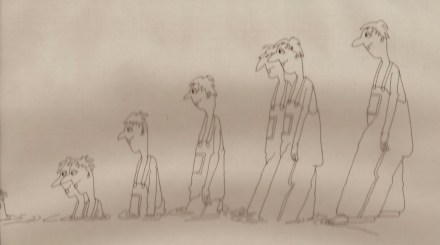
sorry for the quality, I drew this in high school

sorry for the quality, I drew this in high school

Tenth grade biology class was on the second floor.  One of my best friends said that for five dollars he would jump out of the window during class, sort of like falling out of the stupid tree and hitting every branch on the way down.  Others took the bet.  Lemmings.  They all jumped.  Speaking in parenthesis for a moment, this same friend was interviewed on Larry King on September 11, 2001, discussing how to run covert ops on Bin Laden.  I haven’t slept well since I learned that.

As I talk with clients and several of the healthcare thought leadership, I see consensus building around a lemming-like acquiescence about reform, especially as relates to EHR.  That wasn’t much of a segue, but my children stared school today, and I am still in shock from having let me seven-year-old pack his lunch—very different food groups.

I read an article in a much respected—I wrote ‘very’ instead of ‘much’, Word didn’t like it.  Learn something every day—publication that the primary business driver behind EHR is that it is perceived as a mandate.  (Sorry, that was written poorly—I may have to fire that guy.)

If that’s why your organization is doing it, do yourself a favor and stop.  The ROI from the stimulus money will not make EHR worth your while.  How will you know if you did it for the right reasons?  When you get to the end, if you aren’t able to say, “I wish we had done this years ago”, you’ve done something very wrong.

drevil

If reform fails…

fries

EHR: What bugs you about it?

16This is the time of year in the east when cinerescent caterpillar nests hang thickly from the trees, peppered tufts of cotton candy.  During these long, flavorless August days, the sky is a similar achromatic color.  My nine-year-old is concerned because I told her we are having caterpillar soup for dinner tonight—watch out for the crunchy bits.  Once again, it seems I’ve gotten off message.

I wonder how much of the difficulty surrounding EHR has to do with getting off message, much like we seem to have done with the reform discussion.  What difficulties?  Got time?  You can name more of them than can I. 

What is off message?  It’s that the day-to-day tactics of implementing EHR office by office, and hospital by hospital have overshadowed the strategy, have displaced the business driver behind the mandate.  The focus became internal, not national.  Bits and bytes have overshadowed charts.

I doubt few, if any, can articulate a believable explanation of how a few years from now your medical records will accurately and expeditiously be delivered from where you live to the lone clinic on Main Street, Small Town, USA, to the nurse practitioner who at midnight is giving you an EKG.

It’s that fact, that we are not able to define how we get from A to B, let alone do so with multitudes of A’s and B’s, that to me suggests we are building something of which we have little comfort will do what we set out for it do.

Clearly, there are hundreds if not thousands of very talented and dedicated professionals focused on finding a solution.  However, it seems their efforts remain handcuffed by hundreds of competing products, no well-defined overriding set of requirements that would enable anyone to say with certainty, “Yes, that is it.  That captures what we need to do.  When we have done that, we are done.”

Until that time, I think we all need to be concerned about the crunchy bits.

What do you think?

gravia1