EHR-Do not use as a flotation device

Camp_012_01EHR potentially will offer a number of benefits.  It won’t offer much at all if you don’t install it right.

However, it’s not a panacea.  Without having a detaile understading of the business problems you are trying to solve, it may not be of much more value than a Xerox machine.

Can you make color copies with your EHR?

sainttop5

Step Away From the Computer

deletelifeThere are days when it doesn’t pay to be a  serial malingerer, and when it does, the work is only part time, but I hear the benefits may be improving as I think I heard somebody mention healthcare is being reformed.

I don’t know if you are aware of it, but there are actually people who have taken an Alfred E. Newman, “What, me worry” attitude towards EHR.  For the youngsters in the crowd, Alfred was the poster child for Mad Magazine, not Mad Med.

Just to be contrarian for a moment–as though that’s out of character for me–most providers have no need to fear–does this happen to you?  You are writing aloud, trying to make a point, and the one thing that pops into your mind after, ‘there’s no need to fear’ is “Underdog is here.”

Anyway, since many providers haven’t begun the process, or even begun to understand the process, there is still time for them to lessen the risk of failure from an EHR perspective.  Many don’t want to talk about it, the risk of failure.

Here’s another data set worth a look (The Chaos Report).  They went a little PC on us calling them ‘Impaired” factors.  EHR impairment.  Step away from the computer if you are impaired, and take away your friend’s logon if they are.  These are failure factors.

Project Impaired Factors % of  the Responses
1. Incomplete Requirements 13.1%
2. Lack of User Involvement 12.4%
3. Lack of Resources 10.6%
4. Unrealistic Expectations 9.9%
5. Lack of Executive Support 9.3%
6. Changing Requirements & Specifications 8.7%
7. Lack of Planning 8.1%
8. Didn’t Need It Any Longer 7.5%
9. Lack of IT Management 6.2%
10. Technology Illiteracy 4.3%
11. Other 9.9%

My take on this is with overall “failures” so high, several respondents could have replied to “all of the above.”  Also of note is that these failure reasons differ from the ones listed previously.

Who knows, maybe if we multiply them by minus one we can call them success factors.

sainttop5

When good projects go bad

A Bag of Rocks

A Bag of Rocks

What are the EHR fail-safe points?  The points of no return, beyond which you can’t recover without exploding the budget and the  schedule?

Although there are several, my take on it is that the most important one is the planning process.  What plan do you have to rigorously evaluate the plan before you step off the EHR cliff?  Are you stepping off with a parachute or a bag of rocks?

My best – Paul

funny-keep-right-sign

EHR PMO

not realy

not really

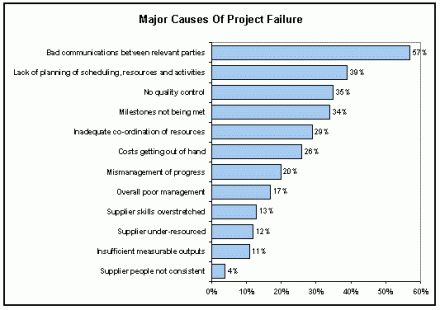
Again on the project failure?  Yes.  Why?  Trying to head it off at the pass.  Source, The Bull Report.

Failure_Cause_Survey.264

Fifty-seven percent of failures are due to bad communication.  What’s that?  Poor grammar?  No.  Not enough meetings?  Doubtful.

It’s about PMO.  A hired gun?  Perhaps.  An advocate who will manage the vendor on your behalf.  What’s the rest of their job description?  The stuff in blue.

The good news is that being a bad dresser will not hurt the project.

Why buy an EHR system?

readjhmDo you ever wonder why people buy drills?  Because they need a drill?  No.

They buy drills because they don’t sell holes.

Why buy an EHR system? Because you need an EHR?

I hope you have a better reason than that.  If you’re interested, I sell holes.

what

EHR–it’s like herding cats

herding catsI spent a summer in Weaverville, North Carolina, just outside of Asheville. (I couldn’t find it on the map either.) That summer, I was the head wrangler at Windy Gap, a summer camp for high school kids. I’m not sure I’d ever seen a horse, much less ridden one, so I guess that’s why they put me in charge. I thought that maybe if I dressed the part that would help. I bought a hat and borrowed a pair of cowboy boots from a friend; the boots were a half size too small, and I spent the better part of the first night stuffing sticks of butter down them trying to get them off my swollen feet.

The ranch’s full-time hand taught us how saddle the horses and little bit about how to ride. In the mornings we had to herd the horses from the fields, bring them into the corral, and saddle them. The other wranglers would ride out to the field to bring in the horses, while I being the least experience of the wranglers would race after them in my running shoes trying to coax them back to the barn. We would take the children for a breakfast ride halfway up a mountain path where we would let them rest and cook them a breakfast of sausage and scrambled eggs. One morning there were a group of 15 high school girls sitting on the fence of the corral. I walked up behind them carrying two saddle bags filled with the breakfast fare. I slung the saddlebags over the top rail of the fence, and hoping to make a good impression I placed one hand on the rail and vaulted myself over. I landed flat on my back smack dab in the middle of the pile of what horses produce when they’re done eating—so much for the good impression.  That earned me the nick-name, “Poop Wrangler.”

I brushed myself off and saddled my horse. The moment I gripped the reins the horse reared, made a dash for the fence and jumped it in one motion. I could tell the high school girls were impressed as I flew by them. Both of my arms were wrapped around the horse’s neck, and I had my hands locked in a death grip. I yelled, “whoa” and stop”, only to learn that the horse didn’t speak English. We raced the 200 yards to the dining hall, stopped on a dime, and raced back to the corral, as the girls continued to cheer. One final leap, and I was back where I started; on the ground, in the corral, looking up at the girls. I took a bow and quickly remounted my steed. The full-time ranch hand came over and instructed me rather loudly, “You can’t let the horse do that. You have to show the horse that you’re in charge.” After that piece of wisdom he grabbed my horse by its bit, pulled its head down, and bit a hole in my horse’s ear. I’m not sure what kind of in an impression it made on my horse. I guarantee you it made an impression on me.

Horses aren’t very intelligent, but they know when you don’t know what you’re doing, when you’re bluffing—dressing like a cowboy didn’t even fool the girls, much less my horse—I guess he hadn’t seen many westerns. Here we go—you had to know where this was headed.

Selecting and implementing an EHR will be the most complex project your hospital will undertake.  If you do it wrong, you may not look any better than I did laying on my back in the corral.  You won’t have girls laughing at you, but you also may be looking for another line of work.

You don’t want to read this, but if your projected spend exceeds ten million dollars, your chances of success, even if you do everything right, is less than fifty percent.  I define success as on time, on budget, functioning at the desired level, and accepted by the users.  That’s reasonable, correct?  We don’t need to talk percentages if you don’t do everything right.

These figures come from the Bull Report—that’s really the name, honest.

The main IT project failure criteria identified by the IT and project managers were:

missed deadlines (75%)
exceeded budget (55%)
poor communications (40%)
inability to meet project requirements (37%).

The main success criteria identified were :

meeting milestones (51%)
maintaining the required quality levels (32%)
meeting the budget (31%)

How is yours matching against these?  Given a choice, sometimes I’d rather be the horse.

Gumby1

Don’t just follow the ARRA money, take it all

010_food1What if hospitals paid to implement EHR at doctors’ offices and the doctors signed away their stimulus money back to the hospitals?

This is my idea for the day, send donations to me at PayPal.

My best – Pauleddiesmal

EHR–where do you place the emphasis?

imagesmilkman-smallYou said I stole the money. Sometimes it all depends on what you emphasize. For example, say the sentence aloud to a friend, and each time place the emphasis on a new word. You said I stole the money. You said I stole the money. You said I stole the money. You said I stole the money. You said I stole the money. The meaning changes as you change your emphasis. You said I stole the money? You can even change it so that it reads like a question.

The same is true with providers and the level of success a firm has working with EHR. Where is your emphasis? If you believe there is a correlation between emphasis and spending, I bet we can prove your firm’s is much more closely aligned to technology than it is to process. What does technology address? Let’s list how deploying technology makes your firm better, or does it?  Millions followed by millions more. Redesign the patient portal.  Add EHR. Mine the data—heck, strip mine it. Show me the ROI. Isn’t that a lot of money to spend without a corresponding business justification?

The technology that is tossed at the problem reminds me of the scene from the “Wizard of Oz” when the Wizard instructs Dorothy and the others, “Pay no attention to the man behind the curtain.” When Toto pulls the curtain aside, we see a nibblet—I love that word—of a man standing in front of a technological marvel. What’s he doing? He’s trying to make an impression with smoke and mirrors, and he’s hoping nobody notices that the Great Oz is a phony, that his technology brings nothing to help them complete their mission.

From whose budget do these technology dollars usually come? IT. From the office of the CIO. What did you get for those millions?  Just asking.
Part of the problem with doing something worth doing on the EHR front is that it requires something you can’t touch, there’s no brochure for it, and you can’t plug it in. It’s process. It requires soft skills and the courage to change your firm’s emphasis. They won’t like doing it, but they will love the results.

drevil

Why certification is not important

PigsFlyJust shoot me now

Policy Committee OKs Plan To Establish Multiple EHR Certifiers

They are killing me.

How about that for strategic guidance.  If they state that the earth is flat, and create multiple certifiers, I guess it’s time for Elvis to leave the building.

May we consider this for a moment, just between the two of us?  We are paying them to come up with this, and I want a refund.

Does anyone esle take issue with this?  Here’s my problem–or at least the one I am legally allowed to disclose.

Certification, by definition, only exists because of a high possibility of systems being implemented that won’t do what some group deems they need to do.

Allow me to be a heretic for a few minutes.  Maybe certification is bad.  Catch your breath and think about it.  The only thing certification gets you is the possibility of stimulus rebates being made available to healthcare providers by people who have demonstrated all most no understanding of the business issues you face.  Is that possibly true?

For many, the rebates are nothing more than a rounding error.  Why build a system to be able to attest to goals which may not benefit your business?  In spite of how it’s written, I think certification and meaningful use won’t be known for a few years.  When it’s finally defined, it will have to do with how well your EHR connects to their network.  That’s what they want, that’s what the money is for interoperability.  The other issues are window dressing.

Build your EHR as though Washington and certification don’t exist.  Build it based on what it does for you, not on what they think it may do for them.

My best- Paul

pastedGraphic.tiff.converted

I’d hate to be thought of as superfluous

fieldofdreamsmannIf you and I agreed on everything, one of us wouldn’t be needed.

Of the many special things associated with growing up in this country, one is held dearly by every American eight-year old male who owned a flashlight and an AM transistor radio with an earplug–I am dating myself which is something I promised my parents I wouldn’t do.  During those long hot summer nights when the adults of Baltimore sat on their cement back stoop nursing a bottle of Carling and waiting for their window air conditioners to suck out enough of the heat to make the inside of the house bearable, thousands of boys across the country lay under their bed covers, with a flimsy plastic earplug dangling from their ear as they continued to turn the dial to tune in the lone radio station covering the home team. In spite of the static, they faithfully kept score for their favorite baseball team, jotting the statistics in the back of their black and white Composition notebook.

The scorecard was homemade, carefully drafted using a pencil and something relatively straight to draw the lines that separated each of the nine innings. Unlike today, when the concept of team has given way to the concept of players whose loyalty lies with the highest bidder—free agents, the lineup for the home team rarely changed by more than a player, the pitcher, and had been mostly the same for years.

My team was the Baltimore Orioles. Their team pennant hung on my bedroom wall, a team photo was on my dresser along with my membership card to the Junior Orioles. Under the blanket with me was my taped-up shoe box containing my collection of baseball trading cards, sorted by team and held together by rubber bands I had removed from the Baltimore Sun. A few hundred stale sticks of the pink powdered bubble gum that came with each five-pack of cards was stacked neatly in one end of the box. The cards for the opposing team were spread before me so I could get the lineup and study their batting statistics.

What made me think of this was that recently my son and I went to see a minor league game. Although the grass was just as green, and the hot dogs smelled the same, nothing was the same. Still, it beat having a stick in the eye. Things change. Baseball changed, and nobody conferred with me before changing it. I didn’t see a single person keeping a scorecard, let alone a dad teaching his son or daughter how to keep it. The only constant throughout the game was the commercialization, to the point where it made it difficult to simply follow the game.

That’s progress. Or maybe not. Some progress is good. Some progress doesn’t exist even though everybody around it believes that it does. Implementing new technology doesn’t in and of itself infer progress, it simply means you bought more technology. Not convinced? Add up all the money you’ve spent on EHR and technology and recalculate your RIO.  Was it worth it?

Ray, people will come Ray. They’ll come to Iowa for reasons they can’t even fathom. They’ll turn up your driveway not knowing for sure why they’re doing it. They’ll arrive at your door as innocent as children, longing for the past. Of course, we won’t mind if you look around, you’ll say. It’s only $20 per person. They’ll pass over the money without even thinking about it: for it is money they have and peace they lack. And they’ll walk out to the bleachers; sit in shirtsleeves on a perfect afternoon. They’ll find they have reserved seats somewhere along one of the baselines, where they sat when they were children and cheered their heroes. And they’ll watch the game and it’ll be as if they dipped themselves in magic waters. The memories will be so thick they’ll have to brush them away from their faces. People will come Ray. The one constant through all the years, Ray, has been baseball. America has rolled by like an army of steamrollers. It has been erased like a blackboard, rebuilt and erased again. But baseball has marked the time. This field, this game: it’s a part of our past, Ray. It reminds of us of all that once was good and it could be again. Oh… people will come Ray. People will most definitely come.
-Terrance Mann in the movie, “Field of Dreams”

I cry every time he say,”Want to have a catch dad?”

gumby