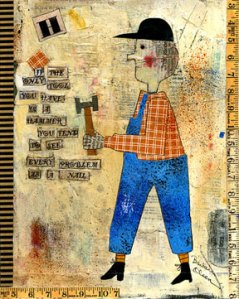
 Those of you who’ve visited previously may have caught on to the fact that my wife likes to keep me away from bright shiny objects such as tools. Let me tell you about my first house, a two-story stucco building in Denver, built in 1902. My favorite part of the home was the brick wall. That is had a brick wall was not apparent when I purchased it.
I came home from work to find that my dog had eaten through the lath and plaster in the living room and there was the brick. I had to decide what to do. I knew nothing about lathing—I know that’s not really a word—or plastering. What to do. My only tool was a hammer, so I began to hammer. For those who haven’t done this, hundred year old plaster being pounded with a hammer makes a lot of dust. This process proved to be very slow.
What did I do? I bought a bigger hammer—such a guy approach to a problem, isn’t it? It took three hammers to get down to just bare brick. What would you have done? When your only tool is a hammer every problem looks like a nail.
As you go through the EHR planning process in your war room—you do have a war room, don’t you? (Try Sam’s Club, after all, they sell EHRs.) Get out the really big piece of paper, the one with your EHR design—you do have a really big piece of paper, don’t you? (Back to Sam’s.)
Next to the box on the paper labeled “Shiny New EHR” should be lots of empty space so you can draw in all of the other systems with which your EHR will have to interface. One of the readers of this blog wrote recently that his EHR had more than 400 interfaces.
EHR, if done correctly, will do much for patients, doctors, and administrators. It’s not a panacea. It won’t reach its potential unless you also integrate it with those systems that unlock its potential. Improving your efficiency and effectiveness takes more than merely an EHR system.
When your only tool is a hammer, you’d better hope every problem is a nail. What other tools are you using? Please share your ideas about what works well.

 It’s hot and muggy; a hazy pall seems to levitate before me. We call it Pennsylvania in summer. Chest pain yesterday, nitro in gym bag. Intervals today. I hate running intervals as much now as I did in high school, but they’re better for the heart than just running distance. Twenty-four 110’s. Did I mention it was hot?
 Okay, so today was going to be one of those days when I wasn’t going to allow myself to be stupified–at least no more than was really required.
 EHR certification inspectors will be dropping in on hospitals like UN inspectors looking for WMDs, only they’ll be slightly less congenial.
 There were four of us, each wearing dark suits and sunglasses, uniformly walking down the street, pausing at a cross-walk labeled “consultants only”—I think it’s a trick because a lot of drivers seem to speed up when they see us. We looked like a bad outtake from the movie Reservoir Dogs. We look like that a lot.
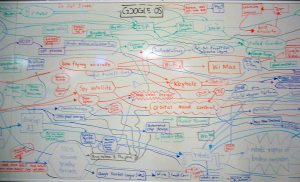 Most of the real work that needs to be done in EHR workflow improvement happens in the blank white space between the boxes on the org chart. That’s where you’ll find a lot of the BRPs–Barely Repeatable Processes.
 Looks like it came from the same people who write the tax codes.
 What if hospitals paid to implement EHR for their docs in IPAs, group practices, and soloists, and paid for the expense by having those docs sign over their stimulus money to the hospital?
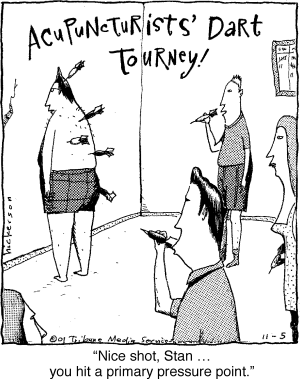 EHR Buying Guide—Vendor darts
 EHR potentially will offer a number of benefits. It won’t offer much at all if you don’t install it right.
 Pale Rhino Consulting