EHR Thought Leadership Summit Slides

This presentation was delivered 12.10.09 in NJ.

http://www.slideshare.net/paulroemer/em-rgemcy-medicine-event-121009-joint-ppt-final

The impact of Moses on EHR

Does anyone remember how many of each type of animal God told Moses to put on the ark? Are you sure? For those who missed it, Noah built the Ark, Charlton Heston built the stone tablets.

One word can make the difference between right and wrong, especially if the question is big enough. Who is asking the questions that are shaping your firm’s EHR strategy? Do you know the name of the person? What question are they asking? Is it the right one?

Why additional money may not be needed to solve your EHR problems

Have you ever done any sort of group problem solving exercise like Outward Bound to help you to think as a team? Suppose there was an exercise for healthcare and IT executives, whose goal was to get the executives to think about how to best deploy can EHR system. To do this they are given a problem and access to ‘technology.’

Here is the scenario and the rules as they are presented to the group. They are given ten dollars. The executives are presented with a bathtub filled with water, and told that the winning team will figure out the best use of money and time to empty the bathtub. Also available to them is a bucket which costs ten dollars and has a hole in it, a four-dollar cup, and a collection of wooden spoons which are free.

Any idea what the right combination is? Is there a best answer? Bucket? Cup and spoons? How would you solve the problem? Sometimes the best answer is so obvious it’s silly. Kind of like call centers? What’s the best use of the available tools? Faced with the option of buying more technology to solve the problem, when was the last time you saw someone refuse the funds?

Figured it out?

Pull the plug from the drain.

In many cases, we already have everything we need to solve the problem, we just need to know how to use it.

Just like Dorothy in the ‘Wizard of Oz.’  She had the ruby slippers the entire time, she just didn’t know how to use them. I think most EHR strategies can be improved without spending requiring millions more in technology.

That’s my story and I’m sticking to it.

Interoperability-this is the problem

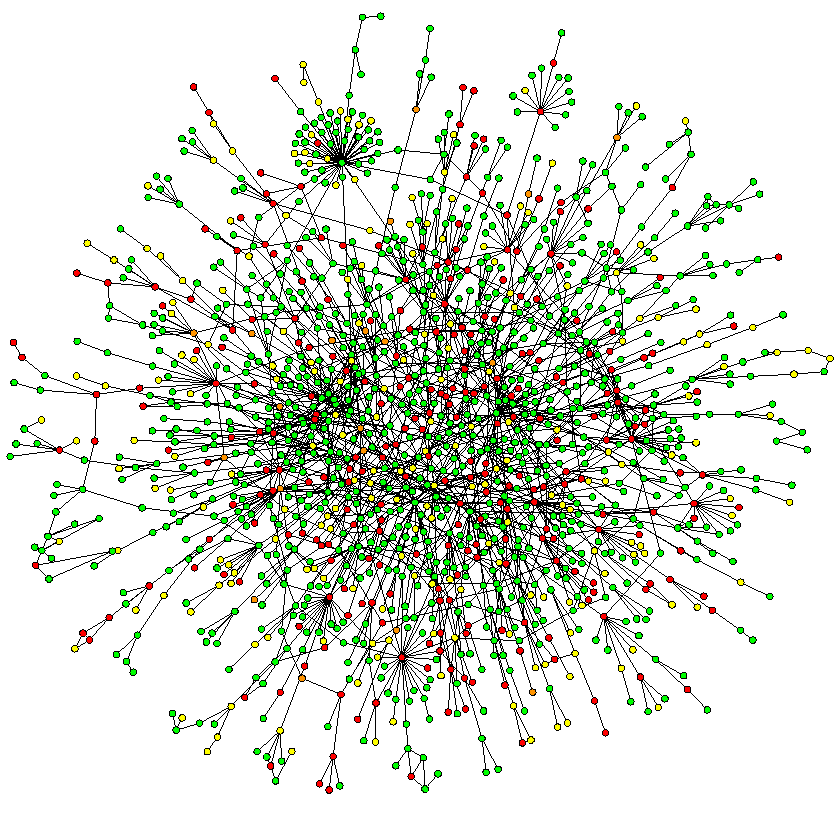
How does one depict the complexity of the mess being presented as the national roll out plan of electronic health records (EHR) via the national health information network (N-HIN) using Health Information Exchanges (HIEs) designed by Regional Health Information Organizations (RHIOs), with the help of regional extension centers (RECs) without Standards (Standards) and with N too many vendors?

Class?  Ideas?  Class?

If this looks dumb, undo-able, unimplementable, uninteroperable–it’s because it is.  your vision is fine.

Remember the idea behind all this is to get your health record from point A to point B, any point B.  It’s that little word ‘any’ that turns the problem into a bit of a bugger.

Find yourself in the picture below, pic a dot, any dot (Point A).  Now, find your doctor, any doctor (Point B).  Now figure out how to get from A to B–it’s okay to use a pen on your monitor the help plot your course.   That was difficult. Now do it for every patient and every doctor in the country.

Now, do you really think the DC RHIO-NHIN plan will work?  If EHR were a Disney park, who’s playing the Mouse?

Should you hire a swim coach?

Swimming with guppies

Got the new bike, got the new bike shoes, got the uni (uniform-not unitard).  I’ve written about my desire to compete in a triathlon.  Actually, I miswrote.  My desire is not to compete, it’s more accurately a desire not to make a fool of myself during the swim, more specifically not to drown.

The swimming is one of those events where having the coolest outfit doesn’t help, as there are no coolest swimming outfits (men do not let men wear Speedos).  There aren’t enough North Face labels for me to wear to make me look like I know what I’m doing in a pool.

What to do?  Here’s my thinking.  I made a new friend, and as a bonus, she happens to be pretty sharp on the pharma side of healthcare.  She swims—fast.  She swims—a lot.  Did I mention she swims?  Longtime readers know I like to color outside the lines.  Maybe I could hire her to take my place during that part of the race.  Then we get back to the issue of the uni.  One way or another that becomes an issue for one of us.

She offered to teach me.  Lesson one was today.  Lesson two will begin right after the EMTs finish their CPR on me.  Rule one, no matter how cool you think you are, you can’t breathe under water.  That took a few laps to master.  More breathing, stroke, legs.  Lots to learn.

“Let’s get a pool boy to help you not drag your legs,” she suggested.

I have difficulty passing up the opportunity to comment.  She could see I had the broccoli in the headlights look in my eyes.  “You hold it between your legs and it helps you float.”

I scanned the pool.  There we the two of us…and the lifeguard.  “It looks like he’s busy,” I offered somewhat sheepishly.  “Besides, if that’s what it takes, I think we’re both better off if I drag my legs.” (A little un-PC pool humor, but why not, I was already wet and being out swum.

So, what does this have to do with why we’re here?  Here’s the take away.  Sometimes, no matter how smart, no matter how big your ego, you need help.  Sometimes it makes a huge difference to have someone on your side who’s been there, done that, got the T-shirt.

Not with me yet?  A guy (man or woman guy—send me an email and let me know when we can let go of this PC thing and just write) is walking down the road, not watching where he’s going, and he/we/she/it falls into a deep hole.

An engineer walks by.  “Help me,” shouts Hole Person.

The engineer thinks for a moment, writes some ideas on a piece of paper and tosses them into the hole.

Several hours later, a finance guy walks by.  “Help me out (literally)” yells Hole Person.  The CFO tosses down a cheque (I use the Canadian spelling to distinguish it from someone from the Eastern Bloc as it would make no sense to toss another person into the hole.)

Days later, Hole Boy (not the same as Pool Boy in case anyone is still reading) is at the end of his rope.  The work plan failed. The Check bounced.

A consultant passed, saw the man, and hopped into the hole.

“Why did you do that?  Now we’re both stuck.”

The consultant smiled in a Grinch-like fashion—please see prior blog for the segue.  “I’ve been down here before, and I know the way out.”

Kind’ a like a swim coach.

EHR projects have more zeros than you can count.  What if you could hire someone who knew the way out?

I may know someone who can help.

EHR: Is your plan aiming far enough out?

Can being an early adopter save your hospital millions of dollars?  We both know the answer depends on what one happens to adopt.  Suppose we are discussing the adoption of an idea?  Can that be analogous to not adopting another idea?  I think it can.  Allow me to explain.

Many providers are in the process of making a very expensive, highly complex, and wide-ranging decision regarding their healthcare information technology strategy (HIT) for their electronic healthcare records system (EHR).

A non-trivial moment.  Careers will be made and lost as a result—I’m betting more will be lost.  Why?  By making a bad choice on the EHR, on how to implement it, and on how to modify your organization.

I think the choices will be bad not from lack of effort but from lack of understanding of the complete issue.  What is the part of the issue that is lacking?  It’s the part which requires clairvoyance.  Whew, that was easy.

Defining your requirements does not pass the test of necessity and sufficiency.   It’s like playing darts while blindfolded.  The plan to select, implement, and deploy an EHR must account for a number of risky unknowns, including:

  • How will healthcare reform impact my organization
    • What constraints will it produce
    • What demand will it create for new HIT systems
    • What new major operating processes will result
    • When will reform really be implemented
    • How will reform be reformed
    • How will payors, suppliers, and people react to reform
    • How will you offset a resource shortage of fifty percent
    • What will change as a result of
      • Interoperability
      • Certification
      • Meaningful Use
      • Mergers and acquisitions

We don’t know what we don’t know.  That is not a throw-away line.  By definition, we never know what we don’t know.   However, the downstream success of your EHR will be highly dependent on these unknowns.

So, where does your need to be clairvoyant come into play?  One word—flexibility.  Every part of the plan must be built with that requirement in mind.  What will the system need to do in three years?  How will the landscape have changed?

If you aren’t convinced your EHR is either flexible or disposable, you’d benefit by rethinking your plan.  The idea for which I think we need early adopters is to spend time building to what will be, not what is.

At some point you’re no longer twenty

There is a first time for everything.  Yesterday was the first time it occurred to me that there is a difference between being twenty and not being twenty.  A few days ago one of the women at the gym was bemoaning the fact that being forty wasn’t at all like being thirty–puhleeaasse.

There are those who would have you believe that there is no single muscle that is connected to every other muscle, a muscle which if pulled will make every other muscle hurt.  I beg to differ.  I think I found it—I call it a my groinal—it’s connected to my adverse and inverse bent-egotudinals, the small transflexors located behind the mind’s eye.  I found the muscle while running back a kickoff during a Thanksgiving morning game of flag football.

Call it homage to the Kennedys.  Sort of made me feel like one of them—I think it was Ethyl.  Old guys versus new guys—I know it’s a poor word choice but you know what I mean which after all is why we’re both here.  Did I mention that everything aches, so much so that I tried dipping myself in Tylenol?

There are two types of people who play football, those who like to hit people and those who don’t like being hit.  I am clearly a member of the latter camp.  I used to be able to avoid being hit by being faster than the other guy.  This day I avoided getting hit by running away from the other guy.

The weird part is that my mind still pictures my body doing things just like the college kids on the field, and it feels the same, it just isn’t.  Two kids just ran past me at the speed of light, and my only reaction was feeling like I wanted to ground the two of them.  Half the guys are moving at half the speed of the other guys.  At the end of each play, we find our side doubled over, our hands on our knees, our eyes scanning the sidelines for oxygen and wondering why the ground appears to be swaying.

As the game progresses, instead of running a deep curl pattern, I find myself saying things like, “I’ll take two steps across the line of scrimmage, hit me if I’m open.”  Thirty minutes later I’m trying to cut a deal with their safety, telling him, “I’m not in this play, I didn’t even go to the huddle.”  After that I’m telling the quarterback, “If you throw it to me, I’m not going to catch it, no matter what.”

All the parts are the same ones I’ve always had, but they aren’t functioning the way they should.  It’s a lot like assembling a gas grill and having a few pieces remaining—I speak from experience.  Unfortunately, implementing complex healthcare information technology systems can often result in things not functioning the way they should, even if you have all the pieces.  It helps to have a plan, have a better one than you thought you needed, have one written by people who plan nasty HIT systems, then have someone manage the plan, someone who can walk into the room and say, “This is what we are going to do on Tuesday, because this is what you should do on Tuesday on big hairy projects.”.

Then, if you still happen to lose your EHR bearings, remember it grows best on the north-facing wall of the hospital.

The Dark Side versus the Blind Side

My take on this is probably far-afield from the mainstream. I think the Dark-Side, firms like Google, Microsoft, and Oracle look at the confusion and lack of planning in terms of what the final EHR/PHR platform will look like and they simply drool. With hundreds of EHR vendors and RHIOs and RECs and standards groups all operating independently, all aiming at an undefined target, which group is best positioned to solve this platform problem, the Dark Side, or the Blind Side?

The Dark Side’s plans are underway and visible through their PHRs. Like the tip of an iceberg, I bet that most of what they are doing to own this space is presently unseen. Practice Fusion, if their product attracts enough customers will be devoured, or they will be ignored. RECs, RHIOs, Meaningful Use, Certification, a lack of standards, and no network are large red flags from the government saying “we don’t know where we’re going, but we’re making real good time.”

Here’s a reply I drafted at the request of Brian Ahier to his blog, http://radar.oreilly.com/2009/11/getting-personal-with-health-t.html

The Dark Side knows exactly where they’re going. They don’t need a network; they have one. The Internet. There are those who argue HIPAA and security. HIPAA and security can be more readily handled on a network that’s been up and running for twenty years and was built by the military than they would be under anything developed off the cuff under Washington’s leadership.

Now for the Deathstar issue–ownership of the data. The question is are ownership and possession one in the same? I bet they will not be. I’d also bet that five years from now somehow that Dark Side will have at least access to it. I can’t prove any of this, but I’d love to sit in on the strategic planning committees of the Dark Side. I bet some or all of this is underway. The Blind Side may be blind-sided.

EHR meeting etiquette and survival guide

cricket


How many times have you been involved in one of those EHR committee meetings whose purported purpose was to elicit ideas?  I find it to be a helpful barometer to scout the room and see if the person who offered an idea at last month’s meeting was invited to this month’s meeting.   To survive across months of meetings requires a lemmingesque ability to walk in silence to the edge of the cliff.

Don’t be fooled into offering an idea simply because the leader is doing that tricky thing about using silence to see who will get so uncomfortable that they just need to hear a voice–their own.  Mistakenly, you believe that someone is actually interested in what you have to say, and you toss your idea into the black hole that used to be your career. Your idea is met with silence, the kind of silence you hear on a warm summer night. You swear you can discern the chirping of individual crickets outside.

Those voices you’ll been talking about in counseling are trying to warn you.  But to no avail, out it comes; “How come we’re not doing those work flow things they talked about?”  “Why did Our Lady of Perpetual EHR Hospital use and RFP to select their EHR vendor?”  “Why is radiology bulding their own EHR?”  “How come nobody is worried about whether this system will allow the referral docs to connect?”

You notice that your brother-in-law, the CMIO, has moved his chair away from yours.  Your best friend’s eyes are locked on his Blackberry.  It’s only then you learn that you and your colleagues aren’t petting the same dog. I think EHR implementations are a lot like that. There’s a lot of talk about doing something new, but more often than not it’s just talk.

sainttop5

EHR: there’s a difference between finished and done

complicated127

The phone rang last fall. It was the school nurse asking me if I would come pick up my seven year-old son. When I inquired as to the reason she informed me he exhibited the classic symptoms of the crud; tummy-ache, non-responsive, crying. She’s the nurse, so without better information, who was I to question her diagnosis?

We got into the car and the tears started to come again. “Do you feel like you’re going to be sick?” I asked as I looked at the leather upholstery. He didn’t answer me other than to whimper. He didn’t seem sick at breakfast. I remembered that he was crying last night, but that had nothing to do with his stomach. At first I thought it was related to the thunder. Nope. He was hugging his favorite dog, a five year-old Bichon.

We had learned a few weeks prior that the Bichon is ill and won’t ever be a six year-old Bichon. The person having the most difficulty with it is my youngest. I asked him if that was why he was crying in class and he confirmed that it was. Dads know everything, at least some times.

So, here’s the deal. The school nurse had done all the right things to diagnose my son’s problem, but she stopped short of determining what was wrong. Let’s try a more relevant situation from the perspective of an EHR implementation.  The word implementation sort of suggests that when you reach the point of having implemented that there’s nothing left to do.

There’s finished and then there’s complete.  Finished doesn’t mean the task is over until the system does what it was supposed to do.  If you didn’t do a good job of defining it up front you may never know the breadth of what was intended for the EHR.  In the case of EHR, done includes change management, work flow engineering, training, and user acceptance.
The point is, if it looks like you finished the EHR implementation, double check that you have before you take a bow. Technology alone will not an EHR implementation make, it is simply a part of the overall task.

saint