Why the N-HIN will be owned by public firms

Here are a few more thoughts just to Emerilize the discussion—to kick it up a notch.  Not only do I think the national EHR market is ripe for the taking by a big three like Microsoft, Google, and Oracle, I’ll go so far to suggest that when the dust settles in 5-7 years, the N-HIN, the National Health Information Network, will be a regulated combination of a handful of those firms.

As for the other firms offering or planning to offer PHRs, permit me to suggest the following scenario.  Let’s say I am in charge of Google’s so far somewhat nonexistent healthcare line of business.  One of my goals would be to have more users of my PHR than any other firm.

Why does this model make sense?  Two ways, both of which come from the cable/telco business model.  Rule number one, content is king.  In cable, it is shows like HBO and Discovery.  In healthcare it is data; patient data, effectiveness data, disease data.

Reason number two, the cable/telco model values the businesses based on the number of assets.  What are the assets?  Subscribers.  You and me.  Each body adds somewhere between five and ten thousand dollars to the valuation model of a Comcast or Verizon.  Downstream, some valuation will be placed on each PHR subscriber.

So, back to the example of me running Google’s healthcare offering—if you don’t like Google as an example, insert your favorite firm.  If I’m Google, am I troubled by the fact that other firms are building their own solutions?  No, and here’s why.  The difficult part of the business model is adding users, adding subscribers.  Why not let a bunch of firms do the business development work for me, do the dirty work to get the users, and then just devour those firms?  Once I own them, I convert them to my platform.  Do I then get some ‘ownership’ or right to use the data?  That would certainly be the business goal.

One million users valued at five thousand dollars adds five billion in valuation.  Ten million adds fifty billion.  Ten billion is about 2.5% of the US market.  Do I stop at the border?  Of course not.

By the way, while all this is going on, Google, MS, or whoever will also be creating standards and be building or buying up EHR firms.

EHR-a doctor/CMIO’s perspective

Dirk Stanley wrote this in reply to a post on http://radar.oreilly.com/2009/11/converting-to-electronic-healt.html

I felt it needs to be heard.

I can only say that no matter what we do from a technical standpoint, a lot of medicine isn’t ready from the cultural standpoint.

Medical culture is a weird creature, that not a lot of people understand. (I’m sure Glenn above can attest to this.) Docs, historically, have been used to people “compensating for them”, for example :

1. A doc writing a script for Percocet (1) tab PO QID PRN instead of Percocet (1) tab PO q6h PRN pain.
2. A doc writing for “regular diet” instead of “Regular diet, dysphagia level I, nectar thickened liquids.”
3. A doc having weeks to co-sign their verbal orders.
4. A doc writing “Vanco 1gram IV x1 STAT” instead of “Vancomycin 1 gram in 250mL 0.9% NS run over 2 hours at a rate of 125mL/hour”
5. A doc writing “Heparin protocol” in the pre-EMR world, versus an electronic order for “Heparin protocol” where *all of the teammembers know what to do*.
6. A doc choosing an EMR because “It’s the best for me” versus “It’s the best thing for my patient”.

These are the hidden implementation costs. Training docs to think along these lines is important, but nobody has a clear training plan on how to change this medical culture.

This is why, some people look at OpenVista as the solution – IMHO, putting OpenVista into a private hospital will not produce the results it does in a VA hospital. Docs need to understand there will be compromises, and they need to buy-in to those compromises, before any migration to EMR will work.

Technology only works if the culture supports it.
I can tell you there are still a LOT of cynical docs out there who are quick to try a solution, and if it doesn’t work the first time, they lose faith.

Again, I wish things were different, but as a practicing physician who sees a lot of different medical computing environments (ICU to private office), I’m really concerned about the implementation plan here.

Finally, I agree, we do need an EMR Czar, or a “rockstar” who will talk about these things openly to help change the culture to be more supportive of technology. The problem is that to talk about it openly would mean having frank discussions that a lot of people don’t want to hear yet…

– Dirk 😉

RECs, HIEs, & EHRs: Curiouser and Curiouser

Here’s a response I wrote for a very interesting conversation started by Andy Oram, though a posting, http://radar.oreilly.com/2009/11/converting-to-electronic-healt.html

I think the very existence of the Regional Extension Centers (RECS)is but another sign that there is no workable plan for a national rollout of EHR. There is a plan, a word I use reluctantly—there may be several. Several things surrounding the rollout exist that reinforce the idea that the plan is not operational—Meaningful Use, Certification, RECs—and these things exist as a series of band-aids in the hope they will enable the plan. These band-aids have been cobbled together over time and by different parties.
There is no EHR Czar.

There is no roll out czar. I defy anyone to present their work plan for how this ties together and show where these add-ons are on the plan.

Back to RECs. Similar format to Healthcare Information Exchanges (HIEs). Political in their origin and format. Carte blanche in terms of how they are built, what they will deliver, how they relate to HIEs and standards, and how the quality of their output will be measured. Five hundred and ninety-eight hope this helps million dollars. Has anyone sought out the credentials of those running the hope-this-works RECs? Does anyone doubt that they don’t have the experience to make these of any value? Where’s the national REC work plan? The individual work plans?

Who likes the REC idea? The payors. Regionally deployed and state authorized, the payors have more than a vested interest in helping the healthcare providers in their region with their EHR efforts.

This is another lipstick on the pig effort. By now, the pig is just about covered with lipstick. Does it make it a better pig? Of course not, it just makes it red.

saintlogo2

EHR: work plans are necessary but not sufficient

114454101_a0f39220a7


I wonder about things, little things, things I see on Nova or on Bizarre Foods.  Take water, more specifically, ice.  It floats.  The only solid that floats in its liquid state.  Most solids sink, not ice.  For those of you thinking boats float, they’re not considered to be solids—does that make them liquids?

It turns out that as water goes from four degrees centigrade, its densest point, and towards freezing, it becomes less dense and floats.  It’s volume increases by 9%, and part of that 9% is trapped air.  That air, even though you can’t see it, exists between the two H’s and the O.  which takes us to the following.

Have you spent much time studying work plans?  While there are more interesting ways to spend your time, there are times meant for writing them, and times meant for studying them.

Having a work plan can be a little like having a bike; nice, practical for some things, impractical for others.  Like with most things, there are work plans and there are work plans.  Some may not be worth the paper on which they are written.

Just like not everyone can write a book worth reading, not everyone can write a work plan worth implementing.  Lines on paper don’t necessarily yield a project of much value.  Remember how with the ice there are things between the H’s and O’s?  Well, with a lot of healthcare IT and EHR work plans, there are things between the tasks on the work plan, or at least there should be.  Can’t see them either.  Those things?  The missing tasks, the tasks that should have been in the plan, the tasks that would have given the plan a fighting chance to succeed.

Some gaps are good, like with ice.  Others can leave you hanging.

saint

A reply to the idea of Mandated Coverage

Below is a comment on a Washington Post article on mandated coverage, http://www.washingtonpost.com/wp-dyn/content/article/2009/10/25/AR2009102502607_Comments.html

Great movie, poor reform—at least that’s my take on how poorly the current healthcare legislation will actually work regarding a mandate.  There are probably more federal judges with gangsta rap on their iPods than congressmen who have actually read the reform bill.

I call the idea of the mandate “must carry”.  The only option of the public option and must carry provisions is the option to “opt”.  Individuals can “opt” and so can firms.  “Opt-in”, “Opt-out”—like clap-on clap-off.

However well intended it may be, as structured, the mandate will not work; neither for individuals or for firms.  The individuals who will be required to carry, can opt out for a $750 annual fine and “opt” in when they are sick or injured.  The fine will be less than the cost of the insurance premiums.  That way, their out-of-pocket costs are actually paying co-payments not premiums.

It appears that firms may be able to pay the fines on a per person basis rather than opting to pay for healthcare insurance for their employees.

Hence, mandated coverage may only apply to those who haven’t figured out that it doesn’t apply.

sainttop5

The effect of healthcare reform on others

"Not a real boy"

"Not a real boy"

Somebody had to do this, so it may as well be me.  Sometimes to bring clarity to issues, it helps me if I dumb-it-down.  Which got me to wondering, how would the whole healthcare reform debate play out with Mother Goose?  Here’s what I was able to learn from my interviews.

Jack & Jill went up the hill, Jack fell down, and learned Mother Goose’s insurance wouldn’t cover him because he’s not a real boy.  Having recovered, Jack was soon found not so nimbly jumping over the candlestick.  His charred wooden body is being sanded in an effort to heal the burns.  Not only is Jack not a real boy, he’s also not a candidate for Mensa.

They sent the Little Old Woman who lived in the shoe home with a can of Desenex because her AARP insurance had expired and Medicare told her she already used her share of the money.  Afterwards, she was interviewed by Planned Parenthood for an episode of “I didn’t know I was pregnant.”

And remember that tuffet upon which Little Miss Muffet sat?  It wasn’t the spider who frightened her away, it was the deductible she’d hay to pay to cover the rash she got.  She tried sussing out her own treatment using social media on WebMd.

Jack Sprat could eat no fat, but he forgot to disclose that when he completed his insurance application.  He now suffers anemia anonymously as his not so lean wife left him.

How about Peter Peter Pumpkin eater?  All that fiber blocked his colon—a little personal prevention could have saved him a lot of time posed in the Thinker position.

Mary and Little Bo-Peep had a little mutton for dinner which after having sat on the counter all day produced various toxins which were absorbed into their bloodstream.  This resulted in them being rushed to the Mother Goose Clinic with a case of food poisoning.

Simple Simon met a pieman who knew nothing of pasteurization.  Simple is sitting three seats away from Mary in the waiting room.  The Clinic has been unable to locate either of their records on their EHR which cost in excess of one hundred million dollars.

Old King Cole called for his pipe even though he had a severe case of sinusitis.  CVS was out of Z-packs, and home he went with just a tin of Prince Albert.

All the king’s men tried to make a meal out of Mr. Dumpty.  Several were to learn later that one can get Salmonella from eating a raw egg that had been tromped on by horses.

Pat-a-cake.  The baker’s man, not one for washing his hands before pattying his cakes, caused Tommy to be seen by an internist.  Apparently neither real men nor cartoon men wash there hands.

The Butcher, the Baker, and the Candlestick-Maker, were being treated for nontuberculous mycobacterial disease for poor hygiene having been found bathing together.

It was reported that Georgie Porgie who’d been kissing girls had made them cry when they discovered they had contracted the herpes simplex virus.  Their mother, embarrassed by the turn of events, reported to the school that her twins were out with the H1N1 virus.

The Three Blind Mice were found to have stitched themselves together after unsuccessfully trying to sew back on each other’s tails.  It was later discovered that the tails had been cut off by the Farmer’s wife with the Butcher’s knife.  The mice are suffering from septicemia.  The Crooked Man and Yankee Doodle are trying to ascertain why the Farmer’s Wife and the Butcher were later found hiding in the barn.  The Farmer’s wife is being treated with Effexor on an out-patient basis for clinical depression.  The Farmer was not available for comment.

It’s believed that Willie Winkie is suffering from a plantar wart after running through the town in just his nightgown.  Uninsured, he tried removing the wart with the knife he’d borrowed from the Butcher, only learn the knife had been recently use to amputate the tails of some handicapped mice.

Old Mother Hubbard, a spinster of questionable repute, upon learning that there were no bones in the cupboard for her dog Hannibal, began to get hungry herself.  She settled for a meaty broth, and fava bean soup, and a nice Chianti.  Polly was seen putting on the kettle.  The SPCA continues to look for Ms. Hubbard’s dog.

saint

Is the term “Payor” healthcare’s oxymoron?

One of the great things about fall is that as I prune back the vestiges of my virtual garden I am able to collect basketful upon basketful of overly ripe metaphorical tomatoes, perfect for tossing at aberrant analogies and inappropriate idioms.

It’s a curious time.  We give away money to the middle class and rich so they can upgrade their BMWs on the backs of the poor.  The feds market that idea as though that pittance will either jump start the economy, or to hide the fact that that the administration has managed to budget for a nine trillion dollar deficit gap over ten years.

By now we know there are no quick fixes, no magic formulas for fixing the economy.  Finding a formula that works will be more difficult than learning how to neatly fold a fitted bed sheet.

“Is it the essential paradox of the age of Obama that we have to destroy the village in order to save it, bust the budget in hopes someday we’ll balance it?” Nancy Gibbs, Time, September 9, 2009.

“It takes an idiot to raze a village.” Paul Roemer, today.

Congress is trying to decide what the final bill will look like without ever having read the first draft.  How will we know when they have something that makes sense?  Do we watch the Congressional chimney to see if the smoke is white or black?  Does that mean we have a bill, or is it simply that the chef burnt the Peking Duck?

Then there are the payors.  Get me started, or don’t.  We all know that one of the driving factors for reform is the behavior of the payors.  A friend asks—for full disclosure I note that she is one of “them”—why do people view health insurers differently from auto, life, or home owners insurance.  She was serious.

Here’s my take on the answer.  If the health insurance firms provided life insurance they’d be exhuming the deceased and trying to prove they weren’t dead.  Car smashed, get a check.  House leaks, get a check.  Die, get a check.  Need surgery.  Not so fast.  Let’s see if you’re covered for that.  If not, whew.  If yes, let our doctors decide if you really need the surgery.  It won’t cost you a minute of your time as our doctors don’t even need to examine you.  You see how this plays out?

It happened to me after my heart attack, albeit with my disability payor, sort of the evil step sister of the health side.  My doctor put me on six months disability, naturally, the payor declined to pay.  There doctor, who never examined me decided I was fine, at least that’s what their letter stated.  How do we know these doctors even exist?  Have they ever been seen in the daylight?

Most Americans don’t believe that insurance companies are interested in helping people.  They like us fine when people are payors.  They are much less fond of us when people become patients.  It’s a simple matter of flow theory.  As long as the flow of cash is in-bound, all is well.  When people move to the dark side, from payors to patients, payors have no patience.

Is there anyone who believes that there is a single payor in the country whose mission statement says anything about doing all we can to help those who need us?  Of course not.  Payors have claims adjusters.  What is their role?  It’s certainly not to adjust the payment higher.

Do payors incent their employees to pay out as little as possible?  I believe they do.  Do payors penalize or retrain people who pay out too much?  I believe they do.  Do they design the claims and dispute process so as to make it so cumbersome on patients and doctors that parties give up prior to settling?  I believe they do.

I believe the payor business model is not much different from that of tobacco companies.  For years tobacco firms claimed there was no public evidence to support the fact that nicotine was addictive.  It turns out they buried the evidence.  Payors claim they are not bad actors.  Some claim the moon landing was faked.

I am a firm believer that pictures can sometimes convey more than mere words.  To me, this link explains a lot about what’s wrong with healthcare.

http://www.youtube.com/watch?v=Z7Forzj5-O0 Start playing at 6 minutes and 40 seconds.

pastedGraphic.tiff.converted

Your EHR –Do you neeed to change the threat level?

escapekeyboard“Step away from the wall,” Veronica yelled through her ear microphone, loud enough so everyone could hear her.

I knew if I released my grip, the chances of me remaining upright weren’t very good.  Permit me to roll back the clock thirty minutes.  Friday morning in Philadelphia.  It’s raining.  In Texas they call this much rain a frog-floater.  Two and a half hour delays at the airport.  A cold biting rain, the kind that sees you in Gortex and simply laughs at you for being too silly to be indoors.

I cancelled my run and decided to sit in on one of the classes at the gym, take a break, rest up for a long run tomorrow.  The only class scheduled was kickboxing, and it’s being led by the mother of my seven year-olds best friend—not exactly my biggest physical threat. She wore her hair like Veronica in the Archie comic books, and because I couldn’t remember her real name, for purposes of this narration, that’s how we will address her.  I don’t even know what kickboxing is, but I know it doesn’t get any easier than that.  I’d finished my lifting, finally got to thirty pull-ups today—yes, in a row, and I was pumped.

I walked into the mirrored room.  The floors were recently shellacked—I love the smell of shellac in the morning.  Spandex clad women decked out in puce—isn’t that a great word—purple, lime green, and hot pink were everywhere.  The music—some sort of electronic something or other—started to blare and bodies started to move.  Knowing that I wouldn’t be sucking wind, I thought about asking Veronica to put on some music with words so we could sing along.  She gave me one of those looks that said, “In five minutes you will be so mine.”

The class is scheduled to last sixty minutes.  We began by jumping rope and I almost broke both of my legs—I am the poster boy for the theory that white men can’t jump.  I grabbed a pair of dumbbells to do with the exercises, just to make sure I got a bit of a workout.  Twelve minute into the class and I looked like the rain had followed me inside.  At minute thirteen, I dropped the dumbbells.  By minute sixteen, I no longer had any feeling in my shoulders.  I thought I saw a few of the participants checking me out, one advantage of being the only Y chromosome in the class—the one closest to me came over to ask if I was okay.

A twenty-second break for a sip of water—I had already downed my liter.  The colors of the spandex outfits had started to blur into what looked like a Peter Max painting that had been left out during a downpour.  Minute twenty-two, thighs are burning.  Twenty-four, I am found clinging to the wall.  I would not have made the twenty-fifth minute.  I reached for my cell phone and pretended that I had a voice message.  Two minutes later, I crawled out of the room.

I had under estimated the threat level, under planned, and under delivered, surpassing even my own inadequacies.

My fall from grace was short lived.  A fall from grace once you get beyond seven figures of cost implementing your EHR won’t be so short lived.  Those names will echo down the commercially carpeted hallways for a long time.

What’s being under planned?  The plan for one thing.  Once you’re into eight figures, I hope you have a written and signed-off plan.  That sign-off may be your life jacket, unless they decide to parole only those above you.  Once you get into even the potential of a nine-figure spend, I’d plan on a planning process of three to six months.

Anything less may find you clinging to a wall.

021_18A

A different approach to reform

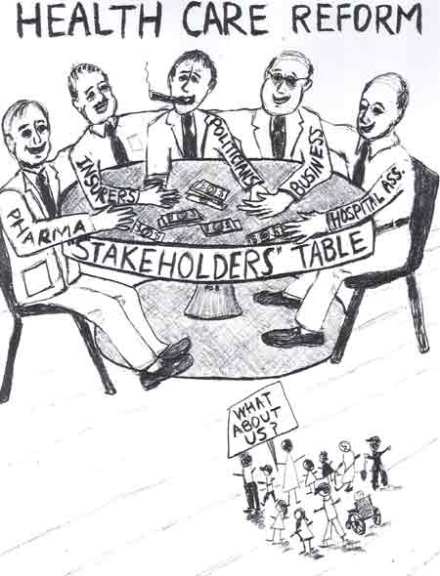
BurgerStakeholdersTable1

Labor Day cookout.  America, God blesses us.

Five of our neighborhood’s Wisteria Lane wives—wildebeests—pitched a ten-dollar K-Mart tarp to provide a modicum of shade for the BBQ guests—see prior posts to understand the wildebeest reference.  I should have You-Tubed their struggle.  I had less difficulty pitching my tent by myself on side of a volcano at 2 AM at nineteen thousand feet in a blizzard.  To those who would question why I wasn’t helping them it’s because they didn’t seem to be a Y-chromosome friendly group.

American food—burgers, dogs, sausages, beans, chips.  Then there’s the side dishes brought by the neighbors; salads that require a team of forensics to ferret out the ingredients, and cookies that look so goofy that not even the kids will try them.  Oreos, never mess with perfection.

Okay, down to business.  I’m looking for someone to tell me whether this idea makes sense or if it is all wet.

Premise one:  Most of the reason reform being discussed is to solve or improve the healthcare “business model”.  Most of the clinical side is not up for debate, that is, we are not discussing the need to revamp dermatology or pediatrics.

Premise two:  About half of healthcare is government run—the VA, Medicare, Medicaid, and government employee health.

Question one:  Which business model are the reformers trying to address?

  • Private—if a good portion of what’s broken with the healthcare business model can be attributed to the private sector, why are they not leading the discussion?
  • Federal—if some portion of the business model problem lies with the government, and this is the same organization who broke it and are trying to fix it, isn’t that a conflict?
  • Both—why are legislators drafting any portion of this?  What large business problems have any of them resolved?

Question two:  Which group of people should be at the forefront of defining what’s broken, how to solve the business problems, determining what it will cost, and how to pay for it?  Pelosi, Ried, et al?  Or a group of business people headed by someone like Jack Welch?

Question three:  Whose plans are Americans more likely to believe, one coming out of DC, or one coming from a non-partisan group of business leaders?

Question four:  How many committees and firms are developing standards?  How many standards committees would a “Jack Welch” led reform effort have?  That’s right, one.

Question five:  Federal led reform requires teams to confirm that billions spent by healthcare providers on electronic health records will yield systems that actually work (certification and meaningful use).  Would a “Jack Welch” led effort require the same, or would they know the systems would work simply because they had one set of standards and a viable plan for interoperability?

Question six:  Who are the reformers?  What are the names and experience of the people who drafted the 1,000 pages?  Why aren’t they on the talk shows?

Question seven:  Who should draft the reform document?

I recommend a bi-partisan committee of business leaders, no current politicians—something akin to the committee which studied the Challenger disaster.  If we’re talking a trillion dollars, let’s invest six months or so to define a plan, one that can be presented to the country—Ross Perot with one of his PowerPoint presentations, then let’s figure out some way for the people to comment and “vote”.

If reform is going to impact everyone, shouldn’t everyone at least understand it and be free to comment? Doesn’t a trillion dollar spend deserve some form of popular vote?  Congress has a favorability rating in twenties. If four in five people have lost confidence in their ability to do anything in everyone’s best interest, are we willing to let them make this decision for all of us?  It’s “We the people”, not “They the elected”.

My closing thought—no charge.  Have you noticed when our elected representatives soapbox this issue, they speak of us in term of, “the citizens” or “Americans”, seemingly excluding or elevating themselves from the fray.  They need help understanding this is a square and rectangle issue, not every rectangle gets to be a square, but every square is a rectangle.  We need the squares to start listening and stop talking.

Be it enacted by the Senate and House of Representatives of the United States of America in Congress assembled offer comment on the Healthcare Reform Act of 2009.  Acknowleding that we do not have a clear plan, hereby turn the task of planning back to the people.

pastedGraphic.tiff.converted

Is EHR as difficult as everyone says it is?

Yes, and then some.  EHR is at the beginning of a national rollout .
• Studies suggest that 200,000 healthcare IT professionals are needed for EHR. The total number it healthcare IT professionals today is 100,000
• It’s not known which EHRs qualify for incentives under ARRA
• Less than 8% of non-VA hospitals have EHR in even a single department (this does not mean these pass meaningful use test)
• Only 1.5% have them in all departments
• Studies state that 1/3 to 2/3’s of implementations fail
• Implementation by small practices has been almost non-existent
• Small and individual practices will need a full service “wrap around” solution encompassing the following services:
o Project management
o Selection
o Implementation
o Adapting work flows
o Training
o Support
• Major reasons for not doing EHR are
o Up-front costs
o Lack of IT skills
o Ongoing support costs
• Hospitals and large providers usually use their own IT departments for EHR, none of which has ever implemented EHR. Hence for the most important project undertaken by a provider, they elect to do it with people with no experience, relying on the vendor
• Where will the EHR vendors find the IT expertise and project management resources to staff a national roll out?