Social Media, an example

social-mediaA cold wind is blowing in from the north, blowing so hard that at times that the rain seems to be falling sideways, echoing off the windowpanes like handfuls of pea gravel. The leaves from the walnut trees, that had prematurely yellowed, dance a minuet as they slowly make their way to the ground in the woods. It feels like the first day of fall, a day for jeans, a long sleeve shirt, and a pair of long woolen socks. The temperature has nosedived. On a normal day, the first indication of sunrise would have begun to push the darkness from the sky. But today is not a normal day. The clouds are hanging low and gray against the dark sky.

The garage door creaked and moaned as it rose along the aluminum track. Halogen headlights pierced the darkness. Its driver, an unkempt and rather rotund woman in her 40s eased the car down her driveway and proceeded through the still slumbering neighborhood. She was a friendless woman, who along with her husband and daughter kept to herself. The neighborhood children were afraid of her, too frightened to retrieve a ball if it fell into her yard.

“Were those your dogs barking? I was asleep,” she screeched as she hurriedly exited the car wearing her oversized pajamas. The site alone was enough to frighten children and a few grown men. “I’m going to find out whose dogs were barking,” she chided. “And when I do, someone will be hearing from me. I took my last neighbors o court because their dog barked. I don’t like children. I don’t like dogs. I don’t like yard work, and I don’t want to be invited to any community activities.” I feel pretty confident she won’t have to worry about being swamped by invitations.

It was actually almost ten in the morning the day she registered her complaint—dawn to some people I guess. Three days later, the letter arrived in the mail. The return address indicated it was from a homeowners association. The letter stated that if we couldn’t control the barking of our dogs that we would be reported to the community board of directors. For second, we didn’t know how to react—then we started to laugh. The reason for the laughter was simple; my wife is on the Board of Directors. It’s like the East German Stasi is alive and well and living in Pennsylvania. I can picture this woman hiding behind her drapes, her little steno pad in hand, recording each and every bark that disrupts her bliss.

She’s a tattletale, a 40-something whose problem solving skills never grew beyond that of a third grader. She lives right next door, 100 feet away. We’ve only seen her three times in the 28 months we’ve lived here. Six months ago she sent us a fax, complaining about something or other. A fax, mind you. To her next door neighbor. This is too easy. It’s social networking run amok. She has become my poster child for bad manners, a benchmark against which all subsequent social networking commentaries will be measured.

There are also good social networking opportunities, especially for large healthcare providers.  Such as?  Do you record the number of patient calls you get each year by call type?  The fully loaded cost of each call is probably somewhere around twenty dollars.  What percentage of those calls are resolved the first time?  What percentage of those calls could be answered  more effectively without the phone? How do you answer a call without a phone?  By having the caller get what they need from some form of social media site.  In less than a few months you could design a web site and YouTube presentation to explain your bills better than any single person could explain it on the phone.  You could provide a similar service for patients who need help contacting their insurance company, and need help dealing with that firm.  The ROI on social media is significant, and it’s nicer than sending a fax.

Well, that’s it for the moment. I’m off to the store. I think I’m going to buy a third dog.

pastedGraphic.tiff.converted

Your EHR –Do you neeed to change the threat level?

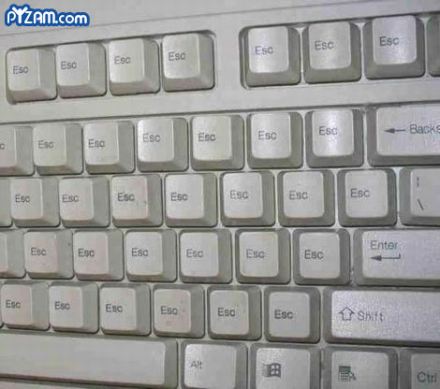
escapekeyboard“Step away from the wall,” Veronica yelled through her ear microphone, loud enough so everyone could hear her.

I knew if I released my grip, the chances of me remaining upright weren’t very good.  Permit me to roll back the clock thirty minutes.  Friday morning in Philadelphia.  It’s raining.  In Texas they call this much rain a frog-floater.  Two and a half hour delays at the airport.  A cold biting rain, the kind that sees you in Gortex and simply laughs at you for being too silly to be indoors.

I cancelled my run and decided to sit in on one of the classes at the gym, take a break, rest up for a long run tomorrow.  The only class scheduled was kickboxing, and it’s being led by the mother of my seven year-olds best friend—not exactly my biggest physical threat. She wore her hair like Veronica in the Archie comic books, and because I couldn’t remember her real name, for purposes of this narration, that’s how we will address her.  I don’t even know what kickboxing is, but I know it doesn’t get any easier than that.  I’d finished my lifting, finally got to thirty pull-ups today—yes, in a row, and I was pumped.

I walked into the mirrored room.  The floors were recently shellacked—I love the smell of shellac in the morning.  Spandex clad women decked out in puce—isn’t that a great word—purple, lime green, and hot pink were everywhere.  The music—some sort of electronic something or other—started to blare and bodies started to move.  Knowing that I wouldn’t be sucking wind, I thought about asking Veronica to put on some music with words so we could sing along.  She gave me one of those looks that said, “In five minutes you will be so mine.”

The class is scheduled to last sixty minutes.  We began by jumping rope and I almost broke both of my legs—I am the poster boy for the theory that white men can’t jump.  I grabbed a pair of dumbbells to do with the exercises, just to make sure I got a bit of a workout.  Twelve minute into the class and I looked like the rain had followed me inside.  At minute thirteen, I dropped the dumbbells.  By minute sixteen, I no longer had any feeling in my shoulders.  I thought I saw a few of the participants checking me out, one advantage of being the only Y chromosome in the class—the one closest to me came over to ask if I was okay.

A twenty-second break for a sip of water—I had already downed my liter.  The colors of the spandex outfits had started to blur into what looked like a Peter Max painting that had been left out during a downpour.  Minute twenty-two, thighs are burning.  Twenty-four, I am found clinging to the wall.  I would not have made the twenty-fifth minute.  I reached for my cell phone and pretended that I had a voice message.  Two minutes later, I crawled out of the room.

I had under estimated the threat level, under planned, and under delivered, surpassing even my own inadequacies.

My fall from grace was short lived.  A fall from grace once you get beyond seven figures of cost implementing your EHR won’t be so short lived.  Those names will echo down the commercially carpeted hallways for a long time.

What’s being under planned?  The plan for one thing.  Once you’re into eight figures, I hope you have a written and signed-off plan.  That sign-off may be your life jacket, unless they decide to parole only those above you.  Once you get into even the potential of a nine-figure spend, I’d plan on a planning process of three to six months.

Anything less may find you clinging to a wall.

021_18A

EHR Strategy, a call to action

EHR Strategy, What I Do & How I Can Improve Your Efforts

Several people have told me that I need to come right out and state the role I play in the Electronic Healthcare Records (EHR) space, and how my consulting firm will add value to your efforts.  Spell out your services, and state a call to action.  This writing will address that topic, and will be the only time I use your time to try to sell you on me.  If you’ll bear with me for a few minutes, I will explain why I write with such self-assurance that most organizations (Hospitals, clinics, IPAs, and providers) have the wrong EHR Strategy—or no recognizable strategy—and my equally self-assured belief that working together we will mitigate that problem.

Here are the facts around EHR:

  • Most large EHR projects have a high probability of failing—the larger the project, the higher the probability
  • Large EHRs may cost more than a new hospital wing—a number of people know of one truly outstanding hospital who spent more than $300,000,000 on their EHR
  • Hospitals are much more knowledgeable about the requirements of a hospital wing and what it will do for them than they are about their EHR strategy
  • All healthcare providers who have entered the EHR space have done so trying to hit the trifecta of moving Gossamer targets;
    • Certification
    • Meaningful use
    • Interoperability
    • Hundreds of vendors who have their own agenda at heart
    • So many individual, disparate, committees are working on standards…do we need to even go there?  Doesn’t each committee create its own standards—if so, where is the standardization?
    • If one removes DC from the loop, many providers can’t articulate the business problem they want the EHR to solve, nor can they articulate an ROI
    • Providers have budgets without requirements, budgets without any knowledge of what an EHR system should cost
    • An EHR should have a greater impact on patients, providers, and payors than any other single program, yet who is in charge?  What skill set to they have to do this?
    • Most providers do not have a plan, a qualified planner, a decider.  Who is reviewing and approving the plan?  What makes them credible?

Those are the reasons we are here.  Our job is to reposition those facts such that they improve your chances of being successful with your EHR selection and implementation.

You know what?  It’s not about the EHR.  It never should be.  The EHR system only accounts for about 20% of the projects success or failure.  It’s code.  The other 80% comes down to planning, conversion, change management, training, user acceptance (patient, doctors, nurses, and administrators), and workflow improvement.

You know what?  It’s about breaking down kingdoms between intra-hospital departments.

It’s about knowing that you can walk into the EHR war room and know that somebody is the decider.  That somebody is able to say, “This is what we are going to do first, second, and third, because that’s the only way we can improve your chances of having a successful EHR program.

That’s what we do.  Most people, given the opportunity, will fail 100% of the time performing open-heart surgery.  A mere handful will avert failing.  Most people will fail 100% of the time who are leading an EHR program will fail.  A mere handful will not.

We are the ERHPMO (Program Management Office).  We are your advocate in managing the EHR vendor to benefit you.  Needless to say, most vendors do not like having us on board.  We are vendor neutral, provider advocates.

We are the anti-Accenture business model.  We do not back up the bus and drop off the children.  We will not try to put 30 people on your project.  You do that—clinicians, and IT.  We pull up in a Prius, drop off a few grownups who’ve been there, done that, got the T-shirt.

We work hand in hand with Hospitals, IPAs, clinical providers, and doctors to help you successfully address some or all of the following;

  • understand the EHR landscape
  • create your EHR strategy, in-house versus SaaS
  • eliminate wasteful redundant costs via shared services analyses
  • define your requirements
  • issue an RFP
  • evaluate vendors
  • negotiate contracts with the vendors
  • plan and execute the change management
  • rationalize your EHR with other which may exist within your walls
  • define and rebuild workflows
  • develop and execute a training program for user acceptance

This is not the time to experiment, or hope you get it right.  To minimize the probability of failure, this is the time to bring in the adults.

That’s what we do.  Sorry for the sales pitch.  Please let me know how we can help.

paulroemer@healthcareitstrategy.com

021_18A

Is EHR as difficult as everyone says it is?

Yes, and then some.  EHR is at the beginning of a national rollout .
• Studies suggest that 200,000 healthcare IT professionals are needed for EHR. The total number it healthcare IT professionals today is 100,000
• It’s not known which EHRs qualify for incentives under ARRA
• Less than 8% of non-VA hospitals have EHR in even a single department (this does not mean these pass meaningful use test)
• Only 1.5% have them in all departments
• Studies state that 1/3 to 2/3’s of implementations fail
• Implementation by small practices has been almost non-existent
• Small and individual practices will need a full service “wrap around” solution encompassing the following services:
o Project management
o Selection
o Implementation
o Adapting work flows
o Training
o Support
• Major reasons for not doing EHR are
o Up-front costs
o Lack of IT skills
o Ongoing support costs
• Hospitals and large providers usually use their own IT departments for EHR, none of which has ever implemented EHR. Hence for the most important project undertaken by a provider, they elect to do it with people with no experience, relying on the vendor
• Where will the EHR vendors find the IT expertise and project management resources to staff a national roll out?