Why should you reframe the EHR discussion?

Are you one of the millions with recurring dreams of taking college exams?  I remain haunted by two, both which happen to be rebroadcasts of real events.

In the first, I had convinced my graduate school professor of operations management that since I took operations research in college that I could “audit” his class and be the teaching assistant.  I used the term auditing to mean I didn’t have to attend the class or do the home work.  From the school’s perspective, it did mean I had to take the final.  As I learned sitting at my desk, wishing I could think of any excuse to move my pencil across the pristine pages of the blue book, apparently there is a difference between operations research and operations management.  Whatever the difference was, it accounted for the blank pages staring up at me.

At the end of the exam the only marking in my book was the note I wrote to the professor, “I think we both know I know how to do this however, I froze.  If you need to fail me, I understand.”  He gave me a “C”.  I saw him when I visited Vanderbilt last year, and he recognized me and remembered the story—I like to keep my audience riveted.

The other dream has to do with my lone Poly-Sci class as an undergrad.  I am a proponent of the notion that I can answer almost any question provided I can reframe the question into one I can answer.  The exam instructed us to answer a question about a book I hadn’t read.  My only choice was to reframe the question, equating it to one from a book I had read.  I gave what I thought amounted to a fairly reasoned response to “my” version of the question.  The professor agreed that I had, and then wrote on the cover of the exam book that he too used the same device when he was in college.  It had not worked for him and he wasn’t going to allow it to work for me.

I think many of those grappling with EHR would benefit from reframing the question.  Many view the question as, “How do I accomplish what the folks in Washington want me to do?”  Sometimes that question might deserve an answer.  In the case of EHR I do not think it does.  In fact, I think answering the question, and then building a plan around your answer can make EHR more difficult, and it can move you away from your business goals.

A better question, at least for your hospital or practice is, “Does it make sense for me to accomplish what the folks in Washington want me to do?”  Has Washington demonstrated enough leadership over EHR, Meaningful Use, Interoperability, or reform to justify following?  Have they provided enough clarity, defined a set of business objectives, or justified their reasoning?  Does their reasoning fit your business model?

I bet it does not.

May I borrow your pen?

Have I written recently I’m not a fan of technology for unless someone knows what business problem they intend to solve? It’s not so much that I have anything against any of the technology or any particular technology or EHR vendor, it’s more that I think many are misjudging what the technology will do for them, what they have to do to it, and they forget to ask themselves how to best address the problems.

Whatever do you mean? Thanks for asking—here’s an example. When the United States first started sending astronauts into space, they quickly discovered that ballpoint pens would not work in zero gravity.

To combat the problem, NASA scientists spent a decade and $12 Billion to develop a pen that writes in zero gravity, upside down, underwater, on almost any surface including glass and at temperatures ranging from below freezing to 300C.

The Russians used a pencil.

Have a meeting about how to best plan for and implement EHR in your hospital. One rule, all discussion should involve process, not technology. Try first to reach consensus about what to do, then look at how to do it. You may find out that all you need is a pencil.

What is the value of perfection?

Here’s another great post by another great person I met online, Maryanne Colter, of MMColter Ltd.   She’s on Twitter @mmcolter.  What I love about this post is her emphasis on hitting a target worth hitting.  Aim for the moon on quality or defects and you may hit it.  Perfect ought not be a stretch goal, as a target it should be de rigeur.  Thanks Maryanne–the rest is hers.

Treating people like shoes…

On January 19th Senator Grassley issued an open letter to medical software vendors and hospitals, chastising them for slamming in EMR software, giving higher regard to being on time and on budget than making sure the software was performing flawlessly.  After all, we are dealing with people’s lives. I got the impression from the Senator’s letter that the passive “mistakes were made” is not going to be an acceptable answer; 100% accuracy should be the only acceptable answer.

And yet it happens. A few weeks ago I spoke to a charge nurse at an Academic Medical Center  (one that was cited in a 2006 study as being exemplary in high quality care) who told me they had around 100 fixes to their system in the first few weeks after go-live.  He also recounted an incident where they lost an entire day of a patient’s nursing documentation somewhere in the transfer between the PACU and the patient’s room.

Strange as this may sound, the solution may be to treat people like shoes.   I once consulted at a company that’s known for its shoes.  Not a tiny company, but one where probably half the world owns a pair of their shoes.  A team of highly trained employees and consultants streamlined processes and put in the technology that increased the overall efficiency of the supply chain by 34%.

Imagine if we had done a shoddy job with their data and said 98% accuracy was ‘good enough’?   We would have transferred data from design to manufacturing, but maybe the shoelaces were a little short, but that hit the 98% mark and would have been ‘good enough’.  When we started manufacturing the shoes, who would have cared if the sole were a little cockeyed?  It still would have been within our 98% mark.  Two percent of the customer orders for the faulty shoes would have contained 2% wrong products or the wrong sizes. Two percent of all orders would have been shipped to the wrong stores. Invoices that were 98% accurate would have been ‘good enough’.  And all of those mistakes would have been done 34% faster.

How about if we treat the delivery of medicine with the same regard as a carton of shoes? We supplied shoes to a major retailer who demanded 100% accuracy of carton labels.  If any one of the hundreds of characters on the carton label were misplaced, the carton would be automatically rerouted, photographed, and emailed back to the supplier with the message of “get this 100% accurate, or else…”.  Think of all the places in medicine where a “get it 100% accurate, or else” rejection message might save a life.

There is no single analogous situation from business to medicine and there are certainly enormous differences, not the least of which is we are dealing with biological systems and the things that can go wrong increase by a thousand-fold.  But instead of looking at what works and adapting it to healthcare, most of healthcare patently rejects ‘outsiders’ with ‘outside ideas’ and throws the baby out with the bathwater.

Whenever using analogies it is imperative to do a thorough analysis of the differences, but the answer to the question “what is different?” is not “everything”! Data is either accurate or not.  Software testing results are either thorough or not. The only answer to the question, “Did you get enough training to flawlessly perform you job?” should be yes, or else more training is needed. Period. These are not unique notions. The healthcare industry has the worst case of ‘not invented here’ refusal to adapt quality improvement measures from ‘outside sources’ since JIT had to be renamed Lean because the US could not get over its WWII bigotry of anything remotely Japanese.

“Outsiders” are not viewed as people who would take accuracy even more seriously when dealing with human beings. Instead, we are viewed with the assumption that because we have only dealt with shoes and cardboard boxes that our concern for accuracy and quality must somehow be cavalier.

The healthcare industry needs perfectionists and they can come from anywhere.  It needs people who when they hear “perfect is the enemy of the good” answer with “tell that to the patient whose medicine is one decimal point away from killing them.” Sometimes, perfect is the only option.

I have a dear friend who has a brain tumor.  Thankfully it is benign, but eventually he will need radiation or surgery.   When that day comes, one of the most brilliant, wise, and compassionate minds in the world will be one decimal point away from destruction or cure.  He is the only reason I keep pounding my head against the wall of “ideas from outsiders are not good enough here.”

One of my heroes once said about accidents, “I am of the opinion that zero is the right number…You cannot plan to kill three people a year because you killed four people last year and you want to get a little better…So the goal is zero…Zero injuries. Zero reportable incidents.”  That man was Paul O’Neill when he was the CEO of Alcoa.  Heaven forbid we should learn a lesson from people who make pop cans.

EHR: Is your plan aiming far enough out?

Can being an early adopter save your hospital millions of dollars?  We both know the answer depends on what one happens to adopt.  Suppose we are discussing the adoption of an idea?  Can that be analogous to not adopting another idea?  I think it can.  Allow me to explain.

Many providers are in the process of making a very expensive, highly complex, and wide-ranging decision regarding their healthcare information technology strategy (HIT) for their electronic healthcare records system (EHR).

A non-trivial moment.  Careers will be made and lost as a result—I’m betting more will be lost.  Why?  By making a bad choice on the EHR, on how to implement it, and on how to modify your organization.

I think the choices will be bad not from lack of effort but from lack of understanding of the complete issue.  What is the part of the issue that is lacking?  It’s the part which requires clairvoyance.  Whew, that was easy.

Defining your requirements does not pass the test of necessity and sufficiency.   It’s like playing darts while blindfolded.  The plan to select, implement, and deploy an EHR must account for a number of risky unknowns, including:

  • How will healthcare reform impact my organization
    • What constraints will it produce
    • What demand will it create for new HIT systems
    • What new major operating processes will result
    • When will reform really be implemented
    • How will reform be reformed
    • How will payors, suppliers, and people react to reform
    • How will you offset a resource shortage of fifty percent
    • What will change as a result of
      • Interoperability
      • Certification
      • Meaningful Use
      • Mergers and acquisitions

We don’t know what we don’t know.  That is not a throw-away line.  By definition, we never know what we don’t know.   However, the downstream success of your EHR will be highly dependent on these unknowns.

So, where does your need to be clairvoyant come into play?  One word—flexibility.  Every part of the plan must be built with that requirement in mind.  What will the system need to do in three years?  How will the landscape have changed?

If you aren’t convinced your EHR is either flexible or disposable, you’d benefit by rethinking your plan.  The idea for which I think we need early adopters is to spend time building to what will be, not what is.

Why is EHR too much for normal brains?

So, I’m watching the Alabama Auburn game and it suddenly strikes me, there are probably a lot of people trying to understand what it is a consultant does that we can’t do for ourselves.

For those who have a life, those who missed the game, Alabama entered the game undefeated and had a good chance to play for the national title.  Auburn opens the game with the best scripted opening plays I’ve ever witnessed—touchdown, onside kick, trick plays, touchdown.  14-0.

Their first however many offensive plays were brilliant.  They were planned perfectly.  The next time they had the ball it was apparent that they had not planned the however many and first play.  The plan failed to go beyond what they’d already accomplished.

How does that apply to what you do, what I do, and why I think I can help you?  It is best described by comparing your brain to a consultant’s brain.  Your work brain functions exactly as it should.  It’s comprised of little boxes of integrated work activities, one for admissions and registration, one for diagnosis, another for care.  There’s probably another box for whatever it is that the newsletter stated IT was doing three months ago and how that impacts what you do.  That’s your job.

Your boxes interface in some form or fashion with the boxes of the person next to you in the hospital’s basement cafeteria who is paying for her chicken, broccoli, and rice dish that reminds you of what you ate at crazy Uncle Bob’s wedding reception.  That interface is the glue that makes the hospital work.  It’s also the synapse, the connective tissue—I know it’s a weak metaphor, but it’s a holiday weekend—give me some slack—that tries to keep healthcare functioning in an 0.2 business model.

There are names for the connective tissue, you know it and I know it.  It’s called politics.  It’s derived from antiquated notions like, “this is how we’ve always done it”, “that’s radiology’s problem”, “nobody asked me”,

At some point over the next week or two the inevitable happens; the need arises for you to add some tidbit of information.  Do you add it to an existing box, put it in an empty box, or ignore it?  This is where you must separate the wheat from the albumen—just checking to see how closely you’re following.

Your personal warehouse of boxes looks like the final scene in Raiders of the Lost Ark—acre after acre of dusty, full boxes, no Dewy-decimal filing system, and no empty box.  There are two rules at the hospital; one, bits of information must go somewhere, and two, nobody can change rule one.

The difference, and it’s a big one, is that consultants have an empty box.  It’s our Al Gore lockbox.  We were born that way.  It’s like having a cleft chin.  We also have no connective tissue to your organization.  No groupthink.  No Stepford Wives. No Invasion of the Body Snatchers to turn us into mindless pods moments.  Consultants may be the only people who don’t care.  Let me rephrase that.  We don’t care about the politics.  We don’t care that the reason the hospital has four IT departments is because the hospital’s leadership was afraid to tell the siloed docs that they couldn’t buy or build whatever they wanted.

Sometimes it comes down to your WWOD (what would Oprah do) moment.  Not, what do they want me to do, not what would they do, not what is the least disruptive, not what goes best with what the other hospital did.

At some point it comes down to, what is the right thing to do; what should we do.

Big, hairy healthcare IT projects come out of the shoot looking like Auburn did against Alabama.  The first however many moves are scripted perfectly.  Heck, you can download them off Google.  Worse yet, you can get your EHR vendor to print them for you.

The wheat from the albumen moment comes when you have to come up with an answer to the question, “What do we do next?”

That’s why consultants have an open box.  You know what we are doing when our brain takes us to the open box?  Thinking.  No company politics to sidetrack us.  Everybody knows the expected answers, but often the expected answer is not the best answer.  Almost everybody knows what comes after A, B, C, and D.

Sometimes…E is not the right answer or the best answer.

“We need to talk about your TSP reports”


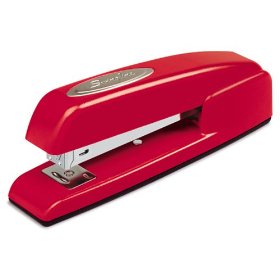
If you recognize the stapler, you know the movie.  “Office Space”—Possibly the best movie ever made. Ever worked for a boss like Lumbergh? Here’s a smart bit of dialog for your Friday.

Peter Gibbons: I work in a small cubicle. I uh, I don’t like my job, and, uh, I don’t think I’m gonna go anymore.

Joanna: You’re just not gonna go?

Peter Gibbons: Yeah.

Joanna: Won’t you get fired?

Peter Gibbons: I don’t know, but I really don’t like it, and, uh, I’m not gonna go.

Joanna: So you’re gonna quit?

Peter Gibbons: Nuh-uh. Not really. Uh… I’m just gonna stop going.

Joanna: When did you decide all that?

Peter Gibbons: About an hour ago.

Joanna: Oh, really? About an hour ago… so you’re gonna get another job?

Peter Gibbons: I don’t think I’d like another job.

Joanna: Well, what are you going to do about money and bills and…

Peter Gibbons: You know, I’ve never really liked paying bills. I don’t think I’m gonna do that, either.

One more tidbit:

Peter Gibbons: Well, I generally come in at least fifteen minutes late, ah, I use the side door – that way

Lumbergh can’t see me, heh heh – and, uh, after that I just sorta space out for about an hour.

Bob Porter: Da-uh? Space out?

Peter Gibbons: Yeah, I just stare at my desk; but it looks like I’m working. I do that for probably another hour after lunch, too. I’d say in a given week I probably only do about fifteen minutes of real, actual, work.

I like to think of Peter as my alter-ego.

When I’m playing me in a parallel universe, I’m reading about a surfer dude cum freelance physicist, Garrett Lisi. Even the title of his theory, “An exceptionally simple theory of everything,” seems oxymoronic. He surfs Hawaii and does physics things—physicates—in Tahoe. (I just invented that word; it’s the verb form of doing physics, physicates.)

Ignoring that I can’t surf, and know very little physics, I like to think that Garrett and I have a lot in common. I already know Peter Gibbons and I do. So, where does this take us?

It may be apparent that I look at healthcare IT and reform from a different perspective than most; I’m the guy who doesn’t mind yelling ‘fire’ in a crowded theater. The guy who will never be invited to speak at the AMA convention unless they need a heretic to burn for the evening entertainment. I can live with that.

Like Garrett, I too see an exceptionally simple theory in everything, especially when it comes to improving the business of healthcare. It’s not rocket surgery, but then, it was never meant to be–before someone writes, I know it should be scientists.  It’s process, change management, leadership and foresight.

Sometimes I like to look at the problem from a different dementia—Word didn’t have a problem with my usage of that word.  I look at healthcare and ask myself three questions:

1. How did they ever get so siloed?

2. How did they ever get so so big without a cohesive IT strategy?

3. Is it possible to reverse both of those AND improve the business.

I am convinced the answer is yes.

EHR: work plans are necessary but not sufficient

114454101_a0f39220a7


I wonder about things, little things, things I see on Nova or on Bizarre Foods.  Take water, more specifically, ice.  It floats.  The only solid that floats in its liquid state.  Most solids sink, not ice.  For those of you thinking boats float, they’re not considered to be solids—does that make them liquids?

It turns out that as water goes from four degrees centigrade, its densest point, and towards freezing, it becomes less dense and floats.  It’s volume increases by 9%, and part of that 9% is trapped air.  That air, even though you can’t see it, exists between the two H’s and the O.  which takes us to the following.

Have you spent much time studying work plans?  While there are more interesting ways to spend your time, there are times meant for writing them, and times meant for studying them.

Having a work plan can be a little like having a bike; nice, practical for some things, impractical for others.  Like with most things, there are work plans and there are work plans.  Some may not be worth the paper on which they are written.

Just like not everyone can write a book worth reading, not everyone can write a work plan worth implementing.  Lines on paper don’t necessarily yield a project of much value.  Remember how with the ice there are things between the H’s and O’s?  Well, with a lot of healthcare IT and EHR work plans, there are things between the tasks on the work plan, or at least there should be.  Can’t see them either.  Those things?  The missing tasks, the tasks that should have been in the plan, the tasks that would have given the plan a fighting chance to succeed.

Some gaps are good, like with ice.  Others can leave you hanging.

saint

EHR Tips for supplementing ARRA funding

tipjar

EHR: shift happens

After several years of therapy, I’d begun to accept that I might not be the “Voice of Reason” for all things, maybe just for the important things.  Laugh all you want—most of you have been here, you just don’t blog about it.  To fully grasp the import of what I’m about to write, for the newbies, there’s benefit in reading https://healthcareitstrategy.com/2009/09/19/ehr-how-to-recover-from-poor-planning/.  If there was ever déjà-vu all over again, this is it.  It takes an idiot to be this stupid once.  I’ve managed to refine the process.

At some point, there may be benefit to society as whole for someone to do the math and holler above the fray, “he doesn’t get it and he never will.”  This is not a discussion about what is PC, it’s about my ineptitude.  I have become my own euthanasia moment.

The chicken breasts are moved from the freezer to the sink to be thawed by water because the energy used to heat water is cheaper than energy used to run the microwave.  Forgive me for tearing.  (I am at an impasse between tear and tear.)

This is twice in fewer months than it takes not to approve healthcare reform.

I am watching, “Trauma in the ER”.  It’s part of my MD correspondence course.  I’d just about learned to insert a chest tube when something reminded me of running water.  I ran to the kitchen.  The water is running. The chicken breasts are floating. Hawaiians are surfing the curl in my kitchen.  We have so been there done, that.  I am stupefied.  The last time I did this, I was able to hide it from my wife.  The oak floor boards are now warped to the point where they now look more like bread bowls from the Plymouth colonies than boards.

I wish I spent my days inventing this material.  It’s difficult to understand, but in spite of my ineptitude, I am allowed to vote to determine who will be the next president.  I have become a Mensa wanna-be gone amuck.

Where does this leave us?  There are no second chances with healthcare reform, EHR, or HIT.  We are talking about gazillions of dollars and people whose lives depend on the outcome.  This is an economy shifting moment.  This is our paradigm shift.  ess it up and we will all be saying, “shift happens”

saint

Stilleto Change Management

shoe


I just returned from the Prada show in Milan. Not really—that was the opening line from a piece on NPR. Apparently this year’s runaway hit on the runways has to do with high heels, with the emphasis on the notion of high.

The following comes from the UK Telegraph: The girls looked like rabbits trapped in the headlights; their faces taut and unsmiling, their eyes wide with fear and apprehension. Were they about to undertake a parachute jump? Abseil down a 1,000ft mountain? None of the above. All they were doing was trying to negotiate the catwalk at Prada during this week’s Milan fashion shows in shoes that were virtually impossible to walk in. At least two models tripped and fell on to the concrete floor; others wobbled and stumbled, teetering and tottering, clearly in agony, and all the while their minds were fixated on just one thing: reaching the sanctuary and safety of the backstage area without suffering a similar fate.

According to the NPR reporter, the heels are so high that regular people—women people that is—can’t seem to walk in them without falling. This problem has led to the creation of an entirely new micro-industry. In L.A. and New York, there are classes to teach ladies how to walk in very high heels without hurting themselves. These classes are being offered through dance schools that couldn’t fill their dance classes—they are now booked solid.

Tell me this isn’t the same as trying to walk and chew gum at the same time. Multitasking. Now before I make fun of some thirty year-old that has to relearn how to walk, let us turn our attention back to those dancing—cum—walking schools. From a consultant’s perspective what makes this story interesting is that those businesses saw a need and re-engineered a part of their operation to meet that need, sort of like we’ve been discussing regarding the impact EHR and reform can have on your organization.  With the implementation of EHR, many things will change.  If they don’t require change, you probably wasted your money on the EHR.  What’s important is having a plan to define the change and manage it.  Rework work flows, remove duplicated processes and departments.

Now I’m going to go saw the heels off my wife’s shoes before she hurts herself.

saint