Pigeon Project Management Office (PMO)

1906_Whittling_Webster_adx

I just finished stacking two cords of wood, much like a squirrel getting ready for a long cold winter. My feet were doing the “Boy is it cold dance” in an effort to keep the blood circulating.  As I was picking up the scraps, my eldest picked up a piece and placed it in his backpack. When I asked him what he would do with it he told me he was going to carve it after school. His statement brought back boyhood memories of hours of whittling, an activity done if for no other reason than to get from one minute to the next. Grab a stick and whittle it away until there was nothing left.  What next? Grab another. The weight of the pocketknife felt equally good in my hand as it did in my pocket.
When is the last time the thought of whittling crossed your mind? Probably been a long time. It’s an activity meant for idle minds and hands, or minds that should be idle. There are times I find myself questioning what value so and so brings to the party. Do you do that?  “Why is she in this meeting?”  You know who I mean.  You’re sitting there trying to get your work done and all of a sudden, some Mensa wannabe with more idle time on their hands than a Lipitor salesman at a BBQ cook-off, makes an aerial assault on your cubicle like a pigeon on a Rodin bronze.  Drops in and changes the rules of the universe, at least your universe.

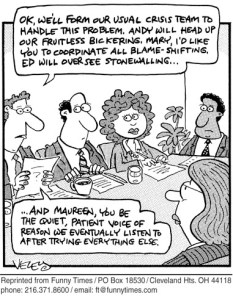
This happens more often than is documented on large healthcare IT projects.  People set new courses and define programs rules that may have nothing whatsoever to do with the project’s charter or scope.  You do have a written charter and scope in the project office, don’t you?  If not, it’s easy to see how new directions and rules can be given a certain specious authority.

What’s the best way to handle this situation? Often these management Mensas are nervous about a lack of visible results and they need to report on something.  They may feel the need to be doing something, something resembling leading.  They don’t mean to interfere, and they believe that their little forays into the world of super PMO (Program Management Officer) will actually add value. You tell me, are they adding value, or are they preventing the team from sticking to the scope? There’s that irritating scope word again.  The next time you see one wandering aimlessly through the rows of cubicles, hand that person a pocketknife and a nice piece of balsa wood.  Although their efforts won’t add any value to what you’re trying to accomplish, at least it will get them out of the way for a little while.

saint

Who was that woman who put in our first EHR system?

vacuum_cleaner

The first home I bought was in Denver.  Built in 1898, it lacked so many amenities that it seemed better suited as a log cabin.  There was not a single closet, perhaps because that was a time when Americans were more focused on hunting than gathering.  Compared to today’s McMansions, it was doll-house sized.

It needed work—things like electricity, water—did I mention closets?  I stripped seven costs of paint from the stairs.  Hand-built a fireplace mantel and a deck.  I arrived home to find my dog had eaten through the lathe and plaster wall of the space which served as my foyer/family room/ living room-cum-hallway.  I discovered the plaster and lathe hid a fabulous brick wall.

My choice was to patch the small hole, or remove the rest of the plaster.  Within an hour I had purchased man-tools; two mauls, chisels, and a sledge hammer.  I worked through dinner and through the night.  The only scary moment came as the steel chisel I was using connected to the wiring of two sconces which were embedded in the plaster.  On cold nights I can still feel the tingling in my left shoulder.

As the first rays of dawn carved their way through the frosted beveled glass of the front door, I wondered why I never before had noticed that the glass was frosted.  I wiped two fingers along the frost.  A fine coating of white powder came off the glass leaving two parallel tracks resembling a cross-country ski trail.  I surveyed the room only to see that the air made it look like I was standing inside of a cloud.  The fine white powder was everywhere—my Salvation Army sofa and semi-matching machine-loomed Oriental rug from the Far East (of Nebraska), a two-ton Sony television, and a component stereo system that had consumed most of much earnings.

Bachelor living can be entertaining.  One of my climbing buddies moved in with me.  The idea was I’d keep the rent low, and he’d help me by maintaining the house.  He didn’t help.  I made a list of duties; he didn’t help.  I left the vacuum in the middle of the floor, for two weeks; he didn’t help.  I made him move out, and advertised for a female roommate—an idea I now wish I’d marketed.  A girl from church came over to see the place.  I turned my back on her, only to find when I returned that she was on her hands and knees cleaning the bathroom.  I was in love.  It was like having a big sister and mother.  She even asked if it was okay if since she was doing her laundry if she did mine at the same time.  Life was oh so good.

Sometimes when one approach isn’t working it’s real easy to try something else.  And sometimes the something else gives you a solution in the form of a water-walker.  Healthcare IT and EHR aren’t ever going to be one of those sometimes.  There will be no water-walkers, no easy do-overs.  There won’t be anyone walking your hallways talking about their first wildly unsuccessful EHR implementation.  Nobody gets to wear an EHR 2.0 team hat.  Those who fail will become the detritus of holiday party conversations.  Who will be the topic of future holiday parties?  I’m just guessing, but I’m betting it will be those who failed to develop a viable Healthcare IT plan, whoever selected the EHR without developing an RFP, the persons who decided Patient Relationship Management (PRM) was a waste of money.  The good news is that with all of those people leaving your organization, it costs less to have the party.

I’d better go.  Somebody left the vacuum in the middle of the floor so I need to get cracking before my wife advertises for a female roommate.

saint

What are the voices telling you?

voices

My favorite thing about healthcare is having witnessed it up close and personal both as a cancer patient in the 80’s and as the survivor of a heart attack seven years ago.

I was fortunate enough to have testicular cancer before Lance Armstrong made it seem kind of stylish.  Caught early, it’s one of the most curable cancers.  As those who’ve undergone the chemo will attest, the cure is almost potent enough to kill you.

I self-diagnosed while watching a local news cast in Amarillo where I was stationed on one of my consulting engagements.  As we were having dinner, my fellow consultants voted to change the channel—I however had lost my appetite.  I went to my room, looked in Yellow Pages—see how times have changed—and called the first doctor I found.  This is one of those times when Never Wrong Roemer hated being right.

So, yada, yada, yada; my hair falls out in less time than it took to shower.  A few more rounds of chemo, the cancer’s gone and I start my see America recovery Tour, my wig and I visiting friends throughout the southeast.  If I had it to do over, I would go without the wig, but at twenty-seven the wig was my security blanket.  I don’t think it ever fooled anyone or anything—even my house plants snickered when I wore it around them.

I owned a TR-7 convertible—apparently it never lived up to its billing as the shape of things to come, more like the shape of things that never were.  My wig blew out of the convertible as I made my way through Smokey Mountain National Park.  I spent twenty minutes walking along the highway until I spotted what looked like a squirrel laying lifelessly on the shoulder—my wig.

The last stop on my tour was at a friend’s apartment in Raleigh.  Overheated from the long drive and the August sun, I decided to take a few laps in her pool.  I dove in the shallow end, swam the length of the pool, performed a near-flawless kick-turn and eased in to the Australian Crawl.  As I turned to gasp for air, I noticed I was about to lap my hair.  I also noticed a small boy, his legs dangling in the water, with a look of astonishment on his face.

My ego had reached rock bottom and had started to dig.  I had one of those “know when to hold ‘em, know when to fold ‘em moments” and never again wore the wig after learning it was such a poor swimmer.

Do you get those moments, or get the little voice telling you that your EHR strategy isn’t fooling anyone?  It’s okay to acknowledge the voices as long as you don’t audibly reply to them during meetings—I Twitter mine.

Sometimes the voices ask why we didn’t evaluate the EHR vendors with a detailed RFP.  Other times they want to know how that correspondence course in project management is coming along.  It’s okay.  As long as you’re hearing the voices you still have a shot at recovery.  It’s only when they quit talking that you should start to worry.  Either that, or try wearing a wig.

pastedGraphic.tiff.converted

The effect of poor planning

skate

I’ve always considered myself to be rather athletic, although I must have been on break when they handed out the coordination genes.  Perhaps that is why I tended towards individual efforts like running.

As it was, I was fairly good at ice skating as long as I was moving forward, the straighter the better.  Turning and stopping required an abundance of room, and an absence of other skaters.

Whoever came up with the notion that if you can ice skate you can roller skate was either lying through his teeth, or I became skating’s anti-matter.  At the time of my first attempt at roller skating I was unaware that ice and roller skills weren’t transferable.  Have I mentioned I like having an audience?  I decided to audition my roller skating skills at a public skating rink while on a first date.

The night was proceeding swimmingly.  I learned quickly that it I stayed to the edge and leaned towards the center of the rink, centrifugal force would keep me from falling.  My confidence in my abilities began to build.  Music boomed from the overhead speakers.  Several couples held hands, the more skilled ones crossed their arms in front of them and held hands.  I tried it and eased us into the first turn.  The song switched to Barry Manilow’s “I write the songs.”  To my misfortune, I knew the words, and began to serenade my date.  When I guy sings Barry Manilow in front of anyone but his own shadow, only two things can happen and they’re both bad.

We hit the second turn and I began to accelerate.  We sped past a number of couples.  I sang louder, concentrating more on the words than on the task of keeping us both upright.

For those unfamiliar with the design of roller skates I should explain what I perceive to be a flaw design flaw—one which you will note has been eliminated in roller blades.  The flaw?  On the front of each roller skate about an inch from the bottom is a round rubber device that resembles a stunted hockey puck.  It serves no known purpose other than to sucker punch novice skaters.  If you mistakenly try to build speed by pushing off with the toe of your roller skate—as you do in ice skating—you are actually hitting the emergency brake.  And because the brake is at the front of the skate, the physics is such that once your feet stop, the only direction the rest of your body can go is head over heels.

I looked like I had purposefully launched myself over a pommel horse.  During the first few seconds of my flight I was reluctant to let go of my date’s hands.  I thought that if we fell together that there was some small chance that I could shift the blame for the crash to her.  We separated at speed and created sort of a demolition derby for those around us, bodies piling up like logs awaiting entrance to a saw mill.  For the rest of the evening it felt like people were pointing at me as if to say, “Steer clear of him, he’s the one who took us all out.”

My one mistake caused a chain reaction of bad events and a severely hematomaed ego.  Bad things rarely happen in a vacuum.  There’s cause and effect, and the effect can be disastrous.  For those of you whose EHR program is underway who may have scrimped on the planning process—you know who you are—you may as well be the captain of the Titanic throwing refrigerant in the water.  There is no recovery from bad planning.

No matter what the shape of your EHR implementation, if you find yourself humming a few bars of “I write the songs”, only two things can happen and they’re both bad.

saint

EHR: my 12-step program

Sometimes I need to shift into neutral and allow myself the luxury to pause and reflect.  This afternoon I find myself reflecting on the past 35 years, coincidentally, the same number of years since I graduated from high school—it’s okay to fast forward to the end to see if I actually tie this into anything worth your time, I can’t guarantee anything as of yet.  If I don’t come through, I’ll owe you one.  Maybe I’ll write something so obtuse at the end about reform that you’ll feel as though the fault lies with you for not understanding me.

So, we are to meet tonight—I have seen none of them since I departed for the Air Force Academy.  There is a reason I haven’t seen anyone.  The part I don’t get is why at this time we’ve mutually decided to end our hibernation.  It’s a little like the emergence of the seventeen year locusts times two.

We have only Facebook to blame for this folly.  I must admit it has been rather entertaining seeing pictures of them as adults, and reading how they describe themselves.

During my senior year I pulled my hair back when I ran.  My hair is no longer pullable.  I am some twenty pounds heavier than my playing weight.  I considered the drive-through face lift on the way down today, but thought the bandages would give it away.

Do most people go through this, wondering if you’ll impress those for which you held with such low regard, and they for you?  (That sentence was a bugger to piece together.)  At what point do we say this is stupid and move forward?  I’m guessing it must happen at year thirty-six or beyond.

I don’t understand my motivation in agreeing to come.  Is there an entertainment factor, some degree of closure, an in-your-face moment?  Is it because you get to look the high school bully in the eye and pretend he’s the parking attendant, tossing him the key to your Mercedes and ordering him not to scratch it?  What is it about those four years as opposed to any other four years that draws people back?  There is definitely something voyeuristic to it.  No other four year period in anyone’s life could exert that same pull.  Maybe that speaks to the transitory pattern of our lives after high school.

It’s the only time when we saw the same hundreds of people day in and day out for four straight years.  Maybe it had to do with having no responsibility, or maybe it had to do with bell bottoms, platform shoes, and long hair.  Relationships were built in the hallways next to our lockers—sort of a premature cohabitation—and lasted until the bell rung for home room.  New ones—upgrades—began to blossom on the school bus on the way home.  It was the best of times; it was the worst of times.  It was Nixon and Led Zeppelin, Peter Max and 3.2 beer.

These people with whom I am about to reunite, we are strangers once removed—by tomorrow I will know if it would have been better to have left it that way.  Some of them will never be mistaken for someone who knew how to calibrate ground-to-air missiles—perhaps they think that of me.  Some are poltergeists who  think of themselves as the Zeitgeists of my generation—I do not know what that means, but it looked like a good sentence as I was typing it.

There’s less than two hours until the foot lights come up and the actors have to move downstage to their positions.  I’m guessing that only the boringly secure have decided to play themselves.  The twelve-steppers are deciding which character to play on opening night and rehearsing their lines with their spouse or significant other—a term by the way which held no meaning in high school.  Costumes lay strewn across the hotel bed as the actors decide on the perfect, here’s how I turned out after thirty-five years look.  I find myself torn between the erstwhile bon vivant prepster and the Barry Sonnenfeld, Men in Black look.

Anyway, I’ve waxed and waned to the degree where I now feel completely marginalized.  I wrote in my year book that I wanted to be president.  A lot of these people are a few fries short of a Happy Meal, but I think even they will discern quickly that I fell short of that goal.  Nonetheless, I wake each day intent on slaying my personal dragons.  You?  Here comes the segue.

The time is coming where we will need to decide which character we will play in the roll out of our EHR systems.  Are there those who will break from the pack, eschew what others will say about their approach, toss aside the conventional wisdom of being in lock-step with the majority, and decide to approach this as a solution to a business problem?

I dare say that most will choose the path most traveled.  The path that says how wrong can I possibly be by doing what everyone else is doing.  Those who act on what they know is right, those who look for an EHR solution that rates future flexibility higher than the ability to conform to non-existing standards, higher than the gossamer guidelines of certification and meaningful use, will find that not only have they leapfrogged their peers, they will find that they have selected wisely.

Those who choose to follow the crowd may find themselves hibernating with the cicadas.

saint

AP reports EHR plan will fail-now what?

blazzing

I just fell out of the stupid tree and hit every branch on the way down. But lest I get ahead of myself, let us begin at the beginning. It started with homework–not mine–theirs. Among the three children of which I had oversight; coloring, spelling, reading, and exponents. How do parents without a math degree help their children with sixth-grade math?

“My mind is a raging torrent, flooded with rivulets of thought cascading into a waterfall of creative alternatives.” Hedley Lamar (Blazing Saddles). Unfortunately, mine, as I was soon to learn was merely flooded. Homework, answering the phone, running baths, drying hair, stories, prayers. The quality of my efforts seemed to be inversely proportional to the number of efforts undertaken. Eight-thirty–all three children tucked into bed.

Eight-thirty-one. The eleven-year-old enters the room complaining about his skinned knee. Without a moment’s hesitation, Super Dad springs into action, returning moments later with a band aid and a tube of salve. Thirty seconds later I was beaming–problem solved. At which point he asked me why I put Orajel on his cut. My wife gave me one of her patented “I told you so” smiles, and from the corner of my eye, I happened to see my last viable neuron scamper across the floor.

One must tread carefully as one toys with the upper limits of the Peter Principle. There seems to be another postulate overlooked in the Principia Mathematica, which states that the number of spectators will grow exponentially as one approaches their limit of ineptitude.

Another frequently missed postulate is that committees are capable of accelerating the time required to reach their individual ineptitude limit. They circumvent the planning process to get quickly to doing, forgetting to ask if what they are doing will work. They then compound the problem by ignoring questions of feasibility, questions for which the committee is even less interested in answering. If we were discussing particle theory we would be describing a cataclysmic chain reaction, the breakdown of all matter. Here we are merely describing the breakdown of a national EHR roll out.

What is your point?  Fair question.  How will we get EHR to work?  I know “Duh” is not considered a term of art in any profession, however, it is exactly the word needed.  It appears they  are deciding that this—“this” being the current plan that will enable point-to-point connection of an individual record—will not work, and 2014 may be in jeopardy—not the actual year, interoperability.  Thanks for riding along with us, now return your seat back and tray table to their upright and most uncomfortable position.

Even as those who are they throw away their membership in the flat earth society, those same they’s continue to press forward in Lemming-lock-step as though nothing is wrong.

It is a failed plan.  It can’t be tweaked.  We can’t simply revisit RHIOs and HIEs.  We have reached the do-over moment, not necessarily at the provider level, although marching along without standards will cause a great deal of rework for healthcare providers.  Having reached that moment, let us do something.  Focusing on certification, ARRA, and meaningful use will prove to be nothing more than a smoke screen.

The functionality of most installed EHRs ends at the front door.  We have been discussing that point for a few months.  When you reach the fork in the road, take it.  Each dollar spent from this moment forth going down the wrong EHR tine will cost two dollars to overcome.  To those providers who are implementing EHR I recommend in the strongest possible terms that you stop and reconsider your approach.

021_18A

What should be the role of the CMIO?

leadDid you ever notice when you’re watching a sports movie that a down-and-out, last-place team can always be rallied into first place in one season by the simple addition of one player with a winning attitude?  Some people keep going to see Gone With the Wind thinking that if they see it enough times the south might win.  Fantasy works well in almost any setting where popcorn is served.

Unfortunately, they don’t serve popcorn in EHR planning sessions.  Perhaps that’s because there aren’t very many planning sessions.  If there were, and if they were held by people who knew what they were up against and how to deal with it, there would be far fewer failures.

There seems to be a rush amongst hospitals to hire Chief Medical Information Officers (CMIO).  Good.  Hospitals should benefit from their skills.  I am curious, what is the qualification or specific expertise that one must possess to be a CMIO?  Are these people officers in the firm in the same sense as CEO, COO, and CFO, or is it more of a naming convention, a way of stating that a doctor has an understanding of IT?

I raise this question because of a hospital I know acting in the belief that this could be the missing link in their EHR genome program.

From my perspective a CMIO is as necessary—but not sufficient—as a CIO, provided that each is used correctly.  Whichever one is placed in charge of EHR, the other will be slighted.  Not just them, but their organization.  If the “I” in CMIO only refers to an informatics degree, I see the role of a CMIO somewhat like that of a color commentator on ESPN.  Unless the CMIO has a successful track record of planning and implementing eight or nine figure information technology projects, I think the role of the CMIO should be limited to ensuring that the clinical side of the program is functional and effective.  In the same sense, the role of the CIO should be limited to non-clinical issues.

I recommend for large EHR programs that a hospital hire a seasoned Program Management Officer, one who can walk in the door and state with confidence, “This is what we are going to do tomorrow because this is what should be done.”

I recently ran the PMO for a large medical device manufacturer implementing a very pricey Product Lifecycle Management (PLM) system.  I knew with certainty the project was at risk the moment we walked past the smattering of cubicles which housed the PLM team.  There was no ‘I’ in team, there was no ‘ME’ in team, there weren’t enough people to play a good game of dodge ball.  There was no team.

Giving people the responsibility will not get the job done if they don’t have the skills to do it.  Who is leading your effort?  Should they be?  What should the minimum skill set be of someone who will manage this hundred million dollar spend?

pastedGraphic.tiff.converted

Know when to ask for help

I was thinking about the time I was teaching rappelling in the Rockies during the summer between my two years of graduate school.  The camp was for high school students of varying backgrounds and their counselors.  On more than one occasion, the person on the other end of my rope would freeze and I would have to talk them down safely.

Late in the day, a thunderstorm broke quickly over the mountain, causing the counselor on my rope to panic.  No amount of talking was going to get her to move either up or down, so it was up to me to rescue her.  I may have mentioned in a prior post that my total amount of rappelling experience was probably no more than a few more hours than hers.  Nonetheless, I went off belay, and within seconds, I was shoulder to shoulder with her.

The sky blackened, and the wind howled, raining bits of rock on us.  I remember that only after I locked her harness to mine did she begin to relax.  She needed to know that she didn’t have to go this alone, and she took comfort knowing someone was willing to help her.

That episode reminds me of a story I heard about a man who fell in a hole—if you know how this turns out, don’t tell the others.  He continues to struggle but can’t find a way out.  A CFO walks by.  When the man pleads for help the CFO writes a check and drops it in the hole.  A while later the vendor walks by—I know this isn’t the real story, but it’s my blog and I’ll tell it any way I want.  Where were we?  The vendor.  The man pleads for help and the vendor pulls out the contract, reads it, circles some obscure item in the fine print, tosses it in the hole, and walks on.

I walk by and see the man in the hole.  “What are you doing there?”  I asked.

“I fell in the hole and don’t know how to get out.”

I felt sorry for the man—I’m naturally empathetic—so I hopped into the hole.  “Why did you do that?  Now we’re both stuck.”

“I’ve been down here before” I said, “And I know the way out.”

I know that’s a little sappy and self-serving.  But before you decide it’s more comfortable to stay in the hole and hope nobody notices, why not see if there’s someone who knows the way out?

021_18A

How do I know if we’re in trouble?

FunnyCheckDoes anyone remember how many of each type of animal God told Moses to put on the ark? Are you sure? For those who missed it, Noah built the Ark, Charlton Heston built the stone tablets.


One word can make the difference between right and wrong, especially if the question is big enough. Who is asking the questions that are shaping your firm’s EHR strategy? Are they asking the right ones?  What are the right questions?  If your the person responsible for the money that will be spent on EHR, any of these deserve an answer;

  • If the ARRA money went away tomorrow, would we still be doing EHR?
  • May I see a copy of our EHR plan?
  • Who vetted the plan?
  • If so, would we still be doing it the same way?
  • Would we still have selected this vendor?
  • Did we issue an RFP?
  • How did we choose who received the RFP?
  • What criteria did we use to select the vendor?
  • Who in our shop had any experience writing an RFP of this nature?
  • Who has ever evaluated an RFP like this?
  • What commitments do we have from the vendor about meaningful use?
  • What commitments do we have from the vendor if meaningful use changes?

These are very basic questions, but I bet if you ask them of your team, you will not be pleased with several of the answers.  If they can answer all of them to your satisfaction, they may proceed to step two.  If not, send them back for another try.draft_lens5971462module46826602photo_1247932409Creative_Loafing_-_Hanging_out_-_GBowen

EHR: What questions remain unanswered?

red stapler

“We need to talk about your TSP reports.”  Office Space—Possibly the best movie ever made. Ever worked for a boss like Lumbergh? Here’s a smart bit of dialog for your Friday.

Peter Gibbons: I work in a small cubicle. I uh, I don’t like my job, and, uh, I don’t think I’m gonna go anymore.

Joanna: You’re just not gonna go?

Peter Gibbons: Yeah.

Joanna: Won’t you get fired?

Peter Gibbons: I don’t know, but I really don’t like it, and, uh, I’m not gonna go.

Joanna: So you’re gonna quit?

Peter Gibbons: Nuh-uh. Not really. Uh… I’m just gonna stop going.

Joanna: When did you decide all that?

Peter Gibbons: About an hour ago.

Joanna: Oh, really? About an hour ago… so you’re gonna get another job?

Peter Gibbons: I don’t think I’d like another job.

Joanna: Well, what are you going to do about money and bills and…

Peter Gibbons: You know, I’ve never really liked paying bills. I don’t think I’m gonna do that, either.

One more tidbit:

Peter Gibbons: Well, I generally come in at least fifteen minutes late, ah, I use the side door – that way

Lumbergh can’t see me, heh heh – and, uh, after that I just sorta space out for about an hour.

Bob Porter: Da-uh? Space out?

Peter Gibbons: Yeah, I just stare at my desk; but it looks like I’m working. I do that for probably another hour after lunch, too. I’d say in a given week I probably only do about fifteen minutes of real, actual, work.

I like to think of Peter as my alter-ego.

When I’m playing me in a parallel universe, I’m reading about a surfer dude cum freelance physicist, Garrett Lisi. Even the title of his theory, “An exceptionally simple theory of everything,” seems oxymoronic. He surfs Hawaii and does physics things—physicates—in Tahoe. (I just invented that word; it’s the verb form of doing physics, physicates.)

Ignoring that I can’t surf, and know very little physics, I like to think that Garrett and I have a lot in common. I already know Peter Gibbons and I do. So, where does this take us?

It may be apparent that I look at EHR from a different perspective than many of others involved in this debate; I’m the guy who doesn’t mind yelling ‘fire’ in a crowded theater. The guy who will never be invited to speak at the HIT convention unless they need a heretic to burn for the evening entertainment. I can live with that.

Like Garrett, I too see an exceptionally simple theory in everything, especially when it comes to improving business. It’s not rocket surgery, but then, it was never meant to be. You’ve seen the people running it, they are definitely not rocket surgeons—before someone writes, I know it should be scientists.

Sometimes I like to look at the problem from a different dementia—Word didn’t have a problem with that usage. I look at EHR and ask myself three questions:

1. Why do people really believe the existing national roll out plan will work?

2. How did the plan ever get so complex?

3. How much money will be wasted before people look for a realistic solution?

What do you think?

pastedGraphic.tiff.converted