How the Grinch stole healthcare

(n.b. Pelosi, Reid, and the term Payor may be changed to the names of your favorite vilans without materially altering the story.)

Every Congressman
Down in Congress-ville
Liked Health reform a lot…

But the Payors,
Who lived just North of Congress-ville,
Did NOT!

The Payors hated Health Reform! The Congressional reform season!
And as everyone’s heard there is more than one reason.
Was it the fear of losing their monopoly right.
Worried, perhaps, that Congress might indict.
But I think that the most likely reason of all
May have been that the uninsured took them all to the wall.

Staring down from their man-caves with indemnifier frowns
At the warm lighted windows below in the town.
For they knew every Congressman down in Congress-ville beneath,
Canted an ear to hear them gnashing their teeth.

“If this passes, they’ll kill our careers!”
“Healthcare reform! It’s practically here!”
Then they growled, the ideologues nervously drumming,
“We MUST find a way to keep Reform from coming!”
For, tomorrow, they knew…

…Stumbling home from the tavern at a quarter past two                                                                                                                 What each Congressman, intern, and page might just do

And then all the milieu. Oh the milieu, the milieu
The thing the Payor hated more than mom’s Mulligan stew.

Then all the Congressmen, the left and the right, would sit down and meet.
And they’d meet! And they’d meet!
And they’d MEET! MEET! MEET! MEET!
Implement full provision; cover pre-existing…how sweet
Which was something the Payors couldn’t stand in the least!

And THEN
They’d do something Payors liked least of all!
Every Congressman down in Congress-ville, the tall and the small,
Would stand close together, their Healthcare bells ringing.
With Blackberrys-in-hand, the Congress would start pinging!

They’d ping! And they’d ping!
AND they’d PING! PING! PING! PING!
And the more the Obligators thought of the Congressman-Health-Ping
The more they each thought, “I must stop reform-ing!
“Why for all of these years we’ve put up with it now!
We MUST stop health Reform from coming!
…But HOW?”

Then they got an idea!
An awful idea!
THE Indemnifiers
GOT A WONDERFULLY, AWFUL IDEA!

“I know what to do!” The CEO Payor laughed in his throat.
And he made a quick Congressional hat and a coat.
And he chuckled, and clucked, “What a great Payor raucous!
“With this coat and this hat, I’ll look just like Saint Bacchus!”

“All I need is a pass…”
The Payor looked around.
Since Congressional passes are scarce, there was none to be found.
Did that stop the old Payor…?
No! The Payor simply said,
“If I can’t find a pass, I’ll make one instead!”
So he called his aide Max. Then he took some red paper
And he dummied up the pass and he started this caper.

THEN
He loaded some bags
And some old empty sacks
On a Benz 550
And he rode with old Max.

Then the Payor called, “Dude!”
And the Benz started down
To the offices where the Congressmen
Lay a-snooze in their town.

All their windows were dark. Quiet snow filled the air.
All the Congressmen were dreaming sweet dreams of healthcare
When the Payor came to the first office in the square.
“This is stop number one,” The old Warrantist – a winner
And he slipped passed the guard, like sneaking to a State Dinner.

Then he slid down the hallway, Harry Reid was in sight.
Reid was chumming Pelosi, he planned quite a night.
He got nervous only once, for a moment or two.
Then he realized that the leadership hadn’t a clue
Then he found the Congressional stimuli all hung in a row.
“These Stimuli,” he grinned, “are the first things to go!”

The Payor slithered and slunk, with a smile somewhat mordant,
Around the old Cloakroom, and looking discordant!
There were copies of the bill stuffed in jackets and on chairs,  He even found a copy tucked under the stairs
And he stuffed them in bags. Then the Payor, very neatly,
Started humming a tune from Blue Cross rather Cheeky!

Then he slunk to the Senate Chamber, the one facing East
He took the Senators’-copies! … didn’t mind in the least!
He cleaned out that Chamber and almost slipped on the floor.
Saw an Internet router, and thought of Al Gore

Then he stuffed all the copies in the trunk of his Benz.
And he thought to himself, “Why don’t I have friends?”                                                                                                                    “There’s always TW,” he said with no jest                                                                                                                                                    But TW’s being chased by reporters, those pests.

The Payor spotted the Grinch having trouble with his sacks
And he lent him a hand—he offered him Max                                                                                                                                           Max was quite pleased, for he knew this December,
That the Grinch would become the Payor’s board member.

The Grinch was all smiles–he’d made quite a killing
Offering to help pillage if the Payor was willing.
He stared at the Payor and asked, “New glasses?”
The Payor simply smiled, saying “These people are such (You did that to yourself, not me.)

And, you know, that old Payor was so smart and so conniving
When he next saw Pelosi he found himself smiling!
“Why, my dear little Nanc’,” the Bacchus look-alike stiffened,
“Botox in this light makes you look like a Griffin.
“I’m taking these home,” he said pointing to the copies.
“There’s a comma on one page that looks way too sloppy.”

And his fib fooled the Griffin. Then he patted her head
And he gave her a wink, and he sent her to bed
And as Speaker Pelosi shuffled off to her army,
HE said to himself, “What a waste of Armani!”

Then the last thing he needed
Was to mess up HITECH.
Then he went to HHS, the DOD and the VA,
Stuffed mint jelly in their servers so that they would not play

And the one EHR
That still worked in the DC
Was the one bought from CostCo and tucked under the tree.


Then
He did some more damage
To HIEs, and the N-HIN

Leaving PHRs
Far too trashed
For a doctor who did knee-shins!

It was quarter past dawn…
None in Congress were his friends
All the Congressmen, still a-snooze
When he packed up his Benz,
Packed it up with their copies of reform in those bags! Stacked to the leather ceiling,
Manila envelopes with name tags!

Three miles away were the banks of the river,
He was poised with the bags all set to deliver!
“Pooh-pooh to the Congressmen!” he was Payor-ish-ly humming.
“They’re finding out now that no Reform is coming!
“They’re just waking up! I know just what they’ll do!
“Their mouths will hang open a minute or two
“The all the Congressman down in Congress-ville will all cry BOO-HOO!”

“That’s a noise,” grinned the Payor,
“That I simply must hear!”
So he paused and the Payor put a hand to his ear.
And he did hear a sound rising over the snow.
It started in low. Then it started to grow…

But the sound wasn’t sad!
Why, this sound sounded merry!
It couldn’t be so!
But it WAS merry! VERY!

He stared down at Congress-ville!
The Payor popped his eyes!
Then he shook!
What he saw was a shocking surprise!

Every Congressman down in Congress-ville, the tall and the small,
Was singing! Without any health reform at all!
The Congress didn’t care, a few were disgraces,
All they wanted, it seemed, was TV with their faces

And the Payor, with his Payor-feet knee deep in the muck,
Stood puzzling and puzzling: “Man, there goes my bucks.
It could be about healthcare! It could be global warming!
“It could be Al Qaeda, Afghanistan and desert storming”
And he puzzled three hours, `till his puzzler was sore.
Then the Payor thought of something he hadn’t before!
“Maybe Congress,” he thought, “simply needs a free ride.
“Maybe Congress…just needs to look like they tried.

And what happened then…?
Well…in Congress-ville they say
That the Payor’s small wallet
Grew three sizes that day!
And the minute his wallet didn’t feel quite so tight,
He whizzed in his Benz passing through a red light
And he brought back the copies of the bill for reform!
And he…

…HE HIMSELF…!
The Payor calmed the whole storm!

‘Twas the night before reform when all in the House…

‘Twas the night before reform when all in the House

Were Tweeting and blogging and squawking like grouse

Their bill filled with zeroes and commas and flair

In hopes that the Senate would soon be there

The voters were restless, and in need of good care,

And they whined and they pleaded and they yelled ‘don’t you dare’

“Don’t sidestep this issue, don’t do it for votes”

“Don’t kowtow to payors or we’ll be at your throats.”

With Pelosi and her Botox and while Reid took his nap

Didn’t care if the people put up with their (you rhyme it, I’m pretending to be neutral)

The docs sat on the sidelines, bemoaning their fate,

While payors dressed like succubi caroled “ain’t this great?”

On the lawn of the White House there arose such disdain

As the public fought reform from ‘Frisco to Maine.

MSNBC, neigh now Comcast, buttressed their base,

And Fox, aka Rupert, said it was all a disgrace.

The words on the pages of the newly printed bill,

Hid nuance, erudition, obfuscation, and skill,

Do not read the details, adjectives and signs,

Do not worry how it impacts your bottom line.

We are here to pretend we did that of import,

To Hell with Medicare, Medicaid and the sort

It’s voters we want, It’s our doxology, our mantra,

And this year silly people, this year WE are Santa

On Boxer, on Biden on Fienstein they came,

And we chortled, berated, and chided by name.

“What about seniors, and sick people” we cried?

“What about uninsured, don’t you care if they died”

“This is about people you meet on the street.

People who must choose between their meds and to eat

It’s about Lipitor, Xanax, Prozac and Viagra,

It’s about doing what’s right, do what’s right or we’ll bag ‘ya”

And then in a twinkling I heard in my head,

The gnawing and chiding of Congress, who said,

We cavorted and sucked up, the best we knew how,

We spent bucks, made payoffs, and said the time is now.

Festooned all in new regs from NHS to VA

There were those who suggested, this is not going to play,

HITECH and ARRA are not making it fun,

RHIOs and RECs will soon come undone,

We’re paying the hospitals to do EHR

We know it seems silly, like we lowered the bar

If that doesn’t work we will tax them instead,

Make them spend gobs of money, make their budgets bleed red.

Spend it, refund it, and print new money now,

Buying Canada would be cheaper and easier but wow

They want to sign something, sign it soon, sign it fast,

But don’t assume that they’ve read it from first page to last,

We could’a been more like France, like the Swiss or the British

Make us more European, make our rich people skittish,

The tall socialist exclaimed as the dems shifted right,

Will Obamacare fail, have I lost all my might?

EHR: Is your plan aiming far enough out?

Can being an early adopter save your hospital millions of dollars?  We both know the answer depends on what one happens to adopt.  Suppose we are discussing the adoption of an idea?  Can that be analogous to not adopting another idea?  I think it can.  Allow me to explain.

Many providers are in the process of making a very expensive, highly complex, and wide-ranging decision regarding their healthcare information technology strategy (HIT) for their electronic healthcare records system (EHR).

A non-trivial moment.  Careers will be made and lost as a result—I’m betting more will be lost.  Why?  By making a bad choice on the EHR, on how to implement it, and on how to modify your organization.

I think the choices will be bad not from lack of effort but from lack of understanding of the complete issue.  What is the part of the issue that is lacking?  It’s the part which requires clairvoyance.  Whew, that was easy.

Defining your requirements does not pass the test of necessity and sufficiency.   It’s like playing darts while blindfolded.  The plan to select, implement, and deploy an EHR must account for a number of risky unknowns, including:

  • How will healthcare reform impact my organization
    • What constraints will it produce
    • What demand will it create for new HIT systems
    • What new major operating processes will result
    • When will reform really be implemented
    • How will reform be reformed
    • How will payors, suppliers, and people react to reform
    • How will you offset a resource shortage of fifty percent
    • What will change as a result of
      • Interoperability
      • Certification
      • Meaningful Use
      • Mergers and acquisitions

We don’t know what we don’t know.  That is not a throw-away line.  By definition, we never know what we don’t know.   However, the downstream success of your EHR will be highly dependent on these unknowns.

So, where does your need to be clairvoyant come into play?  One word—flexibility.  Every part of the plan must be built with that requirement in mind.  What will the system need to do in three years?  How will the landscape have changed?

If you aren’t convinced your EHR is either flexible or disposable, you’d benefit by rethinking your plan.  The idea for which I think we need early adopters is to spend time building to what will be, not what is.

EHR: shift happens

After several years of therapy, I’d begun to accept that I might not be the “Voice of Reason” for all things, maybe just for the important things.  Laugh all you want—most of you have been here, you just don’t blog about it.  To fully grasp the import of what I’m about to write, for the newbies, there’s benefit in reading https://healthcareitstrategy.com/2009/09/19/ehr-how-to-recover-from-poor-planning/.  If there was ever déjà-vu all over again, this is it.  It takes an idiot to be this stupid once.  I’ve managed to refine the process.

At some point, there may be benefit to society as whole for someone to do the math and holler above the fray, “he doesn’t get it and he never will.”  This is not a discussion about what is PC, it’s about my ineptitude.  I have become my own euthanasia moment.

The chicken breasts are moved from the freezer to the sink to be thawed by water because the energy used to heat water is cheaper than energy used to run the microwave.  Forgive me for tearing.  (I am at an impasse between tear and tear.)

This is twice in fewer months than it takes not to approve healthcare reform.

I am watching, “Trauma in the ER”.  It’s part of my MD correspondence course.  I’d just about learned to insert a chest tube when something reminded me of running water.  I ran to the kitchen.  The water is running. The chicken breasts are floating. Hawaiians are surfing the curl in my kitchen.  We have so been there done, that.  I am stupefied.  The last time I did this, I was able to hide it from my wife.  The oak floor boards are now warped to the point where they now look more like bread bowls from the Plymouth colonies than boards.

I wish I spent my days inventing this material.  It’s difficult to understand, but in spite of my ineptitude, I am allowed to vote to determine who will be the next president.  I have become a Mensa wanna-be gone amuck.

Where does this leave us?  There are no second chances with healthcare reform, EHR, or HIT.  We are talking about gazillions of dollars and people whose lives depend on the outcome.  This is an economy shifting moment.  This is our paradigm shift.  ess it up and we will all be saying, “shift happens”

saint

A reply to the idea of Mandated Coverage

Below is a comment on a Washington Post article on mandated coverage, http://www.washingtonpost.com/wp-dyn/content/article/2009/10/25/AR2009102502607_Comments.html

Great movie, poor reform—at least that’s my take on how poorly the current healthcare legislation will actually work regarding a mandate.  There are probably more federal judges with gangsta rap on their iPods than congressmen who have actually read the reform bill.

I call the idea of the mandate “must carry”.  The only option of the public option and must carry provisions is the option to “opt”.  Individuals can “opt” and so can firms.  “Opt-in”, “Opt-out”—like clap-on clap-off.

However well intended it may be, as structured, the mandate will not work; neither for individuals or for firms.  The individuals who will be required to carry, can opt out for a $750 annual fine and “opt” in when they are sick or injured.  The fine will be less than the cost of the insurance premiums.  That way, their out-of-pocket costs are actually paying co-payments not premiums.

It appears that firms may be able to pay the fines on a per person basis rather than opting to pay for healthcare insurance for their employees.

Hence, mandated coverage may only apply to those who haven’t figured out that it doesn’t apply.

sainttop5

The effect of healthcare reform on others

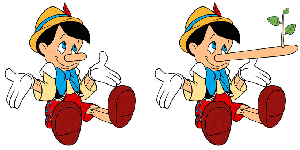
"Not a real boy"

"Not a real boy"

Somebody had to do this, so it may as well be me.  Sometimes to bring clarity to issues, it helps me if I dumb-it-down.  Which got me to wondering, how would the whole healthcare reform debate play out with Mother Goose?  Here’s what I was able to learn from my interviews.

Jack & Jill went up the hill, Jack fell down, and learned Mother Goose’s insurance wouldn’t cover him because he’s not a real boy.  Having recovered, Jack was soon found not so nimbly jumping over the candlestick.  His charred wooden body is being sanded in an effort to heal the burns.  Not only is Jack not a real boy, he’s also not a candidate for Mensa.

They sent the Little Old Woman who lived in the shoe home with a can of Desenex because her AARP insurance had expired and Medicare told her she already used her share of the money.  Afterwards, she was interviewed by Planned Parenthood for an episode of “I didn’t know I was pregnant.”

And remember that tuffet upon which Little Miss Muffet sat?  It wasn’t the spider who frightened her away, it was the deductible she’d hay to pay to cover the rash she got.  She tried sussing out her own treatment using social media on WebMd.

Jack Sprat could eat no fat, but he forgot to disclose that when he completed his insurance application.  He now suffers anemia anonymously as his not so lean wife left him.

How about Peter Peter Pumpkin eater?  All that fiber blocked his colon—a little personal prevention could have saved him a lot of time posed in the Thinker position.

Mary and Little Bo-Peep had a little mutton for dinner which after having sat on the counter all day produced various toxins which were absorbed into their bloodstream.  This resulted in them being rushed to the Mother Goose Clinic with a case of food poisoning.

Simple Simon met a pieman who knew nothing of pasteurization.  Simple is sitting three seats away from Mary in the waiting room.  The Clinic has been unable to locate either of their records on their EHR which cost in excess of one hundred million dollars.

Old King Cole called for his pipe even though he had a severe case of sinusitis.  CVS was out of Z-packs, and home he went with just a tin of Prince Albert.

All the king’s men tried to make a meal out of Mr. Dumpty.  Several were to learn later that one can get Salmonella from eating a raw egg that had been tromped on by horses.

Pat-a-cake.  The baker’s man, not one for washing his hands before pattying his cakes, caused Tommy to be seen by an internist.  Apparently neither real men nor cartoon men wash there hands.

The Butcher, the Baker, and the Candlestick-Maker, were being treated for nontuberculous mycobacterial disease for poor hygiene having been found bathing together.

It was reported that Georgie Porgie who’d been kissing girls had made them cry when they discovered they had contracted the herpes simplex virus.  Their mother, embarrassed by the turn of events, reported to the school that her twins were out with the H1N1 virus.

The Three Blind Mice were found to have stitched themselves together after unsuccessfully trying to sew back on each other’s tails.  It was later discovered that the tails had been cut off by the Farmer’s wife with the Butcher’s knife.  The mice are suffering from septicemia.  The Crooked Man and Yankee Doodle are trying to ascertain why the Farmer’s Wife and the Butcher were later found hiding in the barn.  The Farmer’s wife is being treated with Effexor on an out-patient basis for clinical depression.  The Farmer was not available for comment.

It’s believed that Willie Winkie is suffering from a plantar wart after running through the town in just his nightgown.  Uninsured, he tried removing the wart with the knife he’d borrowed from the Butcher, only learn the knife had been recently use to amputate the tails of some handicapped mice.

Old Mother Hubbard, a spinster of questionable repute, upon learning that there were no bones in the cupboard for her dog Hannibal, began to get hungry herself.  She settled for a meaty broth, and fava bean soup, and a nice Chianti.  Polly was seen putting on the kettle.  The SPCA continues to look for Ms. Hubbard’s dog.

saint

Is the term “Payor” healthcare’s oxymoron?

One of the great things about fall is that as I prune back the vestiges of my virtual garden I am able to collect basketful upon basketful of overly ripe metaphorical tomatoes, perfect for tossing at aberrant analogies and inappropriate idioms.

It’s a curious time.  We give away money to the middle class and rich so they can upgrade their BMWs on the backs of the poor.  The feds market that idea as though that pittance will either jump start the economy, or to hide the fact that that the administration has managed to budget for a nine trillion dollar deficit gap over ten years.

By now we know there are no quick fixes, no magic formulas for fixing the economy.  Finding a formula that works will be more difficult than learning how to neatly fold a fitted bed sheet.

“Is it the essential paradox of the age of Obama that we have to destroy the village in order to save it, bust the budget in hopes someday we’ll balance it?” Nancy Gibbs, Time, September 9, 2009.

“It takes an idiot to raze a village.” Paul Roemer, today.

Congress is trying to decide what the final bill will look like without ever having read the first draft.  How will we know when they have something that makes sense?  Do we watch the Congressional chimney to see if the smoke is white or black?  Does that mean we have a bill, or is it simply that the chef burnt the Peking Duck?

Then there are the payors.  Get me started, or don’t.  We all know that one of the driving factors for reform is the behavior of the payors.  A friend asks—for full disclosure I note that she is one of “them”—why do people view health insurers differently from auto, life, or home owners insurance.  She was serious.

Here’s my take on the answer.  If the health insurance firms provided life insurance they’d be exhuming the deceased and trying to prove they weren’t dead.  Car smashed, get a check.  House leaks, get a check.  Die, get a check.  Need surgery.  Not so fast.  Let’s see if you’re covered for that.  If not, whew.  If yes, let our doctors decide if you really need the surgery.  It won’t cost you a minute of your time as our doctors don’t even need to examine you.  You see how this plays out?

It happened to me after my heart attack, albeit with my disability payor, sort of the evil step sister of the health side.  My doctor put me on six months disability, naturally, the payor declined to pay.  There doctor, who never examined me decided I was fine, at least that’s what their letter stated.  How do we know these doctors even exist?  Have they ever been seen in the daylight?

Most Americans don’t believe that insurance companies are interested in helping people.  They like us fine when people are payors.  They are much less fond of us when people become patients.  It’s a simple matter of flow theory.  As long as the flow of cash is in-bound, all is well.  When people move to the dark side, from payors to patients, payors have no patience.

Is there anyone who believes that there is a single payor in the country whose mission statement says anything about doing all we can to help those who need us?  Of course not.  Payors have claims adjusters.  What is their role?  It’s certainly not to adjust the payment higher.

Do payors incent their employees to pay out as little as possible?  I believe they do.  Do payors penalize or retrain people who pay out too much?  I believe they do.  Do they design the claims and dispute process so as to make it so cumbersome on patients and doctors that parties give up prior to settling?  I believe they do.

I believe the payor business model is not much different from that of tobacco companies.  For years tobacco firms claimed there was no public evidence to support the fact that nicotine was addictive.  It turns out they buried the evidence.  Payors claim they are not bad actors.  Some claim the moon landing was faked.

I am a firm believer that pictures can sometimes convey more than mere words.  To me, this link explains a lot about what’s wrong with healthcare.

http://www.youtube.com/watch?v=Z7Forzj5-O0 Start playing at 6 minutes and 40 seconds.

pastedGraphic.tiff.converted

Reform’s possible negative impact on payors

Don’t start cheering yet, but there may be a negative financial impact for payors.  How?

A fine will be imposed on people who do not get insurance.  The fine will be an annual charge of $750, far less than what insurance would cost.

People can opt-out of insurance until they are ill enough to require treatment.  Insurers  must provide coverage for those people. When healthy people pay premiums, the margins earned by the insurers are almost infinite.  If payors could figure out how to legally offer insurance to rocks and get the rocks to write a premium check each month, they probably would.  (Can’t you just see the business development people getting sweaty palms over this idea?)

When healthy people cross over to the dark side–going from insured to patient–margins go from infinite to very negative which is why it there is no business model that works if all you do is insure sick people.  To really mess with their minds and their margins, all that needs to happen is for people to opt-out of paying premiums when they’re healthy and opt-in when they are sick.

Of course, payors will build this into their actuarial tables, and simply pass on the cost  of these occurrences to the rest of us thereby making it a wash for them.   Well, the idea that the payors might be adversely impacted was nice for the minute it took to read this.

saint

Reform: confessions of a drive-by mind

My wife said she had to call DC.  “All of it?” I asked.  Failed to even crack a smile—she must have left her funny bone in her briefcase.  I described her mom’s dog as a tennis ball with lips which seemed to be bred to be terrified of everything.  That had me zero for two, and losing ground quickly.

Today’s social networking technology allows one to take umbrage with everything from reform to how your neighbor shovels the snow from their sidewalk.  It’s an especially neat set of tools for those of us who have borderline control issues.  Which I do not, I told the unfunny woman next to me.  “You want to tell people how to tie their shoes because you think you do it better than them,” she remarked.  “Which is probably why flying bothers you so much; your nagging belief that the pilot isn’t qualified.”

Where was I before I interrupted myself?  Now, before anyone starts name-calling, I shall admit that I can be a bit of a heterodox.  Sometimes instead of talking I write, it’s like taking my thoughts for a walk in the park with an occasional pause at a fire hydrant.

I am beset by several unanswered questions about reform.  What do you think?  Is healthcare reform an attempt to make America a risk-free society, to rid people of what might be in order to exercise control where none exists?  Is it possible Jerry Springer was asked to provide ad hominem comment over the healthcare reform legislation, or that the plot line was a rerun of something written by David Mamet?  Does the tedium of reading the bill’s thousand-plus pages make stamp collecting seem like a full contact sport?

It’s too bad the Administration had the misfortune of drafting the reform legislation without having the luxury of hiding behind the Iraq maelstrom as we did during the Cheney presidency.  We may find some solace in that even with it now looking like some form of reform—version 5.0—will pass this year, our system will still be better than the UK’s, which is essential since they do much better with Shakespeare than us—I think it has something to do with their dedication to the diction of the British English.  “O, yet defend me, friends; I am but hurt.” (Claudius in Hamlet.  Is this where Python got the idea for, “I’m not dead yet?”)

We would be more likely to turn Hamlet into a navel gazing rap musical, than try to do it justice by reciting the original English.  Perhaps that is why we enjoy PBS as it gives our snobbery a chance to imagine the world as a series of Masterpiece Theater renditions.

If the reform effort still smacks of vestiges of nineties healthcare kitsch, it may be because nostalgia is still what it used to be and never was.  Either way, it looks like we will have something more concrete at which we can pit our opinions.  It will cost in the neighborhood of nine hundred million dollars, and yet we still aren’t able to distill the main talking points on two or three PowerPoint slides.

saint

Reform: Congress must answer, “What’s in it form me?”

If reform fails to pass, what’s the reason?

Is it because Congress ignored that ninety-eight percent of healthcare is local; Hyperlocal?  I think the answer is a resounding yes.  What is hyperlocal?  You know the saying, “All politics is local?”  Well, hyperlocal is local on steroids.  It’s moms and dads making choices about who will care for their family.  It’s the doctor down the street, not the doctor chosen by some system.

I think individuals see the bill as “What’s in it for them—them is defined as anyone other than me” and “What will it do to me?”  HR 3200 isn’t viewed as improving my healthcare, nobody sees it as meCare.  That is why when viewed nationally so few are behind it.

It’s not that nobody is interested in providing healthcare to those who don’t have it.  What concerns people who do have healthcare is their belief—which may have nothing to do with reality—is that to provide healthcare to those who don’t have it requires that those who have it to give up some of their benefits.  Those with healthcare see reform as a zero sum game.

What has people trying to kill the bill is that nobody who currently has healthcare believes they will see any net gain benefit from the bill—they will see a net loss.  If any benefit will accrue to those who presently have healthcare, they certainly can’t articulate the benefit.

To gain support for HR3200, Reform 3.0, or whatever it comes to be called the bill must address first person interests, not second or third.  Does that sound selfish?  It may be.  However, they are toying with reforming a fifth of the economy and a service of which eighty percent of the people are generally pleased.

For reform to pass, Congress must learn to conjugate the care verb: First person—iCare, meCare Second and third person—heCare, sheCare, theyCare, youCare. That about covers all the various forms of caring.

What Congress hasn’t come to grips with is that there is no meCare in heCare, sheCare, or theyCare—hence, people don’t care to support reform.

What do you think?

black saint 2