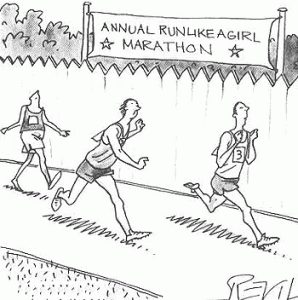
 The title sounds like a Robert Ludlum novel.
Now before you get all upset about the sexist picture, at least read a little bit of this to see why I selected it. Yesterday morning, five miles into my run, I was feeling pretty good about myself. I had passed seven runners, had a nice comfortable rhythm, no insurmountable aches, and Crosby Stills & Nash banging away on my MP3. I don’t like being passed—never have. Some people say I’m competitive. They say other things too, but this is a family show.
I’m a mile away from my car when I see a slight blurring movement out of the corner of my left eye. A second later I am passed by a young blond woman wearing a blue and yellow, midriff-revealing spandex contraption. Her abs are tight enough that I could have bounced a quarter off of them. She is pushing twins in an ergonomic stroller that looked like it was designed by the same people who designed the Big Wheel. I stared at her long enough to notice that not only was she not sweating, she didn’t even appear winded. Blondie returned my glance with a smile that seemed to suggest that someone my age should consider doing something less strenuous—like chess. Game, set, match.
Having recovered nicely from yesterday’s ego deflation, today at the gym I decide to work out on the Stairmaster, the one built like a step escalator. I place my book on the reading stand, slip on my readers—so much for the Lasik surgery, and start to climb.
Five minutes into my climb, a spandex clad woman chipper enough to be the Stepford twin of the girl I encountered on my run mounts the adjoining Stairmaster. We exchange pleasantries, she asks what I’m reading, and we return to our respective workouts. The first thing I do is to toss my readers into my running bag. I steal a glance at the settings on her machine and am encouraged that my METS reading is higher than hers, even though I have no idea whether that is good or bad.
Fifteen minutes; twenty minutes. I am thirsty, and water is dripping off me like I had just showered with one of Kohler’s full body shower fixtures. I want to take a drink and I want to towel off, but I will not be the first to show weakness. Sooner or later she will need a drink. I can hold out, I tell myself. Twenty-five minutes—she breaks. I wait another two minutes before drinking, just to show her I really didn’t need it.
She eyeballs me. Game on. She cranks up her steps per minute to equal mine. Our steps are in synch. I remove my hands from the support bars as a sign that support bars are for sissies–like bed railings for toddlers. Without turning my head, I can see that she’s noticed. She makes a call from her cell to demonstrate that she has the stamina to exercise and talk.
When she hangs up I ask her how long she usually does this machine—we are approaching forty minutes and I am losing feeling in my legs. She casually replies that she does it until she’s tires, indicating she’s got a lot left in her. I tell her I lifted for an hour before I started; she gives me a look to suggest she’s not buying that. I add another ten steps a minute to my pace. She matches me step for step.
Fifty minutes. I’m done toying with her. I tell Spandex I’m not stopping until she does. She simply smiles. Her phone rings and she pauses her machine—be still my heart—and talks for a few minutes. I secretly scale down my pace, placing my towel over the readout hoping she won’t notice. She steps down from the machine. My muscles are screaming for me to quit, but I don’t until I see that she’s left the gym.
Victory at any cost. What’s the point? For what was lost, for what was gained (McKendree Spring).
Men versus women. Healthcare providers versus EHR vendors. It’s warm and fuzzy until the contract is signed, and niether side is prone to yield, sort of like trying to dispute an insurance claim. The only way to disarm this food fight is by being excrutiatingly detailed in the planning stage. The value of warm and fuzzy in court is zero.
Both sides must be held accountable for what is implemented. It does no good to say, “I thought it was going to be able to do this.” What to do? Document. Everything. Define the functional and technical requirements with rigor–the non medical kind. Spell them out in a requirements document, have the vendor document if they can meet it and have them provide detailed estimates of any and all modifications or customizations. Make the RFP a part of the contract.
Meet their customers. Spend a few days with them. This is not a phone call, this is not lunch, this is roll up the sleves, learn about what they did wrong, ask what the vendor didn’t do, document it, and–class–put it in the RFP. Change management, workflows, training–soft issues. Difficult to document. Too bad. Document the heck out of these–requirements and responsibilities of both sides. I guarantee the vendor will document your responsibilities and then show you where you failed to meet them.
It is in the best interest of the vendor for you to do what is in your best interest. That is the only way to make this work. This is a double-sided ‘trust but verify’ situation.

 Pale Rhino Consulting
Excellent post.
BTW, I am a vendor. 🙂
LikeLike
Thanks for the kind words Doc. No vendors were hurt in the writing of the blog.
LikeLike
LOL. And, I agree.
LikeLike