What people at HIMSS were afraid to say

One image of HIMSS that will not escape my mind is the movie Capricorn One—one of OJ’s non-slasher films.  For those who have not seen it, the movie centers on the first manned trip to Mars.  A NASA Mars mission won’t work, and its funding is endangered, so feds decide to fake it just this once. But then they have to keep the secret…

The astronauts are pulled off the ship just before launch by shadowy government types and whisked off to a film studio in the desert.  The space vehicle has a major defect which NASA just daren’t admit. At the studio, over a course of months, the astronauts are forced to act out the journey and the landing to trick the world into believing they have made the trip.

Upon the return trip to Earth, the empty spacecraft unexpectedly burns up due to a faulty heat shield during reentry. The captive astronauts realize that officials can never release them as it would expose the government’s elaborate hoax.

I think much of what I saw at the show was healthcare’s version of Capricorn One.  Nothing deliberately misleading, or meant as a cover-up or a hoax.  Rather more like highlighting a single grain of sand and trying to get others to believe the grain of sand in an entire beach.

The sets for interoperability and HIEs served as the Martian landscape, minus any red dust.  There was a wall behind the stage from where the presentation interoperability was shown.  I was tempted to sneak behind it to see if I could find the Wizard, the one pulling all the nobs and using the smoke and mirrors to such great effect.  It was an attempt to make believers, to make people believe the national healthcare network is coming together, to make us believe it is working today and that it is coming soon to a theater near you.

After all, it must be real; we saw it.  People wearing hats and shirts emblazoned with interoperability were telling us this was so, and they would not lie to you.

The big-wigs, and former big-wigs—kudos to Dr. B. for all his hard work—were at the show for everyone to see, and to add a smidgen of credibility to the message.  They would not say this was going to happen if it were not—Toto, say this ain’t true.

The public relations were perfect, a little too perfect if you asked me.  Everyone was on message.  If you live in Oz and go to bed tonight believing all is right with the world, stop reading now.  If what you wanted from HIMSS was a warm and fuzzy feeling that everything is under control and that someone really has a plan to make everything work you probably loved it.

Here is the truth as this reporter saw it.  This is not for the squeamish, and some of it may be offensive to children under thirteen or C-suiters over forty.  In the general sessions nobody dared speak to the fact that:

  • Most large EHR implementations are failing.
  • Meaningful Use isn’t, and most hospitals will fail to meet it.
  • Hospital productivity is falling faster than are the Cubs chances of winning a pennant.
  • Most hospitals changed their business model to chase the check
  • Most providers will not see a nickel of the ARRA money—the check is not in the mail and it may never be.

The future as they see it is not here, and may never be, at least until someone comes up with a viable plan.  Indeed, CMS and the ONC have altered the future, but it ain’t what it used to be.  People speak to the need to disrupt healthcare.  Disrupt it is exactly what they have done.  The question is what will it cost to undo the disruption once reason reenters the equation?  What then is the future for many hospitals?

  • Hospitals on the whole will lose more much more money due to failing to be ready for ICD-10 than they will ever have seen through the ARRA lottery.
  • It make take years to recover the productivity loses from EHR and the recoup those revenues.
  • Hospitals spending money to design their systems to tie them into the mythical HIE/N-HIN beast will spend millions redesigning them to adapt to the real interconnect solution.
  • The real interconnect solution will be built bottom-up, from patients and their primary care physicians.
  • Standardized EMRs will reside in the cloud and patients will use the next generation of smart devices.  And like it or not, the winners will be Apple, Google, and Microsoft, not the ONC and CMS.  Why?  Because that is who real people go to to buy technology and applications.  A doctor still does not know which EHR to buy or how to make it work.  Give that same doctor a chance to buy a solution on a device like an iPad and the line of customers will circle the block.

And when doctors are not seeing patients they can use the device to listen to Celine Dion.  This goes to show you there are flaws with every idea, even some of mine.


CHIME versus RHIME (Roemer’s Health Information Management Executives)

So, what’s up with CHIME?  The attendees are all tucked away in an underground bunker in the convention center, the entrance of which is guarded by members of AARP.  Rows of cellophane sandwiches are lined up behind the concertina wire.  The group remind me of Yale’s Skull and Bones society, or at very least some renegade chapter of the masons.

If you walk up to Checkpoint Charlie, you must shield your eyes from the search lights.  German Shepherds pull at their leashes lest you get too close.

You need to be a CIO, I am told.  I am not one of the chosen.  I try every trick–they all fail.  I meet one man who is a member of the elite group.  He used to be a CIO, but is no more.  Yet still he is a member.  I asked him how he managed this feat of deception.  He tells me he is a FIO–freelance information officer.  Suddenly, my mind is all-a-twitter.

Change the letters, and I am in.  I try to bluff my way past the guards with the FIO idea.  I don’t really want to be in the meetings; but the free food has my attention.  Mrs. AARP stops me cold.

Then it comes to me.  The answer lies in changing the letter, but not the CIO letters, the CHIME letters.

I have decided to form RHIME.  Roemer’s Health Information Management Executives.  Avoid the rush, join today–and bring sandwiches.

Poken: How to push the EMR to the cloud

For those wondering if the fact that I have not written recently is a result of me having mellowed or having found the world more to my liking, not true.  I have been busy earning minus points as I tried to get it sorted in those wide open spaces of my mind.  It is difficult for me to find much comfort in sleep when I think all the leftist gremlins are in cahoots—I see two masons shaking hands and I think conspiracy.

Now, before this begins to read like I wandered too far from the republican rest home, I note that some of my best friends actually know democrats; so I am not as close-minded, or perhaps clothes-minded, as I would like to be.

Some are slow to adapt ideas to a changing world, aimlessly swatting new ideas away with a no-pest-strip as though they were plague carrying mosquitos.  Their thoughts, frozen in time, move so slowly they have been overtaken by a skateboard—and that skateboard was under someone’s arm.  These are the same individuals whose ability to play outside of the comfort of their own sandbox has not been seen since the internet was powered by steam.  It is a little like being a dinosaur while those around you are still floundering in the primordial bisque, still trying to wrap their synapses around the cold ideas distilled in the anecdote.

That is not to suggest that others do not think.  I am sure they have dozens of thoughts scribbled on the inside of their head, but those thoughts are erased each time they play with their hair—brains not big enough to swing a cat in without giving it a minor concussion.  There are fomenting alchemies of thought nuggets, but never quite enough to turn base metals into gold.  Sometimes, when the lighting is just right, you can see their curve of illogic thought arching overhead like static electricity.

In normal prose, I tend to be few of words.  I can get through entire days uttering no more than ‘uh-huh,’ a condition to which I attribute having exited the womb not fully-formed.  Writing is different than the spoken word.  For one thing it is infinitely easier and more pleasingly voyeuristic, for it can more entertaining to write about venomous ideas, not enough to kill my prey, simply to stun it.

Where then do ideas originate?  They are not like sex in a packet where all you have to do is add water.  The lack of thinking has led us to a tragic age most refuse to take tragically.  Thought patterns are aborted before they germinate, as though the thinker was taking intellectual contraceptives.  But believe it or not, I often find myself hoisted high on the petard of my own self-induced mesanic naivetés.  When a spark of a thought enters my mind, I rarely let it go quietly into that good night.  Instead I tear at it like Henry VIII coming off a forced diet—I know I mixed the metaphor, but I liked it.

I know rarely how my mind moves me from thoughts A to B.  Today proved no different.  Take the Poken.  This device is the newest technological mind-nibblet—a tiny jump-drive device about the size of prune whose purpose in life is to help two individuals sync their personal contacts by pok-in’ their respective Pokens.

You have got to hand it to them, for it sounds like it could be more entertaining than syncing one’s Blackberry.  If I understand correctly the concept, if my Poken pokes your Poken the Pokii mate—Pokii may or may not be the correct form of the plural, but it will have to do for now.  Once the mating process has ended, and before mine finishes its cigarette, I have your contact information and you have mine.

This could be an interesting way to swap business contacts, but as I live in the land of the Jabberwocky my mind does not work that way.  “Then he got an idea, an awful idea. The Grinch got a wonderful, awful idea.”

I jested about the Poken a few days ago, and then I thought about how this device could be made to work in healthcare.  The Poken is a communication device, sending and receiving secure requests to the cloud to permit one to access and update contact information.  Not much of a healthcare offering doing that, but what if?  What if instead of letting me share my contact information with someone I select, it, or something like it, allowed me to share my personal health record with my physician?  What if my physician was able to update my health record using a similar device?

The EMR and PMR applications would be in the cloud.  The Poken would provide the “handshake.”  One fully functional EMR.  The rest is history.  Thanks for playing along.


Guest post: EHR would work better if we just got rid of the doctors

I am pleased to share a guest blog by Sue Kozlowski, the Manager of Performance Improvement at Henry Ford Hospital in Detroit, Michigan. She’s a featured blogger at iSixSigma.com, writing on lean process improvement and change management.  Sue and I were speaking about some of the issues surrounding EHR.  She had an interesting and new perspective, and I asked her to share it with you.  One of my physicians shard something similar with me about the value of the data in their EHR, “The data is great if you are a patient or payer who wants to sue us.”

Thanks Sue.  The rest is hers.

The EHR’s New Clothes

Paul and I were talking the other day about Electronic Health Record systems, and he made an interesting comment. It seems that some hospitals and systems implement their EHR expecting great things, and then they’re somewhat startled to see a big drop in productivity – sometimes on the order of 10 – 30%.

I have a hypothesis about this, related to the way healthcare experts work and the way EHRs are designed. To become a physician, you go through years of school. You learn to develop an intuitive thought process that puts together the patient’s current state, his or her desired future condition, and medical pathway to get there. You were trained to document on a paper chart and when you write assessments or orders, you write them in the chart, sign/date/time it, and then leave the chart for a clerk to transcribe orders and follow through on them.

Now let’s look at this process with an EHR which has a feature called CPOE, Computerized Physician Order Entry. Let’s write a prescription, shall we? (By the way, this scenario is not based on any one system but may be considered a possible experience.)
1. Go to the meds tab
2. Start typing into the field “Tyl”
3. See the drop-down list bring up Tylenol, pick Tylenol
4. Click on the dose field to bring up the drop-down list
5. Scroll down and select 200 mg
6. Click on the route field to bring up the drop-down list
7. Scroll down and look for “oral;” settle for “by mouth”
8. Click on the frequency field to bring up the drop-down list
9. Scroll down and look for PRN; have to select “every 4 hours as needed”
10. Click on the Start Date field to bring up the calendar (can’t just type it in)
11. Select the start date
12. Go to “Electronic Signature” field and type in first three letters of last name
13. Find name in drop-down box
14. Click “Enter”
15. Get warning message, “Medication Alert;” click on alert button to see details
16. Read that Tylenol may have a reaction with another medication the patient is taking; click “Continue”
17. Scroll back down to click on “Enter”

And that’s just for one medication order!

So my point to Paul in this discussion was that so far, we have developed electronic documentation and billing systems that are wonderful for capturing standard documentation information; this is very useful for data-mining and for coding and billing. Features like cross-checking drug interactions, or pre-loading patient care pathways, can also enhance patient safety. These are all good things.

But, it doesn’t do so much for fast-thinking, highly trained, busy caregivers. The cost is in the productivity of the people who are entering the data. From a computer standpoint, everything is codified and the programmers have been careful to provide every possible alternative available in drop-down and radio-button format. We’ve turned the process from a 30-second note (granted, sometimes illegible) into a 3-minute process that is safer, great for reporting, and maximizes appropriate revenue.

And drops your productivity about 20%.

Lest you consider me a Luddite, I’m actually an early adopter of most new technologies and I love the prospect of safer patient care that an electronic medical record can bring. As a process improver, I’m ecstatic about the data mining opportunities. But let’s be realistic when we make these decisions: there is a cost, in addition to money, that must be paid to use these systems in their current state. I hope that in the future, programming can mimic the physician’s thought process and approach. In today’s world, it feels like we are asking our clinicians to meet the needs of the capability of the application, rather than building systems that maximize the value of the clinician’s time.

Healthcare IT: Shave the Cat

As I was going up the stair, I met a man who wasn’t there.

He wasn’t there again today…I think, I think, he’d gone away.

This particular fellow happened to be a CIO.  Now, before you throw tomatoes at your monitor, he was atypical; I hope.

We were talking about the various healthcare initiatives that have his attention as the CIO of a hospital.

EHR—done

Meaningful Use—we will pass it in April

Planning for HIPAA 5010 and ICD-10—starting in July

He did not even blink.  It was almost like he was bemused by the triviality of what he faced.  Listening to him, it sounded like he was reading from a scrap of paper he had pulled from hi pants pocket:

  1. Pick up one gallon of milk
  2. Finish EHR
  3. Drop off dry cleaning
  4. Collect ARRA money
  5. Shave the cat
  6. Convert ten thousand systems to 5010
  7. Walk on water

If there is a difference between being confident and being grounded in reality, he may be the poster child.

EHR–where do you place the emphasis?

You said I stole the money. Sometimes it all depends on what you emphasize. For example, say the sentence aloud to a friend, and each time place the emphasis on a new word. You said I stole the money. Yousaid I stole the money. You said I stole the money. You said I stole the money. You said I stole the money. The meaning changes as you change your emphasis. You said I stole the money? You can even change it so that it reads like a question.

The same is true with providers and the level of success a firm has working with EHR. Where is your emphasis? If you believe there is a correlation between emphasis and spending, I bet we can prove your firm’s is much more closely aligned to technology than it is to process. What does technology address? Let’s list how deploying technology makes your firm better, or does it?  Millions followed by millions more. Redesign the patient portal.  Add EHR. Mine the data—heck, strip mine it.  Show me the ROI. Isn’t that a lot of money to spend without a corresponding business justification?  Then add in the fact that the productivity at many hospitals after implementing EHR is twenty percent below what it was prior to EHR.  That does not not do much for the ROI.

The technology that is tossed at the problem reminds me of the scene from the “Wizard of Oz” when the Wizard instructs Dorothy and the others, “Pay no attention to the man behind the curtain.” When Toto pulls the curtain aside, we see a nibblet—I love that word—of a man standing in front of a technological marvel. What’s he doing? He’s trying to make an impression with smoke and mirrors, and he’s hoping nobody notices that the Great Oz is a phony, that his technology brings nothing to help them complete their mission.

From whose budget do these technology dollars usually come for EHR? IT. From the office of the CIO–the only department in the whole hospital which will not “use” the EHR. What did you get for those millions?  Just asking.
Part of the problem with doing something worth doing on the EHR front is that it requires something you can’t touch, there’s no brochure for it, and you can’t plug it in. It’s process. It requires soft skills and the courage to change your firm’s emphasis. They won’t like doing it, but they will love the results.

Blazing Saddles: the original HIE-NHIN model

Several have inquired as to why I came down so hard in yesterday’s post regarding the CMS-ONC’s approach to link our physicians and hospitals through the development of HIEs and the N-HIN.  I think, as do others, the goal is worthwhile but, is the current strategy going to work?
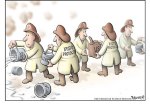
I think the current plan is fatally flawed, and is racing ahead like a herd of turtles.  Just because everyone is working hard, and has good intentions, does not necessarily mean the outcome will deliver what is needed.  It seems over engineered to the point that it is like trying to put ten pounds of turnips into a five-pound bag.

Unfortunately, until the leadership of the CMS and the ONC come to that realization the CMS, the ONC, and healthcare providers will continue to spend hundreds of millions of dollars to support an infrastructure that:

  • Unnecessarily complex
  • Is not necessary nor sufficient
  • Cannot be built
  • Will not work

Call me Deep Throat.  The perspective that the HIE-NHIN plan will not work is only spoken of in the bowels of the Watergate Hotel’s parking garage in hushed voices late at night.  Many of you have shared with me that you are of the same opinion but, like vampires you shudder that your voice on this matter would see the light of day.  It would be less antagonistic to open a kosher deli in Tehran than to say the CMS-ONC needs to be rethunk but, sometimes a little antagonism is what is needed.

Do you recall the scene in Blazing Saddles when Harvey Korman’s horde of bad guys is racing through the desert on horseback to get to the town of Rock Ridge only to be halted in the middle of a wide open prairie by a lone toll gate?  Instead of being able to go directly to where they wanted to go they are forced to go through the toll gate, and their progress is stopped entirely because nobody has any spare change.

What makes it nonsensical, and quite funny, is their failure to realize that all they had to do was o ride around the toll gate.  Maybe it is just the way my mind works, but trying to get electronic health records to a national network via several hundred disparate HIEs reminds me of the toll gate.  Why not just go around it?


EHR, HIEs & N-HIN; a prophecy of doom

Whether it’s vendors, RHIOs, HIEs, or the N-HIN, where is a plan that will work?  Is not this what it’s all about?  Perhaps it is time that the rest of the national HIT leaders at CMS and the ONC who devised this plan, and who have lead physicians and hospitals down this ill-fated path promising them riches at the end of the journey should acknowledge their mistake and look for other ways to pass their time; pursue something more achievable, like gardening.

If the plan of of nationalizing healthcare by using HIEs, RHIOs, Meaningful Use, and the N-HIN had any real chance of working, don’t you think we would see a lot more organizations lining up to collect their EHR rebate?

In 1-2 years Meaningful Use will have been replaced by something else or done away with entirely.  In 3-5 years the HIE-NHIN plan will have changed dramatically.  That does not help people who are spending money today chasing ghosts.

As a side note, many hospitals will miss the ICD-10 conversion date.  Not for lack of interest, but because so much of their attention is focused on chasing the banshee known as EHR.

HIEs remind me of hand-to-hand fire bucket brigades.  It’s time we agree to use a truck.

EHR–it’s like herding cats

Herd of cats? Of course I’ve heard of cats.

I spent a summer in Weaverville, North Carolina, just outside of Asheville. (I couldn’t find it on the map either.) That summer, I was the head wrangler at Windy Gap, a summer camp for high school kids. I’m not sure I’d ever seen a horse, much less ridden one, so I guess that’s why they put me in charge. I thought that maybe if I dressed the part that would help. I bought a hat and borrowed a pair of cowboy boots from a friend; the boots were a half size too small, and I spent the better part of the first night stuffing sticks of butter down them trying to get them off my swollen feet.

The ranch’s full-time hand taught us how saddle the horses and little bit about how to ride. In the mornings we had to herd the horses from the fields, bring them into the corral, and saddle them. The other wranglers would ride out to the field to bring in the horses, while I being the least experience of the wranglers would race after them in my running shoes trying to coax them back to the barn. We would take the children for a breakfast ride halfway up a mountain path where we would let them rest and cook them a breakfast of sausage and scrambled eggs. One morning there were a group of 15 high school girls sitting on the fence of the corral. I walked up behind them carrying two saddle bags filled with the breakfast fare. I slung the saddlebags over the top rail of the fence, and hoping to make a good impression I placed one hand on the rail and vaulted myself over. I landed flat on my back smack dab in the middle of the pile of what horses produce when they’re done eating—so much for the good impression.  That earned me the nick-name, “Poop Wrangler.”

I brushed myself off and saddled my horse. The moment I gripped the reins the horse reared, made a dash for the fence and jumped it in one motion. I could tell the high school girls were impressed as I flew by them. Both of my arms were wrapped around the horse’s neck, and I had my hands locked in a death grip. I yelled, “whoa” and stop”, only to learn that the horse didn’t speak English. We raced the 200 yards to the dining hall, stopped on a dime, and raced back to the corral, as the girls continued to cheer. One final leap, and I was back where I started; on the ground, in the corral, looking up at the girls. I took a bow and quickly remounted my steed. The full-time ranch hand came over and instructed me rather loudly, “You can’t let the horse do that. You have to show the horse that you’re in charge.” After that piece of wisdom he grabbed my horse by its bit, pulled its head down, and bit a hole in my horse’s ear. I’m not sure what kind of in an impression it made on my horse. I guarantee you it made an impression on me.

Horses aren’t very intelligent, but they know when you don’t know what you’re doing, when you’re bluffing—dressing like a cowboy didn’t even fool the girls, much less my horse—I guess he hadn’t seen many westerns. Here we go—you had to know where this was headed.

Selecting and implementing an EHR will be the most complex project your hospital will undertake.  If you do it wrong, you may not look any better than I did laying on my back in the corral.  You won’t have girls laughing at you, but you also may be looking for another line of work.

You don’t want to read this, but if your projected spend exceeds ten million dollars, your chances of success, even if you do everything right, is less than fifty percent.  I define success as on time, on budget, functioning at the desired level, and accepted by the users.  That’s reasonable, correct?  We don’t need to talk percentages if you don’t do everything right.

These figures come from the Bull Report—that’s really the name, honest.

The main IT project failure criteria identified by the IT and project managers were:

missed deadlines (75%)
exceeded budget (55%)
poor communications (40%)
inability to meet project requirements (37%).

The main success criteria identified were :

meeting milestones (51%)
maintaining the required quality levels (32%)
meeting the budget (31%)

How is yours matching against these?  Given a choice, sometimes I’d rather be the horse.


The impact of ACO on financial systems

This is my latest post on healthsystemCIO.com

http://healthsystemcio.com/2011/02/08/the-rough-road-to-interoperable-financials/