Healthleaders Media: E-Health Systems: For Love or Money?

The following are the comments I posted to Gienna’s article, http://ow.ly/3FWTP

Nicely written Gienna.  My concerns from the get go regarding Meaningful Use (MU) and Certification are:

  • Is Meaningful Use meaningful
  • If so, to whom


My answer to both questions is it is meaningful, on paper, to the ONC and CMS.  It is meaningful with the respect that it does one thing.


  • Meaningful Use changes the course of a healthcare provider’s business strategy from whatever internal course it was pursuing to one having a national focus.

If you do not believe me, look at your resource plan for meeting MU.  Some hospitals are having to redirect more than fifty percent of their IT resources away from whatever they were doing for the hospital to meet the MU requirements.

The article reports several sets of numbers which I think are at best misleading.  I think those hospitals who meet MU will do so much later than are being reported.  Few will make it in time to capture the full EHR “rebate”.  As such, the pool of available money to go back to hospitals is overstated, as are the number of hospitals who will receive it.

There is a broad chasm between those who expect to receive money and the amount they expect to receive, and how much will paid be paid to how many.

Now, with respect to whether any of this is meaningful; how many hospitals would have been willing to sacrifice their business strategy and spend millions of dollars to try to meet such a gossamer directive if this was tied to any other directive originating out of Washington?

Let us take something so outlandish as to be silly just to try to illustrate the point; paining your hospital pink.  If Washington offered similar sums of money and if one had to spend similar resources to earn it, would a hospital’s executive team approve the expenditure?  What is the business reason that makes MU so different?

The other issue I have with their optimistic MU adoption forecasts is the following.  Meeting MU is binary.  That is, there are no points for getting close.  A hospital which meets ninety-five percent of the criteria receives the same rebate as a hospital which meets none of the criteria.  Zero.  Using their own figures, if hospitals meet it by 2016, all they will have done is spent millions to receive zero payout.

As you calculate the ROI for EHR/MU be sure to include the following:

  • Will your EHR implementation be successful?  The latest figures I have seen suggest that your odds of having a successful implementation of EHR are less than one in two.
  • If you are “successful” will you meet it in time to potentially qualify for the full amount—if not, decrease what you expect to receive.
  • Will you complete the requirements to your satisfaction—if not, multiply your expected payout by a number less than one?
  • Will you pass the MU audit?  Some will not.  That is why there is an audit.  If you do not pass, you can reapply at a later date, but you will no longer be entitled to the full amount.  Again, multiply your expected payout by a number less than one.

And, here’s the kicker.  Here is the calculation most hospitals have overlooked.  How much has your productivity dropped since you implemented EHR?  A heads up for hospitals who have not completed their implementation—a large number of hospitals have spent in excess of a hundred million dollars only to see their productivity still twenty percent below what it was without EHR.

What does such a productivity loss do to your ROI calculation?  There is no language from ONC and CMS stating that such a productivity loss is meaningful.
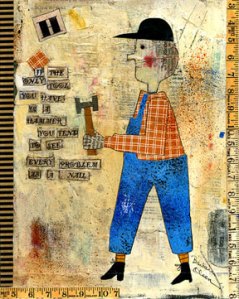
 

EHR: where’s my hammer?

Those of you who’ve visited previously may have caught on to the fact that my wife likes to keep me away from bright shiny objects such as tools.  Let me tell you about my first house, a two-story stucco building in Denver, built in 1902.  My favorite part of the home was the brick wall.  That it had a brick wall was not apparent when I purchased the home.
I came home from work to find that my dog had eaten through the lath and plaster in the living room and there was the brick.  I had to decide what to do.  I knew nothing about lathing—I know that’s not really a word—or plastering.  What to do.  My only tool was a hammer, so I began to hammer.  For those who haven’t done this, hundred-year-old plaster being pounded with a hammer makes a lot of dust.  This process proved to be very slow.

What did I do?  I bought a bigger hammer—such a guy approach to a problem, isn’t it?  It took three hammers to get down to just bare brick.  What would you have done?  When your only tool is a hammer every problem looks like a nail–or a wall.

As you go through the EHR planning process in your war room—you do have a war room, don’t you?  (Try Sam’s Club, after all, they sell EHRs.)  Get out the really big piece of paper, the one with your EHR design—you do have a really big piece of paper, don’t you?  (Back to Sam’s.)

Next to the box on the paper labeled “Shiny New EHR” should be lots of empty space so you can draw in all of the other systems with which your EHR will have to interface.  One of the readers of this blog wrote recently that his EHR had more than 400 interfaces.

EHR, if done correctly, will do much for patients, doctors, and administrators.  It’s not a panacea.  It won’t reach its potential unless you also integrate it with those systems that unlock its potential.  Improving your efficiency and effectiveness takes more than merely an EHR system.

When your only tool is a hammer, you’d better hope every problem is a nail.  What other tools are you using?  Please share your ideas about what works well.

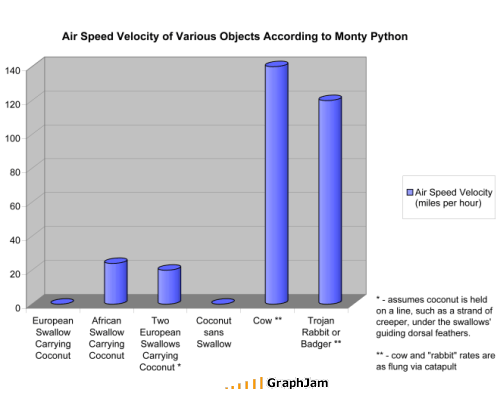
EHR: The Migratory Patterns of Coconuts

Are you suggesting coconuts migrate? (Not at all, but a swallow could grip it by its husk.)

Sometimes I get reactions from my clients which suggest that my ideas have people questioning if I just fell out of the stupid tree and hit every branch on the way down, especially when what we’re discussing seems to move from the theoretical and towards the heretical. However, there was a presentation I made to one of my clients where I had the entire room believing that i might as well have been suggesting that coconuts migrate.

Allow me to set the stage. I presented to the CIO of one of the largest providers in Europe a vision for what their IT strategy should be. This was an 0.2 firm requiring a 2.0 solution.  As you can guess, it was fairly easy to suggest that better alternatives were available to them, but if you’re a member of the Flat Earth Socitey you’re not going to believe anything until someone is able to literally change your perspective.

During my presentation I wrote on the white board that I would help them choose between three alternatives. At this point, a British colleague and good friend, came to the front of the room—uninvited, removed the marker from my hand, erased the word ‘between’, and penned the word ‘amongst’. “We choose between two things, and amongst three or more,” he said with a grin and then returned to his seat. I suggested that since English was not the native language of our client that his point was probably lost on them, to which he stated that his point was directed at me whose native language was supposed to be English. God save the queen. He also tried to make the point on more than one occasion that the American War of Aggression with England did not end in 1783 with a victory for America, but with a British retreat.

Anyway, we were choosing between three alternatives, at least I was. After about ten minutes of explaining what could be achieved and how it might be structured, I was interrupted again, this time by the CIO. He too took my marker, concluding that I was a coconut. It took me about thirty minutes to convince him that everything I’d presented was not only achievable, but already operational in a number of their competitors.

So, as we head down the EHR path with our Project Management Executive, the person who will be spearheading the internal effort to affect change, we must find a way to make sure the executive is properly equipped. For starters, the executive needs to have, and to be able to communicate a vision, a vision for the change, for how it will impact the organization, and an ability to communicate it.


EHR, the wisdom of crowds

According to National Geographic, a single ant or bee isn’t smart, but their colonies are. The study of swarm intelligence is providing insights that can help humans manage complex systems. The ability of animal groups—such as this flock of starlings—to shift shape as one, even when they have no leader, reflects the genius of collective behavior—something scientists are now tapping to solve human problems.  Two monumental achievements happened this week; someone from MIT developed a mathematical model that mimics the seemingly random behavior of a flight of starlings, and I reached the halfway point in counting backwards from infinity–the number–infinity/2.

Swarm theory. The wisdom of crowds. Contrast that with the ignorance of many to listen to those crowds. In the eighties it took Coca-Cola many months before they heard what the crowd was saying about New Coke. Where does healthcare EHR fit with all of this? I’ll argue that the authors of the public option felt that wisdom.  If you remember the movie Network, towards the end of the movie the anchorman–in this case it was a man, not an anchor person–besides, in the eighties, nobody felt the need it add he/she or it as some morphed politically correct collection of pronouns.  Whoops, I digress.  Where were we?  Oh yes, the anchor-person.  He/she or it went to the window and exhorted everyone to yell, “I’m mad as hell, and I’m not going to take it anymore.”  Pretty soon, his entire audience had followed his lead.

So, starting today, I begin my search for starlings.  A group whose collective wisdom may be able to help shape the healthcare EHR debate.  The requirements for membership is a willingness to leave the path shaped by so few and trodden by so many, to come to a fork in the road and take it. Fly in a new flock.  A flock that says before we get five years down the road and discover that we have created such an unbelievable mess that not only can we not use it, but that we have to write-off the entire effort and redo it, let us at least evaluate whether a strategic change is warranted.  The mess does not lie at the provider level.  It lies in the belief that hundreds of sets of different standards can be married to hundreds of different applications, and then to hundreds of different Rhios.

Where are the starlings headed?  Great question, as it is not sufficient simply to say, “you’re going the wrong way”.  I will write about some of my ideas on that later today.  Please share yours.

Now, when somebody asks you why you strayed from the pack, it would be good to offer a reasoned response.  It’s important to be able to stay on message.  Reform couldn’t do that and look where it is. Here’s a bullet points you can write on a little card, print, laminate, and keep in your wallet if you are challenged.

  • Different standards
  • Different vendors
  • Different Rhios
  • No EHR Czar

Different Standards + Different Vendors + Different Rhios + No Decider = Failure

You know this, I know this.

To know whether your ready to fly in a new direction, ask yourself this question.  Do you believe that under the present framework you will be able to walk into any ER in the country and know with certainty that they can quickly and accurately retrieve all the medical information they need about you?  If you do, keep drinking the Kool Aid.  If your a starling, come fly with us and get the word out.  Now return your seat backs and tray tables to their upright and most uncomfortable positions.


EHR Milestones, should that read Millstones?

If you like adventure, here’s a site to check,http://www.jfk50mile.org/.  This is an annual event whose origin came about during the cold war.  Fortunately for both of us, the entry date has already passed.  The thought behind the JFK fifty-mile hike/run was that because of the possibility of a nuclear attack, each American should be in good enough shape to cover fifty miles in a day.

I participated in the event twice—I wrote participated because to state that I ran the entire way would be misleading— and I can state with certainty that almost no Americans are close to being able to complete this.  The event is run in the fall starting in Boonsboro, Maryland.  It takes place along the Appalachian Trail and the C&O Canal and various other cold, rain soaked, and ice and leaf covered treacherous terrains.

We ran it in our late teens or early twenties, the time in your life when you are indestructible and too dumb to know any better.  One of my most vivid memories of the event was that on the dozen or so miles along the mountain trail, leaves covered the ground.  By default that meant they also covered the rocks along the trail, thus hiding them.  That we were running at elevation—isn’t everyone since you can’t not run at at least some elevation, (that may be the worst sentence every written) but you know what I mean—meant the prior night’s rain resulted in the leaf covered rocks being sheathed in black ice.  That provided a nice diversion, making us look like cows on roller skates—roller blades had yet to catch on outside of California.

There were several places along the trail where the trail seemed to fork—I’m not going to say and I took it—and it wasn’t clearly marked.  Runners could easily take the wrong fork (or should that be Tine?).  I think it would have been helpful had the race organizers installed signs like, “If you are here, you are lost.”  Hold on to that thought, as we may need it later.

Some number of hours after we began we reached the C&O Canal, twenty-six miles of flat terrain along the foot path.  It’s difficult to know how well I was doing in the fifty-mile race, in part because I had never run this distance and because there we no obvious mile markers, at least so I thought.  Then we noticed that about every five and a half to six minutes we would pass a numbered white marbled marker that was embedded along the towpath.  Mile stones.  At the pace we were running, we anticipated we would finish high in the rankings.  As fast as we were running, we were constantly being passed, something that made no sense.  That meant that a number of people were running five minute miles, which we knew they couldn’t do after running through the mountains, or…Or what?

The only thing we knew with any certainty at the end of the day was that the markers with which we used to determine our pace and measure how far we’d run were not mile markers.  We never figured out why they were there or how far apart they were, but we greatly underestimated their distance and hence our progress.

It doesn’t really matter whether you call them mile stones or milestones.  What matters is whether they serve a valid purpose.  If they don’t, milestones become millstones.  Milestones are only useful if they are valid, and if they are met.  Otherwise, they are should’ a, could’ a, would’ a—failure markers, cairns of missed goals and deliverables.

How are your milestones?  Are they valid?  What makes them valid?  Are they yours, or the vendors’?  All things to think about as you move forward.


May I have receipt for my EHR in case I return it?

A hospital in our area just dedicated a new wing.

For months the job site was a maze of people, duct, and tools.  It cost $145 million.  Affixed to the new wing is a plaque displaying the name of the architect, the contractor, the mayor, and the rest of the adults who made it happen.  While it was being built there were numerous permits, certifications, and sign-offs taped to the building.  Their purpose was to ensure the public that the adults were keeping an eye on things.  A phase of work couldn’t be started until the prior phase had all the requisite sign-offs.

Those in authority had to be licensed.  Had to be certified as qualified.

They have another project underway.  One that costs more than the new wing and impacts more people.  This one doesn’t have a blueprint.  There are no building permits.  No certifications.  No licensed professionals.  You can’t even see it.  There are no hard-hatted workers.  No foreman.  You know who’s in charge of the project?  A hospital executive—prior experience—zero.  Has he ever built one before?  No.  Does he know what to do when he encounters risks, pitfalls?  No.  There is one other person running the show—a vendor—that should let everyone get a good night’s sleep.

Would anyone let this same executive be in charge of building a new wing?  Of course not.  Why then do we not employ the same standards for what will turn out to be the most expensive and far reaching non-capital project that the hospital will ever undertake?  If you think you know, please share your answer.

By the way, I asked one of those executives how it was that he happened to be selected to lead the EHR project.  “I forgot to duck,” he quipped.  I guess that’s as good a reason as any.


Meaningful Use is a binary contest—you make it or you don’t

If you haven’t begun the process of selecting and implementing an EHR, Meaningful Use may not be something with which to concern yourself.  The reason, you will probably not be done in time to collect the incentive money. How can that be stated with such assurance?

If you haven’t begun, there may be no rush to acquire an EHR, although the EHR vendors will not tell you that. Don’t cost yourself tens of millions get to have a chance at a few.

Meaningful Use will be delayed because few if any of the providers will pass the Meaningful Use Audit. Washington created a multi-billion dollar lottery, and they are having trouble finding any providers who are able to purchase tickets.

Now for those whose EHR implementation is well underway or up and running — should you try for the incentive money? That’s a valid question. Just because someone is offering you a check doesn’t mean you have to take the money. Here are some questions you ought to be able to answer prior to deciding if Meaningful Use is meaningful to you.

  • Meeting MU requires a shift in your direction; you take on the MU tasks and sacrifice some of what you were going to do
  • What are those tasks, what resources will they consume
  • What year is the best year for you to meet MU; 2011-2015?
  • Did you know you can still maximize incentive dollars if you pass MU in 2013?
  • However, that gives you almost no time to react to Stage 2 & 3 requirements

Meaningful Use is a binary contest — you make it or you don’t. The decision to meet Meaningful Use does not have to be binary. There is no way to collect for meeting 90 percent of the requirements. How might you financially calculate the probability of obtaining the incentives? Let’s begin with Stage 1—the easy one.

  • Calculate the maximum incentive you could receive
  • Multiply that figure by the degree of certainty you have that your plan will be completed on time — a number less than 1
  • Then multiply it by the probability you think exists for passing the audit, another number less than 1
  • Calculate your cost to complete Stage 1, then figure out your ROI — not much is it?
  • This makes evaluating Stage 2 & 3 calculations seem rather superficial.

Take time to evaluate your options. The only people who will look foolish are those who don’t know what questions to ask.

Informatics, Is There Really an Impact?

I posted the following to a post on the HIMSS Blog titled, Informatics, Is There Really an Impact?.  http://blog.himss.org/2010/09/16/informatics-%E2%80%93-is-there-really-an%C2%A0impact/#comment-434 What do you think?

I think there is an impact, but for all but a few the impact of informatics is not positive. It is however, exactly the one for which they planned—albeit not deliberately. I think the evidence supports the reasons for the abject pickle in which providers find themselves comes from the fact that most failures can be traced back to the very beginning of a provider’s efforts to implement EHR.

To compound matters, as these same providers look to implement Accountable Care Organizations (ACOs) to their existing business models, they will find themselves pickling their entire informatics effort.

A hospital CEO recently confided to me that his peers could not be less qualified when it comes to the skills needed to select an EHR system. He stated EHR decisions are being made based on what others have done, on conversations had at a trade show, or on a pitch from a vendor.

Now, before we start slamming the vendors and their products—as I can be fond of doing—I do not think most EHR failures have as much to do with the vendors as they have to do with the providers. Very little documented rigor exists when it comes to selecting an EHR vendor. In fact, I would wager many large providers issued a more detailed request for proposal (RFP) to select their cafeteria vendor than they did for the EHR.

I am a firm believer that if you cannot find something on Google, the reason you cannot find it is that it does not exist. Googling EHR RFP does not offer anything useful. Is that perhaps because there are not many providers who have developed a meaty EHR RFP?

There are a number of providers who are on version 2.0 for the EHR. They are doing so under the mistaken belief that the problems they encountered with version 1.0 had to do with the software. Looking at the large provider EHR landscape, there are providers who are switching from vendor A to vendor B. Now, if that was the only thing going on, one might find cause to blame vendor A. Unfortunately, other providers, some in the same town are switching from vendor B to vendor A which sort of leads one to suspect that perhaps the software is not the problem.

An argument can be made that if a provider selects its EHR from among the leading 5-7 vendors, they should have about an equal chance of having a successful implementation. At some providers, vendor A is working reasonably well. At other providers, vendor B is working reasonably well.

Of course, as the evidence supports, providers have about an equal chance of having an unsuccessful EHR implementation. Some providers are trying to make the argument that after implementing EHR—and spending an excess of one hundred million dollars—having a productivity loss of around twenty percent does not mean their EHR implementation failed.

I think one can state categorically that if your productivity drops twenty percent, your implementation failed. I think that if your EHR plan at the outset predicted a twenty percent productivity drop, your EHR project would never have been approved.

So, why the mess? If a provider ran a disaster recovery project on what went wrong, the most likely answers would come down to many of the items you listed in your post; a lack of requirements, poor planning, and a morbid lack of time and resources directed to process alignment and change management. Why is this the case? I think it is because the target providers are trying to hit has more to do with meeting Meaningful Use than with implementing an EHR that will meet their needs.

Two years from now when providers reassess informatics in light of the failure of ACOs, it will likely come down to these same issues. There is plenty of time to get these issues right. But then again, there is always plenty of time to do it twice.


What are the success factors for EHR?

Not long after graduating with an MBA from Vanderbilt, I returned to Vandy to interview job candidates.  With me, was my adult supervisor, the VP of human resources—a stunning olderwoman; about thirty-five.  At dinner, she invited me to select the wine.  Not wanting to appear the fool, and trying to control my fawning, I pretended to study carefully the wine list.  Not having a clue, I based my selection entirely on price.  I had little or no knowledge of the subject; nonetheless, I placed the order with all the cock-sureness of a third-grader reciting the alphabet.

A few moments later Wine-man returned with a bottle, angled it towards me, and stood as rigid as a lawn statue.  After a few seconds my adult paused and motioned my attention towards Wine-man.  I remained nonplussed.  “You are supposed to tell him that the bottle he is holding is the one you ordered.”

“He knows it is what I ordered, that is why he brought it.”  I thought they were toying with me.

A few seconds later there was a slight popping sound and then Wine-man placed the cork before me on my napkin in a manner similar to how Faberge must have delivered his fabled egg to Tsar Alexander III for his wife Empress Fedorovna.  They were both staring at me, not the Tsar and the Empress—Wine-man and my adult.  “You are supposed to smell the cork.”  And so I did.

“Now what?”

“If it smells bad, it means the wine may be bad.”

To which I replied, “This is the Opryland Hotel—have you seen the wine prices?  They don’t sell bad wine.”  She nudged me with her elbow.  I could tell I was wowing her.  I smelled the cork.  “It smells like a cork,” I whispered to Wine-man.  He smiled and poured a half inch of wine in my glass.  I thought he was still pulling my lariat.

I looked bemusedly at the mostly empty glass, held it out to him, and asked him if I could have some more—I was thirsty.  Rather than embarrass me further, with a slight nod of her head my adult instructed the Wine-man that my sommelier class was over—any further proof of my inadequacies would be of limited marginal value.  Any chance that we would have gone dancing later that evening was about as flat as the wine.  I should have ordered a beer.  I was good at beer.

For those who are still reading, if you are wondering if I am actually going to make a point, here it comes.  I’m not fond of segues, so don’t blink.

Sometimes, a little guidance is helpful—even if it has to come in the form of being led around like camel with a ring through its nose.  One of my on-line friends, a nurse who teaches nursing—seems like a good fit–asked me what are the success factors for EHR.

Often, what is important in a leader is having the knowledge and temerity to ask the right question.  In healthcare it appears that the number of executives with answers may exceed the number asking questions.  Value is often measured by scarcity.   Good questions, especially around EHR and Meaningful Use, seem to be in short supply.

Here’s my take on some of the critical success factors:

  • Adult supervision—this is not defined by the age on your driver’s license
  • Invest time to plan your EHR plan; 6-9 months for a fair sized hospital
  • Actual written requirements (an RFP) that comes from your business strategy
  • A written healthcare information technology plan
  • Invest more than half of your time and effort in work flow alignment, change management, and training.
  • Should your plan seek to meet Meaningful Use
    • By when
    • How
    • What drives your strategy—Washington or your business model

Pretty simple things.  The right things usually are—like knowing what to do with the wine cork.


Why we don’t allow horses do medical procedures or EHRs

There are three or four basic rules those of us who write should use, unfortunately I do not know them. For those of my ramblings that seem long, it’s only because I have not had the time that is required to make them shorter. This I fear is one of those. I write to find out what I am thinking; if and why you read remains uncertain. All of us learned to write in elementary school—most then moved on to greater things—I remained trapped with the notion that being able to spell words more than one way may one day be regarded as a talent.

I found it is not a bad idea to get in the habit of writing down my thoughts–it saves me from having to verbally rake others with them. Some of my thoughts require little or no thought from those who read them, for the very simple reason, they made no such equivalent demand upon me when I wrote them. My goal in writing, other than to entertain myself is to create a somewhat humorous context to facilitate thinking. As one who enjoys the written word I understand that no urge is equal to the urge to edit someone else’s thoughts, as several of you have done with mine. It sometimes feels as though the best I can hope for in formulating a series of ideas about a topic is to borrow well from experts, those people whose have already made all the mistakes that can be made in a very narrow field. The need to write and share my opinions requires constantly trying to prove my opinion to an audience who may not be friendly, which is why silence may be better–silence is often the most difficult opinion to refute. Unfortunately, trapped inside every consultant is the urge to write; sometimes that urge is best left trapped inside.

Much of the project management office consulting I do comes from having listened respectfully to very good advice, and then going away and doing the exact opposite. In general there appears to be a lack of strategy concerning EHR, making it like trying to jump a chasm in two leaps—it can’t be done. Without knowing what outcome you want to achieve, any path will take you there. This isn’t because the people in charge don’t see the solution—it is because most people have no familiarity with the scope and magnitude of the problem.

Large information technology projects like EHR are often dominated by two types of people: those who understand what they do not manage, and those who manage what they do not understand. If we are being honest, the end product of project management is making it more and more difficult for people to work effectively. It’s sort of like why we don’t allow horses do medical procedures—it would probably take way too much training. I think that many EHR projects are ineffective because those leading the charge attempt to rely upon reason for answers, thinking, “If we know one then we know two since one and one are two”.

To make the EHR efforts more effective, I humbly suggest we need to learn much more about what constitutes the “and”.

EHR technology makes it easier to do a lot of things, but some of the things it makes easier ought not to be done. The only reason to have an EHR system is to to solve specific business problems within the organization. Getting EHR to do want you want it to is ninety percent mental–the other fifty percent involves voodoo. If you don’t make mistakes during the process, you’re not working hard enough on the problem—and that’s a big mistake. Need I say more? Any complex system that works almost always comes from a simple system that works. The corollary is also true, if the current paper and manual records system didn’t deliver best practices, how can the more evolved ones be expected yield best practices?  EHR alone won’t make you better, it will just make you automated.

Success is a much more likely outcome when one builds upon success. Most EHRs have enough technology to handle anything that comes up, unless a provider forgets that the EHR is just a tool.  It took human error to create the problems we have with our health records processing.  Why then are we so quick to think that technology will fix them?

Misery not only loves company, it insists on it. That is why having a competent project management office (PMO) plays such a dominant role in the success or failure of the EHR. When the circumstances turn extraordinary, as they are in today’s economy, extraordinary measures are required. Plan, take time to deliberate, and when the time for action has arrived, stop thinking and get after it. The important thing to remember in deciding what action to take is not to search for new data points but to discover new ways to think about the ones you have. The direction of am EHR strategy may have limits, but perhaps it says more about the limits of imagination and common sense instead of the limits of what is possible. And remember this basic rule, when assessing common sense and imagination, always round up.

I’m not always disgruntled about that which I write, but I’m often far from gruntled. As graduate student I aspired to a stable job, I craved factual certainty and the respect of my peers—so I became a consultant. I soon learned that this is like wanting to be a vegetarian so you can work with animals. The only job I was fit for was consulting. This notion rested on my belief that I was not suited to work nine to five, and that consulting wasn’t quite like working. One of the nice things about consulting is that putting forth absurd ideas is not always a handicap. The good news is that consultants, when addressing things outside of their expertise are just as dumb as the next guy. I’ve always believed that being honest with my clients is the best policy—does that mean that if I chose to be dishonest I would be using second best policy? Oscar Wilde said, “If you want to tell people the truth, make them laugh, otherwise they’ll kill you.” That’s my hope with these little musings. Remember, we’re all in this alone.

The preceding was a pilfering of quotations.