Another comment of mine to Barbara Quack’s post; http://ducknetweb.blogspot.com/2010/12/cio-confidence-in-meaningful-use-drops.html#comment-form
I think you hit the nail on the head. I think a lot of this can be attributed to the fact that stuff rolls down hill and that shift happens.
In healthcare, as in every significant industry, part of the problem seems to come from the fact that CIOs are often considered to be part of the C-suite in name only. There are several notable exceptions to this observation, CIOs who drive business strategy instead of merely implementing the business strategy that was developed in the “real” C-suite. Many C-suiters perceive the real role of the CIO is to apply technology to accomplish what they (the C-suite) want done.
Many executives, CFOs, CMOs, COOs, and CEOs regard the position of CIO such that the “C” (chief) and “O” (officer) are honorariums; officers in name only, officers with commensurately sized offices located on the third floor or in an offsite location. Responsibility often without authority.
I think the issue of Meaningful Use is a clear example of how the practice works. I worked with a large group of hospitals whose CIO had a detailed IT strategy and plan—projects, ROIs, resources, and capital. His plan was tied to the business plan which he helped author.
He did EHR and CPOE before EHR was de rigueur. Then along came Meaningful Use. Without any understanding of the business issues or consequences associated with meeting Meaningful Use, the C-er’s and the board decided that not meeting Meaningful Use was not up for discussion. The analysis was thorough, but unimportant.
In a nutshell, the organization which had already implemented EHR and CPOE because of his thought leadership—and long before DC got into the EHR thought leadership business—was instructed to meet Meaningful Use, all else be damned. The “all else” included whatever it was that eighty percent of his IT staff would have worked on during the next three years.
For the sake of a check, the IT strategy was sacrificed, and the IT strategy’s alignment to the business strategy was sacrificed. Did they get the check? Will they pass the Meaningful Use audit? IT will be blamed if they fail to meet Meaningful Use. They will be blamed when they fail to deliver all of the other parts of their original plan. And, they will be blamed if the standards shift in mid-stream. Why? Shift happens. Responsibility often without authority.
“Memo from the CFO: How’s that whole ICD-10 initiative coming? Holler if I can do anything.”
And guess what’s coming around the corner? The new hot topic to roll down hill will be the decision that comes out something like this; “Memo from the CEO: The board decided we need to be seen as an Accountable Care Organization by the end of 2012. Holler if I can do anything.”
Information Technology—IT. “That must be where we keep all the technology in case we need it.” Just send out a request and one of those technology guys will put it in for us.
There is only one thing that will stop this train from making the office of the CIO the bucket into which the downhill water is running. Lead. Plan. Instead of planning for what technology and IT resources you need to deliver to meet their orders, draft a healthcare strategy instead of an IT strategy. Bring forth a business plan addressing business problems that uses technology as a solution to solve the problems.
Define what is needed, on top of what you already need, to meet ICD-10.
Define what is needed, on top of what you already need, to make ACOs viable.
If you wait to respond to their IT orders, it will be too late.
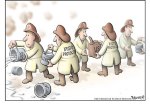 Whether it’s vendors, RHIOs, HIEs, or the N-HIN, where is a plan that will work? Is not this what it’s all about? Perhaps it is time that the rest of the national HIT leaders at CMS and the ONC who devised this plan, and who have lead physicians and hospitals down this ill-fated path promising them riches at the end of the journey should acknowledge their mistake and look for other ways to pass their time; pursue something more achievable, like gardening.
 Pale Rhino Consulting