Inside & Outside

When speaking about EHR system there are huge differences from an implementation and usage standpoint depending on if one is discussing record inside the healthcare provider or the movement or transport of the information from point A to point B.

Since most EHR statements have to do with one or the other, not both, for purposes of clarity, is there merit to labeling statements about EHR that mostly relate to the healthcare provider as IntraEHR, and those dealing the the transport of the record as InterEHR?

The_Saint_Pin

At what point do we decide this will not work?

We haven't tried this approach yet

We haven't tried this approach yet

What is your natural reaction when you are faced with something that you know doesn’t make sense?  Most people respond with silence, or they join the majority, whatever the issue.  I’ve never been good at being most people–the shoes are too tight.

For your edification and consideration.

State CIOs Get ‘To-Do’ List

HDM Breaking News, August 25, 2009

The National Association of State Chief Information Officers has published a report giving guidance to CIOs as their states implement health information technology provisions of the HITECH Act within American Recovery and Reinvestment Act.

The act requires state leadership in two primary areas: oversight for the planning and deployment of health information exchanges and management of the Medicaid incentive payments for meaningful use of electronic health records, the report notes.

“The passage of the HITECH Act essentially merged health policy with technology policy across state government and state CIOs must play a key role in HIE development and implementation,” according to the report.

The report includes a list of upcoming deadlines for specific federal regulatory actions, including those most affecting states and their CIOs. The report also details four broad areas where CIOs can have a major impact on HIE initiatives: planning, governance, financing/sustainability and policy.

“The HITECH Act placed a significant amount of new responsibilities on states in regards to state oversight for HIE and the planning and implementation grants for preparing for HIE,” the report states. “During this initial planning period, state CIOs must secure a seat at the table to establish themselves as key stakeholders and also to recognize strengths and identify weaker points that require resolution within their own offices relating to statewide HIT/HIE planning. They must ask themselves what they, with their unique enterprise view, can do to support and contribute to each of these areas.”

That was simple.  I’m thinking that if we can tie the IRS into this system of HIE, HITECH, ARRA, Rhoi, CIO, MOUSE we may be on to something useful.  Did you ever think that acronyms are used as a means of obfuscation, or to hide the identities of the people making these decisions?  I am much more likly to lend my avatar to a group of State This & Thats than I am to have someone write, Paul Roemer is the brainchild behind this I^(*&^%%!.  I like committees of three, especially when the other two don’t know for what time I scheduled the meeting.

English 101.  The desk is hard, the task is difficult, and the task described above is impossible or at least out of the realm of mortals.  Does someone think checking off the items on the list will easily allow my doctor to follow me on business or vacation across the country?  We are all smarter than that and we need to stand up and lead.  The time to follow has ended.

MyHero

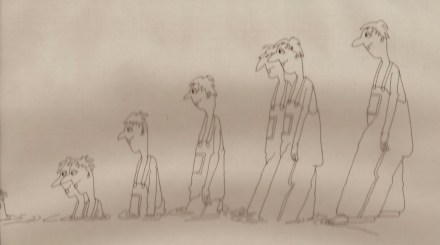
What did you do in reform daddy?

sorry for the quality, I drew this in high school

sorry for the quality, I drew this in high school

Tenth grade biology class was on the second floor.  One of my best friends said that for five dollars he would jump out of the window during class, sort of like falling out of the stupid tree and hitting every branch on the way down.  Others took the bet.  Lemmings.  They all jumped.  Speaking in parenthesis for a moment, this same friend was interviewed on Larry King on September 11, 2001, discussing how to run covert ops on Bin Laden.  I haven’t slept well since I learned that.

As I talk with clients and several of the healthcare thought leadership, I see consensus building around a lemming-like acquiescence about reform, especially as relates to EHR.  That wasn’t much of a segue, but my children stared school today, and I am still in shock from having let me seven-year-old pack his lunch—very different food groups.

I read an article in a much respected—I wrote ‘very’ instead of ‘much’, Word didn’t like it.  Learn something every day—publication that the primary business driver behind EHR is that it is perceived as a mandate.  (Sorry, that was written poorly—I may have to fire that guy.)

If that’s why your organization is doing it, do yourself a favor and stop.  The ROI from the stimulus money will not make EHR worth your while.  How will you know if you did it for the right reasons?  When you get to the end, if you aren’t able to say, “I wish we had done this years ago”, you’ve done something very wrong.

drevil

EHR Millstones, should that read Milestones?

cowsIf you like adventure, here’s a site to check, http://www.jfk50mile.org/.  This is an annual event whose origin came about during the cold war.  Fortunately for both of us, the entry date has already passed.  The thought behind the JFK fifty-mile hike/run was that because of the possibility of a nuclear attack, each American should be in good enough shape to cover fifty miles in a day.

I participated in the event twice—I wrote participated because to state that I ran the entire way would be misleading— and I can state with certainty that almost no Americans are close to being able to complete this.  The event is run in the fall starting in Boonsboro, Maryland.  It takes place along the Appalachian Trail and the C&O Canal and various other cold, rain soaked, and ice and leaf covered treacherous terrains.

We ran it in our late teens or early twenties, the time in your life when you are indestructible and too dumb to know any better.  One of my most vivid memories of the event was that on the dozen or so miles along the mountain trail, leaves covered the ground.  By default that meant they also covered the rocks along the trail, thus hiding them.  That we were running at elevation—isn’t everyone since you can’t not run at at least some elevation, (that may be the worst sentence every written) but you know what I mean—meant the prior night’s rain resulted in the leaf covered rocks being sheathed in black ice.  That provided a nice diversion, making us look like cows on roller skates—roller blades had yet to catch on outside of California.

There were several places along the trail where the trail seemed to fork—I’m not going to say and I took it—and it wasn’t clearly marked.  Runners could easily take the wrong fork (or should that be Tine?).  I think it would have been helpful had the race organizers installed signs like, “If you are here, you are lost.”  Hold on to that thought, as we may need it later.

Some number of hours after we began we reached the C&O Canal, twenty-six miles of flat terrain along the foot path.  It’s difficult to know how well I was doing in the fifty-mile race, in part because I had never run this distance and because there we no obvious mile markers, at least so I thought.  Then we noticed that about every five and a half to six minutes we would pass a numbered white marbled marker that was embedded along the towpath.  Mile stones.  At the pace we were running, we anticipated we would finish high in the rankings.  As fast as we were running, we were constantly being passed, something that made no sense.  That meant that a number of people were running five minute miles, which we knew they couldn’t do after running through the mountains, or…Or what?

The only thing we knew with any certainty at the end of the day was that the markers with which we used to determine our pace and measure how far we’d run were not mile markers.  We never figured out why they were there or how far apart they were, but we greatly underestimated their distance and hence our progress.

It doesn’t really matter whether you call them mile stones or milestones.  What matters is whether they serve a valid purpose.  If they don’t, milestones become millstones.  Milestones are only useful if they are valid, and if they are met.  Otherwise, they are should’ a, could’ a, would’ as—failure markers, cairns of missed goals and deliverables.

How are your milestones?  Are they valid?  What makes them valid?  Are they yours, or the vendors?  All things to think about as you move forward.
geicocavemen