Does reform need to be reformed?

The following is the comment I posted to,

Kent Bottles: Is It Really Impossible to Control the Cost of Health Care in the U.S.?

Kent, your narrative should be mandatory reading for all those in Washington whose vision of reform stands in stark contrast to the piece. Then, before they are allowed to propose or vote on their vision, they should be forced to explain why their vision doesn’t address these issues.

In my non-luminary opinion, here’s where I think the reformists have failed. The notion of spending funds that don’t exist, to fix things that may not be broken, without fixing those that are could only come from Washington.

Permit me to over simplify things to make a point. When I look at healthcare, I see a three legged stool; pharma, the payors, and the providers—the three P’s. Not exactly in a pod, each working to their own benefits and operating under different business models—models which are in conflict. For example, many hospitals operate as not for profits, which conflicts with the for profit sectors.

I believe the present reform effort will increase the conflict. Why? Because the legislation is siloed—it looks a lot like the word ‘soiled’ which might also be part of the problem. The legislation does not seem designed to address healthcare as in integrated industry. The way reform is positioned, each nudge that is put to one leg of the stool will cause a reaction, an unfavorable one, to the other legs. It is a little like doing an experiment, changing multiple variables at once, and hoping for the best.

Two sides of the stool, the payors and pharma, have behemoths running the show. Among the behemoths, the business models in pharma are quite similar and the same holds for the payors.
I think it is important to distinguish between the business of healthcare (the dollars and cents) and the healthcare business (the clinical side). The provider segment is highly fragmented. There is no behemoth provider cartel. The business of healthcare, is the side most in need of reform. Each of the thousands of providers operates under their own business model. None of these businesses was designed to be interoperable—I do not use this term in the same sense being used by the ONC and CMS.

The business of healthcare, with all of its inefficiencies, is designed to operate within its four walls and across a limited geographical radius. The long term goal of healthcare reform, I believe, is to make the provider side appear as one giant services provider. Just because consolidation sort of worked for steel, the airlines, and the automotive industry does not mean it will work for delivering healthcare.

My final comment has to do with the payor side of healthcare, and I’ll start by acknowledging that this one is more than a little provocative, one for which I have not thought through a workable solution—I’ll leave that to those of you who aren’t grasping for metaphorical tomatoes to throw. I could be convinced to skip the rest of my comments if for a moment I thought that the business model of the payors was—let’s cover everyone who needs care for a fair cost. Ignore for the moment that my statement is naive.

We know that on a small scale it is possible for people to self-insure, to meet their needs without having to rely on payors. I’ll frame my final comment with a question—where is the value-add to healthcare from the payors?

Here is my issue with the current model. You want to go to the movie, you hand me ten dollars for an eight dollar ticket, and I pay the movie theater on your behalf and pocket the two dollars. In this instance I am merely the middle man, I manage the transaction. The theater gets no marginal benefit, and you get no marginal benefit.

Not complex enough? Let’s say someday millions of people want to go to the movies and a ticket will cost them eight dollars. Anticipating that, everyone pays me a dollar a day so that when the time comes they can go. On that day, I pay for movie tickets for those who want to go, pocket the difference, and I keep the money for those who don’t go.

In my small mind, that’s how I view the payor leg of the stool. I think the payors relish reform. I think the more they complain about how badly this will hurt them the more they may like it. It reminds me of the Uncle Remus story in which Brer Rabbitt pleading with Brer Bear and Brer Fox not to throw him into the briar patch.

What industry wouldn’t be salivating if they could find an additional thirty or forty million customers overnight? What if you could charge them a monthly fee and make the co-pay so high that you might not have to cover major medical claims? Does this sound absurd or does it sound a little like the mortgage banking industry? Fess for no service. I am not saying that this will happen in every case, but I do not think one can argue that this will never happen.

Circling back to how to reform reform. From my vantage point, the most advantageous reform idea would be to force multiples of payors to compete in every state. Competition could do wonders for cost control.

A final thought. Earlier this year a House committee passed legislation on “can’t fail” businesses. The Financial Services Committee voted on an amendment that would let regulators dismantle a firm, limit mergers and acquisitions, and force an end to activities deemed systemically risky. The financial industry opposed the measure, as part of legislation to overhaul Wall Street rules. This could be another opportunity for the camel—Washington—to get its nose further under the healthcare tent. There is nothing that limits the legislation to financial services. Call me a cock-eyed pessimist, but what is there to prevent Congress from deciding that the payors need to be dismantled, thereby ushering in a federal payor model? That would give them two legs of the stool. What if…?

Patient Relationship Management & Patient Equity Management

Here’s a link to my deck on the above. I’d like to read your thoughts.

http://www.slideshare.net/paulroemer/good-CEM-deck

In accordance with the prophecy

Counting me, there were six of us; college spies. Maybe that is a grammatical error; we were spies who happened to be in college. Well, maybe that’s a half-truth. We were co-op students with rather high security clearances, working at a place in the DC area which made the type of things of which Nancy Pelosi would deny having any knowledge. I was a mathematics intern—not a bad step on the rungs of the career ladder given that the dean of my math department had tried on more than one occasion to get me to change majors. Everyone I worked with had at least a PhD in math. At least I had enough firing synapses to know I would never be their intellectual peer.

During the summers, we six would report at one of the complex’s gates, flash our badges at the marine guards, make our way past the military weapons testing facilities, and head to our basement offices. At lunch time we’d break out our briefcases, and take out our tools of the trade—Frisbees, bag lunch, sun tan oil (this was in the days before anyone could spell SPF, pure Hawaiian Tropic.) Within minutes we’d be stripped down to our cutoffs, running across the field where the helicopters landed, and dripping with sweat. After lunch we’d help draft differential equations whose aim was to read target signatures sent from one of our missiles at a Soviet or Chinese aircraft. Not a bad gig if you can get it.

That was then. Now we are aging adolescents clinging woefully to rapidly fading images of summers past, whose idea of getting wasted is drinking multiple espressos. Gone are the days where we could abnegate responsibility. We matured, at least a lot of us. We’ve learned pretending you know what you’re doing is almost the same as knowing what you are doing. We’ve accepted it to the extent that we act like we know what we’re doing even if we don’t and, we do it.

Pretending is a skill. Guys do it all the time, secretly hoping no one will notice. People who answer your hospital phones do it too. Sometimes patients will settle for an answer; any answer. It’s sort of like bluffing in Trivial Pursuit—if you bluff with enough confidence, your opponent may not even check your answer. For some patient questions, there are three states of being; not knowing, action and completion. The goal is to move as rapidly as possible from the first state to the third. If the patient proves to be a problem, the patient care rep should finish each sentence with the phrase, “In accordance with the prophecy.”

Of course, if face-to-face interaction proves to be too much, you can always tighten up the dialog. For example;

RING …RING …

*click*

Welcome to the Patient Care Hotline.

If you are obsessive-compulsive, please press 1 repeatedly.

If you are codependent, please ask someone to press 2.

If you have multiple personalities, please press 3, 4, 5 and 6.

If you are paranoid-delusional, we know who you are and what you want.

If you are schizophrenic, listen carefully to the little voice until it tells you which number to press.

If you are manic-depressive, it doesn’t matter which number you press. No one will answer.

If you are delusional and hallucinate, please be aware that the thing you are holding on the side of your head is alive and about to bite off your ear.

Thanks for calling.

Is wellness being overlooked?

The following are my comments to Sue Schick’s blog, Are you ready to commit to a wellness program?

With all of the pronouncements coming from Washington about healthcare reform, it is easy to be waylaid by Gossamer eddies and side currents that pay little attention to one key area—health. There is plenty of discussion about insuring the uninsured, covering pre-existing conditions, and the rollout of a national healthcare model under the guise of healthcare information technology and facilitating the transport of electronic medical records.

I think Sue’s words are spot-on and timely. Even if nobody is going to pay for it, with so many Americans participating in the healthcare conversation, an entire industry being re-engineered, and a trillion dollars to fund the transformation, should not there be more attention paid to wellness, to proactively making one responsible for one’s own health?

Unfortunately, my perspective on this issue is shaped from having been there, done that, got the T-shirt—a heart attack at the age of forty-six. I’ve transformed myself from someone who took twenty-four years off between workouts to barely taking twenty-four hours off between workouts. I didn’t need an employer to sponsor a wellness program; all I needed was a ride in an ambulance.

There may be a lot of different ways to get someone’s attention around wellness, around being responsible. Those who want to be well will have to make that decision for themselves. No company can do it for you, but companies certainly can be supportive of your efforts to help yourself.

There has been a lot of conversation in the healthcare debate about what role the insurance companies have played in driving reform. Right or wrong, a number of stakeholders view payors as bad actors, as the raison d’être of reform.

Wellness seems to offer payors a way to put on the white hat, to be proactive. Patients understand that they do not pay their providers for their healthcare. In the event patients need a provider, patients pay the insurers, cross their fingers, and hope the insurers agree to cover the expense.

I am somewhat of a dilettante to the insurance side of the healthcare model, so I apologize in advance if I misspeak. Here’s my take as to the white hat opportunity, a way to take a leadership role in the matter of wellness. When you apply for insurance, you receive negative ratings for unhealthy and unsafe behaviors; smoking, health history, sky diving. However, if you run five days a week, maintain your weight, eat fish and refrain from drinking, you accrue no points for good behavior. In fact, you are rated as though you made no proactive attempts to manage your own health.

Auto insurance companies raise your rates for certain bad behaviors, and they lower them for certain good behaviors. No accidents for two years—the rate goes down. No traffic violations—the rate goes down. Behavior modification. I am aware of it and I manage my behavior to get lower rates.

Can a similar model work for health insurance? What would it take for payors to offer an incentive model for rewarding good behaviors?

Dear Sir Richard Branson:

For those who care about how your patients view you.

REF: Mumbai to Heathrow 7th December 2008

I love the Virgin brand, I really do which is why I continue to use it despite a series of unfortunate incidents over the last few years. This latest incident takes the biscuit.

Ironically, by the end of the flight I would have gladly paid over a thousand rupees for a single biscuit following the culinary journey of hell I was subjected to at thehands of your corporation.

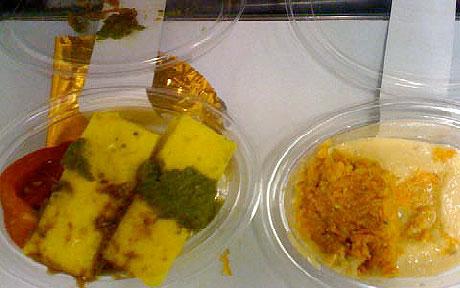
Look at this Richard. Just look at it: [see image 1,].

I imagine the same questions are racing through your brilliant mind as were racing through mine on that fateful day. What is this? Why have I been given it? What have I done to deserve this? And, which one is the starter, which one is the desert?

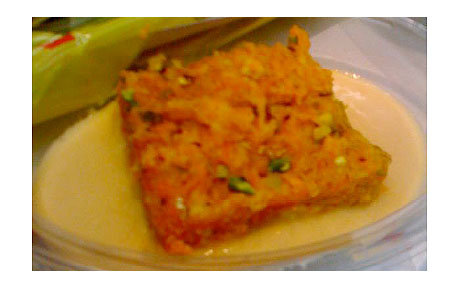
You don’t get to a position like yours Richard with anything less than a generous sprinkling of observational power so I KNOW you will have spotted the tomato next to the two yellow shafts of sponge on the left. Yes, it’s next to the sponge shaft without the green paste. That’s got to be the clue hasn’t it. No sane person would serve a desert with a tomato would they. Well answer me this Richard, what sort of animal would serve a desert with peas in: [see image 2,].

I know it looks like a baaji but it’s in custard Richard, custard. It must be the pudding. Well you’ll be fascinated to hear that it wasn’t custard. It was a sour gel with a clear oil on top. It’s only redeeming feature was that it managed to be so alien to my palette that it took away the taste of the curry emanating from our miscellaneous central cuboid of beige matter. Perhaps the meal on the left might be the desert after all.

Anyway, this is all irrelevant at the moment. I was raised strictly but neatly by my parents and if they knew I had started desert before the main course, a sponge shaft would be the least of my worries. So lets peel back the tin-foil on the main dish and see what’s on offer.

I’ll try and explain how this felt. Imagine being a twelve year old boy Richard. Now imagine it’s Christmas morning and you’re sat their with your final present to open. It’s a big one, and you know what it is. It’s that Goodmans stereo you picked out the catalogue and wrote to Santa about.

Only you open the present and it’s not in there. It’s your hamster Richard. It’s your hamster in the box and it’s not breathing. That’s how I felt when I peeled back the foil and saw this: [see image 3,].

Now I know what you’re thinking. You’re thinking it’s more of that Baaji custard. I admit I thought the same too, but no. It’s mustard Richard. MUSTARD. More mustard than any man could consume in a month. On the left we have a piece of broccoli and some peppers in a brown glue-like oil and on the right the chef had prepared some mashed potato. The potato masher had obviously broken and so it was decided the next best thing would be to pass the potatoes through the digestive tract of a bird.

Once it was regurgitated it was clearly then blended and mixed with a bit of mustard. Everybody likes a bit of mustard Richard.

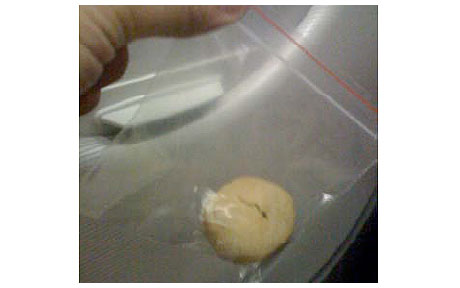
By now I was actually starting to feel a little hypoglycaemic. I needed a sugar hit. Luckily there was a small cookie provided. It had caught my eye earlier due to it’s baffling presentation: [see image 4,].

It appears to be in an evidence bag from the scene of a crime. A CRIME AGAINST BLOODY COOKING. Either that or some sort of back-street underground cookie, purchased off a gun-toting maniac high on his own supply of yeast. You certainly wouldn’t want to be caught carrying one of these through customs. Imagine biting into a piece of brass Richard. That would be softer on the teeth than the specimen above.

I was exhausted. All I wanted to do was relax but obviously I had to sit with that mess in front of me for half an hour. I swear the sponge shafts moved at one point.

Once cleared, I decided to relax with a bit of your world-famous onboard entertainment. I switched it on: [see image 5,].

I apologise for the quality of the photo, it’s just it was incredibly hard to capture Boris Johnson’s face through the flickering white lines running up and down the screen. Perhaps it would be better on another channel: [see image 6,].

Is that Ray Liotta? A question I found myself asking over and over again throughout the gruelling half-hour I attempted to watch the film like this. After that I switched off. I’d had enough. I was the hungriest I’d been in my adult life and I had a splitting headache from squinting at a crackling screen.

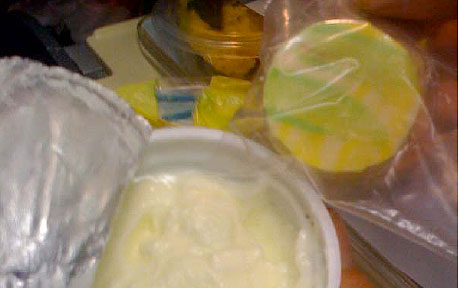
My only option was to simply stare at the seat in front and wait for either food, or sleep. Neither came for an incredibly long time. But when it did it surpassed my wildest expectations: [see image 7,].

Yes! It’s another crime-scene cookie. Only this time you dunk it in the white stuff.

Richard…. What is that white stuff? It looked like it was going to be yoghurt. It finally dawned on me what it was after staring at it. It was a mixture between the Baaji custard and the Mustard sauce. It reminded me of my first week at university. I had overheard that you could make a drink by mixing vodka and refreshers. I lied to my new friends and told them I’d done it loads of times. When I attempted to make the drink in a big bowl it formed a cheese Richard, a cheese. That cheese looked a lot like your baaji-mustard.

So that was that Richard. I didn’t eat a bloody thing. My only question is: How can you live like this? I can’t imagine what dinner round your house is like, it must be like something out of a nature documentary.

As I said at the start I love your brand, I really do. It’s just a shame such a simple thing could bring it crashing to it’s knees and begging for sustenance.

Yours Sincererly

XXXX

  • Paul Charles, Virgin’s Director of Corporate Communications, confirmed that Sir Richard Branson had telephoned the author of the letter and had thanked him for his “constructive if tongue-in-cheek” email. Mr Charles said that Virgin was sorry the passenger had not liked the in-flight meals which he said was “award-winning food which is very popular on our Indian routes.”

A reply to the idea of Mandated Coverage

Below is a comment on a Washington Post article on mandated coverage, http://www.washingtonpost.com/wp-dyn/content/article/2009/10/25/AR2009102502607_Comments.html

Great movie, poor reform—at least that’s my take on how poorly the current healthcare legislation will actually work regarding a mandate.  There are probably more federal judges with gangsta rap on their iPods than congressmen who have actually read the reform bill.

I call the idea of the mandate “must carry”.  The only option of the public option and must carry provisions is the option to “opt”.  Individuals can “opt” and so can firms.  “Opt-in”, “Opt-out”—like clap-on clap-off.

However well intended it may be, as structured, the mandate will not work; neither for individuals or for firms.  The individuals who will be required to carry, can opt out for a $750 annual fine and “opt” in when they are sick or injured.  The fine will be less than the cost of the insurance premiums.  That way, their out-of-pocket costs are actually paying co-payments not premiums.

It appears that firms may be able to pay the fines on a per person basis rather than opting to pay for healthcare insurance for their employees.

Hence, mandated coverage may only apply to those who haven’t figured out that it doesn’t apply.

sainttop5

Is the term “Payor” healthcare’s oxymoron?

One of the great things about fall is that as I prune back the vestiges of my virtual garden I am able to collect basketful upon basketful of overly ripe metaphorical tomatoes, perfect for tossing at aberrant analogies and inappropriate idioms.

It’s a curious time.  We give away money to the middle class and rich so they can upgrade their BMWs on the backs of the poor.  The feds market that idea as though that pittance will either jump start the economy, or to hide the fact that that the administration has managed to budget for a nine trillion dollar deficit gap over ten years.

By now we know there are no quick fixes, no magic formulas for fixing the economy.  Finding a formula that works will be more difficult than learning how to neatly fold a fitted bed sheet.

“Is it the essential paradox of the age of Obama that we have to destroy the village in order to save it, bust the budget in hopes someday we’ll balance it?” Nancy Gibbs, Time, September 9, 2009.

“It takes an idiot to raze a village.” Paul Roemer, today.

Congress is trying to decide what the final bill will look like without ever having read the first draft.  How will we know when they have something that makes sense?  Do we watch the Congressional chimney to see if the smoke is white or black?  Does that mean we have a bill, or is it simply that the chef burnt the Peking Duck?

Then there are the payors.  Get me started, or don’t.  We all know that one of the driving factors for reform is the behavior of the payors.  A friend asks—for full disclosure I note that she is one of “them”—why do people view health insurers differently from auto, life, or home owners insurance.  She was serious.

Here’s my take on the answer.  If the health insurance firms provided life insurance they’d be exhuming the deceased and trying to prove they weren’t dead.  Car smashed, get a check.  House leaks, get a check.  Die, get a check.  Need surgery.  Not so fast.  Let’s see if you’re covered for that.  If not, whew.  If yes, let our doctors decide if you really need the surgery.  It won’t cost you a minute of your time as our doctors don’t even need to examine you.  You see how this plays out?

It happened to me after my heart attack, albeit with my disability payor, sort of the evil step sister of the health side.  My doctor put me on six months disability, naturally, the payor declined to pay.  There doctor, who never examined me decided I was fine, at least that’s what their letter stated.  How do we know these doctors even exist?  Have they ever been seen in the daylight?

Most Americans don’t believe that insurance companies are interested in helping people.  They like us fine when people are payors.  They are much less fond of us when people become patients.  It’s a simple matter of flow theory.  As long as the flow of cash is in-bound, all is well.  When people move to the dark side, from payors to patients, payors have no patience.

Is there anyone who believes that there is a single payor in the country whose mission statement says anything about doing all we can to help those who need us?  Of course not.  Payors have claims adjusters.  What is their role?  It’s certainly not to adjust the payment higher.

Do payors incent their employees to pay out as little as possible?  I believe they do.  Do payors penalize or retrain people who pay out too much?  I believe they do.  Do they design the claims and dispute process so as to make it so cumbersome on patients and doctors that parties give up prior to settling?  I believe they do.

I believe the payor business model is not much different from that of tobacco companies.  For years tobacco firms claimed there was no public evidence to support the fact that nicotine was addictive.  It turns out they buried the evidence.  Payors claim they are not bad actors.  Some claim the moon landing was faked.

I am a firm believer that pictures can sometimes convey more than mere words.  To me, this link explains a lot about what’s wrong with healthcare.

http://www.youtube.com/watch?v=Z7Forzj5-O0 Start playing at 6 minutes and 40 seconds.

pastedGraphic.tiff.converted

A response to an ICMCC blog on Meaningful Use

This reminds me of the old Wendy’s commercial, “Where’s the beef?”  The comment regards the posting, http://blog.icmcc.org/2009/10/02/meaningful-use-where-is-the-patient/comment-page-1/#comment-98522

I think three years from know we will see that meaningful use proved to be a smokescreen which demonstrated no meaningful use. I also think there is benefit in looking at why healthcare providers have to be offered money and subjected to potential fines to do something that is supposed to be good for them. In turn, why do they then need to be pushed into rolling it out according to someone’s timetable who’s not even a part of their organization.

1. Why are providers running from EHR instead of towards EHR?

2. Why do they have to be paid to implement EHR?

3. Why do they have to be cajoled to roll it out according to somebody else’s time table?

black saint 2

Patient Relationship Management (PRM)

georgeIf you watch too much television your brain will fry. Sometimes I feel like mine is in a crepe pan that was left sitting on the stove too long. Two nights ago I’m watching Nova or some comparable show on PBS. The topic of the show was to outline all the events that took place that helped Einstein discover that the energy of an object is equal to its mass times the speed of light squared, better known as E=mc². It was presented to the audience at a level that might best be described as physics for librarians, which was exactly the level at which I needed to hear it. It’s physics at a level that is suitable for conversation at Starbucks or any blog such as this.

So here’s what I think I understood from the show. It tracked the developments of math and physics in 100 years prior to Einstein’s discovery. The dénouement appeared to occur when Einstein and his fiancée were riding in the bow of the small boat. Apparently, he was leaning over the side of the boat and noticed that the waves generated by the front of the boat moved at the same speed as the boat. He then noted that fact only held true for those persons in the boat, who were in fact, traveling at the same rate of speed. However for those persons watching from the shore, that same wave was not only moving slower than the boat it got further behind over time. Some other things occurred, yada, yada, yada, and there you have it. Clearly, the details are in the yada, yadas.

So here’s what happens when you watch too much television. As I’m running this morning somehow my mind takes pieces from that show and staples them together to yield the following. Let’s go back to the equation E=mc². For purposes of this discussion I’ll redefine the variables, so that:


E = the percentage of Patient Complaints/Inquiries.
m = Patient in-bound calls.
c = number of Patients


If this were true–this is an illustration, not an axiom–the percentage of complaints in the call centers of an healthcare provider is equal to the number of in-bound calls times the square of the number of patients. So as the number of calls increases the number of complaints/questions increases and as the number of patients increases the number of complaints increases exponentially. Of course this is made up, but there appears to be a grain of truth to it. As a number of calls increase the percentage of complaints is likely to increase, and as the number of patients increases there will probably be an even greater increase in the percentage of complaints incurred. I think we can agree that a reasonable goal for a healthcare provider is to decrease the percentage of complaints and perhaps to shift a hefty percentage of inquiries to some form of internet self-service vehicle. 

I think sometimes the way providers like to assess the issue of Patient Relationship Management  (PRM) is by looking at how much money providers throw at the problem. I think some people think that if one provider has 2 call centers, and another provider has 3 call centers, that the provider with 3 must be more interested in taking care of the their patients, and might even be better at PRM.  I don’t support that belief. I think it can be demonstrated that the provider with the most call centers, and most Patient Service Representatives, and the most toys deployed probably has the most problems with their patients. I don’t think it’s a chicken and egg argument. If expenditures increase year after year, and resources are deployed continuously to solve the same types of problems, I think it’s a sign that the provider and its patients are growing more and more dysfunctional.

How does this tie to Einstein and his boat? Perhaps the Einsteins are those who work with the provider; those who are moving at the same speed, those in lockstep. From their vantage point, the waves and the boat, like the provider and its patients, are all moving forward at the same speed. Perhaps only the people standing along the shore are able to see what is actually occurring; the waves distance themselves from the boat in much the same way that the patients distance themselves from the provider.

PRM is such an easy way to see large improvements accrue to the provider, especially using social media.

pastedGraphic.tiff.converted

Who was supposed to be watching the customer?

customer_relationsSometimes it’s easier if I simply shoot myself in the foot rather than having to wait around for others to do it.  Permit me to begin with a disclaimer; my comments and questions almost always pertain to the non-clinical side of healthcare.

We’ve spent time discussing how we take an industry that in many respects functions on a 0.2 business model and transform it rather quickly to one comfortable operating in a 2.0 model—effective and efficient.

So, while that’s going on, what other things are underway which will impact that transformation?  Reform is one.  What will be the impact?  Nobody knows, but it may not be pretty.  One of the largest implications of reform is that the industry is being forced to integrate.  For example, it’s one thing to build a phone company.  There is a whole new order of magnitude of difficulty when one phone company has to integrate seamlessly with all of the other phone companies.

That integration is being driven by hundreds of different teams of vendors, standards setters, certifiers, and networkers, each having its own goals and working in their own vacuum chamber.

As I’ve studied this business problem for the past few years it becomes more and more apparent that something has been overlooked.  It gets it share of lip service, however unless it is addressed concurrently with reform and EHR, EHR will prove to be of such low value as to stymie people who later have to justify the expenditure.

It’s the missing link, the customer.  I know customer is not the politically correct term in healthcare because it sort of blemishes the notion that nobody is in this for the money.  We’d rather talk about patients.  Patients are on the clinical side, customers are on the business side.  Healthcare needs systems that work for both.

Where does customer care, customer relationship management (CRM), and customer equity management (CEM) fit within the realm of EHR?  The wrong answer to this question could set your EHR effort back years and millions.

The following link takes you to a presentation of mine on CRM and discusses the merits of looking at treating customers via CEM.

 http://www.slideshare.net/paulroemer/good-CEM-deck

I am curious to learn how you are incorporating the customer into your transition.

021_18A