EHR–the five stages of grief

The Kübler-Ross model, commonly known as the five stages of grief, was first introduced by Elisabeth Kübler-Ross in her 1969 book, On Death and Dying.  I heard a story about this on NPR, and it made me think about other scenarios where these stages might apply.

My first powered form of transport was a green Suzuki 250cc motorcycle.  My girlfriend knitted me a green scarf to match the bike.  One afternoon my mother walked into the family room, saw me, and burst into tears.  When I asked her what was wrong, she told me that one her way home she saw a green motorcycle lying on the road surrounded by police cars and an ambulance—she thought I had crashed.  I asked her why, if she thought that was me lying on the road, she did not stop.

My girlfriend’s mother, didn’t like my motorcycle—nor did she like me.  Hence, my first car; a 1969 Corvair.  Three hundred and fifty dollars.  Bench seats, AM radio.  Maroon—ish.  It reminded me a lot of Fred Flintstone’s car in that in several places one could view the street through the floor.  Twenty miles per gallon of gas, fifty miles per quart of oil.

Buyer’s remorse.  We’ve all had it.  There is a lot of buyer’s remorse going around with EHR, a lot of the five stages of grief.  I see it something like this:

  • Denial—the inability to grasp that you spent a hundred million dollars or more on EHR the wrong EHR, one that will never meet your needs
  • Anger—the EHR sales person received a six-figure bonus, and you got a commemorative coffee mug.  The vendor’s VP of Ruin MY life, took you off his speed dial, unfriended you in Facebook, and has blocked your Tweets. You phone calls to the vendor executive go unanswered, and are returned by a junior sales rep who thinks the issue may be that you need to purchase additional training.
  • Bargaining—when you have to answer to your boss, likely the same person who told you which system to purchase, as to why productivity is below what it was when the physicians charted in crayon.
  • Depression—you come in at least fifteen minutes late, and use the side door, taking the stairs so you won’t see anyone.  You just stare at your desk; but it looks like you are working. You do that for probably another hour after lunch, too. You estimate that in a given week you probably only do about fifteen minutes of real, actual, work. (Borrowed from the movie, Office Space.)
  • Acceptance—the EHR does not work, it will never work, you won’t be around to see it if it ever does.  Your hospital won’t see a nickel of the ARRA money.  You realize the lake house you were building will never be yours, but the mortgage will be.

The five stages of EHR grief.  Where are you in the grieving process?

True, there are a handful of EHR successes.  Not nearly as many as the vendors would have you believe.  More than half of hospital EHR implementations are considered to have failed.

If you are just starting the process, or are knee-deep in vendor apathy you have two options.  You can bring in the A-team, people who know how to run big ugly projects, or you prepare to grieve.

If it was me, I’d be checking my list of friends on Facebook to see if I was still on my vendor’s list of friends.

Overcoming competency

Which is more difficult—overcoming competency or incompetency, or is this another example of rhetorical nonsense? Experience has taught me that some firms are ambidextrous when it comes to overcoming competency—they can overcome being competent with either hand or with both hands tied behind their back.

Let’s see. Competency without value is what? I think that’s incompetency. That’s what I call the Competency Gap—not even knowing that what’s being done isn’t delivering the value. The Competency Trap is the silly belief that trying harder and implementing technology somehow improves the problem. It’s sort of like, “We don’t know where we’re going, but we’re making really good time.”

I’ll go out on a limb and guess there was a time in your hospital or clinic when you didn’t have to overcome the competency of those who claimed that EHR would make everything better, those who thought you needed help, thought they knew how to help, those who backed up the truck, dumped the EHR technology at your doorstep, and started you down healthcare’s Bataan death march.

Some EHR initiatives make me more paranoid than I already am.  How is it working out for you?  Are the clipboardists checking your every move to see how well the EHR is performing?  If in the midst of their competency they did not redesign all the processes affected by EHR, it is probably not working too well. It seems a little like planning a daisy and pulling it up every hour to check the roots and see how well it’s growing.

You tell me. Are the doctors and staff any happier? More satisfied? Has the EHR worked, has it improved productivity, or has it simply given the appearance of looking high-tech?  My guess is that everyone would be a lot more successful if people would leave the daisies alone.  

“Incompetency begets incompetency. The last thing a guy who isn’t sure of himself wants is a guy backing him up who is sure of himself.”

Lee Iacocca

“Are the best intentions of EHR Half-Full or Half Empty?”

Doublethink. Functioning simultaneously on two contradictory beliefs and accepting both as true. By definition, one must be false, unless of course you are living in a parallel universe, in which case you’re in need of more help than I can deliver. George Orwell defined it as, “A vast system of mental cheating”—on yourself, I might add.

What does doublethink accomplish and why does it exist with varying degrees within each of us? First, it allows us to overcome our own competence. I think that’s worth repeating, overcoming our own competence. We know better and yet we talk ourselves out of accepting what we know, creating an equal and offsetting false belief.

Second, it acts as a safety net. How? Let’s say we are one hundred percent confident in Belief A. Well, almost. There’s always that little nagging disbelief, that little devil on the shoulder trying to convince you otherwise. Sort of like ‘buyer’s remorse’—only we’ll call it believer’s remorse. Just in case Belief A is wrong, maybe I should have a backup belied, Belief B. Jeckyll and Hyde.

How does that impact one in the EHR problem?  Buckle up. Most people with whom I’ve worked are very passionate about what they do and are paladins of their methods.  Sort of EHR young Turks.  Belief A. They do everything they can for the program.

While sincerely believing in the importance of EHRs, here’s what else I’ve observed.  Much of that belief envelopes the limited notion of believing that nothing lays outside of their skill set. They often recognize it more as a desire than a belief.  They know fully that they will face challenges which are new to them.  They know fully that many implementations have failed and that they need to spend more effort on change management and work flow alignment than was budgeted.  The list of challenges for which they lack the expertise never empties.  They know the light at the end of the tunnel is just a train. They know fully that solving the current problem only seems to reveal the next one.  Belief B.

So, we’ve come full circle. We outwardly profess we can do what others have failed to do, yet in our heart of hearts we believe that you may never see an ROI. Doublethink.

Which gets us back to our original question, “Are the best intentions Half-Full or Half Empty?”

Should you listen to the voices in your head?

Well, for starters, if you don’t nobody else will.

Just because I’m paranoid, doesn’t mean the voices in my head aren’t real. What voices?  They don’t like it when I speak of them, so I am going to speak in parentheses so they do not hear me.)

Riding the in the car yesterday with my son, the radio was playing Barber’s adagio, a mournful and eerily melancholy piece. It has long been one of my favorites.  I tried to get my son to turn off his PSP long enough for him to try to develop an appreciation for it.

He asked me to tune the radio to what he calls ‘his’ station while I kept extolling the specific virtues of the adagio, of Barber, and of classical music in general. I intended to win him over to my way of thinking.

The phrases I used to bolster my opinion kept coming to me, although I knew not from where.  I soon reached the point where I knew that I was no longer speaking to him, but role playing the very same discussion I had had with my father when I was about the same age as my son. Déjà vu. I have become my father’s son. The voice in my head was my father’s and I was not even charging my father rent for the space.

Do you hear the voices? No, not those voices. The ones you hear at work when you realize that the person speaking to you is your other self. The same voice you hear when you go out after work with your friends and begin to talk shop. By the third glass of wine the conversation has shifted from swapping stories about the craziest patient to wondering aloud when the company is ever going to learn how to fix their business. By glass five, you’re fixing it for them, diagramming solutions on cocktail napkins.

A word of encouragement. Listen to the voices. I bet you’ve come up with some great ideas. They won’t do anyone any good locked up in your head. Let them out. Show someone who can do something about it what you wrote on the napkins.

Project Management lessons from Alice and Wonderland

During my career I’ve been involved with hundreds of project teams, some quite gifted, others whose collective intellect was rivaled only by simple garden tools.  I’ve been asked often if I can define what distinguishes the two types of teams.  For me it always comes down to leadership.  It doesn’t matter how hard the people work, it matters how well they are lead.  Does the leader know what to do tomorrow?

That got me to thinking.  Are there some leadership secrets, some project management gems that may have been overlooked?  Rather than offering traditional mish-mash consulting jargon, I thought it would be helpful to find a common ground by which we can form a basis for this discussion.  Hence the following narrative: Everything I learned about project management I learned from Alice in Wonderland.

So, you have spent tens of millions on an electronic health records system.  Some did so without even defining their requirements.  The project is chugging along, new regulations and penalties are appearing through the diaphanous mist like the Cheshire Cat’s toothy grin.

“Well! I’ve often seen a cat without a grin,” thought Alice.  “But a grin without a cat! It’s the most curious thing I ever saw in my life!”


How fast must you run so as not to lose ground?  How many milestones do you have to meet, how many due dates do you have to check?  What can be learned from the Red Queen in Alice in Wonderland?  She told Alice, “It takes all the running you can do, to keep in the same place. If you want to get somewhere else, you must run at least twice as fast.”


For the EHR project to progress it requires extraordinary effort.  This begs a question of the project leader, where does the project need to go?  In a conversation with the Cheshire Cat Alice asks,

Would you tell me, please which way I ought to go from here?” “That depends a good deal on where you want to get to,” said the Cat.
“I don’t much care where,” she said.
“Then, it doesn’t matter which way you go.” “So long as I get SOMEWHERE,” Alice added as an explanation.
“Oh, you’re sure to do that,” said the Cat, “if you only walk long enough.”

If you only walk long enough.  What is enough for a three year project?  When are you done?  When the money runs out; when there are no more tasks in the work plan.  It seems many EHR projects are much bigger than allowed for by the plan.  They get big, impossibly big.  A lot of that size comes from underestimating the effort to support workflow improvement, change management, and user acceptance.

“Sorry, you’re much too big.  Simply impassible,” said the Doorknob to Alice.   “You mean impossible?” “No, impassible.  Nothing’s impossible.”

We don’t have the benefit of getting advice from talking doorknobs which is why we get so stymied when confronted with having to do the impossible. What is impassible or impossible for your project?  It might be deciding or knowing when to stop.

Alice laughed. “There’s no use trying,” she said: “one can’t believe impossible things.”
“I daresay you haven’t had much practice,” said the Queen. “When I was your age, I always did it for half-an-hour a day. Why, sometimes I’ve believed as many as six impossible things before breakfast.”

Believing it does not make it so.  Never has, never will.  Belief does not beget success.  Planning does.  Defining your requirements may.  There is no shortage of ex-CIOs who believed their EHR vendor.

Then there’s the skill of managing your EHR vendor.  Perhaps Eaglet said it best, “Speak English! I don’t know the meaning of half those long words, and I don’t believe you do either!”

There will always be those select members of every project team who are so dense that light bends around them; those who have not learned that it is better to keep their mouth shut and appear unintelligent than to open it and remove any doubt; those who have the right to remain silent, who just don’t have the ability.

“You couldn’t deny that, even if you tried with both hands.”

“I don’t deny things with my hands,” Alice objected.

“Nobody said you did,” said the Red Queen. “I said you couldn’t if you tried.”

Do you find yourself sitting through a status meeting unable to tell if the project is moving backwards or forwards, unable to tell what is hiding around the bend?  You think so hard your head feels like your ears are trying to switch places with your eyes.  When all else fails, try this bit if advice.

“Fan her head!” the Red Queen anxiously interrupted. “She’ll be feverish after so much thinking.”  A little thinking won’t hurt, who knows; in small doses it might even be beneficial.

Now, let’s assume you’ve got yourself all worked up.  You and your team are pouring over your work plan, trying to decide what’s left to accomplish, or what can’t be accomplished.  How do you know what’s what and which is which?

“Begin at the beginning,” the King said, very gravely.  “And go on till you come to the end: then stop.”

I’ll take the King’s advice and do the same.

Donuts and plants, project management 101

(I sometimes find it helpful to recite my blogs using different voices like Neil Diamond.  You?)

Do you ever look back with amazement on how naïve you were in your first job?  You walk in, your head so full of knowledge it feels like it should explode.  You’re just waiting for that first opportunity to release the pearls of wisdom accumulated during all those years of schooling.  I was pretty sure I knew almost everything that needed knowing.

I worked as the assistant to the CFO of a large petroleum services firm in Fort Worth, Texas.  Lot’s of visibility, lot’s of people watching my every move.

My first day on the job, I was expected to attend a meeting at 7:30 AM.  Overtime.  I brought donuts, knowing how hungry everyone must be because they hadn’t had time to eat breakfast.  As I soon learned, the others in the room had been there since 6 AM for another meeting—they were not impressed by my offer of donuts.  My boss walked me over to an east-facing window an pointed at the orange ball of light floating above the horizon.

“That’s the sun,” he said.  “It’s been up two hours—so have we.  It comes up this time every morning.  Get used to it.”

That went well.  I noted that five o’clock had come and gone and nobody made any attempt to rush the doors.  I decided to leave around seven.  As I waited for the elevator I noticed that two very large plants in very attractive pots were being thrown away.  They’d be perfect for my barren apartment.  It took me several trips to get the plants and pots situated in my TR-7 convertible.  Over the next several days I noticed that next to the elevator bays on the other floors were identical plants in identical pots.  What was the likelihood that these were all being thrown away?  Probably zero I surmised.

So, my first day on the job I unknowingly stole the company’s plants.  What would day two offer, a walnut credenza, brass lamps?  Gonna’ need a bigger car.

Do you know people like that on your project, those who portend to know everything that don’t?  Plant thieves.  Sometimes they masquerade as program managers, sometimes as analysts.  They hide what they don’t know behind a flurry of meetings, a full calendar, reams of emails.

It’s easier to spot the plant thieves than it is to stop them from adversely affecting your project.  It’s easy to observe, easier to complain about.  What to do about it?  Why are you asking me?  That’s why they pay you the big bucks.

EHR: work plans are necessary but not sufficient

114454101_a0f39220a7


I wonder about things, little things, things I see on Nova or on Bizarre Foods.  Take water, more specifically, ice.  It floats.  The only solid that floats in its liquid state.  Most solids sink, not ice.  For those of you thinking boats float, they’re not considered to be solids—does that make them liquids?

It turns out that as water goes from four degrees centigrade, its densest point, and towards freezing, it becomes less dense and floats.  It’s volume increases by 9%, and part of that 9% is trapped air.  That air, even though you can’t see it, exists between the two H’s and the O.  which takes us to the following.

Have you spent much time studying work plans?  While there are more interesting ways to spend your time, there are times meant for writing them, and times meant for studying them.

Having a work plan can be a little like having a bike; nice, practical for some things, impractical for others.  Like with most things, there are work plans and there are work plans.  Some may not be worth the paper on which they are written.

Just like not everyone can write a book worth reading, not everyone can write a work plan worth implementing.  Lines on paper don’t necessarily yield a project of much value.  Remember how with the ice there are things between the H’s and O’s?  Well, with a lot of healthcare IT and EHR work plans, there are things between the tasks on the work plan, or at least there should be.  Can’t see them either.  Those things?  The missing tasks, the tasks that should have been in the plan, the tasks that would have given the plan a fighting chance to succeed.

Some gaps are good, like with ice.  Others can leave you hanging.

saint

Why we don’t allow horses do medical procedures or EHRs

ffetPOTTER103


There are three or four basic rules those of us who write should use, unfortunately I do not know them. For those of my ramblings that seem long, it’s only because I have not had the time that is required to make them shorter. This I fear is one of those. I write to find out what I am thinking; if and why you read remains uncertain. All of us learned to write in elementary school—most then moved on to greater things—I remained trapped with the notion that being able to spell words more than one way may one day be regarded as a talent.

I found it is not a bad idea to get in the habit of writing down my thoughts–it saves me from having to verbally rake others with them. Some of my thoughts require little or no thought from those who read them, for the very simple reason, they made no such equivalent demand upon me when I wrote them. My goal in writing, other than to entertain myself is to create a somewhat humorous context to facilitate thinking. As one who enjoys the written word I understand that no urge is equal to the urge to edit someone else’s thoughts, as several of you have done with mine. It sometimes feels as though the best I can hope for in formulating a series of ideas about a topic is to borrow well from experts, those people whose have already made all the mistakes that can be made in a very narrow field. The need to write and share my opinions requires constantly trying to prove my opinion to an audience who may not be friendly, which is why silence may be better–silence is often the most difficult opinion to refute. Unfortunately, trapped inside every consultant is the urge to write; sometimes that urge is best left trapped inside.

Much of the project management office consulting I do comes from having listened respectfully to very good advice, and then going away and doing the exact opposite. In general there appears to be a lack of strategy concerning EHR, making it like trying to jump a chasm in two leaps—it can’t be done. Without knowing what outcome you want to achieve, any path will take you there. This isn’t because the people in charge don’t see the solution—it is because most people have no familiarity with the scope and magnitude of the problem.

Large information technology projects like EHR are often dominated by two types of people: those who understand what they do not manage, and those who manage what they do not understand. If we are being honest, the end product of project management is making it more and more difficult for people to work effectively. It’s sort of like why we don’t allow horses do medical procedures—it would probably take way too much training. I think that many EHR projects are ineffective because those leading the charge attempt to rely upon reason for answers, thinking, “If we know one then we know two since one and one are two”.

To make the EHR efforts more effective, I humbly suggest we need to learn much more about what constitutes the “and”.

EHR technology makes it easier to do a lot of things, but some of the things it makes easier ought not to be done. The only reason to have an EHR system is to to solve specific business problems within the organization. Getting EHR to do want you want it to is ninety percent mental–the other fifty percent involves voodoo. If you don’t make mistakes during the process, you’re not working hard enough on the problem—and that’s a big mistake. Need I say more? Any complex system that works almost always comes from a simple system that works. The corollary is also true, if the current paper and manual records system didn’t deliver best practices, how can the more evolved ones be expected yield best practices?  EHR alone won’t make you better, it will just make you automated.

Success is a much more likely outcome when one builds upon success. Most EHRs have enough technology to handle anything that comes up, unless a provider forgets that the EHR is just a tool.  It took human error to create the problems we have with our health records processing.  Why then are we so quick to think that technology will fix them?

Misery not only loves company, it insists on it. That is why having a competent project management office (PMO) plays such a dominant role in the success or failure of the EHR. When the circumstances turn extraordinary, as they are in today’s economy, extraordinary measures are required. Plan, take time to deliberate, and when the time for action has arrived, stop thinking and get after it. The important thing to remember in deciding what action to take is not to search for new data points but to discover new ways to think about the ones you have. The direction of am EHR strategy may have limits, but perhaps it says more about the limits of imagination and common sense instead of the limits of what is possible. And remember this basic rule, when assessing common sense and imagination, always round up.

I’m not always disgruntled about that which I write, but I’m often far from gruntled. As graduate student I aspired to a stable job, I craved factual certainty and the respect of my peers—so I became a consultant. I soon learned that this is like wanting to be a vegetarian so you can work with animals. The only job I was fit for was consulting. This notion rested on my belief that I was not suited to work nine to five, and that consulting wasn’t quite like working. One of the nice things about consulting is that putting forth absurd ideas is not always a handicap. The good news is that consultants, when addressing things outside of their expertise are just as dumb as the next guy. I’ve always believed that being honest with my clients is the best policy—does that mean that if I chose to be dishonest I would be using second best policy? Oscar Wilde said, “If you want to tell people the truth, make them laugh, otherwise they’ll kill you.” That’s my hope with these little musings. Remember, we’re all in this alone.

The preceding was a pilfering of quotations.

saint

EHR leadership isn’t always a democracy

CocoaPuffs

Cerealizable.

That’s my new word. I coined it the last time my wife was traveling and I was in charge of breakfast and making sure nobody missed the bus. Cerealizable is what happens when you walk into the kitchen and are confronted with two hungry dogs, three hungry kids, hair that needs brushing, homework assignments that need to be reviewed, and lunches that have to be packed.

Breakfast orders are shouted at me across the room as though I’m their short-order cook; pancakes, French toast, sausage, and who knows what else. What does one do? I was quickly headed down the path of self destruction, too many tasks and not enough taskers. I needed a light at the end of the tunnel and so I created one. I cerealized the problem; simplified it–turned into something I could solve. Go to the pantry, pull out the cardboard cereal boxes, three bowls, three spoons, and the gallon of milk. Check off breakfast.

In case you’re wondering, Cocoa Puffs still turn the milk brown, just like they did thirty years ago. Lunch orders began to be shouted across the bowls of cereal. Ham and cheese, PB&J, tuna–extra mayo, no celery. Once again small beads of perspiration formed quickly on my brow. For a moment I considered calling the school and telling them that all three were sick. That would solve the lunch problem, but it would also mean that the three of them would be home all day–my own private hostage situation. What to do? My coffee remained out of reach, still untouched. That explained the pending headache. Back to lunch. Cerealize it. “Everyone is buying lunch today,” I announced above the roar.

A half hour later, the din had subsided. I made a fresh cup of coffee and collected my thoughts. What had I learned from the exercise? Three things. One, some situations require leadership. Two, three children and one grownup is not time to establish a democracy. There is no Bill of Rights. To quote Mel Brooks, “It’s good to be the king.” Three, break the problem down into bite-sized pieces, don’t try to swallow the elephant whole.

That same approach works just as well with EHR grownups; clinical grownups and IT grownups. Improving the interaction takes leadership. Large, institution-changing projects involve pulling people out of their normal routines and relationships.  Solving problems will not involve a kumbaya moment–Program management is not a democracy. To succeed, the program champion, having created a vision, will have to break it down into bite-sized pieces.

saint

Can we build an Enhanced Healthcare Operations Map; e-HOM

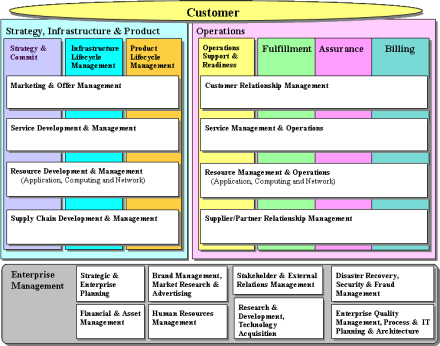
Can we build an Enhanced Healthcare Operations Map–e-HOM to create a standards for processes within the healthcare industry?

Without such a map, knowing which processes are involved with which systems and knowing where to apply change management is like shooting in the dark. I’ve asked and searched, and there does not appear to be anything like e-HOM.

The telecommunications industry has such a model, e-TOM, a global standard.

ETOM (1)

I think that with the gray matter we have in this group, we could make a good stab at building our own healthcare operations map. Please take a look at the diagram and let me know your thoughts as to how we can edit that diagram to create our own. What word would you change, what would you add, what relationships would you add or delete? For example, we would change “customer” to patient. Where would you add “EHR”, registration, etc?

I’ll take point on pulling it together.  Please email me your ideas paulroemer@healthcareitstrategy.com

Thanks.

pastedGraphic.tiff.converted