Dear Sir Richard Branson:

For those who care about how your patients view you.

REF: Mumbai to Heathrow 7th December 2008

I love the Virgin brand, I really do which is why I continue to use it despite a series of unfortunate incidents over the last few years. This latest incident takes the biscuit.

Ironically, by the end of the flight I would have gladly paid over a thousand rupees for a single biscuit following the culinary journey of hell I was subjected to at thehands of your corporation.

Look at this Richard. Just look at it: [see image 1,].
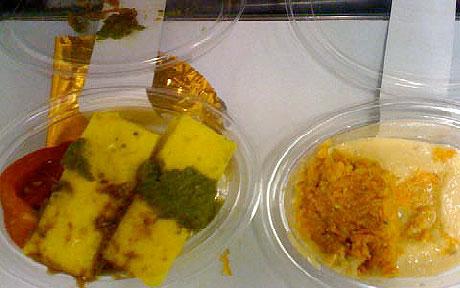
I imagine the same questions are racing through your brilliant mind as were racing through mine on that fateful day. What is this? Why have I been given it? What have I done to deserve this? And, which one is the starter, which one is the desert?

You don’t get to a position like yours Richard with anything less than a generous sprinkling of observational power so I KNOW you will have spotted the tomato next to the two yellow shafts of sponge on the left. Yes, it’s next to the sponge shaft without the green paste. That’s got to be the clue hasn’t it. No sane person would serve a desert with a tomato would they. Well answer me this Richard, what sort of animal would serve a desert with peas in: [see image 2,].
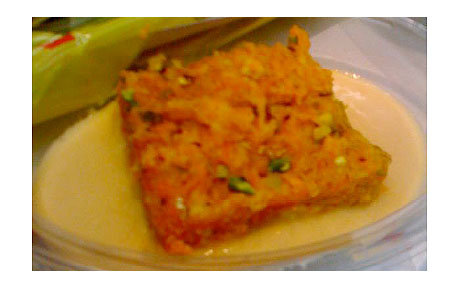
I know it looks like a baaji but it’s in custard Richard, custard. It must be the pudding. Well you’ll be fascinated to hear that it wasn’t custard. It was a sour gel with a clear oil on top. It’s only redeeming feature was that it managed to be so alien to my palette that it took away the taste of the curry emanating from our miscellaneous central cuboid of beige matter. Perhaps the meal on the left might be the desert after all.

Anyway, this is all irrelevant at the moment. I was raised strictly but neatly by my parents and if they knew I had started desert before the main course, a sponge shaft would be the least of my worries. So lets peel back the tin-foil on the main dish and see what’s on offer.

I’ll try and explain how this felt. Imagine being a twelve year old boy Richard. Now imagine it’s Christmas morning and you’re sat their with your final present to open. It’s a big one, and you know what it is. It’s that Goodmans stereo you picked out the catalogue and wrote to Santa about.

Only you open the present and it’s not in there. It’s your hamster Richard. It’s your hamster in the box and it’s not breathing. That’s how I felt when I peeled back the foil and saw this: [see image 3,].

Now I know what you’re thinking. You’re thinking it’s more of that Baaji custard. I admit I thought the same too, but no. It’s mustard Richard. MUSTARD. More mustard than any man could consume in a month. On the left we have a piece of broccoli and some peppers in a brown glue-like oil and on the right the chef had prepared some mashed potato. The potato masher had obviously broken and so it was decided the next best thing would be to pass the potatoes through the digestive tract of a bird.

Once it was regurgitated it was clearly then blended and mixed with a bit of mustard. Everybody likes a bit of mustard Richard.

By now I was actually starting to feel a little hypoglycaemic. I needed a sugar hit. Luckily there was a small cookie provided. It had caught my eye earlier due to it’s baffling presentation: [see image 4,].
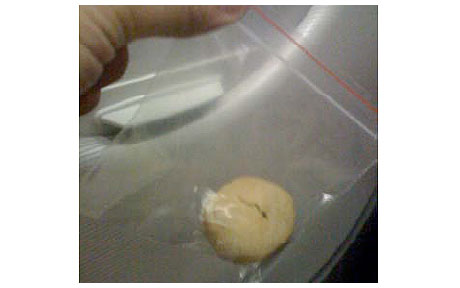
It appears to be in an evidence bag from the scene of a crime. A CRIME AGAINST BLOODY COOKING. Either that or some sort of back-street underground cookie, purchased off a gun-toting maniac high on his own supply of yeast. You certainly wouldn’t want to be caught carrying one of these through customs. Imagine biting into a piece of brass Richard. That would be softer on the teeth than the specimen above.

I was exhausted. All I wanted to do was relax but obviously I had to sit with that mess in front of me for half an hour. I swear the sponge shafts moved at one point.

Once cleared, I decided to relax with a bit of your world-famous onboard entertainment. I switched it on: [see image 5,].
I apologise for the quality of the photo, it’s just it was incredibly hard to capture Boris Johnson’s face through the flickering white lines running up and down the screen. Perhaps it would be better on another channel: [see image 6,].
Is that Ray Liotta? A question I found myself asking over and over again throughout the gruelling half-hour I attempted to watch the film like this. After that I switched off. I’d had enough. I was the hungriest I’d been in my adult life and I had a splitting headache from squinting at a crackling screen.

My only option was to simply stare at the seat in front and wait for either food, or sleep. Neither came for an incredibly long time. But when it did it surpassed my wildest expectations: [see image 7,].
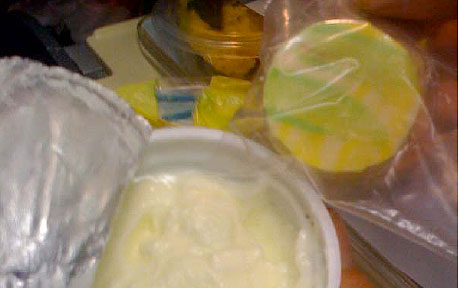
Yes! It’s another crime-scene cookie. Only this time you dunk it in the white stuff.

Richard…. What is that white stuff? It looked like it was going to be yoghurt. It finally dawned on me what it was after staring at it. It was a mixture between the Baaji custard and the Mustard sauce. It reminded me of my first week at university. I had overheard that you could make a drink by mixing vodka and refreshers. I lied to my new friends and told them I’d done it loads of times. When I attempted to make the drink in a big bowl it formed a cheese Richard, a cheese. That cheese looked a lot like your baaji-mustard.

So that was that Richard. I didn’t eat a bloody thing. My only question is: How can you live like this? I can’t imagine what dinner round your house is like, it must be like something out of a nature documentary.

As I said at the start I love your brand, I really do. It’s just a shame such a simple thing could bring it crashing to it’s knees and begging for sustenance.

Yours Sincererly

XXXX

  • Paul Charles, Virgin’s Director of Corporate Communications, confirmed that Sir Richard Branson had telephoned the author of the letter and had thanked him for his “constructive if tongue-in-cheek” email. Mr Charles said that Virgin was sorry the passenger had not liked the in-flight meals which he said was “award-winning food which is very popular on our Indian routes.”

Can you name your Chief Patient Officer?

(This column is not outsourced to Mexico.)

How many chiefs can you name? C-Levels, not Indians. I found these–COO, CIO, CTO, CMO, CMIO, CEO, CAO, CFO, Chief Purchasing Officer, Chief Network Officer, Chief Engineering Officer, Chief Benefits Officer, Chief Development Officer, Chief Brand Officer, Chief Staff Officer, Chief Health Officer, Chief Legal Officer, Chief Quality Officer.

Besides who gets the corner office, these titles demonstrate a firm’s commitment to those areas of their business, and these positions provide that business sector visibility all the way to the top of the firm. There’s a certain cachet that comes from having your sector of the business headed by a C-Level. Those are the ‘in’ jobs, the jobs to which or to whit one is supposed to aspire. You never see anyone clambering for a B-Level position. B-Level is the repository for all non C-Level jobs.

Remember Thanksgiving dinner when you were a child—apologies to those of who aren’t from the colonies. Anyway, if yours was anything like mine, there were two tables, the nice dining room table for the adults, and the smaller card table for the children, the B-Level guests.

So what does this have to do with patient care? You tell me. Let’s go from the premise that the C-Level positions are an accurate reflection of you firm’s focus. Why are we in business? If you go from the premise it must be because of finance, marketing, IT, Purchasing, or any of a dozen other things. The only thing missing in this view of the firm is the patient. The only entity without a seat at the grownup’s table is the person in the firm responsible for the patient. It seems to me a firm’s very existence, it’s raison d’être, is the patient. If that’s true, when do they get to eat with the grownups?

Patients Relationship Management-why not think like one?

I met last week with a number of 1st Year MBA students who have a consulting club to help them figure out if they are suited for this noblest of all professions–supposedly the second oldest profession. “How can you tell if you’ll be any good at it?” They asked.

As far as I can tell, there are two basic requirements. One, you have to be a bit out of kilter, a tad of ADHD doesn’t hurt either. You have to hate repetition.   Second, it helps if you have a belief that there is almost nothing you couldn’t figure out how to improve. While thinking it doesn’t make it true, the attitude is a critical success factor.

For example, I just returned from the post office.  Noon on the Wednesday before the holiday–lunch time rush hour.  I’m standing in a long line underneath a banner with a message emphasizing quality.

There are two clerks, postmen, postpersons, postladies–I’m not sure which one is most appropriate, but as we both know, I’m not going to lose any sleep over it either. The line is out the door. Clerk ‘A’ tells clerk ‘B’, “I’m going on break.” At which point I turned to the person next to me and uttered, “And I’m going to UPS.”   It’s not that difficult to improve.  Not letting half of your customer-facing employees go on break during your busiest time would be a good way to start to improve things.

It’s not rocket surgery. Patient Experience Management, Patient Equity Management. Whatever you call it, big inroads can be made.  Quit thinking like an executive and start thinking like a patient and you’ll have plenty of ideas.

Patient Relationship Management-Master of the Jedi Order

They don’t call me Yoda for nothing. This little rant is for those acolytes drinking the Kool Aid of disbelief, the recipe that says that one day, if we stay the course, this will all get better, those who believe that the light at the end of the tunnel isn’t a train.
For the next few minutes try and disassociate yourself from your responsibilities at work and become a patient.  Recall a time when you’ve been a dissatisfied patient. If you’re totally honest, that simple exercise should quicken your pulse. Cold beads of sweat appear on your forehead; your palms feel a little clammy.

The transition is faster than Clark Kent in a phone booth. A mild mannered and pedestrian acolyte transformed into a right-winged, Myers-Briggs INTJ A-Type with a passion for metaphorically devouring the unfortunate person awaiting your visit.

As you think about managing the equity of your patients think about it from the perspective of the patient, goodness knows they do. That relationship is black and white—there are no shades of gray. It’s good versus evil, Yoda versus Darth Vader.

I think with most patient interactions the patients believe that the person on the other end of the line is incented to make them go away as quickly as possible and at the lowest possible expense to the provider.

For most patients, patient loyalty is a thing of the past. Who do you do business with? Why? For any product that is even close to being a commodity, I deal with the firm who I find to be the least offensive, the one that will irritate me the least. That’s why I buy cars on EBay so I never again have to hear the phrase, ‘What’s it going to take to get you into that car?” If you find yourself doing that, why is it such a stretch to believe that so many patients feel the same way? That said, could it rather naïve to believe that your firm’s current approach to patient relationship management will make any difference?

Taking Care of Patients (TCOP)


That’s me in the back row–just kidding. There are approximately 640 muscles in the human body. Yesterday I pulled 639 of them. In anticipation of the onset of winter I’ve been ramping up my workouts, and at the moment am scarcely able to lift a pencil. I came across an article that describes the full body workout used by the University of North Carolina basketball players. It involves a ten-pound medicine ball, and 400 repetitions spread across a handful of exercises. I’m three days into it and giving a lot of thought about investigating what kind of workout the UNC math team may be using. At my son’s basketball practice last night, the parents took on the boys—they are ten. That 640th muscle, the holdout, now hurts as bad as the rest of them.

So, this morning I’m running on the treadmill, because it’s cold and the slate colored clouds look heavy with rain. While I’m running, I am watching the Military History Channel, more specifically a show on the Civil War’s Battle of Bull Run—I learned that that’s what the Yankees called it, they named the battles after the nearest river, the Rebs called it the Battle of Manassas, named after the nearest town. The historian doing the narration spoke to the wholesale slaughter that occurred on both sides. He equated the slaughter to the fact that military technology had outpaced military strategy. The armies lined up close together, elbow to elbow, and marched towards cannon fire that slaughtered them. Had they spread themselves out, the technology would have been much less effective.

Don’t blink or you’ll miss the segue. You had to know this was coming. Does your hospital have one of those designer call centers? You know the ones—wide open spaces, sky lights, sterile. Fabric swatches. The fabric of the chair matches that of the cubicle, which in turn are coordinated with the carpeting. Raised floors. Zillions of dollars of technology purring away underfoot. We have technology that can answer the call, talk to the caller, route the caller, and record the caller for that all important black hole called “purposes of quality.”

The only thing we haven’t been able to do is to find technology to solve the patient’s problems. Taking Care of Patients (TCOP).  We’ve used it to automate almost everything. If we remove all the overlaying technology, we still face the same business processes that were underfoot ten years ago. Call center technology has outpaced call center strategy. Call center technology hasn’t made call centers more effective, it’s made them more efficient. Call center strategies are geared towards efficiencies. Only when we design call center strategies around being more effective will the strategy begin to maximize the capabilities of the technologies.

Patient Relationship Management: Got Pigeons?


I was recently in a large call center of one of my clients. Supervisors and CSRs were scurrying about clearing their desks of binders and cheat sheets in an effort to make the center look paperless. I looked up just in time to see an ominous looking flock of people being given the nickel tour. They swept through in a scene reminiscent of the gathering of fowl in Hitchcock’s The Birds. In an instant we knew the flock was from corporate. The suit-people were tethered to their Blackberries and they kept glancing at their watches as though doing so was going to make lunch arrive quicker.

They encircled a cubicle, a few of them preening themselves, leaned forward, pretended to be interested in what they were being shown, nodded appropriately, scribbled down a few notes, and moved on. At one point, a few of them donned headsets to monitor a call. Within thirty minutes, it was all over, just like in the movie.

The next day the memo filtered down from corporate customer care and marketing, outlining all the new procedures the flock deemed necessary based on all the information they’d gleaned during their brief flyover.

Remember, pigeons happen.

Patient Relationship Management-there are some easy answers

MANUALSThere’s a reason penguins don’t play the viola—maybe that’s why they don’t have a home page. I used to try to approach things with an open mind, but people kept trying to put things like that in it. Did you ever notice that it’s difficult to encourage people to think outside the box especially if you haven’t seen evidence that the people inside the box are thinking? I’m sure there are those who think these ideas are mere snake oil, but who among you has ever seen a rusty snake?

There is often an inverse relation between the relevance of a document and its brevity. Roemer’s Law 17: the value of a patient user manual used in your call centers is approximately equal to the square root of the number of chapters. (That bit of insight is the equivalent of 4.6 raiments, where one raiment has been universally established as the amount of consulting insight needed to awe a frog for one hour.)

How many different patient user manuals are there in your patient call center? How many pages do those manuals occupy? I think user manuals are so long because call center managers believe busy people are effective people. People who aren’t busy all the time might start to think, and what good has ever come from that?

The United States Constitution is about 9,000 words—that’s about thirty pages. What is it about the interactions between patients and call center reps that requires more verbiage than the amount needed to keep 350,000,000 people living in prosperity and at peace with one another for more than 220 years?

For some people, work takes place in the fast lane. For me, it often takes place in oncoming traffic. To conclude, let’s agree to quit viewing things from the dark side of the sun. Sometimes instead of complaining about the darkness, it’s better to ignite a flame. The next time you are at your desk, open the user manuals, take out all the pages, and replace them with this one rule:

DO WHATEVER IT TAKES TO SOLVE THE PATIENT’S PROBLEM.

I guarantee that will improve performance. Some executives argue that the chances of something so patently absurd actually being true are a million to one. But consultants have calculated that million-to-one chances crop up nine times out of ten. It’s also fair to state that all mushrooms are edible, however it’s equally fair to state that some mushrooms aren’t edible more than once.

To those who want to prove me wrong, go ahead. Destroy the fabric of the universe, then call me.

saint

What if your patients controlled their relationship with you?

There are no atheists in foxholes.  The corollary is that there are no bloggers on bright sunny days.  The best blogs come from angst, gloom, from something amiss.  Things that can take the sun right out of the day.

Today is such a day.  I begin with a question.  How important are patients to your practice or hospital.  Is the attitude that they were coming here one way or another because that’s where the ambulance took them, or we’re the only hospital their payor covers?

If so, you’re home free—it’s like having a built-in retention model.  It reminds me of the line in The Eagles song, “Hotel California”—you can check out any time you want but you can never leave.  You don’t need to be good; you just need to be there.  You can eschew PRM (patient relationship management).  As long as people continue to get sick year-over-year at an increasing rate, your PRM, Marketing, and Social Media strategy can be that of Alfred E. Newman, “What, me worry?”

However, if having good PRM is important because of what it adds to the bottom line, or simply because it’s the right and polite way to relate to patients, here’s an example of how not to keep your patients.

I was on the phone with HP, trying to get someone to answer a question about why my desk-top speakers are filled with static.  Prior to calling, I replaced the old speakers with new ones, same model, and heard the same static.  No answers on line, no answers on Google.  I wind up be handled by an ESL/ASC person, English as a Second Language, America as a Second Country.

We spend nine minutes and fifty-four seconds on the phone as I give him my phone number, my wife’s email which somehow confirms I’m not a mirror image of myself, and crawl under my desk and flip over the HP trying to find and read a serial number that is written in smaller text that the directions on a bottle of cough syrup.  Purchase date, operating system, product ID.

“Now, while I’m waiting on my system, tell me your problem.”

I did.  To which he said, “I can help you for a nominal fee.”  Ten minutes into the conversation before he’s able to tell me that answers cost money.  I shared my dissatisfaction with him and his firm and his country—not really.  I suggested he could have answered my question nine minutes ago for less cost than HP had already incurred for this service call.  I suggested he could point me to a helpful web site, or save us all additional embarrassment and just whisper something like, “you have a bad sound card.”  No, no, and no.

For those who may be new to the idea of PRM and social media, this is how it works.  I will not buy another HP even if the ambulance takes me to the HP store.  Since I can’t listen to my music on my HP, I will make it my mission to go out of my way to convince others that HP is not worth their money.  I will post and Tweet until I grow tired of the exercise or until I simply plug in my iPod.  Whatever happens, I will have done my best to take all of the toothpaste out of the HP tube, knowing they can’t put it back.

This is what happens when customers and patients take PRM and social media into their own hands.  It may also be what happens when the 12-step program proves to have been a few steps short of complete therapy program.

pastedGraphic.tiff.converted

Patient Relationship Management–why patients and hospitals collide

Rod


When universes collide, or is universi the plural? Not that is matters. I was watching NOVA.  The show focused on the lead singer of the Indie group The Eels.  The show walked through the singer’s attempt to understand was his father had done for a living.  His father was a physicist, in fact he was the person who came up with the notion of colliding universes. Colliding universes has something to do with quantum mechanics and cosmology—did you also wonder what makeup had to do with particle physics? In its rawest meaning, parallel universes have something to do with the notion of identical worlds living side-by-side, with no notion of each other, with differing outcomes from similar events. Got it?  Me either.

I’ll try to illustrate if for nothing else than my own attempt to understand. Let’s say I’m concurrently teaching my two sons to play two different card games, Poker and War. Poker, albeit a game of chance, is heavily rules-based—when to bet, when to fold, when to raise. On the other hand, War is purely a game of chance. The poker player likes rules and order. The one playing war—he’s seven—likes to win, and will do what is required to bring about that outcome. Each one plays independent of the other, using the tools at their disposal to direct the outcome of the game in their favor. They are oblivious to the goals and tactics employed by the person sitting beside them. Parallel universes.

What if we allowed these two universes to collide, to come into conflict with one another? For example, let’s say I have them play each other and I re-deal the cards, giving one the cards he needs for a poker hand, and the other the cards to play war. I then instruct them to play one another. The poker player becomes focused on the rules, and the one playing war has a laser focus on one thing—winning. The poker player quickly caves, knowing that he is engaged in a futile endeavor. This does not bother the other one whose only focus was to win.

Imagine if you will—sort of Rod Serlingish—two other games going on simultaneously, one team whose sole focus is winning, the other whose focus is on the rules. For the rules-based team there is no winning. The best they can ever hope to do is to measure up to the rules by which they are judged. Millions have been spent on technology to help ensure that adherence. Adherence to the rules will be monitored, recorded, reported, and measured. The rules-based team’s ability to continue to play the game will be based solely on how well they follow the rules. Now imagine that the universes in which these two teams are playing collide and these two teams play their separate games but against each other. One team having never been told how to win, never been instructed to win, never even given permission to win. The other team’s only purpose is to win.

This is a nonsense game. One we play every day.  One team is the hospital’s patients the other team is the employees who are tasked with patient customer care, patient relationship management (PRM).  The patients are focused on winning, those tasked with customer care or PRM are not permitted or equipped to win.

It’s possible for these two groups to change the outcome, to take away the nonsense.  To make that happen, the rules must change.  PRM can be very effective provided that it is designed to help the patients “win”, designed to facilitate favorable outcomes for patients.  The trick to changing the outcome is that the hospital must understand that a win for the patients in most cases is also a win for the hospital.

saint

Who was that woman who put in our first EHR system?

vacuum_cleaner

The first home I bought was in Denver.  Built in 1898, it lacked so many amenities that it seemed better suited as a log cabin.  There was not a single closet, perhaps because that was a time when Americans were more focused on hunting than gathering.  Compared to today’s McMansions, it was doll-house sized.

It needed work—things like electricity, water—did I mention closets?  I stripped seven costs of paint from the stairs.  Hand-built a fireplace mantel and a deck.  I arrived home to find my dog had eaten through the lathe and plaster wall of the space which served as my foyer/family room/ living room-cum-hallway.  I discovered the plaster and lathe hid a fabulous brick wall.

My choice was to patch the small hole, or remove the rest of the plaster.  Within an hour I had purchased man-tools; two mauls, chisels, and a sledge hammer.  I worked through dinner and through the night.  The only scary moment came as the steel chisel I was using connected to the wiring of two sconces which were embedded in the plaster.  On cold nights I can still feel the tingling in my left shoulder.

As the first rays of dawn carved their way through the frosted beveled glass of the front door, I wondered why I never before had noticed that the glass was frosted.  I wiped two fingers along the frost.  A fine coating of white powder came off the glass leaving two parallel tracks resembling a cross-country ski trail.  I surveyed the room only to see that the air made it look like I was standing inside of a cloud.  The fine white powder was everywhere—my Salvation Army sofa and semi-matching machine-loomed Oriental rug from the Far East (of Nebraska), a two-ton Sony television, and a component stereo system that had consumed most of much earnings.

Bachelor living can be entertaining.  One of my climbing buddies moved in with me.  The idea was I’d keep the rent low, and he’d help me by maintaining the house.  He didn’t help.  I made a list of duties; he didn’t help.  I left the vacuum in the middle of the floor, for two weeks; he didn’t help.  I made him move out, and advertised for a female roommate—an idea I now wish I’d marketed.  A girl from church came over to see the place.  I turned my back on her, only to find when I returned that she was on her hands and knees cleaning the bathroom.  I was in love.  It was like having a big sister and mother.  She even asked if it was okay if since she was doing her laundry if she did mine at the same time.  Life was oh so good.

Sometimes when one approach isn’t working it’s real easy to try something else.  And sometimes the something else gives you a solution in the form of a water-walker.  Healthcare IT and EHR aren’t ever going to be one of those sometimes.  There will be no water-walkers, no easy do-overs.  There won’t be anyone walking your hallways talking about their first wildly unsuccessful EHR implementation.  Nobody gets to wear an EHR 2.0 team hat.  Those who fail will become the detritus of holiday party conversations.  Who will be the topic of future holiday parties?  I’m just guessing, but I’m betting it will be those who failed to develop a viable Healthcare IT plan, whoever selected the EHR without developing an RFP, the persons who decided Patient Relationship Management (PRM) was a waste of money.  The good news is that with all of those people leaving your organization, it costs less to have the party.

I’d better go.  Somebody left the vacuum in the middle of the floor so I need to get cracking before my wife advertises for a female roommate.

saint