What was the name of your project that lost all the productivity

Since we are already talking about productivity I thought it would be worth spending a few minutes trying to understand why large numbers of hospitals seem to have acquiesced to the notion that operating with a productivity loss is their new steady state.

Imagine for a second that you were to discover that your least costly resource, say the person who answered the phones was spending twenty percent of their day updating their Facebook page.  Were that the case, you would know two things with a high degree of certainty;

  1. The productivity loss had a measurable cost
  2. The productivity loss would be corrected quickly

Now imagine that your hospital spent eight or nine figures on an EHR system.  Imagine that the hospital’s most expensive resources, the doctors, are spending most of their time entering data into the hospital’s expensive EHR system, so much time in fact that they are only able to see eighty-percent of their patients.  Now imagine that you do not have to imagine these because they are real.

Headline:  EHR results in a twenty-percent productivity loss.

Any hospital executive should be able to answer the following two questions:

  1. How much does each percentage of productivity loss cost the hospital?
  2. What is the name of the project to recover the lost productivity?

The project has no name because there is no project, and that is a shame.  The project to create the productivity loss had some stellar name, it had a war room, and it probably even had its own T-shirts.  The project to lose all of that productivity was a massive undertaking.

Should not the project to recover the productivity receive a little attention?

There are those who believe the lost productivity is gone forever.  Productivity is not like energy; it can be created and destroyed.  All kidding aside, there is a way to retrieve the lost productivity, all of it.  If you would like to know let me know.

EHR: It is like herding cats

I spent a summer in Weaverville, North Carolina, just outside of Asheville. (I couldn’t find it on the map either.) That summer, I was the head wrangler at Windy Gap, a summer camp for high school kids. I’m not sure I’d ever seen a horse, much less ridden one, so I guess that’s why they put me in charge. I thought that maybe if I dressed the part that would help. I bought a hat and borrowed a pair of cowboy boots from a friend; the boots were a half size too small, and I spent the better part of the first night stuffing sticks of butter down them trying to get them off my swollen feet.

The ranch’s full-time hand taught us how saddle the horses and little bit about how to ride. In the mornings we had to herd the horses from the fields, bring them into the corral, and saddle them. The other wranglers would ride out to the field to bring in the horses, while I being the least experience of the wranglers would race after them in my running shoes trying to coax them back to the barn. We would take the children for a breakfast ride halfway up a mountain path where we would let them rest and cook them a breakfast of sausage and scrambled eggs. One morning there were a group of 15 high school girls sitting on the fence of the corral. I walked up behind them carrying two saddle bags filled with the breakfast fare. I slung the saddlebags over the top rail of the fence, and hoping to make a good impression I placed one hand on the rail and vaulted myself over. I landed flat on my back smack dab in the middle of the pile of what horses produce when they’re done eating—so much for the good impression.  That earned me the nick-name, “Poop Wrangler.”

I brushed myself off and saddled my horse. The moment I gripped the reins the horse reared, made a dash for the fence and jumped it in one motion. I could tell the high school girls were impressed as I flew by them. Both of my arms were wrapped around the horse’s neck, and I had my hands locked in a death grip. I yelled, “whoa” and stop”, only to learn that the horse didn’t speak English. We raced the 200 yards to the dining hall, stopped on a dime, and raced back to the corral, as the girls continued to cheer. One final leap, and I was back where I started; on the ground, in the corral, looking up at the girls. I took a bow and quickly remounted my steed. The full-time ranch hand came over and instructed me rather loudly, “You can’t let the horse do that. You have to show the horse that you’re in charge.” After that piece of wisdom he grabbed my horse by its bit, pulled its head down, and bit a hole in my horse’s ear. I’m not sure what kind of in an impression it made on my horse. I guarantee you it made an impression on me.

Horses aren’t very intelligent, but they know when you don’t know what you’re doing, when you’re bluffing—dressing like a cowboy didn’t even fool the girls, much less my horse—I guess he hadn’t seen many westerns. Here we go—you had to know where this was headed.

Selecting and implementing an EHR will be the most complex project your hospital will undertake.  If you do it wrong, you may not look any better than I did laying on my back in the corral.  You won’t have girls laughing at you, but you also may be looking for another line of work.

You don’t want to read this, but if your projected spend exceeds ten million dollars, your chances of success, even if you do everything right, is less than fifty percent.  I define success as on time, on budget, functioning at the desired level, and accepted by the users.  That’s reasonable, correct?  We don’t need to talk percentages if you don’t do everything right.

These figures come from the Bull Report—that’s really the name, honest.

The main IT project failure criteria identified by the IT and project managers were:

missed deadlines (75%)
exceeded budget (55%)
poor communications (40%)
inability to meet project requirements (37%).

The main success criteria identified were :

meeting milestones (51%)
maintaining the required quality levels (32%)
meeting the budget (31%)

How is yours matching against these?  Given a choice, sometimes I’d rather be the horse.

The Cat in the Hat’s EHR Philosophy

My mind is a raging torrent, flooded with rivulets of thought cascading into a waterfall of creative alternatives. (Hedley Lamar—that’s Hedley)

Let’s see if we can tie this collection of thoughts into something that won’t waste your time or mine.

The sun did not shine.  It was too wet to play.  So I sat in the house all that cold, cold, wet day.  It was too wet to go out and too cold to play ball, so I sat in the house and did nothing at all. (Dr. Seuss)  It was around that time when my wife decided maybe this whole sitting around thing wasn’t optimizing my time, so she decided “we”—which can also be interpreted to mean “me”—should caulk the master shower.  Personally, I thought that why God invented the Yellow Pages, you know, the whole thing about, “Let your fingers do the walking.”

I notice we just blew through an entire paragraph without accomplishing anything.  Sorry.  I got my designer tool belt, the same one I’ve had for twenty years—still looks the same as the day I bought it.  Today’s Roemer Minute—the less you know about what you’re doing, the more important it is to dress the part.  (This does not seem to work with the people whom I’ve told that I’m studying cardiology.)

Tool belt.  Tools—caulk taker-outer, caulk puter-inner.  Paper towels—the need for these will become clear.  Worse case, this is a ten minute job, but if I finish too quickly, there will be additional assignments coming my way.  The trick with caulking is that the success or failure can all come down to how much of the plastic tip you circumcise (can I say that on TV?).  Too much and caulk is everywhere, not enough and it is nowhere.  I made the incision and started to lay down the first bead.  It was quickly apparent that I should have used clear caulk as the white stuff stared back at me like bleached bones—I try and add a little medical flavor wherever I can.

I’ve watched the same shows as you.  Sometimes people spread the caulk with a tool, others prefer a wet finger.  I am equally unskilled with both, so I went with the finger method, smoothing the caulk into the joint.  I wipe my sticky white finger on the paper towel, place the towel on the limestone tile, and return to work, only to notice that although the caulk looks good, my finger created to parallel lines of caulk on either side of the repair, sort of like a snow plow does.  I grab another piece of paper towel and begin the process of trying to remove the excess caulk, finally tossing the paper towel to the side.

Fast forward twenty minutes.  The caulking is done.  My hands are so white it looks like I am wearing a pair of Mickey’s gloves.  (That’s spelled M-O-U-S-E.)  As I wipe my hands with a used piece of towel—there are no more clean ones—I unknowingly step on one of the pieces.  The piece sticks to my shoe.  I retrieve the other pieces and notice that the caulk which had been on the paper towels is now spread all over the tile like someone had a food fight with smores.

Whatever I touched only exacerbated the problem.  I am immediately reminded of the Dr. Seuss book, “The cat in the hat comes back.”  In the book, the cat goes from good intentions to spreading a pink stain over everything—sort of like me with the caulk.

Sometimes good intentions don’t add up to much.  I’d wager that everyone in the EHR process has good intentions.  Sometimes it’s more important to pair good intentions with good skills.  Let’s call EHR one of those sometimes.  Good intentions are okay up to the point when you’re dealing with two or more commas on the cost side.

Here is today’s thought, the one reason you keep coming back to this site. Why did you implement EHR?  The answer will surprise you.  You did it for one simple reason, to get people, doctors and nurses, to do what you want them to do and to do it in a way you want them to do it.  EHR will modify their behavior.  I am sure yours did, but did it modify it in the way you wanted?

Most times it’s good to call a professional before you start tracking caulk across the floor.

I can fix your EHR productivity

That is a bold statement and one I can back up. I feel so confident in this claim that if productivity of your EHR does not improve the cost to you is nothing.

EHR potentially will offer a number of benefits.  It won’t offer much at all if you don’t install it right.

However, it’s not a panacea.  Without having a detailed understanding of the business problems you are trying to solve, it may not be of much more value than a Xerox machine.

Do you want make color copies with your EHR?  Probably not.

I picture your office situation is something like this.  The EHR vendor left months ago.  IT keeps coming around to ask how you are doing, to ask how the system is performing.  Not wanting to hurt their feelings you tell them everything is fine, but it is not fine.  It has not been fine since you started using it. Your productivity is down, way down, and it looks like it is not going to get better any time soon.

Does that sound about right?

What is I told you your productivity loss can be fixed?  Stop laughing long enough to read.  The vendor will not be the one to fix it. IT will not be the one to fix it.

All kidding aside, if you want to discuss how you can recoup your productivity, please let me know.

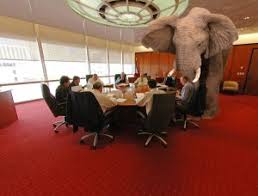
Social Media: The Elephant in the Bored Room

Pardon the idiom, and yes, the misspelling was deliberate.  You may want to grab a sandwich, this is a long read.

For the longest time it has occurred to me that most companies find themselves in a state of what I like to label Permanent Whitewater. As they careen through the rapids, it is anybody’s guess as to whether they will capsize.  And the philistines they have appointed as commissioners would be more appropriately described as Ommissioners, as they have omitted themselves from understanding the world and leading their charges.

Now, what does that have to do with anything?  Thanks for asking.

For those of you who can find Vietnam on the map, you will recall the great turnip boycott of the nineteen seventies—I know they boycotted grapes, but I like grapes and do not like turnip, so I choose to have my own protest.  Anyway, this boycott worked, and as a result, the working conditions for migrant workers improved albeit only modestly.

And here is the kicker.  An entire industry was brought to its knees.  That is not the surprising part.  The surprising part is that all of this change was brought about at a time when there were three television channels and when people actually subscribed to newspapers.

From where I sit, social media can be divided into two camps, those who have not slept since the launch of Google+, and the far larger camp of those who have not lost a minute of sleep.  Businesses, for the most part are well entrenched in the latter group.

Part of the reason why businesses are slow to adopt social media can be attributed to their lack of belief that social media matters or can impact their business one way or the other.  And frankly, I think that has a lot to do with why our economy continues to rejoice in its malaise.

So, how to those of us in the first camp get those in the second camp to see the world our way, how do we get them to jump head-first into social media.  The answer is simple.  We need to create our own turnip debacle.

They say it cannot be done, so let us show them.  The one thing that would get companies to embrace quickly and unashamedly social media would be if there was one less company.

Companies, big ones, fat ones, firms that climb on rocks—feel free to finish the tune without my help have the following issues, they think they:

–       control their market

–       own their customers

–       are managing their customers

Companies are wrong about those three assumptions and the use of social media can and will prove this.  I would ask for a volunteer, but that would take too long.

If ABC, CBS, and NBC were able through their coverage of the grape boycott, bring about change to an entire industry, imagine with me what impact a committed bunch of savvy social media users could do to a single firm.

Here is what I propose.  Let us pick one firm.  The characteristics of this firm should be that it is well known and not well liked—this way we can argue that we acted on behalf of a greater good.  It should also be a firm associated with technology, a firm that ought to at least be able to spell social media.  If I were asked which firm I would choose I would pick a firm in some aspect of telecommunications, say a firm like Comcast or Verizon.

Now, the idea of our little social project will be to provide a heads-up to all of the other companies about the start date of our little social media experiment.  Let’s tentatively agree on the first of November unless there is a game on television I want to watch.

The goal of the project is to demonstrate that the bourgeois, the working class, with its harmless set of social media tools, can create affect enough of a disruption to an organization to make it sit up and take notice, or to disappear.

I am sure you remember the YouTube video of the Comcast technician that fell asleep on a customer’s couch.  It went viral, but Comcast did not, and that was simply a single posting by a single customer.  What would happen if the social media mavens decided to use the tools at their disposal and concentrate their efforts at or against a single firm?

Crowdsourcing 101.

I think the end result of such an effort would have a significant impact.  The impact could easily bring about more fundamental change as to how firms view and use social media than was brought about by the grape boycott.

Sometimes something has to be sacrificed on behalf of the greater good.  Although a rising tide lifts all boats, but it can ruin your day if your firm is the one chained to the pier.

What are your ideas?

When Good Projects Go Bad

What are the EHR fail-safe points?  The points of no return, beyond which you can’t recover without exploding the budget and the  schedule?

Although there are several, my take is that the most important one is the planning process.  Without the right plan, an organization is entering its permanent whitewater moment.

What plan do you have to rigorously evaluate the plan before you step off the EHR cliff?  Are you stepping off with a parachute or a bag of rocks?

My best – Paul

“Improved” never sold anything.

(AP) Redmond Washington.  After a much heralded launch, the buzz around Microsoft’s launch of Windows 8.0 is centered on the fact that when the computer crashes that users will no longer see the blue screen of death.  Instead, users will now see a friendly screen requesting that they restart their systems.

“Which is why we have decided to close the company at the start of 2012,” said CMO Droid Nelson.  “I mean when you spend two hundred million dollars just to market 8.0 and the only chatter is about the crash screen, the time has come.  We have not offered anything of interest to early adopters since 1997.  After all, what are we supposed to do?  If we continue on at this rate sooner or later we will hold a news conference for Windows 17.0 and Office 2024 and nobody will care.

How many times can we put a new ribbon around the same old software?  It is not like we can make it run any faster or any easier to navigate.  And Office is still Office.  When was the last time we added anything to that suite?  Most of our customers already cannot use half of the features we built, why should we keep building until we get that figure up to eighty percent?

The innovation train left the station around the time Starbucks came out with their half-caf-decaf with a double shot.  We made ourselves irrelevant.  Hell, I use an iPad and Google Docs.”

Can you name what Microsoft launched the last time you were willing to tailgate to be the first one to own it?  Nobody can.

Can you name the last time your customers were willing to tailgate to be the first one to purchase your firm’s newest offering?  Didn’t think so.

The thing to remember about new and improved is that it isn’t either.  If it was so brand spanking new, you wouldn’t have to tell anyone.

New is not a feature.

Improved is not a feature.

When Apple launched the first iPod their pitch was something along the lines of every song you every wanted to listen to in this little box.

Customers stand in line for innovation.  Is there a line outside your door?

Your company needs a CFO–Chief Failure Officer

Willingness to make mistakes, trial and error, the idea comes first

To me, one of the great unknowns about Albert Einstein is the question of what he did when he was not publishing his theories.  Assuming you are not among those who read People Magazine, the average layman has probably heard of his Theory of Relativity.  Fewer still can state the theory, and only a small number of people have any idea of its implications.

So, he’s got a couple of theories to his credit.  I’ll ask again, what did he do with all of his non-theory time?

He failed; prolifically.  Einstein always began with an idea, something simple like explaining the entire universe with a single equation.  In between the idea and the equation were years of trial and error—lots of errors.

Einstein planned for failure.  If he did not fail nobody alive would know his name.

Who is in charge of failure at your firm?  Whose career hinges on making colossal failures?

Everyone in business fails.  Somebody didn’t me plan.  A large customer went elsewhere.  The new plant in China is two years late.  Joe was 1.3% over budget.  In the grand scheme of things, those failures are irrelevant, they are rounding errors, errors which over time have little impact on the bottom line.

There are two types of failures; operational—like above—and strategic.  Given the choice I’d opt for strategic failures every time.  To fail strategically means somebody is at least trying to do something.

Don’t place someone in charge of making sure everyone is on budget.  If you want to be innovative, make sure you have someone overseeing failure.

Certification: Myth or just plain stupid?

EHR certification inspectors will be dropping in on hospitals like UN inspectors looking for WMDs, only they’ll be slightly less congenial.

Why is this a part of the overall plan?  Is this planned failure?  Do they have reason to believe that a certain percentage of EHRs will fail the inspection?

Of course they do.

Permit me to begin with a C-Suite IQ test. Given the choice would you rather have:

  1. A certified EHR that resulted in a productivity loss of 20%
  2. An uncertified EHR that resulted in a productivity gain
If you picked ‘1’ reading further is useless.

Let’s describe two failure types; certification and Full test.  The certification test, by definition, is necessary.  The Full test is both necessary and sufficient.  It is possible to pass certification without passing the Full test.  Therefore, the Full test is a stricter test.  Build out to pass the Full test, and by default, one should pass the Certification test.

What is the full test?  Same as always.  Fully functional, on time, within budget, and user accepted.  Functional, for purposes of this discussion includes updated workflows, change management, and interoperability, and a slew of other deliverables.

Here’s what can be concluded just based on the facts.

Fact:  One-third to two-thirds of EHRs are listed as having failed—this statistic will get smaller over time.

Opinion:  The reason the failure rate will get smaller is that the failure rate will be artificially diluted by a large number of successful small-sized implementations.  Large implementations, those have far-reaching footprints for their outpatient doctors, Rhios, and other interfaces requiring interoperability will continue to fail if their PMO is driving for certification.  (Feel free to add meaningful use to the narrative, it doesn’t change the result.)

Fact:  Most large, complex, expensive IT projects fail—they just do.  This statistic has remained constant for years, and it is higher than the percentage of EHR projects that have failed.  Even a fairly high percentage of those projects which set out to pass the Full test.

Opinion:  Failure rate for large EHR projects—let’s say those above $10,000,000 (if you don’t like that number, pick your own)—as measured by the Full test, will fail at or above the rate for non-EHR IT projects.)

Bleak?  You bet.  Insurmountable?  Doesn’t have to be.

What can you do to improve your chances of success?  Find, hire, invent a killer PMO executive out of whole cloth who knows the EHR Fail Safe Points.  EHR Fail Safe Points?  The points, which if crossed unsuccessfully, place serious doubt about the project’s ability to pass the Full test.  The points which will cause success factors to be redefined, and cause one or more big requirements—time, budget, functionality—to be sacrificed.

This person need not and perhaps should not be the CMIO, the CIO, or an MD.  They need not have a slew of EHR implementation merit badges.  The people who led the Skunk Works had had zero experience managing the types of planes and rockets they built.  They were leaders, they were idea people, they were people who knew how to choose among many alternatives and would not be trapped between two.

The person need not be extremely conversant in the technical or functional intricacies of EMR.  Those skills are needed—in spades—and you need to budget for them.  The person you are looking for must be able to look you in the eye and convince you that they can do this; that they can lead, that these projects are their raison d’etre.  They will ride heard over the requirements, the selection process, the vendors, the users, and the various teams that comprise the PMO.

A certified EHR is all it never was.

What do you think?

Business Innovation: Hamsters Only Bounce Once

Hamsters only bounce once—next time I will read the fine print.  This was the lesson I learned today from my thirteen-year-old son as he tried to hold my nine-year-old son’s hamster—I keep wanting to insert a ‘p’ after the ‘m’, but my inability to spell will not affect the hapmster’s condition.

So, from hamsters to the Soviets—those too young to remember the Soviets, Google it.  I am reading a book about the latter years of Stalin’s reign.  In the book Nikita Khrushchev, while dedicating a school, reportedly stated the USSR needed highly productive, healthy scientists, engineers, and gold-medal athletes.

The implication of Nikita’s pronouncement was the country did not need any poets, philosophers, and priests.  It needed productivity that could be measured and quantified; success that could be timed with a stopwatch.

Perhaps it is the cynic in me, but those few paragraphs reminded me immediately of how individual American corporations are run.  After all, is not that what our firms do?  We measure and quantify and time.  Whether it is earnings per share or inventory or supply change.  We tend to think and act that business success is all about the numbers, that if we study them hard enough, we will divine how to move forward.

How well is that working?  The hamster wheel is no longer spinning.  How many new ideas have resulted from the approach of quantification?  Every company can measure.  It just so happens what they have been measuring is declining revenues.

Things that do not measure well include strategy and innovation.  Firms cannot increase innovation by twenty percent or execute strategy fifteen seconds faster.  Perhaps there is merit in placing less emphasis on quantitative efforts.  Is it possible that a more qualitative focus would improve the quantitative results?