EHR, HIEs & N-HIN; a prophecy of doom

Whether it’s vendors, RHIOs, HIEs, or the N-HIN, where is a plan that will work?  Is not this what it’s all about?  Perhaps it is time that the rest of the national HIT leaders at CMS and the ONC who devised this plan, and who have lead physicians and hospitals down this ill-fated path promising them riches at the end of the journey should acknowledge their mistake and look for other ways to pass their time; pursue something more achievable, like gardening.

If the plan of of nationalizing healthcare by using HIEs, RHIOs, Meaningful Use, and the N-HIN had any real chance of working, don’t you think we would see a lot more organizations lining up to collect their EHR rebate?

In 1-2 years Meaningful Use will have been replaced by something else or done away with entirely.  In 3-5 years the HIE-NHIN plan will have changed dramatically.  That does not help people who are spending money today chasing ghosts.

As a side note, many hospitals will miss the ICD-10 conversion date.  Not for lack of interest, but because so much of their attention is focused on chasing the banshee known as EHR.

HIEs remind me of hand-to-hand fire bucket brigades.  It’s time we agree to use a truck.

EHR–it’s like herding cats

Herd of cats? Of course I’ve heard of cats.

I spent a summer in Weaverville, North Carolina, just outside of Asheville. (I couldn’t find it on the map either.) That summer, I was the head wrangler at Windy Gap, a summer camp for high school kids. I’m not sure I’d ever seen a horse, much less ridden one, so I guess that’s why they put me in charge. I thought that maybe if I dressed the part that would help. I bought a hat and borrowed a pair of cowboy boots from a friend; the boots were a half size too small, and I spent the better part of the first night stuffing sticks of butter down them trying to get them off my swollen feet.

The ranch’s full-time hand taught us how saddle the horses and little bit about how to ride. In the mornings we had to herd the horses from the fields, bring them into the corral, and saddle them. The other wranglers would ride out to the field to bring in the horses, while I being the least experience of the wranglers would race after them in my running shoes trying to coax them back to the barn. We would take the children for a breakfast ride halfway up a mountain path where we would let them rest and cook them a breakfast of sausage and scrambled eggs. One morning there were a group of 15 high school girls sitting on the fence of the corral. I walked up behind them carrying two saddle bags filled with the breakfast fare. I slung the saddlebags over the top rail of the fence, and hoping to make a good impression I placed one hand on the rail and vaulted myself over. I landed flat on my back smack dab in the middle of the pile of what horses produce when they’re done eating—so much for the good impression.  That earned me the nick-name, “Poop Wrangler.”

I brushed myself off and saddled my horse. The moment I gripped the reins the horse reared, made a dash for the fence and jumped it in one motion. I could tell the high school girls were impressed as I flew by them. Both of my arms were wrapped around the horse’s neck, and I had my hands locked in a death grip. I yelled, “whoa” and stop”, only to learn that the horse didn’t speak English. We raced the 200 yards to the dining hall, stopped on a dime, and raced back to the corral, as the girls continued to cheer. One final leap, and I was back where I started; on the ground, in the corral, looking up at the girls. I took a bow and quickly remounted my steed. The full-time ranch hand came over and instructed me rather loudly, “You can’t let the horse do that. You have to show the horse that you’re in charge.” After that piece of wisdom he grabbed my horse by its bit, pulled its head down, and bit a hole in my horse’s ear. I’m not sure what kind of in an impression it made on my horse. I guarantee you it made an impression on me.

Horses aren’t very intelligent, but they know when you don’t know what you’re doing, when you’re bluffing—dressing like a cowboy didn’t even fool the girls, much less my horse—I guess he hadn’t seen many westerns. Here we go—you had to know where this was headed.

Selecting and implementing an EHR will be the most complex project your hospital will undertake.  If you do it wrong, you may not look any better than I did laying on my back in the corral.  You won’t have girls laughing at you, but you also may be looking for another line of work.

You don’t want to read this, but if your projected spend exceeds ten million dollars, your chances of success, even if you do everything right, is less than fifty percent.  I define success as on time, on budget, functioning at the desired level, and accepted by the users.  That’s reasonable, correct?  We don’t need to talk percentages if you don’t do everything right.

These figures come from the Bull Report—that’s really the name, honest.

The main IT project failure criteria identified by the IT and project managers were:

missed deadlines (75%)
exceeded budget (55%)
poor communications (40%)
inability to meet project requirements (37%).

The main success criteria identified were :

meeting milestones (51%)
maintaining the required quality levels (32%)
meeting the budget (31%)

How is yours matching against these?  Given a choice, sometimes I’d rather be the horse.
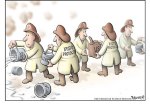
 

EHR Failure Factors–step away from the computer

There are days when it doesn’t pay to be a  serial malingerer, and when it does, the work is only part time, but I hear the benefits may be improving as I think I heard somebody mention healthcare is being reformed.

I don’t know if you are aware of it, but there are actually people who have taken an Alfred E. Newman, “What, me worry” attitude towards EHR.  For the youngsters in the crowd, Alfred was the poster child for Mad Magazine, not Mad Med.

Just to be contrarian for a moment–as though that’s out of character for me–most providers have no need to fear–does this happen to you?  You are writing aloud, trying to make a point, and the one thing that pops into your mind after, ‘there’s no need to fear’ is “Underdog is here.”

Anyway, since many providers haven’t begun the process, or even begun to understand the process, there is still time for them to lessen the risk of failure from an EHR perspective.  Many don’t want to talk about it, the risk of failure.

Here’s another data set worth a look (The Chaos Report).  They went a little PC on us calling them ‘Impaired” factors.  EHR impairment.  Step away from the computer if you are impaired, and take away your friend’s logon if they are.  These are failure factors.

Project Impaired Factors % of  the Responses
1. Incomplete Requirements 13.1%
2. Lack of User Involvement 12.4%
3. Lack of Resources 10.6%
4. Unrealistic Expectations 9.9%
5. Lack of Executive Support 9.3%
6. Changing Requirements & Specifications 8.7%
7. Lack of Planning 8.1%
8. Didn’t Need It Any Longer 7.5%
9. Lack of IT Management 6.2%
10. Technology Illiteracy 4.3%
11. Other 9.9%

My take on this is with overall “failures” so high, several respondents could have replied to “all of the above.”  Also of note is that these failure reasons differ from the ones listed previously.

Who knows, maybe if we multiply them by minus one we can call them success factors.


EHR’s Gordian knot

There were four of us, each wearing dark suits and sunglasses, uniformly walking down the street, pausing at a cross-walk labeled “consultants only”—I think it’s a trick because a lot of drivers seem to speed up when they see us. We looked like a bad outtake from the movie Reservoir Dogs. We look like that a lot.
Why do you consult, some ask? It beats sitting home listening to Michael Bolton or practicing my moves for, So You Think You Can Dance, I tell them.

Listening to the BBC World News on NPR whilst driving, there’s one thing I always come away with—they’re always so…so British. No matter the subject—war or recession—I feel like I should be having a proper pot of tea and little cucumber sandwiches with the crusts removed; no small feat while navigating the road.

Today’s conversation included a little homily about the Gordian knot with which the company Timberland is wrestling, questioning whether as a company Timberland should do well, or do good. (Alexander the Great attempted to untie such a knot, and discovered it had no end (sort of like a Möbius strip, a one-sided piece of paper–pictured above. (For the truly obtuse, among which I count myself, the piece of paper can be given a half twist in two directions; clockwise and counter-clockwise, thereby giving it handedness, making it chiral—when the narrative gets goofy enough, sooner or later the Word dictionary surrenders as it did with chiral.))) I’m done speaking in parentheses.

Should they do well or good? Knowing what little command some people have of the English language, those listeners must have wondered, why ask a redundant question. Why indeed? That’s why I love the English, no matter the circumstances they, they refuse to stoop to speaking American.

Back to Gordo and his knot. That was the point of the knot. One could not have both—sorry for the homonym. Alexander knew that since the knot had no end, the only way to untie it was to cut it. The Gordian knot is often used as a metaphor for an intractable problem, and the solution is called the “Alexandrian solution”.

To the question; Well or good. Good or evil. Are the two choices mutually exclusive? For an EHR? They need not be. The question raised by the BBC was revenue-focused (doing well) versus community or green-focused (doing good). My question to the reader is what happens if we view EHR with this issue as an implication, a la p→q.Let’s review a truth table:

if P equals if Q equals p→q is
define requirements increase revenues TRUE
play vendor darts increase revenues FALSE
ignore change management increase revenues FALSE
no connectivuty increase revenues FALSE
new EHR software increase revenues FALSE
change processes increase revenues TRUE
eliminate waste increase revenues TRUE
decrease redundancy increase revenues TRUE
Strong PMO increase revenues TRUE

From a healthcare provider’s perspective the answers can be surprising; EHR can be well and good, or not well and not good.  The Alexandrian solution for EHR is a Alexandrian PMO.

Have your people call my people–we’ll do lunch.


Healthleaders Media: E-Health Systems: For Love or Money?

The following are the comments I posted to Gienna’s article, http://ow.ly/3FWTP

Nicely written Gienna.  My concerns from the get go regarding Meaningful Use (MU) and Certification are:

  • Is Meaningful Use meaningful
  • If so, to whom


My answer to both questions is it is meaningful, on paper, to the ONC and CMS.  It is meaningful with the respect that it does one thing.


  • Meaningful Use changes the course of a healthcare provider’s business strategy from whatever internal course it was pursuing to one having a national focus.

If you do not believe me, look at your resource plan for meeting MU.  Some hospitals are having to redirect more than fifty percent of their IT resources away from whatever they were doing for the hospital to meet the MU requirements.

The article reports several sets of numbers which I think are at best misleading.  I think those hospitals who meet MU will do so much later than are being reported.  Few will make it in time to capture the full EHR “rebate”.  As such, the pool of available money to go back to hospitals is overstated, as are the number of hospitals who will receive it.

There is a broad chasm between those who expect to receive money and the amount they expect to receive, and how much will paid be paid to how many.

Now, with respect to whether any of this is meaningful; how many hospitals would have been willing to sacrifice their business strategy and spend millions of dollars to try to meet such a gossamer directive if this was tied to any other directive originating out of Washington?

Let us take something so outlandish as to be silly just to try to illustrate the point; paining your hospital pink.  If Washington offered similar sums of money and if one had to spend similar resources to earn it, would a hospital’s executive team approve the expenditure?  What is the business reason that makes MU so different?

The other issue I have with their optimistic MU adoption forecasts is the following.  Meeting MU is binary.  That is, there are no points for getting close.  A hospital which meets ninety-five percent of the criteria receives the same rebate as a hospital which meets none of the criteria.  Zero.  Using their own figures, if hospitals meet it by 2016, all they will have done is spent millions to receive zero payout.

As you calculate the ROI for EHR/MU be sure to include the following:

  • Will your EHR implementation be successful?  The latest figures I have seen suggest that your odds of having a successful implementation of EHR are less than one in two.
  • If you are “successful” will you meet it in time to potentially qualify for the full amount—if not, decrease what you expect to receive.
  • Will you complete the requirements to your satisfaction—if not, multiply your expected payout by a number less than one?
  • Will you pass the MU audit?  Some will not.  That is why there is an audit.  If you do not pass, you can reapply at a later date, but you will no longer be entitled to the full amount.  Again, multiply your expected payout by a number less than one.

And, here’s the kicker.  Here is the calculation most hospitals have overlooked.  How much has your productivity dropped since you implemented EHR?  A heads up for hospitals who have not completed their implementation—a large number of hospitals have spent in excess of a hundred million dollars only to see their productivity still twenty percent below what it was without EHR.

What does such a productivity loss do to your ROI calculation?  There is no language from ONC and CMS stating that such a productivity loss is meaningful.


EHR: where’s my hammer?

Those of you who’ve visited previously may have caught on to the fact that my wife likes to keep me away from bright shiny objects such as tools.  Let me tell you about my first house, a two-story stucco building in Denver, built in 1902.  My favorite part of the home was the brick wall.  That it had a brick wall was not apparent when I purchased the home.
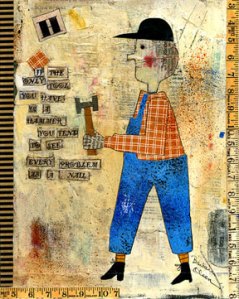
I came home from work to find that my dog had eaten through the lath and plaster in the living room and there was the brick.  I had to decide what to do.  I knew nothing about lathing—I know that’s not really a word—or plastering.  What to do.  My only tool was a hammer, so I began to hammer.  For those who haven’t done this, hundred-year-old plaster being pounded with a hammer makes a lot of dust.  This process proved to be very slow.

What did I do?  I bought a bigger hammer—such a guy approach to a problem, isn’t it?  It took three hammers to get down to just bare brick.  What would you have done?  When your only tool is a hammer every problem looks like a nail–or a wall.

As you go through the EHR planning process in your war room—you do have a war room, don’t you?  (Try Sam’s Club, after all, they sell EHRs.)  Get out the really big piece of paper, the one with your EHR design—you do have a really big piece of paper, don’t you?  (Back to Sam’s.)

Next to the box on the paper labeled “Shiny New EHR” should be lots of empty space so you can draw in all of the other systems with which your EHR will have to interface.  One of the readers of this blog wrote recently that his EHR had more than 400 interfaces.

EHR, if done correctly, will do much for patients, doctors, and administrators.  It’s not a panacea.  It won’t reach its potential unless you also integrate it with those systems that unlock its potential.  Improving your efficiency and effectiveness takes more than merely an EHR system.

When your only tool is a hammer, you’d better hope every problem is a nail.  What other tools are you using?  Please share your ideas about what works well.

EHR: The Migratory Patterns of Coconuts

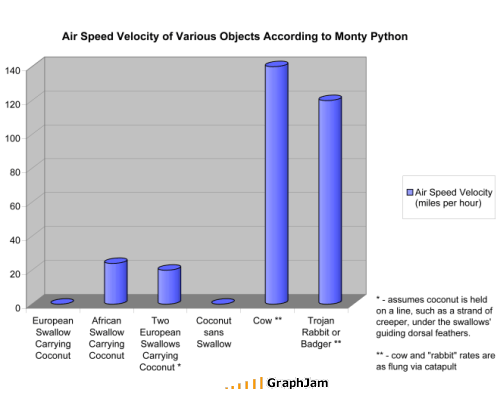
Are you suggesting coconuts migrate? (Not at all, but a swallow could grip it by its husk.)

Sometimes I get reactions from my clients which suggest that my ideas have people questioning if I just fell out of the stupid tree and hit every branch on the way down, especially when what we’re discussing seems to move from the theoretical and towards the heretical. However, there was a presentation I made to one of my clients where I had the entire room believing that i might as well have been suggesting that coconuts migrate.

Allow me to set the stage. I presented to the CIO of one of the largest providers in Europe a vision for what their IT strategy should be. This was an 0.2 firm requiring a 2.0 solution.  As you can guess, it was fairly easy to suggest that better alternatives were available to them, but if you’re a member of the Flat Earth Socitey you’re not going to believe anything until someone is able to literally change your perspective.

During my presentation I wrote on the white board that I would help them choose between three alternatives. At this point, a British colleague and good friend, came to the front of the room—uninvited, removed the marker from my hand, erased the word ‘between’, and penned the word ‘amongst’. “We choose between two things, and amongst three or more,” he said with a grin and then returned to his seat. I suggested that since English was not the native language of our client that his point was probably lost on them, to which he stated that his point was directed at me whose native language was supposed to be English. God save the queen. He also tried to make the point on more than one occasion that the American War of Aggression with England did not end in 1783 with a victory for America, but with a British retreat.

Anyway, we were choosing between three alternatives, at least I was. After about ten minutes of explaining what could be achieved and how it might be structured, I was interrupted again, this time by the CIO. He too took my marker, concluding that I was a coconut. It took me about thirty minutes to convince him that everything I’d presented was not only achievable, but already operational in a number of their competitors.

So, as we head down the EHR path with our Project Management Executive, the person who will be spearheading the internal effort to affect change, we must find a way to make sure the executive is properly equipped. For starters, the executive needs to have, and to be able to communicate a vision, a vision for the change, for how it will impact the organization, and an ability to communicate it.


Reinventing the healthcare insurance business model

If there is a more obtuse business model than the one used by insurance companies I have not seen it.  While I am not an advocate of privatization—because I am a right-wing nut who favors capitalism—I do think there is a smarter way to earn profits.

Taken to its extreme, the ideal way for a payor to earn profits is for payors to take in money without ever having to pay out money.  This is the same model your cable company uses—people simply send them money every month, and never get it back.

To contrast the healthcare insurance model with an insurance model that actually provides some degree of benefit, one needs look no further than the automotive insurance model.  While nobody loves paying car insurance, we do so somewhat secure in the fact that if we are in an accident our insurance will cover us.

A large reason we feel this way is because we have a choice in which auto insurer we select.  If we do not like the coverage, we change providers.  Our employers do not tell us which auto insurer we must purchase, and yet they do when it comes to providing health insurance, and yet ninety-nine percent of the people who work for a firm drive, so the insurable population is about the same size for health and auto.

With health insurance, they best we can do when we are ill is hope our insurance will cover us, and we do so with the hidden expectation that it will not.

Health insurers need to change their model.  If a single payor changed its model to actually cover the claims made by its members it would not have to worry about being profitable because they would be beating people off with a stick.

Instead of hiring so many people to figure out how not to reimburse their members, why not change to model to one by which they actually provided their members with what those members need?


EHR; stop, look, and listen

You have probably figured out that I am never going to be asked to substitute host any of the home improvement shows.  I wasn’t blessed with a mechanical mind, and I have the attention span bordering on the half-life of a gnat.
I’ve noticed that projects involving me and the house have a way of taking on a life of their own.  It’s not the big projects that get me in over my head—that’s why God invented phones, so we can outsource—it’s the little ones, those fifteen minute jobs meant to be accomplished during half-time, between pizza slices.

Case in point, last weekend’s playoff games—trim paint touch ups.  Paint can, brush, paint can opener tool (screwdriver).  Head to the basement where all the leftover paint is stored.  You know exactly where I mean, yours is probably in the same place.  Directions:  grab the can with the dry white paint stuck to the side, open it, give a quick stir with the screwdriver, wipe the screwdriver on your shirt, apply paint, and affix the lid using the other end of the screwdriver.  Back in the chair before the microwave beeps letting you know the pizza is hot.

That’s how it should have worked.  It doesn’t, does it?  For some reason, you get extra motivated, figure you’ll go for spousal bonus points, and so you take a quick spin around the house, dabbing the trim paint on any damaged surface—window and doorframes, baseboards, stair spindles, and other white “things”.  Those of us who are innovators even go so far as to paint over finger prints, crayon marks, and things which otherwise simply needed a wipe down with 409.

This is when it happens, just as you reach for that slice of pizza.  “What are all of those white spots all over the house?”  She asks—you determine who your she is, or, I can let you borrow mine.  You explain that the paint looks like that simply because the paint is still wet—good response.  To which she tells you the paint is dry—a better response and one for which you have no rebuttal.

“Why is the other paint shiny, and the spots are flat?”

You pause.  I pause, like when I’m trying to come up with a good bluff in Trivial Pursuit.  She knows the look.  She sees my bluff and raises the ante.  Thirty minutes later the game I’m watching is a distant memory.  I’ve returned from the paint store.  I am moving furniture, placing drop cloths, raising ladders, filling paint trays, all under the supervision of my personal chimera.  My fifteen-minute exercise has resulted in a multi-weekend amercement.

This is what usually happens when the plan isn’t tested or isn’t validated.  My plan was to be done by the end of halftime.  Poor planning often results in a lot of rework.  There’s a saying something along the lines of it takes twice as long to do something over as it does to do it right the first time—the DIRT-FIT rule.  And costs twice as much.  Can you really afford either of those outcomes?  Can you really afford to scrimp on the planning part of EHR?  The exercise of obtaining EHR champions and believers is difficult.  If you don’t come out of the gate correctly, it will be impossible.

Back to my project.  Would you believe me if I said I deliberately messed up?  Maybe I did, maybe I didn’t, but the one think I know with certainty is that I now have half-times all to myself.

EHR, the wisdom of crowds

According to National Geographic, a single ant or bee isn’t smart, but their colonies are. The study of swarm intelligence is providing insights that can help humans manage complex systems. The ability of animal groups—such as this flock of starlings—to shift shape as one, even when they have no leader, reflects the genius of collective behavior—something scientists are now tapping to solve human problems.  Two monumental achievements happened this week; someone from MIT developed a mathematical model that mimics the seemingly random behavior of a flight of starlings, and I reached the halfway point in counting backwards from infinity–the number–infinity/2.

Swarm theory. The wisdom of crowds. Contrast that with the ignorance of many to listen to those crowds. In the eighties it took Coca-Cola many months before they heard what the crowd was saying about New Coke. Where does healthcare EHR fit with all of this? I’ll argue that the authors of the public option felt that wisdom.  If you remember the movie Network, towards the end of the movie the anchorman–in this case it was a man, not an anchor person–besides, in the eighties, nobody felt the need it add he/she or it as some morphed politically correct collection of pronouns.  Whoops, I digress.  Where were we?  Oh yes, the anchor-person.  He/she or it went to the window and exhorted everyone to yell, “I’m mad as hell, and I’m not going to take it anymore.”  Pretty soon, his entire audience had followed his lead.

So, starting today, I begin my search for starlings.  A group whose collective wisdom may be able to help shape the healthcare EHR debate.  The requirements for membership is a willingness to leave the path shaped by so few and trodden by so many, to come to a fork in the road and take it. Fly in a new flock.  A flock that says before we get five years down the road and discover that we have created such an unbelievable mess that not only can we not use it, but that we have to write-off the entire effort and redo it, let us at least evaluate whether a strategic change is warranted.  The mess does not lie at the provider level.  It lies in the belief that hundreds of sets of different standards can be married to hundreds of different applications, and then to hundreds of different Rhios.

Where are the starlings headed?  Great question, as it is not sufficient simply to say, “you’re going the wrong way”.  I will write about some of my ideas on that later today.  Please share yours.

Now, when somebody asks you why you strayed from the pack, it would be good to offer a reasoned response.  It’s important to be able to stay on message.  Reform couldn’t do that and look where it is. Here’s a bullet points you can write on a little card, print, laminate, and keep in your wallet if you are challenged.

  • Different standards
  • Different vendors
  • Different Rhios
  • No EHR Czar

Different Standards + Different Vendors + Different Rhios + No Decider = Failure

You know this, I know this.

To know whether your ready to fly in a new direction, ask yourself this question.  Do you believe that under the present framework you will be able to walk into any ER in the country and know with certainty that they can quickly and accurately retrieve all the medical information they need about you?  If you do, keep drinking the Kool Aid.  If your a starling, come fly with us and get the word out.  Now return your seat backs and tray tables to their upright and most uncomfortable positions.