EHR: Impact on DR Patient Relationship

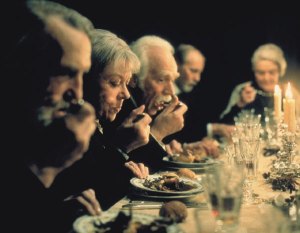
feastI’m a fan of foreign films, but since I don’t speak the language for me to really enjoy the movie, the visual story must be really compelling.  I also love to cook, not from recipes, but creatively, making it up as I go along.  Fortunately for purposes of this blog, there is a film which does both—Babette’s Feast.

The Danish film is set in France in the early eighteen hundreds.  The story centers around a group of pious sisters who receive a visitor who offers to spend her lottery winnings by preparing a feast for them.  The visitor, Babette, happens to be a very skilled chef.  There are those who may think the movie’s plot has more to do with the interplay among the participants.  However, as I am not a professional movie critic, we can skip the interplay and fast forward to the parts I find most relevant, the feast.

(This paragraph comes from Wikipedia.)  The sisters agree to accept Babette’s meal, and her offer to pay for the creation of a “real French dinner”. She leaves the island for a few days in order to return to Paris, as she must personally arrange for supplies to be sent to Jutland. The ingredients are plentiful, sumptuous and exotic, and their arrival causes much discussion amongst the clan. As the various never-before-seen ingredients arrive, and preparations commence, the sisters begin to worry that the meal will be, at best, a great sin of sensual luxury, and at worst some form of devilry or witchcraft. In a hasty conference, the sisters and the congregation agree to eat the meal, but to forego any pleasure in it, and to make no mention of the food during the entire dinner.  The last and most relevant part of the film is the preparation and the serving of an extraordinary banquet of royal dimensions, lavishly deployed in the unpainted austerity of the sisters’ rustic home.

The denouement—I thought it appropriate to use a French word—is whether or not the piety of the guests will prevent them from participating in the feast. It wouldn’t have made for much of a movie if the guests never came and the food sat there getting cold, but what if?  What if there was all of this preparation and no guests?  What if she prepared the feast, and in her haste forgot all about the guests?  Indeed.

Has anyone felt that something is missing in the discussion on EHR?  There’s plenty of talk of Washington and payors.  ARRA and money.  Stimulus and penalties.  Where are the guests?  Are we all responsible for not inviting the EHR dialog to include the patients?  I know it’s there, tucked away somewhere.

We’ve discussed on several occasions the notion that EHR should not be about the EHR.  It should be about the users and the patients.  Nevertheless, how is it being viewed by those groups?  Is it seen as a success?

Let’s make it a little more personal—my recent trip to my cardiologist at a superb teaching hospital in Philadelphia, Pennsylvania.  I usually get about an hour with the doctor—face time—clinical, examination.  Important time to a heart patient, eye contact that communicates you are doing all the right things, your test scores are all off the charts in the right direction, and you are healthier today than most people twenty years younger than you who haven’t had a heart attack.

That’s the real reason I go for the annual checkup, not to find out what I should be doing—I know I’m doing those things, not to find out if I am sick because I know I’m not.  I am there to reap the comfort that comes from having this specific person tell me things that help me believe that if I continue to play an active part in my recovery I will be there to raise my children.

During my last visit, we had about ten to fifteen minutes of eye contact, and the rest of the hour was spent with me watching him enter data into the EHR system.  It wouldn’t have been his choice, and it wasn’t mine.  Other than the first ten minutes, my entire checkup could have been done on WebEx.

I wonder if they offer an EHR?
 Paul Roemer Business Card

Healthcare–0.2 to 2.0, mind the GAP

dog Alex van Klaveren raised a question in his blog, Medicexchange about a point we raised here stating that Healthcare is moving from version 0.2 to 2.0.

My thoughts on this center around differentiating between the business of healthcare and healthcare as a business. That they may not be easily separable makes it difficult. There are many factors which if viewed from the perspective of an MBA student that suggest the as a business (processes, management, use of technology to run the business) it is found lagging when compared to for example to banking and manufacturing. Healthcare is being pushed to catch up quickly, and has little guidance in how to get from A to B, and doesn’t understand how to define the Gap.

We’ve also stated that it’s not about EHR.  So then, what is it about–sorry for the preposition?  It’s about the Gap.  It’s about knowing where you are, defining where you want to be, and being able to articulate a strategy which will get you there.  It’s about change management, and work flow improvement.

My best – Paul

021_18A

Conversations with a Wildebeest

my neighbors

my neighbors

Today’s narrative follows directly from yesterday’s tale of the wildebeest, so it may be helpful to revisit to prior post.  Suffice it to say that the Neiman’s set wasn’t thrilled to learned I  compared them to our cloven friends.

One rule of the Kalahari is that the pursuer must approach the prey stealthily. Picture if you will a David Attenborough looking and sounding chap, more suitably attired to attend a formal tea than a desert trek, inching towards that same Baobab tree we discussed in a prior narration. Bands of perspiration rim his pith helmet, darkening it. He pats his forehead with a freshly pressed linen handkerchief and returns it to the breast pocket of his Khaki shirt. The wildebeest have moved from the shade of the tree to the nearby watering hole. While some stand guard, he notices that a few at a time quench their thirst. For protection the youngest of the wildebeest ensconce themselves in the middle of the circle. The narrator moves the boom of his microphone towards the herd.

“Did you see the Greatest Looser last night?”  Inquired the group’s leader.

“I TIVO’d it.”

“Can I come over and watch it with you?” asked a third as she quenched her thirst with a half-caf, mocha frappachino iced latte. “I totally spaced.”

The circle of soccer moms seemed to tighten as they saw me approach. “Still blogging?” coyly asked the wildebeest—cum soccer mom–wearing the Lilly Pulitzer capris.

All wildebeest aside, here’s the deal. I want to have a conversation with you. I need your help. Here’s my premise. Somewhere along the way we lost our edge, our hunger for excellence. There was a big push twenty years ago, a lot of attention was paid to the topic, and a lot of people cleaned up writing books and giving seminars. I want your help in understanding what brought about the loss of excellence and what can be done to turn it around. I’d like to learn what you’ve seen and heard. You don’t have to name the organization. I won’t name names, yours or the organization. You can send me a message, a private email, or post it for everyone.

Some ideas for comments include but aren’t limited to:

1. What’s broken
2. Why isn’t it being fixed
3. Where does the breakdown for excellence occur
4. Why patients leave
5. What makes them mad
6. Why do they hate a given provider
7. Do patients think they matter
8. Who has the power to solve the problems
9. Do providers want to be excellent business people
10. Is excellence profitable
11. What 3-5 things can a provider do to get on the right path
Thanks in advance.

How does this impact EHR?  It has everything to do with it.  If you only remember one thing, let it be this: It’s not about the EHR.  The EHR is a vehicle.  It can either be a vehicle for change, or it can be used to hamper change.  All the EHR really does it automate certain things.  It’s easier to automated inefficient and ineffective things than it is to automate efficient and effective things.  Why?  Because the bulk of the work lies in making them efficient and effective.  That’s where the change management and workflow efforts come into play.

My best- Pauleddiesmal

The wildebeest postulate

wildThe Kalahari; vast, silent, deadly. The end of the rainy season, the mid-day heat surpasses a hundred and twenty. One of the varieties of waterfowl, most notably the flame red flamingo that nested in the great salt pans in Botswana, has begun its annual migration. In the muck of one of the fresh-water pools that had almost completely evaporated, writhes a squirming black mass of underdeveloped tadpoles. A lone Baobab tree pokes skyward from the middle of the barren savanna. In its shade, standing shoulder to shoulder and facing out, a herd of wildebeest surveys the landscape for predators.  Sir David Attenborough and PBS can’t be far away.

Some things never change. I make my way across the freshly laid macadam to meet the school bus. Fifty feet in front of me is a young silver maple tree, the tips of its green leaves yielding only the slightest hint of the fall colors that are hidden deep within. The late afternoon sun casts a slender shadow across the sodded common area. One by one they come—soccer moms; big moms, little moms, moms who climb on rocks, fat moms, skinny moms, even moms with chicken pox—sorry, I couldn’t stop myself—as they will every day at this same time, seeking protection in its shade. My neighbors.  It’s only seventy-five today, yet they seek protection from the nonexistent heat, a habit born no doubt from bygone sweltering summer days. A ritual. An inability to change. In a few weeks the leaves will fall, yet they will remain in the shadow of what once was, standing shoulder to shoulder facing out, looking for the bus. A herd. Just like wildebeest.

The kids debus–I just made that word, hand me their backpacks, lunch boxes, and hundreds of forms for me to complete.  I look like a Sherpa making my way home from K-2.

I shared this perspective with the moms, and have halted most of my bleeding. I can state with some degree of certainty that they were not impressed with being compared to wildebeest. So here we go, buckle up. By now you’re thinking, “There must be a pony in here somewhere.” Some things never change; it’s not for lack of interest, but for lack of a changer. For real change to occur someone needs to be the changer, otherwise it’s just a bunch of people standing shoulder to shoulder looking busy. How are you addressing the change that must occur for EHR to be of any value?  EHR is not about the EHR, it’s about moving from a 0.2 business model to 2.0.  Someone who sees the vision of what is is—sorry, too Clintonian—must lead.  Be change.

One of the great traits of wildebeest is that they are great followers.

sing4

EHR Millstones, should that read Milestones?

cowsIf you like adventure, here’s a site to check, http://www.jfk50mile.org/.  This is an annual event whose origin came about during the cold war.  Fortunately for both of us, the entry date has already passed.  The thought behind the JFK fifty-mile hike/run was that because of the possibility of a nuclear attack, each American should be in good enough shape to cover fifty miles in a day.
I participated in the event twice—I wrote participated because to state that I ran the entire way would be misleading— and I can state with certainty that almost no Americans are close to being able to complete this.  The event is run in the fall starting in Boonsboro, Maryland.  It takes place along the Appalachian Trail and the C&O Canal and various other cold, rain soaked, and ice and leaf covered treacherous terrains.

We ran it in our late teens or early twenties, the time in your life when you are indestructible and too dumb to know any better.  One of my most vivid memories of the event was that on the dozen or so miles along the mountain trail, leaves covered the ground.  By default that meant they also covered the rocks along the trail, thus hiding them.  That we were running at elevation—isn’t everyone since you can’t not run at at least some elevation, (that may be the worst sentence every written) but you know what I mean—meant the prior night’s rain resulted in the leaf covered rocks being sheathed in black ice.  That provided a nice diversion, making us look like cows on roller skates—roller blades had yet to catch on outside of California.

There were several places along the trail where the trail seemed to fork—I’m not going to say and I took it—and it wasn’t clearly marked.  Runners could easily take the wrong fork (or should that be Tine?).  I think it would have been helpful had the race organizers installed signs like, “If you are here, you are lost.”  Hold on to that thought, as we may need it later.

Some number of hours after we began we reached the C&O Canal, twenty-six miles of flat terrain along the foot path.  It’s difficult to know how well I was doing in the fifty-mile race, in part because I had never run this distance and because there we no obvious mile markers, at least so I thought.  Then we noticed that about every five and a half to six minutes we would pass a numbered white marbled marker that was embedded along the towpath.  Mile stones.  At the pace we were running, we anticipated we would finish high in the rankings.  As fast as we were running, we were constantly being passed, something that made no sense.  That meant that a number of people were running five minute miles, which we knew they couldn’t do after running through the mountains, or…Or what?

The only thing we knew with any certainty at the end of the day was that the markers with which we used to determine our pace and measure how far we’d run were not mile markers.  We never figured out why they were there or how far apart they were, but we greatly underestimated their distance and hence our progress.

It doesn’t really matter whether you call them mile stones or milestones.  What matters is whether they serve a valid purpose.  If they don’t, milestones become millstones.  Milestones are only useful if they are valid, and if they are met.  Otherwise, they are should’ a, could’ a, would’ as—failure markers, cairns of missed goals and deliverables.

How are your milestones?  Are they valid?  What makes them valid?  Are they yours, or the vendors?  All things to think about as you move forward.

geicocavemen

Another perspective on the importance of workflow.

perspective_shadows10The following narrative was written responding to a post of mine on LinkedIn describing some of the healthcare IT issues of EHR.  It’s author is Dr. Edward Kim, Associate Director, Health Economics and Outcomes Research at Bristol-Myers Squibb, and it is used with his permission.  I think it coincides nicely with the need for more chief medical information officers.

EHR is definitely much more complicated in execution than in concept. Major barriers not mentioned include how this affects the process of care. Current healthcare has innate workflows that evolved around paper charts. Current vendors sell to the C-suite decisionmakers who believe linear processes reflect the actual delivery and documentation of treatment.

Having rolled out and used several enterprise EHRs, I can understand the high failure rates. Our clinicians felt they were treating their terminals rather than their patients. I can’t say we were fully successful because, while utilization was high, the quality of documentation was spotty as people found ways to game the system.

Thoughts?

saint