Be very afraid

white_high_heelsI remember two things from my lone sociology class in college.  Somebody name Emile Durkheim—given that I cut almost every lecture, I continue to amaze myself that I spelled his name correctly—he did something about suicide rates, and one thing about inherent fear—we are born with knowledge of two types of fear; heights and loud noises.  I was born with a third, the fear that comes from thinking that one day I might slip out the door wearing white shoes after Labor day—see how timely this is?

There’s been a common thread for the last few days among the social media-ites—sometimes you are forced to make up a word or two.  The thread of which I write is fear, a fear that started in anticipation, and has been building since last week.  Muculent palms, jitters, slight schizophrenia.  The anticipation of the voices, “And he did hear a sound rising over the snow. It started in low… then it started to grow.”  Sorry for the Grinch reference, I’m trying to work through this.

It starts with notifications; emails, letters.  Doctor’s name and phone number.  Emergency contact information.  Write it three times in case we lose the first two.  Then comes the demand for tools—don’t dare go to sleep without completing this; pencils, scissors, crayons…Backpacks.  Lunch boxes.  I can’t wake them up.  They open one, look at me, and roll over.  They say things like, “This is what all the kids are wearing.”  They look you in the eye and lie, “I brushed my teeth.”  “If you don’t fill out the forms I can’t go back tomorrow.”

They fail to recognize that we have multiple degrees.  And if they did realize it, they would not care.  You may be a big shot between 8 and 5, but right now you’re just dad, and why don’t we have any fruit roll-ups for my lunch.

So, how was your day?  For me the voices have subsided, but the sweaty palms will return just prior to the school buses.

I look at healthcare reform and EHR and think, the only thing to fear is reform itself.

I’ve been asking friends for their input about our conversations here, and somebody whose opinion I value highly suggested I write what my audience wants to hear.  I can’t do that—that’s what the other bloggers do—feel good, but this, but that, cheerleaders.

This is difficult, at least if you want it to work.  There’s no shame in asking for help.

drevil

Healthcare social media

SpyvsSpywithoutbombs775529When I run I tend to let my mind go blank–some of you who have been regular readers might suggest this is a steady-state for me. It’s during those runs after I’ve released all the clutter that I’m able to work on my book or come up with new ideas. Today was one of those days. It usually doesn’t make much sense where the ideas come from. There aren’t any segues. A bunch of stuff just floats around and all of a sudden, I have an indication of something I want to say. It’s a little like dreaming with your eyes open, except it’s sweaty.

So as I’m pounding the pavement today, an idea surfaces. I’m reminded of a book I read several years ago entitled, Inside the Aquarium. It’s a book about the secret Soviet military intelligence agency the GRU. The GRU’s headquarters was a building named the Aquarium.

Its author describes his first memory as a member of Soviet Military Intelligence: watching a film of an execution of a would-be defector. The defector in question was strapped into a coffin with an open lid, elevated slightly so he could see what was coming, and then traversed slowly down a conveyor belt into a blast furnace, screaming all the way. The author, along with the other recruits, was getting an extraordinary indoctrination into the concept of social networking. Although I have no evidence to support this, I would assume that he and his fellow recruits did a very good job of relaying the message of what happens to traitors.

Social networking isn’t new. The only new thing about it is that it has a label which means consultants can charge to help firms to figure out how to deal with it. It’s been around for long time. I remember in high school when kids would argue, who made the better car, Ford or Chevrolet. It came down to which of the two cars your family owned. If you owned a Chevrolet, you said Ford stood for Fix Or Repair Daily. If your family owned a Ford, you referred to Chevrolet as Chevy-let-lay. It sounds silly, but I still remember that and it probably has something to with with why I buy foreign cars.

If properly designed, the social networking message has legs. It doesn’t require a computer. It probably doesn’t even have to be based in fact. If I recall, there was even some discussion in the book as to whether or not the execution ever took place. Even if the execution was only mythical, the GRU certainly communicated the message. Customers communicate many messages; some based in fact, some purely mythical. Once the message gets out, it’s difficult to put it back in the box. Even if there is empirical evidence that the GRU never executed anybody, chances are that their agents behaved as though they had.

Bringing this discussion back around to a business focus, there are two perspectives to consider. How much damage are your patients causing by the messages they let out-of-the-box? And second, how much damage is the organization causing by not proactively getting their messages out-of-the-box? It’s time to start sweeping the rug under the carpet.

eddiesmal

Conversations with a Wildebeest

my neighbors

my neighbors

Today’s narrative follows directly from yesterday’s tale of the wildebeest, so it may be helpful to revisit to prior post.  Suffice it to say that the Neiman’s set wasn’t thrilled to learned I  compared them to our cloven friends.

One rule of the Kalahari is that the pursuer must approach the prey stealthily. Picture if you will a David Attenborough looking and sounding chap, more suitably attired to attend a formal tea than a desert trek, inching towards that same Baobab tree we discussed in a prior narration. Bands of perspiration rim his pith helmet, darkening it. He pats his forehead with a freshly pressed linen handkerchief and returns it to the breast pocket of his Khaki shirt. The wildebeest have moved from the shade of the tree to the nearby watering hole. While some stand guard, he notices that a few at a time quench their thirst. For protection the youngest of the wildebeest ensconce themselves in the middle of the circle. The narrator moves the boom of his microphone towards the herd.

“Did you see the Greatest Looser last night?”  Inquired the group’s leader.

“I TIVO’d it.”

“Can I come over and watch it with you?” asked a third as she quenched her thirst with a half-caf, mocha frappachino iced latte. “I totally spaced.”

The circle of soccer moms seemed to tighten as they saw me approach. “Still blogging?” coyly asked the wildebeest—cum soccer mom–wearing the Lilly Pulitzer capris.

All wildebeest aside, here’s the deal. I want to have a conversation with you. I need your help. Here’s my premise. Somewhere along the way we lost our edge, our hunger for excellence. There was a big push twenty years ago, a lot of attention was paid to the topic, and a lot of people cleaned up writing books and giving seminars. I want your help in understanding what brought about the loss of excellence and what can be done to turn it around. I’d like to learn what you’ve seen and heard. You don’t have to name the organization. I won’t name names, yours or the organization. You can send me a message, a private email, or post it for everyone.

Some ideas for comments include but aren’t limited to:

1. What’s broken
2. Why isn’t it being fixed
3. Where does the breakdown for excellence occur
4. Why patients leave
5. What makes them mad
6. Why do they hate a given provider
7. Do patients think they matter
8. Who has the power to solve the problems
9. Do providers want to be excellent business people
10. Is excellence profitable
11. What 3-5 things can a provider do to get on the right path
Thanks in advance.

How does this impact EHR?  It has everything to do with it.  If you only remember one thing, let it be this: It’s not about the EHR.  The EHR is a vehicle.  It can either be a vehicle for change, or it can be used to hamper change.  All the EHR really does it automate certain things.  It’s easier to automated inefficient and ineffective things than it is to automate efficient and effective things.  Why?  Because the bulk of the work lies in making them efficient and effective.  That’s where the change management and workflow efforts come into play.

My best- Pauleddiesmal

The wildebeest postulate

wildThe Kalahari; vast, silent, deadly. The end of the rainy season, the mid-day heat surpasses a hundred and twenty. One of the varieties of waterfowl, most notably the flame red flamingo that nested in the great salt pans in Botswana, has begun its annual migration. In the muck of one of the fresh-water pools that had almost completely evaporated, writhes a squirming black mass of underdeveloped tadpoles. A lone Baobab tree pokes skyward from the middle of the barren savanna. In its shade, standing shoulder to shoulder and facing out, a herd of wildebeest surveys the landscape for predators.  Sir David Attenborough and PBS can’t be far away.

Some things never change. I make my way across the freshly laid macadam to meet the school bus. Fifty feet in front of me is a young silver maple tree, the tips of its green leaves yielding only the slightest hint of the fall colors that are hidden deep within. The late afternoon sun casts a slender shadow across the sodded common area. One by one they come—soccer moms; big moms, little moms, moms who climb on rocks, fat moms, skinny moms, even moms with chicken pox—sorry, I couldn’t stop myself—as they will every day at this same time, seeking protection in its shade. My neighbors.  It’s only seventy-five today, yet they seek protection from the nonexistent heat, a habit born no doubt from bygone sweltering summer days. A ritual. An inability to change. In a few weeks the leaves will fall, yet they will remain in the shadow of what once was, standing shoulder to shoulder facing out, looking for the bus. A herd. Just like wildebeest.

The kids debus–I just made that word, hand me their backpacks, lunch boxes, and hundreds of forms for me to complete.  I look like a Sherpa making my way home from K-2.

I shared this perspective with the moms, and have halted most of my bleeding. I can state with some degree of certainty that they were not impressed with being compared to wildebeest. So here we go, buckle up. By now you’re thinking, “There must be a pony in here somewhere.” Some things never change; it’s not for lack of interest, but for lack of a changer. For real change to occur someone needs to be the changer, otherwise it’s just a bunch of people standing shoulder to shoulder looking busy. How are you addressing the change that must occur for EHR to be of any value?  EHR is not about the EHR, it’s about moving from a 0.2 business model to 2.0.  Someone who sees the vision of what is is—sorry, too Clintonian—must lead.  Be change.

One of the great traits of wildebeest is that they are great followers.

sing4

What did you do in reform daddy?

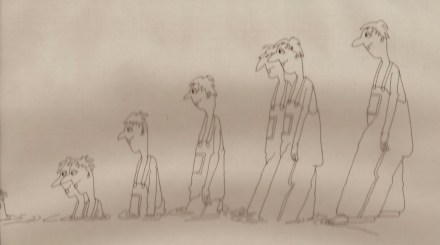
sorry for the quality, I drew this in high school

sorry for the quality, I drew this in high school

Tenth grade biology class was on the second floor.  One of my best friends said that for five dollars he would jump out of the window during class, sort of like falling out of the stupid tree and hitting every branch on the way down.  Others took the bet.  Lemmings.  They all jumped.  Speaking in parenthesis for a moment, this same friend was interviewed on Larry King on September 11, 2001, discussing how to run covert ops on Bin Laden.  I haven’t slept well since I learned that.

As I talk with clients and several of the healthcare thought leadership, I see consensus building around a lemming-like acquiescence about reform, especially as relates to EHR.  That wasn’t much of a segue, but my children stared school today, and I am still in shock from having let me seven-year-old pack his lunch—very different food groups.

I read an article in a much respected—I wrote ‘very’ instead of ‘much’, Word didn’t like it.  Learn something every day—publication that the primary business driver behind EHR is that it is perceived as a mandate.  (Sorry, that was written poorly—I may have to fire that guy.)

If that’s why your organization is doing it, do yourself a favor and stop.  The ROI from the stimulus money will not make EHR worth your while.  How will you know if you did it for the right reasons?  When you get to the end, if you aren’t able to say, “I wish we had done this years ago”, you’ve done something very wrong.

drevil

Health care hero

I continue to struggle with you as to understanding the etiquette of the social web.  In spite of that, each day I become more impressed with those who have something to say and who are able to intelligently and gracefully articulate their positions on a range of issues.

Hero is such a disposable word.  I thought it might be of interest to share the meaning of the word from the eyes of a ten year old.

Forgive me for stealing a minute of your time for these few paragraphs.  Although I rant about the healthcare system, and independent of whether it needs changing and how to change it, I am quite a fan.

One year ago my 10-year-old son was given a writing assignment to draft a paragraph about his hero.  He wrote the following, an event that happened when he was 4,  which I subsequently framed and placed on my night stand—the spelling errors help authenticate the narrative:

“An amblence driver is my hero. He saved one of my familys members lives, My Dad. One late night my dad had a hart attack (I had a horrible ear ake.  We called the hospital and an ambulance came to take my dad.  The driver took him to the hospital (it takes 30 minutes to get there going 60 miles an hour.)

I love to read and write, and as you know, I can be critical of those who do and don’t, but this is the best thing I’ve ever read.

Thanks for indulging me.saint

EHR Millstones, should that read Milestones?

cowsIf you like adventure, here’s a site to check, http://www.jfk50mile.org/.  This is an annual event whose origin came about during the cold war.  Fortunately for both of us, the entry date has already passed.  The thought behind the JFK fifty-mile hike/run was that because of the possibility of a nuclear attack, each American should be in good enough shape to cover fifty miles in a day.

I participated in the event twice—I wrote participated because to state that I ran the entire way would be misleading— and I can state with certainty that almost no Americans are close to being able to complete this.  The event is run in the fall starting in Boonsboro, Maryland.  It takes place along the Appalachian Trail and the C&O Canal and various other cold, rain soaked, and ice and leaf covered treacherous terrains.

We ran it in our late teens or early twenties, the time in your life when you are indestructible and too dumb to know any better.  One of my most vivid memories of the event was that on the dozen or so miles along the mountain trail, leaves covered the ground.  By default that meant they also covered the rocks along the trail, thus hiding them.  That we were running at elevation—isn’t everyone since you can’t not run at at least some elevation, (that may be the worst sentence every written) but you know what I mean—meant the prior night’s rain resulted in the leaf covered rocks being sheathed in black ice.  That provided a nice diversion, making us look like cows on roller skates—roller blades had yet to catch on outside of California.

There were several places along the trail where the trail seemed to fork—I’m not going to say and I took it—and it wasn’t clearly marked.  Runners could easily take the wrong fork (or should that be Tine?).  I think it would have been helpful had the race organizers installed signs like, “If you are here, you are lost.”  Hold on to that thought, as we may need it later.

Some number of hours after we began we reached the C&O Canal, twenty-six miles of flat terrain along the foot path.  It’s difficult to know how well I was doing in the fifty-mile race, in part because I had never run this distance and because there we no obvious mile markers, at least so I thought.  Then we noticed that about every five and a half to six minutes we would pass a numbered white marbled marker that was embedded along the towpath.  Mile stones.  At the pace we were running, we anticipated we would finish high in the rankings.  As fast as we were running, we were constantly being passed, something that made no sense.  That meant that a number of people were running five minute miles, which we knew they couldn’t do after running through the mountains, or…Or what?

The only thing we knew with any certainty at the end of the day was that the markers with which we used to determine our pace and measure how far we’d run were not mile markers.  We never figured out why they were there or how far apart they were, but we greatly underestimated their distance and hence our progress.

It doesn’t really matter whether you call them mile stones or milestones.  What matters is whether they serve a valid purpose.  If they don’t, milestones become millstones.  Milestones are only useful if they are valid, and if they are met.  Otherwise, they are should’ a, could’ a, would’ as—failure markers, cairns of missed goals and deliverables.

How are your milestones?  Are they valid?  What makes them valid?  Are they yours, or the vendors?  All things to think about as you move forward.

geicocavemen

If reform fails…

fries

EHR: What bugs you about it?

16This is the time of year in the east when cinerescent caterpillar nests hang thickly from the trees, peppered tufts of cotton candy.  During these long, flavorless August days, the sky is a similar achromatic color.  My nine-year-old is concerned because I told her we are having caterpillar soup for dinner tonight—watch out for the crunchy bits.  Once again, it seems I’ve gotten off message.

I wonder how much of the difficulty surrounding EHR has to do with getting off message, much like we seem to have done with the reform discussion.  What difficulties?  Got time?  You can name more of them than can I. 

What is off message?  It’s that the day-to-day tactics of implementing EHR office by office, and hospital by hospital have overshadowed the strategy, have displaced the business driver behind the mandate.  The focus became internal, not national.  Bits and bytes have overshadowed charts.

I doubt few, if any, can articulate a believable explanation of how a few years from now your medical records will accurately and expeditiously be delivered from where you live to the lone clinic on Main Street, Small Town, USA, to the nurse practitioner who at midnight is giving you an EKG.

It’s that fact, that we are not able to define how we get from A to B, let alone do so with multitudes of A’s and B’s, that to me suggests we are building something of which we have little comfort will do what we set out for it do.

Clearly, there are hundreds if not thousands of very talented and dedicated professionals focused on finding a solution.  However, it seems their efforts remain handcuffed by hundreds of competing products, no well-defined overriding set of requirements that would enable anyone to say with certainty, “Yes, that is it.  That captures what we need to do.  When we have done that, we are done.”

Until that time, I think we all need to be concerned about the crunchy bits.

What do you think?

gravia1

EHR: Managing the changing change

imagesmilkman-smallI wrote this in reply to a blog written by Gwen Darling August 20 in Healthcare Informatics about how CIOs should staff to meet the demands of EHR.  Please share your thoughts.


Hello to those whom I’ve yet to meet. This is rather long, so you may wish to grab a sandwich. 
I write to share a few thoughts on Gwen’s post. One thing I enjoy about Gwen is that she resides where those who refuse to drink the Kool Aid reside. For those who haven’t been there, it’s a small space where only those who place principle over fees dare to tread.

Where to begin? How to build your team? (Those who wish to throw cabbages should move closer to the front of the room so as not to be denied a decent launching point.) There are two executives, I hasten to add, who will defend what I am about to offer, a CIO, and a CMIO, ideas from both of whom you’ve probably read.

I comment on behalf of those in the majority who have either not started or hopefully have not reached the EHR points of no return—those are points at which you realize that without a major infusion of dollars and additional time the project will not succeed. Those who have completed their implementation, I dare say for many no amount of team building will help. Without being intentionally Clintonian—well, maybe a little—I guess it depends on what your definition of completed is.

If I were staffing, to be of the most value to the hospital, I’d staff to overcome whatever is lying in wait on the horizon. I believe that staffing only to execute today’s perceived demands will get me shot and will fail to meet the needs of hospital. I need to exercise an understanding of what is about to happen to healthcare and to build a staff to meet those implications for healthcare IT.

Several CEO have shared that they are at a total loss when it comes to understanding the healthcare issues from an IT perspective. They’ve also indicated that—don’t yell at me for this—they don’t think their IT executives understand the business issues surrounding EHR and reform. I disagree with that position.

Here’s a simplified version of the targets I think most of today’s CIOs are trying to hit.

1. Certification
2. Meaningful use
3. Interoperability—perhaps
4. Budget
5. Timing
6. Vendor management
7. Training
8. User acceptance
9. Change management
10. Work flow improvement
11. Managing upwards

There are plenty of facts that could allow one to conclude that these targets have a Gossamer quality to them. Here’s what I think. You don’t have to believe this, and you can argue this from a technology viewpoint—and you will win the argument. I recently started to raise the following ideas, and they seem to be finding purchase—I like that word, and since I’m writing, I used it.

Before I go there, may I share my reasoning? From a business perspective, many would say healthcare is being moved from 0.2 to 2.0. The carrot? Stimulus funding—an amount that will prove to be more of a rounding error than a substantive rebate. Large providers are being asked to hit complex, undefined, and moving targets. They are making eight and nine figure purchase decisions based in part on solving business problems they can’t articulate. If success is measured as on time, in budget, and fully functional and accepted, I estimate for any project in excess of $10,000,000, the chances of failure are far greater than the chances of success.

The overriding business driver seems to be that the government has told them to do this. Providers are making purchasing decisions without defining their requirements. Some will spend more on this than they would to build a new hospital wing. They don’t know what it should cost, yet they have a budget. They don’t know if they need a blue one or a green one, if it comes in a box, or if they need to water it.

So, where would I staff—this is sort of like Dr. Seuss’, “If I ran the Circus”—the one with Sneelock in the old vacant lot. I’d staff with a heavy emphasis on the following subject matter experts:

• PMO
• Planning & Innovation
• Flexibility
• Change Management
• PR & Marketing 

None of these high-level people need to have much if any understanding of healthcare or IT. You probably already have enough medical and IT expertise to last a lifetime. That will account for about fifty percent of the success factors.

Here’s why I think this is important. Here’s what I believe will happen. Six to eight years from now there will not be a network of articulated EHRs with different standards, comprised of hundreds of vendor products, connected to hundred of Rhios, and mapped into a NHIN. Under the current model, standardization will not occur if only for the fact that there is no monetary value to those whose standards are not ed. This discussion is orders of magnitude more complex that cassettes and 8-tracks. 

Interoperability, cost, and the lack of standardization will force a different solution. I think the solution will have to be something along the lines of a single, national, open, browser-based EHR. Can an approach to solving this be pieced together by looking at existing examples like airline reservations, ATM, OnStar, Amazon, FaceBook, and others? I believe so. Are some of my words and examples wrong? Count on it. Please don’t pick a fight over my lack of understanding of the technology.

The point I am trying to drive home is that from a staffing perspective, lean towards staffing the unknown. Staff it with leaders, innovators, and people who can turn on a dime. Build like turning on a dime is the number one requirement. Don’t waste time and money on certification or meaningful use. If anyone asks you why, you can blame me. If you want a real reason, I have two. First, they won’t mean a thing three years from now. Second, if I am the person writing a rebate check, I want to know one and only one thing can your system connect with the other system for which I am also writing a check.

However, when all is said and done, I call upon us to remember the immortal words of Mel Brooks, “Could be worse, could be raining.”
geico1