A eulogy for universal healthcare

rip1It’s funny how things work when the cameras are on and all are dressed to the nines.  It appeared as though Hillary and Nancy called each other confirming red was the color of the evening–a quick rock, paper, scissors, and Hillary won the right to wear a pants suit.  Congressman Rangel nattily attired with threads he was able to afford by forgetting to pay taxes on income earned from properties he forgot he owned.  (In sotto voice—I digressed again, didn’t I?)

Amid the applause and bravado, nobody, I mean nobody so much as blinked when the president dropped the number of people covered under the public option from forty-six million to a paltry thirty million.

  • Who are those sixteen million?
  • Did the cost of the plan drop by a similar amount?

Universal coverage was pulled from the table as though it had never been on the table.

SaintLogo

What can be learned from a predecessor

advice1With all the efforts underway with EHR, it’s only natural that some efforts will have problems, and those leading the efforts may be replaced.

If you’re the new EHR lead, how do you know what to do tomorrow?  You walk in to your new office; a withered Ficus tree is leaning awkwardly against the far wall, vestiges of a spider’s web dangle from a dead leaf.

You place your yellowed coffee mug on the worn desk, change out of your sneakers, and after rubbing your feet, slip on a pair of black Bruno Magli pumps.  The feel of the supple leather relaxes you.

You spot the three envelopes that are stacked neatly on the credenza.  A hand-written note on Crane stationary reads, “If there is an emergency, open the first envelope”.  You place the three envelops in your YSL attaché case, and go about trying to salvage the implementation. 

Three weeks pass.  Things are not going well.  You are summoned to meet with the hospital’s COO.  After checking your makeup, you retrieve the first envelope and read it.  “Blame me,” it reads.  You were going to do that anyway.

Two more months.  The vendor has become a sepsis in the lifeblood of the organization—pretty good word for a math major.  You are summoned to meet with the CEO.  After checking your makeup, you bang you first on your desk, tipping over your coffee, and spilling it all over your Dolce & Gabbana suit.  You don’t have time to change.  You retrieve the second envelope and read it.  “Blame the budget,” it reads.  You were going to do that anyway.

Six months.  Deadlines missed.  Staff quit.  Vendor staff doubles.  Vendor output cut by half.

You are summoned before the board.  You no long check your makeup—you haven’t worn makeup since the day you publically went mano y mano with the head of the cardiology department inside the surgical theater, demanding to see his updated work flows.  You still haven’t been able to get the blood off of your Hermès scarf that he used as a towel.  You are dressed in a pair of faded jeans and your son’s black AC/DC T-shirt, the one with the skull on the back.  You don’t care.

As you reach in the desk drawer for the third envelope, you realize you haven’t had a manicure in four months.  You feel like a disenfranchised U.S Postal employee.  You have become the poster child for the human genome project run amuck.  Somebody is going to lose their DNA today.

You open the third envelope.  “Prepare three envelopes,” it reads.  You were going to do that anyway.

My Best – Paul

Austin Powers

Healthcare–0.2 to 2.0, mind the GAP

dog Alex van Klaveren raised a question in his blog, Medicexchange about a point we raised here stating that Healthcare is moving from version 0.2 to 2.0.

My thoughts on this center around differentiating between the business of healthcare and healthcare as a business. That they may not be easily separable makes it difficult. There are many factors which if viewed from the perspective of an MBA student that suggest the as a business (processes, management, use of technology to run the business) it is found lagging when compared to for example to banking and manufacturing. Healthcare is being pushed to catch up quickly, and has little guidance in how to get from A to B, and doesn’t understand how to define the Gap.

We’ve also stated that it’s not about EHR.  So then, what is it about–sorry for the preposition?  It’s about the Gap.  It’s about knowing where you are, defining where you want to be, and being able to articulate a strategy which will get you there.  It’s about change management, and work flow improvement.

My best – Paul

021_18A

CMIO Magazine Article

CMIO invited me to write a regular article for them.  Below is the link to the first.

http://www.cmiomagazine.com/?p=220

Thanks.SaintLogo

Acronym-free EHR–Same Great Taste, Less Confusing

acronymsI raised the following question on Twitter:  Who blieves the current approach (PR, EMR, EHR, Rhio, to NHIN) will actually work in 3, 4, or 5 years?  Will you state why.  I do no think it will.

I raise it here as well.  Can you make an agrument to help me understand what needs to happen for this to possibly work?


  • 400 vendors
  • 300-400 RHIOs–some home made
  • a few hundred standards groups
  • a few hundred thousand instnaces of EHRs
  • 300 million patients


The combinatorics alone of getting my PR up the food chain and back down to the right place should be enough to bring it to the idea to its knees.

Remember that ice-breaker kids play at parties where they sit in a circle?  A phrase is whispered in the ear of one child, and each child in turn whispers the phrase to the person next to them.  By the time the phrase returns to the originator, it sounds nothing like to original.

A colleague whose opinion I respect wrote that I’d get better responses if I explain the acronyms, so that why we’re here.

The offending terms are:

PR–Patient Record

EMR–Electronic Medical Record

EHR–Electronic Health Record

RHIO–Regional Health Information Organization

NHIN–National Health Information Network

Does anyone know of a link to a good healthcare IT/EHR acronym glossary?

My work here today is done.

021_18A

How does the healthcare business mix with the business of healthcare?

Remember when using language correctly while speaking and writing provided a common ground for understanding?  I write what I mean.  Nothing I ever wrote will be used as eleventh grade English Lit class assignment to ferret out my intent.  A few responded to the my discussion questioning if I felt involving business people in reform meant giving them carte blanche to mess in areas where they have no expertise.  I wouldn’t recommend that any more than I would recommend involving its reverse.

I am not a clinician or medical professional, don’t intent to be, don’t play one on TV.  I have not offered, nor will I offer my opinion on anything medical.  There will be no critiquing of who should be seen, what procedure should be performed, how to perform them better, or is entitled to what.  That’s all outside my pay grade.  If I cross that boundary, do us both a favor and take away my crayons.

That said; let met share what I think is being left out of the discussion about EHR and reform, a topic some treat as an unspoken side issue.  It’s almost as though this is the black sheep of reform, the part of the rug we want to sweep under the carpet—how’s that for mixing a metaphor?  There are those who think of healthcare as a business, those who begrudgingly think of it as a business, and those who never will.

Those at both extremes have contributed to healthcare’s present circumstances and an ill-managed rush to change.  Those in the business only camp, instead of making healthcare more effective have opted to make it more efficient, cutting costs by cutting jobs, and services.  The payors have added to the ineffectiveness by managing to the price of their stock instead of the public trust—these need not be mutually exclusive.

Effectiveness is all about quality, efficiency is all about speed.  Poor business leadership has helped some hospitals do a lot of ineffective things very quickly, but not well.  I’ve never met an executive who didn’t know how to cut costs—it doesn’t take a village to raise a cost slasher.  I, like you, have met very few who know how to increase revenues or increase quality.

Then there are those who will never see healthcare as a business, yet some of them hold senior business positions, positions which call upon expertise they do not have or do not find particularly necessary.  Just as business people shouldn’t perform open heart surgery, there are some better suited to medicine than to IT or P&Ls.  Curiously, those words are not mine; they were told to me by healthcare executives, some with MDs and PhDs.

The healthcare business is uniquely intertwined with the healthcare mission.  Should it be subservient?  That is a question better answered by the ethicists than by me.  I conclude that there are ways to make the business better that will make the mission.  That’s what I look to uncover.

Can EHR be used to improve healthcare?  It depends.  If properly planned and executed, yes.  If done simply in the belief that all things automated are better than those that are manual, no.

Think about a hospital you know well.  How many human resource departments does it have?  Registration?  Payroll?  IT?  What else is duplicated?  How many duplicate departments are required?  Can duplication be removed without simultaneously harming the business or clinical side?  If done correctly.

I think much can be done to improve the healthcare business without impeding the business of healthcare.  To me, that is the part of the mission with which reform should come to grips.

saint

A different approach to reform

BurgerStakeholdersTable1

Labor Day cookout.  America, God blesses us.

Five of our neighborhood’s Wisteria Lane wives—wildebeests—pitched a ten-dollar K-Mart tarp to provide a modicum of shade for the BBQ guests—see prior posts to understand the wildebeest reference.  I should have You-Tubed their struggle.  I had less difficulty pitching my tent by myself on side of a volcano at 2 AM at nineteen thousand feet in a blizzard.  To those who would question why I wasn’t helping them it’s because they didn’t seem to be a Y-chromosome friendly group.

American food—burgers, dogs, sausages, beans, chips.  Then there’s the side dishes brought by the neighbors; salads that require a team of forensics to ferret out the ingredients, and cookies that look so goofy that not even the kids will try them.  Oreos, never mess with perfection.

Okay, down to business.  I’m looking for someone to tell me whether this idea makes sense or if it is all wet.

Premise one:  Most of the reason reform being discussed is to solve or improve the healthcare “business model”.  Most of the clinical side is not up for debate, that is, we are not discussing the need to revamp dermatology or pediatrics.

Premise two:  About half of healthcare is government run—the VA, Medicare, Medicaid, and government employee health.

Question one:  Which business model are the reformers trying to address?

  • Private—if a good portion of what’s broken with the healthcare business model can be attributed to the private sector, why are they not leading the discussion?
  • Federal—if some portion of the business model problem lies with the government, and this is the same organization who broke it and are trying to fix it, isn’t that a conflict?
  • Both—why are legislators drafting any portion of this?  What large business problems have any of them resolved?

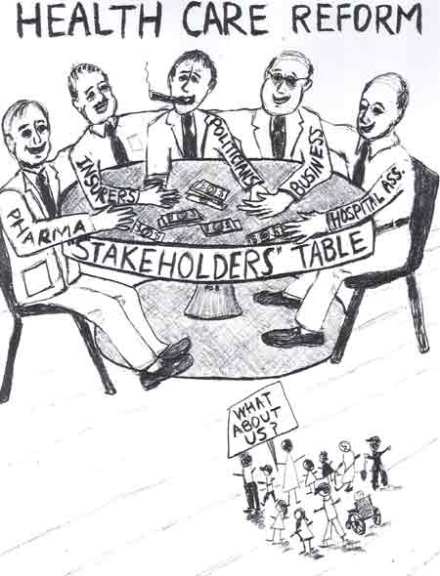
Question two:  Which group of people should be at the forefront of defining what’s broken, how to solve the business problems, determining what it will cost, and how to pay for it?  Pelosi, Ried, et al?  Or a group of business people headed by someone like Jack Welch?

Question three:  Whose plans are Americans more likely to believe, one coming out of DC, or one coming from a non-partisan group of business leaders?

Question four:  How many committees and firms are developing standards?  How many standards committees would a “Jack Welch” led reform effort have?  That’s right, one.

Question five:  Federal led reform requires teams to confirm that billions spent by healthcare providers on electronic health records will yield systems that actually work (certification and meaningful use).  Would a “Jack Welch” led effort require the same, or would they know the systems would work simply because they had one set of standards and a viable plan for interoperability?

Question six:  Who are the reformers?  What are the names and experience of the people who drafted the 1,000 pages?  Why aren’t they on the talk shows?

Question seven:  Who should draft the reform document?

I recommend a bi-partisan committee of business leaders, no current politicians—something akin to the committee which studied the Challenger disaster.  If we’re talking a trillion dollars, let’s invest six months or so to define a plan, one that can be presented to the country—Ross Perot with one of his PowerPoint presentations, then let’s figure out some way for the people to comment and “vote”.

If reform is going to impact everyone, shouldn’t everyone at least understand it and be free to comment? Doesn’t a trillion dollar spend deserve some form of popular vote?  Congress has a favorability rating in twenties. If four in five people have lost confidence in their ability to do anything in everyone’s best interest, are we willing to let them make this decision for all of us?  It’s “We the people”, not “They the elected”.

My closing thought—no charge.  Have you noticed when our elected representatives soapbox this issue, they speak of us in term of, “the citizens” or “Americans”, seemingly excluding or elevating themselves from the fray.  They need help understanding this is a square and rectangle issue, not every rectangle gets to be a square, but every square is a rectangle.  We need the squares to start listening and stop talking.

Be it enacted by the Senate and House of Representatives of the United States of America in Congress assembled offer comment on the Healthcare Reform Act of 2009.  Acknowleding that we do not have a clear plan, hereby turn the task of planning back to the people.

pastedGraphic.tiff.converted

EHR Strategy, a call to action

EHR Strategy, What I Do & How I Can Improve Your Efforts

Several people have told me that I need to come right out and state the role I play in the Electronic Healthcare Records (EHR) space, and how my consulting firm will add value to your efforts.  Spell out your services, and state a call to action.  This writing will address that topic, and will be the only time I use your time to try to sell you on me.  If you’ll bear with me for a few minutes, I will explain why I write with such self-assurance that most organizations (Hospitals, clinics, IPAs, and providers) have the wrong EHR Strategy—or no recognizable strategy—and my equally self-assured belief that working together we will mitigate that problem.

Here are the facts around EHR:

  • Most large EHR projects have a high probability of failing—the larger the project, the higher the probability
  • Large EHRs may cost more than a new hospital wing—a number of people know of one truly outstanding hospital who spent more than $300,000,000 on their EHR
  • Hospitals are much more knowledgeable about the requirements of a hospital wing and what it will do for them than they are about their EHR strategy
  • All healthcare providers who have entered the EHR space have done so trying to hit the trifecta of moving Gossamer targets;
    • Certification
    • Meaningful use
    • Interoperability
    • Hundreds of vendors who have their own agenda at heart
    • So many individual, disparate, committees are working on standards…do we need to even go there?  Doesn’t each committee create its own standards—if so, where is the standardization?
    • If one removes DC from the loop, many providers can’t articulate the business problem they want the EHR to solve, nor can they articulate an ROI
    • Providers have budgets without requirements, budgets without any knowledge of what an EHR system should cost
    • An EHR should have a greater impact on patients, providers, and payors than any other single program, yet who is in charge?  What skill set to they have to do this?
    • Most providers do not have a plan, a qualified planner, a decider.  Who is reviewing and approving the plan?  What makes them credible?

Those are the reasons we are here.  Our job is to reposition those facts such that they improve your chances of being successful with your EHR selection and implementation.

You know what?  It’s not about the EHR.  It never should be.  The EHR system only accounts for about 20% of the projects success or failure.  It’s code.  The other 80% comes down to planning, conversion, change management, training, user acceptance (patient, doctors, nurses, and administrators), and workflow improvement.

You know what?  It’s about breaking down kingdoms between intra-hospital departments.

It’s about knowing that you can walk into the EHR war room and know that somebody is the decider.  That somebody is able to say, “This is what we are going to do first, second, and third, because that’s the only way we can improve your chances of having a successful EHR program.

That’s what we do.  Most people, given the opportunity, will fail 100% of the time performing open-heart surgery.  A mere handful will avert failing.  Most people will fail 100% of the time who are leading an EHR program will fail.  A mere handful will not.

We are the ERHPMO (Program Management Office).  We are your advocate in managing the EHR vendor to benefit you.  Needless to say, most vendors do not like having us on board.  We are vendor neutral, provider advocates.

We are the anti-Accenture business model.  We do not back up the bus and drop off the children.  We will not try to put 30 people on your project.  You do that—clinicians, and IT.  We pull up in a Prius, drop off a few grownups who’ve been there, done that, got the T-shirt.

We work hand in hand with Hospitals, IPAs, clinical providers, and doctors to help you successfully address some or all of the following;

  • understand the EHR landscape
  • create your EHR strategy, in-house versus SaaS
  • eliminate wasteful redundant costs via shared services analyses
  • define your requirements
  • issue an RFP
  • evaluate vendors
  • negotiate contracts with the vendors
  • plan and execute the change management
  • rationalize your EHR with other which may exist within your walls
  • define and rebuild workflows
  • develop and execute a training program for user acceptance

This is not the time to experiment, or hope you get it right.  To minimize the probability of failure, this is the time to bring in the adults.

That’s what we do.  Sorry for the sales pitch.  Please let me know how we can help.

paulroemer@healthcareitstrategy.com

021_18A

Dumber than a box of hair

fix_02Me again.  Back to school 12-step recovery program.  I feel like I’m on the step ‘square root of negative one’—and to think I used to know what that meant.  It’s like herding cats.  Heard of cats?  Sure, a bunch just got on the school bus.  Sorry, sometimes I have trouble getting all of the synapses to fire in order.

This is dedicated to those moms and dads who spent more years in school that America has been a country.  Each year the start of school sort of hits me in the face, like the ice swimmers in Vladivostok—how could I possibly have spelled that correctly—during their New Year ’s Day plunge in to whatever sea is nearby. My gang often looks at me like I am dumber than a box of hair.

They do not care that when the airlines finally decide to board planes by IQ, that I will be in the front of the line—don’t get pithy with me, for you frequent fliers, don’t tell me you haven’t thought of this.  That I regularly advise—albeit recently a little less regularly that I’d like—industry stalwarts they are uniquely unimpressed.  They have other issues; why do I have to wear socks; a bag of Oreos and a bag of Doritos are two different things for lunch.  And so on.  Sometimes they think I am an idiot.  Sometimes I find myself agreeing with them.

The mind is a terrible thing.  The children look to us provide direction.  Some days we have difficulty just providing matching socks.  Is it that we lost control or that we never had it, control, that is?  My nine-year-old daughter winks, says “Oh daddy” to anything I say, and I melt.  That is sooooooooo unfair.

The great thing is the ability to realize how ill-equipped, how unprepared I am to deal with these short people who moved in when my wife and I didn’t understand the consequences of deciding to stay home that rainy night.  Still with me?  I’m not sure I am either, but perhaps we can find comfort in that I really am working to a point.  My children listen to me in the same way I read email—provide me with a summary statement because the rest is superfluous.

I believe that’s what is missing in the ‘reform debate’.  That’s what they call it on TV, but we all know, there is no debate.  To debate, one must define the issues.  They have failed to do that, and I argue their failure is deliberate.

Next Wednesday should be fun.  Mark my words, they still won’t be able to present it on a single PowerPoint slide.

Austin Powers

At what point do we decide this will not work?

We haven't tried this approach yet

We haven't tried this approach yet

What is your natural reaction when you are faced with something that you know doesn’t make sense?  Most people respond with silence, or they join the majority, whatever the issue.  I’ve never been good at being most people–the shoes are too tight.

For your edification and consideration.

State CIOs Get ‘To-Do’ List

HDM Breaking News, August 25, 2009

The National Association of State Chief Information Officers has published a report giving guidance to CIOs as their states implement health information technology provisions of the HITECH Act within American Recovery and Reinvestment Act.

The act requires state leadership in two primary areas: oversight for the planning and deployment of health information exchanges and management of the Medicaid incentive payments for meaningful use of electronic health records, the report notes.

“The passage of the HITECH Act essentially merged health policy with technology policy across state government and state CIOs must play a key role in HIE development and implementation,” according to the report.

The report includes a list of upcoming deadlines for specific federal regulatory actions, including those most affecting states and their CIOs. The report also details four broad areas where CIOs can have a major impact on HIE initiatives: planning, governance, financing/sustainability and policy.

“The HITECH Act placed a significant amount of new responsibilities on states in regards to state oversight for HIE and the planning and implementation grants for preparing for HIE,” the report states. “During this initial planning period, state CIOs must secure a seat at the table to establish themselves as key stakeholders and also to recognize strengths and identify weaker points that require resolution within their own offices relating to statewide HIT/HIE planning. They must ask themselves what they, with their unique enterprise view, can do to support and contribute to each of these areas.”

That was simple.  I’m thinking that if we can tie the IRS into this system of HIE, HITECH, ARRA, Rhoi, CIO, MOUSE we may be on to something useful.  Did you ever think that acronyms are used as a means of obfuscation, or to hide the identities of the people making these decisions?  I am much more likly to lend my avatar to a group of State This & Thats than I am to have someone write, Paul Roemer is the brainchild behind this I^(*&^%%!.  I like committees of three, especially when the other two don’t know for what time I scheduled the meeting.

English 101.  The desk is hard, the task is difficult, and the task described above is impossible or at least out of the realm of mortals.  Does someone think checking off the items on the list will easily allow my doctor to follow me on business or vacation across the country?  We are all smarter than that and we need to stand up and lead.  The time to follow has ended.

MyHero