Patient Relationship Management: Got Pigeons?


I was recently in a large call center of one of my clients. Supervisors and CSRs were scurrying about clearing their desks of binders and cheat sheets in an effort to make the center look paperless. I looked up just in time to see an ominous looking flock of people being given the nickel tour. They swept through in a scene reminiscent of the gathering of fowl in Hitchcock’s The Birds. In an instant we knew the flock was from corporate. The suit-people were tethered to their Blackberries and they kept glancing at their watches as though doing so was going to make lunch arrive quicker.

They encircled a cubicle, a few of them preening themselves, leaned forward, pretended to be interested in what they were being shown, nodded appropriately, scribbled down a few notes, and moved on. At one point, a few of them donned headsets to monitor a call. Within thirty minutes, it was all over, just like in the movie.

The next day the memo filtered down from corporate customer care and marketing, outlining all the new procedures the flock deemed necessary based on all the information they’d gleaned during their brief flyover.

Remember, pigeons happen.

What if your patients controlled their relationship with you?

There are no atheists in foxholes.  The corollary is that there are no bloggers on bright sunny days.  The best blogs come from angst, gloom, from something amiss.  Things that can take the sun right out of the day.

Today is such a day.  I begin with a question.  How important are patients to your practice or hospital.  Is the attitude that they were coming here one way or another because that’s where the ambulance took them, or we’re the only hospital their payor covers?

If so, you’re home free—it’s like having a built-in retention model.  It reminds me of the line in The Eagles song, “Hotel California”—you can check out any time you want but you can never leave.  You don’t need to be good; you just need to be there.  You can eschew PRM (patient relationship management).  As long as people continue to get sick year-over-year at an increasing rate, your PRM, Marketing, and Social Media strategy can be that of Alfred E. Newman, “What, me worry?”

However, if having good PRM is important because of what it adds to the bottom line, or simply because it’s the right and polite way to relate to patients, here’s an example of how not to keep your patients.

I was on the phone with HP, trying to get someone to answer a question about why my desk-top speakers are filled with static.  Prior to calling, I replaced the old speakers with new ones, same model, and heard the same static.  No answers on line, no answers on Google.  I wind up be handled by an ESL/ASC person, English as a Second Language, America as a Second Country.

We spend nine minutes and fifty-four seconds on the phone as I give him my phone number, my wife’s email which somehow confirms I’m not a mirror image of myself, and crawl under my desk and flip over the HP trying to find and read a serial number that is written in smaller text that the directions on a bottle of cough syrup.  Purchase date, operating system, product ID.

“Now, while I’m waiting on my system, tell me your problem.”

I did.  To which he said, “I can help you for a nominal fee.”  Ten minutes into the conversation before he’s able to tell me that answers cost money.  I shared my dissatisfaction with him and his firm and his country—not really.  I suggested he could have answered my question nine minutes ago for less cost than HP had already incurred for this service call.  I suggested he could point me to a helpful web site, or save us all additional embarrassment and just whisper something like, “you have a bad sound card.”  No, no, and no.

For those who may be new to the idea of PRM and social media, this is how it works.  I will not buy another HP even if the ambulance takes me to the HP store.  Since I can’t listen to my music on my HP, I will make it my mission to go out of my way to convince others that HP is not worth their money.  I will post and Tweet until I grow tired of the exercise or until I simply plug in my iPod.  Whatever happens, I will have done my best to take all of the toothpaste out of the HP tube, knowing they can’t put it back.

This is what happens when customers and patients take PRM and social media into their own hands.  It may also be what happens when the 12-step program proves to have been a few steps short of complete therapy program.

pastedGraphic.tiff.converted

Social Media: Learn from Patients

mixer


Ever notice how the computer can shave about fifteen years off your looks? This is especially true when you post old photos of yourself. High School friends, which you know you will never see again, find you on Facebook and comment as to how good you look. That’ll show ‘em.

So, how’s your day going? Mine’s fine—thanks for asking. I’ve been meaning to write about a few customer care experiences I liked, and then see who we can apply the idea to healthcare and Patient Relationship Management (PRM), so here goes.

It recently occurred to me that very few of today’s children know how freshly baked bread smells, so I decided I would learn how to bake. For those who know me, I’m neither big on details nor on taking direction—not a big detail when it comes to mowing the lawn, but rather significant in baking since it’s almost all chemistry. I like sourdough, so I thought I’d start with that.  It turns out you can’t.  You can start to start, but you can’t actually bake any until you’ve created a ‘starter’.  The starter is somewhat akin to creating life where there was none.  From a concoction of flour, water, sugar, and salt (basically the recipe for Play-dough) wild yeasts will infest the mix and begin to grow.

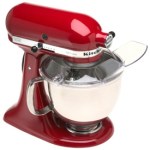
With my science project growing in a Ball jar on my counter, and after several rather impressive attempts at white bread, I decided to whip up a rather large batch of pizza dough.  Since I was in a hurry I ignored the admonition to slowly add the remaining three cups of flour, and dumped it into the mixing bowl.  Thwump!  As the bright red mixer ground loudly to a halt I learned why they’d included that little warning. A faint smell of burnt ozone wafted through the kitchen as the cloud of flour settled slowly on the granite counter top.

The KitchenAid mixer was dead. The last thing I fixed was the bell on my tricycle when I was four, so I don’t know what made me thing I could fix this. I went to Kitchenaid’s web site, typed in the model number, and hit enter. Nothing. I searched their site. Nothing. Went to Google. Typed in, “repair Kitchenaid mixer.” Within two minutes I found a web site that matched exactly my problem. I clicked the link. There was a step-by-step set of instructions and photos instructing how to disassemble the mixer right down to the broken part, the worm gear. The author also provided a link to a parts supplier, the price of the part, and an estimate for how long it takes for it to arrive.

Painless. Within a week my mixer was working although I did have one screw left over. I didn’t have to box it, ship it, pay for it; nothing. Some kind soul had taken it upon himself to make my day by posting his success on the internet. Could KitchenAid have done the same thing? Yes, for almost no cost. Another example of a firm who hasn’t learned to color outside the lines. Thank goodness one of the customers had.

Chances are good that your patients have posted more information about how to help their fellow patients than your hospital has posted.  It’s worth a look.  Chances are that they’ve also posted information that is wrong, things you would like to correct, but if you don’t know about it, you can’t correct it.  Want to know a good place to start a social media strategy?  Learn from your patients.

saint

Patient Relationship Management (PRM)

georgeIf you watch too much television your brain will fry. Sometimes I feel like mine is in a crepe pan that was left sitting on the stove too long. Two nights ago I’m watching Nova or some comparable show on PBS. The topic of the show was to outline all the events that took place that helped Einstein discover that the energy of an object is equal to its mass times the speed of light squared, better known as E=mc². It was presented to the audience at a level that might best be described as physics for librarians, which was exactly the level at which I needed to hear it. It’s physics at a level that is suitable for conversation at Starbucks or any blog such as this.

So here’s what I think I understood from the show. It tracked the developments of math and physics in 100 years prior to Einstein’s discovery. The dénouement appeared to occur when Einstein and his fiancée were riding in the bow of the small boat. Apparently, he was leaning over the side of the boat and noticed that the waves generated by the front of the boat moved at the same speed as the boat. He then noted that fact only held true for those persons in the boat, who were in fact, traveling at the same rate of speed. However for those persons watching from the shore, that same wave was not only moving slower than the boat it got further behind over time. Some other things occurred, yada, yada, yada, and there you have it. Clearly, the details are in the yada, yadas.

So here’s what happens when you watch too much television. As I’m running this morning somehow my mind takes pieces from that show and staples them together to yield the following. Let’s go back to the equation E=mc². For purposes of this discussion I’ll redefine the variables, so that:


E = the percentage of Patient Complaints/Inquiries.
m = Patient in-bound calls.
c = number of Patients


If this were true–this is an illustration, not an axiom–the percentage of complaints in the call centers of an healthcare provider is equal to the number of in-bound calls times the square of the number of patients. So as the number of calls increases the number of complaints/questions increases and as the number of patients increases the number of complaints increases exponentially. Of course this is made up, but there appears to be a grain of truth to it. As a number of calls increase the percentage of complaints is likely to increase, and as the number of patients increases there will probably be an even greater increase in the percentage of complaints incurred. I think we can agree that a reasonable goal for a healthcare provider is to decrease the percentage of complaints and perhaps to shift a hefty percentage of inquiries to some form of internet self-service vehicle. 

I think sometimes the way providers like to assess the issue of Patient Relationship Management  (PRM) is by looking at how much money providers throw at the problem. I think some people think that if one provider has 2 call centers, and another provider has 3 call centers, that the provider with 3 must be more interested in taking care of the their patients, and might even be better at PRM.  I don’t support that belief. I think it can be demonstrated that the provider with the most call centers, and most Patient Service Representatives, and the most toys deployed probably has the most problems with their patients. I don’t think it’s a chicken and egg argument. If expenditures increase year after year, and resources are deployed continuously to solve the same types of problems, I think it’s a sign that the provider and its patients are growing more and more dysfunctional.

How does this tie to Einstein and his boat? Perhaps the Einsteins are those who work with the provider; those who are moving at the same speed, those in lockstep. From their vantage point, the waves and the boat, like the provider and its patients, are all moving forward at the same speed. Perhaps only the people standing along the shore are able to see what is actually occurring; the waves distance themselves from the boat in much the same way that the patients distance themselves from the provider.

PRM is such an easy way to see large improvements accrue to the provider, especially using social media.

pastedGraphic.tiff.converted