If reform becomes Obama’s Kryptonite, does that make him a lame duck with three years to go?
What happens to the EHR roll out and ARRA if reform doesn’t pass?
If reform becomes Obama’s Kryptonite, does that make him a lame duck with three years to go?
What happens to the EHR roll out and ARRA if reform doesn’t pass?

Of what were we last speaking? Do you ever wonder if perhaps you are the only person who was never photographed with one of the Kennedys? That got me thinking about our presidents. Yesterday NPR interviewed the person who spent eighty hours interviewing Clinton during the eight years during which he was allowed to park freely anywhere in DC. See how this is already starting to come together?
The interviewer mentioned that Clinton described the Lewinski episode as a distraction. I also employed several descriptors of that series of affairs—of course, the pun is intentional—but I must have overlooked calling it a distraction. People on both sides of the dialog call the episode a stupid thing. Here’s how I look at it—doing long division and forgetting to carry the one is ‘a stupid thing’; mixing a red sock with a load of whites is ‘a stupid thing’. Sometimes politics can have us all screaming infidelities.
When I share my thoughts about these things, some look at me like they are staring at an unlabeled can of food. I guess objectivity is only for the truly unimaginative.
So all of that thinking about presidents got me to thinking about Mr. Obama, reform, and EHR. Remember that a lot of the original economic reform discussion had to do with TARP monies being almost tossed at the banks. It was almost like a reverse bank holdup, making the banks take money.
Which now takes us to healthcare reform and EHR. ARRA money and states like New York providing a stimulus to the stimulus. What would make governments offer money for EHR? How might we illustrate this?
Let’s say I offer my children a choice of two things to eat; broccoli and chocolate cake. They make a bee-line for the cake. The broccoli requires an incentive to get any takers. I ask a few questions—they are prepared to suffer untold penalties instead of eating the broccoli. There may be some financial incentive which will entice them to eat broccoli, but it will be pricey. Telling them it’s good for them, or that they have to eat it makes no difference to short people—they want to be bribed.
Telling healthcare providers EHR is good for them, or that they have to do it makes no difference to tall people—they want to be bribed. What does this signify? What is it about EHR that requires incentives and some foreign force majeure to get the discussion underway? It’s not as though the healthcare providers don’t want to do things that will improve their business. What is it they know that we don’t? What would make them run towards EHR rather than away from it?
You don’t suppose it has something to do with broccoli, do you?
For those who enjoy Dana Carvey, here’s a link to his song about chopping broccoli.
http://www.youtube.com/watch?v=gO57XRDDodk


Who Will Lead
Dirk Stanley posted this link from the NY Times about the death of the public option.
http://www.nytimes.com/2009/09/13/health/policy/13plan.html?_r=1
Now, we can either bemoan this or we can try to lead. Here’s my take on how to strat the discussion.
To insure the uninsured we don’t need a public option. When poor people were denied access to banking and credit, the government did not create a public bank. It regulated the banking organizations and made it illegal for them to redline the poor.
Can we not regulate the payors in the same fashion, requiring them to insure the uninsured? Were not Medicaid and Medicare created in part because payors relined the elderly?
The government requires everyone to have automobile insurance, placing the onus on the individual. Why not flip it? If the goal of reform is to get people access to healthcare, which under the existing business model implies insurance, require the payors to provide it. The government can subsidize the payors, or pay it in full, and it can do so without adding to the bureaucracy of further entitlements via a public option.
To me, two other ideas make much more sense, one of which I’ve previously offered. Large groups of people are without insurance or are under insured. The government wants them to have access to medical care. As stated above, the government already created two agencies to address this problem, Medicaid and Medicare. Why create a third? Can’t those people be added to the two existing agencies?
The other idea may be the same, but if implemented differently, could streamline the processes and the cost. Make the cost of the coverage to those groups an offset against whatever tax they would owe. If it costs ten thousand dollar to insure a family of five, offset it against their income tax obligation. Net net its’ the same cost whether you collect it and refund it or simply don’t collect it. Give these families so sort of smart healthcare debit card, the government owns the account, and all healthcare providers can accept it for payment.
Sure, there is unlimited fraud potential, just like there is under any other option.

 It’s funny how things work when the cameras are on and all are dressed to the nines. It appeared as though Hillary and Nancy called each other confirming red was the color of the evening–a quick rock, paper, scissors, and Hillary won the right to wear a pants suit. Congressman Rangel nattily attired with threads he was able to afford by forgetting to pay taxes on income earned from properties he forgot he owned. (In sotto voice—I digressed again, didn’t I?)
Amid the applause and bravado, nobody, I mean nobody so much as blinked when the president dropped the number of people covered under the public option from forty-six million to a paltry thirty million.
Universal coverage was pulled from the table as though it had never been on the table.

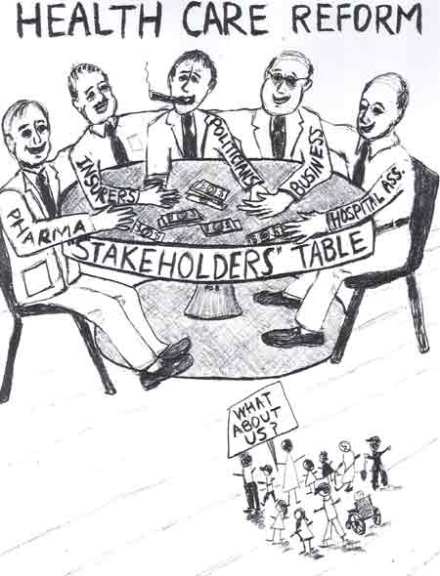
Labor Day cookout. America, God blesses us.
Five of our neighborhood’s Wisteria Lane wives—wildebeests—pitched a ten-dollar K-Mart tarp to provide a modicum of shade for the BBQ guests—see prior posts to understand the wildebeest reference. I should have You-Tubed their struggle. I had less difficulty pitching my tent by myself on side of a volcano at 2 AM at nineteen thousand feet in a blizzard. To those who would question why I wasn’t helping them it’s because they didn’t seem to be a Y-chromosome friendly group.
American food—burgers, dogs, sausages, beans, chips. Then there’s the side dishes brought by the neighbors; salads that require a team of forensics to ferret out the ingredients, and cookies that look so goofy that not even the kids will try them. Oreos, never mess with perfection.
Okay, down to business. I’m looking for someone to tell me whether this idea makes sense or if it is all wet.
Premise one: Most of the reason reform being discussed is to solve or improve the healthcare “business model”. Most of the clinical side is not up for debate, that is, we are not discussing the need to revamp dermatology or pediatrics.
Premise two: About half of healthcare is government run—the VA, Medicare, Medicaid, and government employee health.
Question one: Which business model are the reformers trying to address?
Question two: Which group of people should be at the forefront of defining what’s broken, how to solve the business problems, determining what it will cost, and how to pay for it? Pelosi, Ried, et al? Or a group of business people headed by someone like Jack Welch?
Question three: Whose plans are Americans more likely to believe, one coming out of DC, or one coming from a non-partisan group of business leaders?
Question four: How many committees and firms are developing standards? How many standards committees would a “Jack Welch” led reform effort have? That’s right, one.
Question five: Federal led reform requires teams to confirm that billions spent by healthcare providers on electronic health records will yield systems that actually work (certification and meaningful use). Would a “Jack Welch” led effort require the same, or would they know the systems would work simply because they had one set of standards and a viable plan for interoperability?
Question six: Who are the reformers? What are the names and experience of the people who drafted the 1,000 pages? Why aren’t they on the talk shows?
Question seven: Who should draft the reform document?
I recommend a bi-partisan committee of business leaders, no current politicians—something akin to the committee which studied the Challenger disaster. If we’re talking a trillion dollars, let’s invest six months or so to define a plan, one that can be presented to the country—Ross Perot with one of his PowerPoint presentations, then let’s figure out some way for the people to comment and “vote”.
If reform is going to impact everyone, shouldn’t everyone at least understand it and be free to comment? Doesn’t a trillion dollar spend deserve some form of popular vote? Congress has a favorability rating in twenties. If four in five people have lost confidence in their ability to do anything in everyone’s best interest, are we willing to let them make this decision for all of us? It’s “We the people”, not “They the elected”.
My closing thought—no charge. Have you noticed when our elected representatives soapbox this issue, they speak of us in term of, “the citizens” or “Americans”, seemingly excluding or elevating themselves from the fray. They need help understanding this is a square and rectangle issue, not every rectangle gets to be a square, but every square is a rectangle. We need the squares to start listening and stop talking.
Be it enacted by the Senate and House of Representatives of the United States of America in Congress assembled offer comment on the Healthcare Reform Act of 2009. Acknowleding that we do not have a clear plan, hereby turn the task of planning back to the people.

 I remember two things from my lone sociology class in college. Somebody name Emile Durkheim—given that I cut almost every lecture, I continue to amaze myself that I spelled his name correctly—he did something about suicide rates, and one thing about inherent fear—we are born with knowledge of two types of fear; heights and loud noises. I was born with a third, the fear that comes from thinking that one day I might slip out the door wearing white shoes after Labor day—see how timely this is?
There’s been a common thread for the last few days among the social media-ites—sometimes you are forced to make up a word or two. The thread of which I write is fear, a fear that started in anticipation, and has been building since last week. Muculent palms, jitters, slight schizophrenia. The anticipation of the voices, “And he did hear a sound rising over the snow. It started in low… then it started to grow.” Sorry for the Grinch reference, I’m trying to work through this.
It starts with notifications; emails, letters. Doctor’s name and phone number. Emergency contact information. Write it three times in case we lose the first two. Then comes the demand for tools—don’t dare go to sleep without completing this; pencils, scissors, crayons…Backpacks. Lunch boxes. I can’t wake them up. They open one, look at me, and roll over. They say things like, “This is what all the kids are wearing.” They look you in the eye and lie, “I brushed my teeth.” “If you don’t fill out the forms I can’t go back tomorrow.”
They fail to recognize that we have multiple degrees. And if they did realize it, they would not care. You may be a big shot between 8 and 5, but right now you’re just dad, and why don’t we have any fruit roll-ups for my lunch.
So, how was your day? For me the voices have subsided, but the sweaty palms will return just prior to the school buses.
I look at healthcare reform and EHR and think, the only thing to fear is reform itself.
I’ve been asking friends for their input about our conversations here, and somebody whose opinion I value highly suggested I write what my audience wants to hear. I can’t do that—that’s what the other bloggers do—feel good, but this, but that, cheerleaders.
This is difficult, at least if you want it to work. There’s no shame in asking for help.

sorry for the quality, I drew this in high school
Tenth grade biology class was on the second floor. One of my best friends said that for five dollars he would jump out of the window during class, sort of like falling out of the stupid tree and hitting every branch on the way down. Others took the bet. Lemmings. They all jumped. Speaking in parenthesis for a moment, this same friend was interviewed on Larry King on September 11, 2001, discussing how to run covert ops on Bin Laden. I haven’t slept well since I learned that.
As I talk with clients and several of the healthcare thought leadership, I see consensus building around a lemming-like acquiescence about reform, especially as relates to EHR. That wasn’t much of a segue, but my children stared school today, and I am still in shock from having let me seven-year-old pack his lunch—very different food groups.
I read an article in a much respected—I wrote ‘very’ instead of ‘much’, Word didn’t like it. Learn something every day—publication that the primary business driver behind EHR is that it is perceived as a mandate. (Sorry, that was written poorly—I may have to fire that guy.)
If that’s why your organization is doing it, do yourself a favor and stop. The ROI from the stimulus money will not make EHR worth your while. How will you know if you did it for the right reasons? When you get to the end, if you aren’t able to say, “I wish we had done this years ago”, you’ve done something very wrong.

 Me again. Back to school 12-step recovery program. I feel like I’m on the step ‘square root of negative one’—and to think I used to know what that meant. It’s like herding cats. Heard of cats? Sure, a bunch just got on the school bus. Sorry, sometimes I have trouble getting all of the synapses to fire in order.
 Pale Rhino Consulting