Does it come in blue?

The store for audiophile wannabe’s. Denver, Colorado. The first store I hit after blowing an entire paycheck at REI when I moved to Colorado.

The first thing I noticed was the lack of clutter, the lack of inventory. There were no amplifiers, because amplifiers were down market. There were a dozen or so each of the pre-amps, tuners, turntables, reel to reel tape decks, and these things called CD players. They also had dozens of speakers. At the back of the store was an enclosed 10 x 10 foot sound proof room with a leather chair positioned dead center.

When the ponytailed salesperson asked about my budget, like a rube I told him I didn’t have one. He beamed and took that to mean it was unlimited. It really meant I hadn’t thought of one. He asked me what I liked to listen to.

“Pink Floyd, Dark Side of the Moon.”

Within a few seconds I was seated in Captain Kirk’s chair, and Pink Floyd’s Brain Damage filled the room in pure digital quadraphonic sound. I was in love.

I lived a block and a half away. Since the equipment wouldn’t fit in my Triumph, I made several trips carrying home my new toys—gold plated monster cable, solid maple speakers that rested on nails so as to minimize distortion, a pre-amp, tuner, receiver, turntable, and stylus.

It wasn’t that I deliberately bought stuff I didn’t need. I walked in uneducated. I had never bought what I was looking at. I didn’t know how much to spend, nor what it would do for me. Looking back at that purchase decision, I bought specs I didn’t need. I didn’t realize it was possible to build audio technology that would meet performance specs beyond what I person could hear, heck beyond what anything could hear. Not understanding that possibility, I bought specs I couldn’t hear. I spent hundreds of dollars on features from which I would never receive value. You too?

It happens all the time. Stereos. Cars. Computers. Applications. Technology. Having bought it doesn’t mean it was needed, or that it was the right thing to do, or that it has an ROI, or that it meets the mission.

The cool thing is that even though I could not hear half the features of my new stereo, it looked really, really impressive.

What my daughter taught me about healthcare IT

The other night as I’m sitting on a hard bleacher watching my seven-year-olds baseball practice I noticed the mom sitting next to me looking a little forlorn. Being naturally inquisitive, I asked if everything was okay.

“I lost his glove,” she replied.

Noticing a glove on her son’s hand, she saw my look of confusion. “Not his. My husband’s. I had it with me last Thursday, and I left it here.”

“I don’t suppose this was a new glove. Judging by the look on your face I’d say this was his favorite glove, and was probably handed down from his father. Autographed by Mantle and Maris in 1961.  Fifty years old, supple, broken in, fold flat as a sheet of paper.”

“Fifty-five years,” she corrected as she lowered her eyes.

“It’s rained the last three days,” I told her, which caused her to grimace even more. Having nothing better to do, I flayed her emotions. “I bet that glove meant the world to him. He probably planned on giving it to your son in a few years. The glove probably reminds him of the big events in his life, every scar, each stain on the leather, points to something important. You know, if it was outside for a few days, the field mice will have chewed on the leather.”

She brushed away a tear, and headed to the lost and found.

“Any luck?” I asked when she returned.  She shook her head in despair. “In some countries, if a wife does something life that, the husband can sever the relationship, literally,” I said as I made a slashing motion with my hand. She made the briefest of smiles. At least she knew I was pulling her lariat. Reeling her in, I continued.

“You’re not thinking of spending the night at home, are you? If you are, you should at least call someone and let them know of your plans. He’ll heal over time,” I told her. “But he won’t forget it. Twenty years from now the two of you will be watching something on TV, and something will remind him of the glove YOU lost.”

Fast forward to last Wednesday night. My daughter and I are getting out of the car so I can coach her and her softball team in the playoff game.

“Is your glove in the trunk?” I asked. This is after I spent several minutes grilling her at home about whether she had everything she needed for her game.

“I hope so,” she said shamelessly as I popped the trunk for her. “You hope so?” I repeated with an edge in my voice.

“It’s not here Daddy,” she said as she searched the trunk.

I left her with her friends and drove home to look for it. Ten minutes. Nothing. For some reason, I looked in the trunk. There it was. Death by 1,000 cuts.

Does it all come down to baseball gloves?  “I hope so.”  What kind of a response is that?

Will these EHR expenditures improve our operations? I hope so.

Can you confirm for me that Patient Experience Management won’t fall any further? I hope so.

Are we ready for the reform changes coming to the business model?  I hope so.

Will we meet Meaningful Use? I hope so.

Do you think we should continue to employ you? I hope so.

“FaceBook” EHR –Visionary, or is it time for me to take a nap?

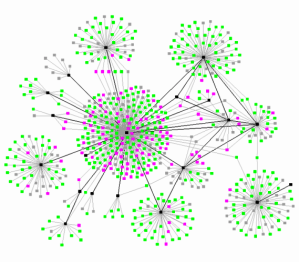
This is what happens when my mind is allowed to free-associate when I run. I was watching a show on the science channel on the mathematics behind the principle of “6 degrees of separation and Small World”. The show demonstrated that very simple networks can be developed to get person A to any other person or entity, B.

This got me thinking–always a dangerous proposition–why couldn’t Small World networks be developed for EHR on a national level?  One Super EHR. Cradle to grave healthcare records, one person (patient) and at time via a Small World network. Super EMRs, patient owned, to a single, repeatable, standardized EHR.  Eliminate the RHIOs with their multiplicitous standards, eliminate hospital’s mini-EHRs.  Document the functionality required of the specialist practices and enable the data to be captured at the EMR level.

EHRBook; but with real privacy controls.

What do you think?

HIE: Are two HIEs one too many?

The is my most recent post at healthsystemcio.com

According to Wikipedia, Health information exchange (HIE) is defined as the mobilization of healthcare information electronically across organizations within a region, community or hospital system. HIE provides the capability to electronically move clinical information among disparate health care information systems while maintaining the meaning of the information being exchanged.

That seems really straight forward, at least to me. I find it helpful to whittle complex ideas down to a point that enables me to explain them to my parents, without either of us having to reach for the Tylenol.

In its simplest form, an HIE is a pipe, a pipe that transports ones and zeroes. Back in the days when I still had hair, one of my clients was the CEO of a large cable television company. He explained his business this way; “We are just like the water department. We put a pipe in the ground, send something through it, and every month people mail me money.”

He also sent ones and zeroes.

Now, there are those around us, apparently thousands of them, who have made it their mission to convince those in the minority that HIEs are far more complex than they really are. Maybe I just do not understand the concept of ones and zeroes.

You probably know that several hundred HIEs are in the process of being built—and they are all being built by people who have little to no experience building HIEs. Now, here is where everything gets a little hairy. Let us look back on the definition of an HIE and let us focus our conversation on building just one HIE. The tricky part about getting the HIE to work is that pesky little word “disparate,” as in disparate health information systems, and the last time I counted EHRs, I hit 300 before giving up.

That is where all that disparate clinical information comes from. However, when push comes to shove, the information from all of those different EHRs is pretty much the same, but the various EHR vendors just line up their ones and zeroes differently, thus enabling them to prevent others from playing in their sandbox.

There is another disparity surrounding HIEs, one that is unspoken. Suppose you and I decide to build an HIE, a good one. After some period of time, we get rid of all the little disparities among the various EHR vendors and are able to zip those little ones and zeroes from one end of the HIE pipe to the other. Let us also suppose we used a very long pipe, so we could use this HIE anywhere. It would work for a hospital, or at an Integrated Delivery Network (IDN), or across a region.

Our HIE is able to move our individual healthcare information from one end of the pipe to the other wherever the other end may be.

I forgot to mention the disparity. The unaddressed HIE disparity is the one created from having hundreds of HIEs, each designed in its own vacuum by people who have little experience filling vacuums. And when those HIEs have been built, what will they do? Exactly. They will move clinical information among disparate healthcare information systems. In laymen’s terms—ones and zeroes from EHR vendors who do not play well together.

The new ones are identical in functionality to the one we just built, only now there are 500 of them.

Now to the meat of the issue. If we build an HIE correctly, and build it to be able to handle any disparity, is there any more need for HIE 2, since in theory HIE 2 will be able to do the same things as HIE 1?  Let us extend this same thinking from HIE 1 through HIE 500. At some point—irrespective of certain technical issues—can it be concluded that the total number of HIEs needed to move ones and zeroes is one?

Other than the redundancy and expense of building a few hundred things that each perform the same function, the real problem of having multiple HIEs is that each new HIE greatly increases the complexity of moving a personal health record from point A to point B. If HIE 2 is the same as HIE 1, we do not need HIE 2. If the two HIEs are not alike, when we try to transport a personal health record from a patient in HIE one and move it to a doctor in HIE 2, the disparity created between the two almost requires a new HIE to resolve the problem. We will have infinitely compound the complexity of moving ones and zeroes by deploying 500 HIEs and hundreds of thousands of healthcare providers and a few hundred million patients, and we have designed quite a mess.

And why does the mess exist? It exists to move those same ones and zeroes we were moving quite nicely by the HIE we built. One can argue that scale may create its own design issues, but those issues do not make this idea dead in the water. Issues of scale are solvable; those of compounded complexity are self-imposed due to an overzealous design.

The proposed way to solve the upcoming problem of compounded complexity is to build the National Health Information Network, the NHIN. We need the NHIN to act as a super HIE, to remove the disparities that result from having multiple disparate HIEs.

Adding further unwarranted complexity to the multi-HIE model is the fact that each HIE has resulted in several hundred providers designing and retooling their healthcare IT systems to adapt to these anomalous HIEs.

Sometimes the most difficult solution to envision is the least difficult one to implement.
 

EHR: When you are in a hole, stop digging

 March 21, 2011 07:05

I was thinking about the time I was teaching rappelling in the Rockies during the summer between my two years of graduate school.  The camp was for high school students of varying backgrounds and their counselors.  On more than one occasion, the person on the other end of my rope would freeze and I would have to talk them down safely.

Late one day, a thunderstorm broke quickly over the mountain, causing the counselor on my rope to panic.  No amount of talking was going to get her to move either up or down, so it was up to me to rescue her.  My total amount of rappelling experience was probably only a few more hours than hers.  Nonetheless, I went off belay, and within seconds, I was shoulder to shoulder with her on the face of the cliff.

The sky blackened, and the wind howled, raining bits of rock on us.  I remember that only after I locked her harness to mine did she begin to relax.  She needed to know that she didn’t have to go this alone, and she took comfort knowing someone was willing to help her.

That episode reminds me of a story about a man who fell in a hole.  The man continues to struggle but can’t find a way out.  A CFO walks by.  When the man pleads for help, the CFO writes a check and drops it in the hole.  A while later an EHR vendor walks by—I know this isn’t the real story, but since I am the one writing I’ll tell it the way I want.  Where were we?  The vendor.  The man in the hole pleads for help and the vendor pulls out the contract, reads it, circles some obscure item in the fine print, tosses it in the hole, and walks on.

I walk by and see the man in the hole.  “What are you doing down there?”  I asked.

“I fell in this hole and don’t know how to get out.”

I felt sorry for the man—I’m naturally empathetic—so I hopped into the hole.  “Why did you do that?”  He asked.  “Now we’re both stuck.”

“I’ve been down here before” I said, “And I know the way out.”

I know that’s a little sappy and self-serving.  However, before you decide it’s more comfortable to stay in the hole and hope nobody notices, why not see if there’s someone who knows the way out?

Drafting someone to sort out your EHR problems doesn’t do anything other than add another name to the org chart.  Work plans and org charts are very similar in one key respect—they both have a lot of blank space between the all of the boxes.  And, that is where a lot of the problems arise—in the blank spaces, spaces that have to do with planning, process improvement, and change management.

Everyone is implementing an EHR, but not everyone is doing it correctly.  There is a very special set of IT skills needed to meet the challenges of a failed or failing project.  People with those skills are disaster recovery specialists.  They are the people who jump in the hole with you because they have been in the hole before and they know the way out.

What is IT’s role in Accountable Care Organizations?

I published this article today in healthsystemcio.com (http://ow.ly/4ecmg), and thought you might find it interesting. Please feel free to comment.


When was the last time you looked at a hospital bill, or one sent directly from your physician? The reason I ask is I have been spending some time trying to develop a clear enough picture of Accountable Care Organizations (ACOs) to describe them easily. After all, ACOs are not something you can touch and see. You cannot just walk up to the third floor of Our Lady of Perpetual Billing and be shown an ACO.


I think it is extremely important to understand what an ACO is before trying to build one. Much of the difficulty in building an ACO has to do with the fact that something, in fact a great many somethings, will have to change for an ACO to function. The question then becomes, change from what to what?

Back to the hospital bill. Scan through the list of charges, and then press the F5 key to let me know when you are ready. Now, highlight all the line items that charge you for the care you received … I found the same thing; there are not any. Volume versus value. Caring for you versus doing stuff to you. The bill of charges under today’s business model is a blow-by-blow description of what was done to you; x-rays, medicines given, IVs, etc.

Hospital billing is not unlike a hotel bill; it is just longer and you do not earn frequent illness points. Embedded in your hospital bill are charges for food and cable television, just like you had been staying at the Four Seasons.

So, as we move from volume to value, how will that impact healthcare information technology, assuming anyone remains standing after Meaningful Use and ICD-10? I keep preaching about how the hospital’s business model must change in order to understand what will be required of IT. To do so, let us compare two very different business models and their operations, both of which are in the same industry.

Hyundai and Bentley. Volume to value. Just-in-time manufacturing versus don’t-rush-me manufacturing. Nobody would argue with the fact that the information systems and business processes needed to run Hyundai’s business are very different from those of Bentley.

I watched a show on how Bentleys are built. A team of people is assigned to each car. Depending on the car’s options, some people roll off the team and others are added, but the team “owns” the car from start to finish, and each subsequent person inspects the work of the prior person.

At Hyundai, it is not apparent that anyone “owns” the car. People have line responsibility; they own a piece of a process. I could be the “left lug nut guy,” having absolutely no responsibility for the rest of the car.

I think this is the degree of change an ACO will require in order to be effective. We will have to change from being lug nut specialists to becoming care owners. This then brings us back to the question of what IT systems will be needed to charge for and manage care.

Unlike moving from ICD-9 to ICD-10, there is no mapping model to guide the change from today’s business model to an ACO model. Three IVs and one MRI do not translate well to 4.5 Accountable Care Units (ACUs) which are then billed at whatever happens to be the going rate.

Today’s systems calculate charges based on what was done to you — $86 million gazillion for the MRI. If requested, nobody in finance or information technology will be able to vivisect the bowels of SAP or Lawson and show you where the information is that records how much the MRI procedure costs. Few can explain how the business processes and information systems that support today’s lug-nut charging model can support and report how the hospital manages its business. Nobody even pretends to explain how effective those same processes and systems are at reporting the quality of care delivered.

The ACO model will require processes and systems that capture, allocate, and report costs. The ACO model will also require processes and systems that can aggregate people and procedures into ACUs and relate patient costs against those ACUs.

We do not have those systems. Since current hospital systems are incapable of really managing today’s business requirements, we should not adapt them to the ACO model.


EHR: How do you define progress?

If you and I agreed on everything, one of us wouldn’t be needed.

Of the many special things associated with growing up in America, one is held dearly by every American eight-year old male who owned an AM transistor radio with an earplug; baseball–I am dating myself which is something I promised my counselor I wouldn’t do.

On hot summer nights in the 1960’s, Baltimore’s adults sat on their cement stoops nursing bottles of Carling beer and waiting for their window air conditioners to suck out the heat.  Their male offspring lay in bed, a plastic earplug dangling from their ear as they turned the dial of their transistor radio to find the lone radio station covering the Baltimore Orioles. In spite of the constant static, they faithfully kept score on a hand-drawn score sheet in their black and white Composition notebook.

My scorecard was homemade; carefully drafted using a pencil and something relatively straight to draw the lines that separated each of the nine innings. Unlike today, when the concept of team has given way to the concept of players whose loyalty lies with the highest bidder—free agents, the lineup for the Orioles rarely changed by more than a player or two each year.

The Orioles team pennant hung on my bedroom wall, and on my dresser was their team photo along with my membership card to the Junior Orioles. Next to me as I kept score was my tattered shoe box containing my collection of baseball trading cards, sorted by team and held together by rubber bands.  A few hundred stale sticks of pink powdered bubble gum that came with each five-pack of cards was stacked neatly in one end of the box. The cards for the opposing team were spread before me so I could get the lineup and study their batting statistics.

What made me think of this was that the last of our snow had melted, and opening day is less than a month away.  Last year my son and I went to a minor league game. Although the grass was just as green, and the hot dogs smelled the same, nothing was the same. Still, it beat a stick in the eye. Things change. Baseball changed, and nobody conferred with me before changing it. At the game I didn’t see a single person keeping a scorecard, let alone a dad teaching his son or daughter how to keep the score. The only constant throughout the game was the commercialization.

That’s progress. Or maybe not. Some progress is good. Some progress doesn’t exist even though everybody around it believes that it does.

Implementing new technology doesn’t in and of itself infer progress, it simply means you bought more technology. Not convinced? How is the productivity of your EHR?  Add up all the money you’ve spent on EHR and technology and recalculate your RIO.  Was it worth it?

Ray, people will come Ray. They’ll come to Iowa for reasons they can’t even fathom. They’ll turn up your driveway not knowing for sure why they’re doing it. They’ll arrive at your door as innocent as children, longing for the past. Of course, we won’t mind if you look around, you’ll say. It’s only $20 per person. They’ll pass over the money without even thinking about it: for it is money they have and peace they lack. And they’ll walk out to the bleachers; sit in shirtsleeves on a perfect afternoon. They’ll find they have reserved seats somewhere along one of the baselines, where they sat when they were children and cheered their heroes. And they’ll watch the game and it’ll be as if they dipped themselves in magic waters. The memories will be so thick they’ll have to brush them away from their faces. People will come Ray. The one constant through all the years, Ray, has been baseball. America has rolled by like an army of steamrollers. It has been erased like a blackboard, rebuilt and erased again. But baseball has marked the time. This field, this game: it’s a part of our past, Ray. It reminds of us of all that once was good and it could be again. Oh… people will come Ray. People will most definitely come.
-Terrance Mann in the movie, “Field of Dreams”

I tear up every time Ray asks, “Want to have a catch dad?”


AP reports EHR plan will fail. Now what?

I just fell out of the stupid tree and hit every branch on the way down. But lest I get ahead of myself, let us begin at the beginning. It started with homework–not mine–theirs. Among the three children of which I had oversight; coloring, spelling, reading, and exponents. How do parents without a math degree help their children with sixth-grade math?

“My mind is a raging torrent, flooded with rivulets of thought cascading into a waterfall of creative alternatives.” Hedley Lamar (Blazing Saddles). Unfortunately, mine, as I was soon to learn was merely flooded. Homework, answering the phone, running baths, drying hair, stories, prayers. The quality of my efforts seemed to be inversely proportional to the number of efforts undertaken. Eight-thirty–all three children tucked into bed.

Eight-thirty-one. The eleven-year-old enters the room complaining about his skinned knee. Without a moment’s hesitation, Super Dad springs into action, returning moments later with a band aid and a tube of salve. Thirty seconds later I was beaming–problem solved. At which point he asked me why I put Orajel on his cut. My wife gave me one of her patented “I told you so” smiles, and from the corner of my eye I happened to see my last viable neuron scamper across the floor.

One must tread carefully as one toys with the upper limits of the Peter Principle. There seems to be another postulate overlooked in the Principia Mathematica, which states that the number of spectators will grow exponentially as one approaches their limit of ineptitude.

Another frequently missed postulate is that committees are capable of accelerating the time required to reach their individual ineptitude limit. They circumvent the planning process to get quickly to doing, forgetting to ask if what they are doing will work. They then compound the problem by ignoring questions of feasibility, questions for which the committee is even less interested in answering. If we were discussing particle theory we would be describing a cataclysmic chain reaction, the breakdown of all matter. Here we are merely describing the breakdown of a national EHR roll out.

What is your point?  Fair question.  How will we get the nationalization of EHR to work?  I know “Duh” is not considered a term of art in any profession, however, it is exactly the word needed.  It appears they  are deciding that this—“this” being the current plan that will enable point-to-point connection of an individual record—will not work, and 2014 may be in jeopardy—not the actual year, interoperability.  Thanks for riding along with us, now return your seat back and tray table to their upright and most uncomfortable position.

Even as some throw away their membership in the flat earth society, those same they’s continue to press forward in Lemming-lock-step as though nothing is wrong.

It is a failed plan.  It can’t be tweaked.  We can’t simply revisit RHIOs and HIEs.  We have reached the do-over moment, not necessarily at the provider level, although marching along without standards will cause a great deal of rework for healthcare providers.  Having reached that moment, let us do something.  Focusing on certification, ARRA, and meaningful use will prove to be nothing more than a smoke screen.

That swishing sound you keep hearing is the sound of productivity in free fall.  The functionality of most installed EHRs ends at the front door.  We have been discussing that point for a few months.  When you reach the fork in the road, take it.  Each dollar spent from this moment forth going down the wrong EHR tine will cost two dollars to overcome.

EHR–what do you do when your vendor leaves?

The room was silent except for the humming noise made by the computers’ fans. It smelled of stale cigarettes and spilt hops.  The venetian blind the program manager had been wearing as a hula skirt lay bent and twisted next to the large aluminum trash can.  Other than the light coming from the smashed exit sign, the only other illumination came from the few remaining flat screen monitors.

I made my way across the floor of the EHR War Room, accidently kicking the empty bottle of Grey Goose.  I watched without interest as it spun around on the damp commercial carpeting as though it was playing a solo game of spin the bottle.

The ten page project plan hung in tatters on the far wall, itself the victim of a game of nacho-darts.  Of the thirty-five desks in the room, all but four were empty.  The empty desks sat barren; no computers, no user manuals—no scraps big enough for the other Whos’ mouces.

Friday’s party was a joint celebration of the project team for the EHR go-live.  The thirty-one members the vendor had supplied were in such a hurry to leave the project at the end of the party that two of them were almost trampled to death by their mates as they rushed the door.  The scene was reminiscent of the Running of the Bulls in Pamplona.

Sally’s desk sat next to the wall chart that displayed the daily decline in productivity.  Her head rested on her desk while her monitor’s coral reef screen saver displayed a single yellow tang swimming from left to right and back again.

Larry was staring aimlessly into a Styrofoam cup, using his index finger to stir what was left of a room temperature margarita.  “What now Boss?” He asked.  “We all know it does not do what it is supposed to do.  And, you know who they are going to blame; us.

“Well, at least we have the Meaningful Use money to look forward to,” chimed Sally.  “That should make them happy upstairs.”

“We spent more money on chips and salsa than we will see of the ARRA money,” I told her.  She slumped back to her desk.

What now indeed, I wondered.  What do we do once all the money has been spent and the subject matter experts leave?

“Maybe if we do not say anything nobody will know,” I offered.  “Let’s pretend we know something about ICD-10, keep our heads down, and try to look busy.”

What should we do?  What would you do if your mother asked you?

Is there a valid business argument for certification?

Policy Committee Establishes Multiple EHR Certifiers

They are killing me.

How about that for strategic guidance.  If they state that the earth is flat, and create multiple certifiers, I guess it’s time for Elvis to leave the building.

May we consider this for a moment, just between the two of us?  We are paying them to come up with this, and I want a refund.

Does anyone esle take issue with this?  Here’s my problem–or at least the one I am legally allowed to disclose.

Certification, by definition, only exists because of a high possibility of systems being implemented that won’t do what some group deems they need to do.

Allow me to be a heretic for a few minutes.  Maybe certification is bad.  Catch your breath and think about it.  The only thing certification gets you is the possibility of stimulus rebates being made available to healthcare providers by people who have demonstrated all most no understanding of the business issues you face.  Is that possibly true?

For many, the rebates are nothing more than a rounding error.  Why build a system to be able to attest to goals which may not benefit your business?  In spite of how it’s written, I think certification and meaningful use won’t be known for a few years.  When it’s finally defined, it will have to do with how well your EHR connects to their network.  That’s what they want, that’s what the money is for interoperability.  The other issues are window dressing.

Build your EHR as though Washington and certification don’t exist.  Build it based on what it does for you, not on what they think it may do for them.