How difficult are EHR, Reform, & Interoperability

My daughter asked me to kill the bug in her room—Super Dad to the rescue.  That got me wondering.  Do most men think we excel at most things?  As I pondered weak and weary, I started to formulate this list.  I ask the men as they read through the list to score themselves on a ranking of one to five, with five being the highest, how they view their abilities in each area.  Ladies, feel free to play along on behalf of someone you know.

  1. Sunday Sports
  2. Getting a taxi
  3. Navigating
  4. Mowing the lawn
  5. Killing spiders
  6. Drawing a straight line by hand
  7. Multitasking
  8. Parallel parking
  9. Anything to do with fire
  10. Opening jars
  11. Sharpening a pencil with a knife
  12. Tipping
  13. Driving
  14. Cooking on the grill

Maybe this comes from that hunter-gatherer thing.  Total your score silently in your head—you can do this because you also happen to think you excel in math.  My guess is that 98% of us scored somewhere between 56 and 70, the majority leaning towards the higher end of the range.  Granted, these are simply opinions, nothing any of us has to prove.

However, when pushed most of us will back down on one or two things if we had to prove our prowess.  Take juggling for example.  Even an egoist will be reticent to rate himself an excellent juggler.

Here we go.  Why then when we (ladies, this also includes you) are faced with something challenging at work we do our best to convince ourselves and others that the task can be no more difficult than opening a jar, asking directions, or asking for help?  We prefer to fly solo, believing we will somehow figure it out on the way.

I cannot recall the last time I heard someone facing a big ugly IT project state anything like:

  • You’ve got the wrong person
  • I have no idea how to do this
  • There is no way this is going to work

EHR, reform, Meaningful Use, interoperability.  These are big ugly projects.  Some are projects for which only a scarce few have real subject matter expertise—a handful of which truly ‘get it’, and others for which no one is credentialed.  Yet when we hear the proclamations about how standards are coming, how the N-HIN will work, and how reform will impact healthcare over the next five years, they seem to be stated with such assurance so as to infer that these industry-altering programs are no more difficult than parallel parking.

Remember the game Trivial Pursuit?  There was an inverse relationship between how certain I was of an answer and the certainty with which I asserted it.  If I said the answer quickly and with enough confidence I could occasionally convince the other players not to even check the answer on the back of the card.  For example, if the question is “name the bird who lays its eggs in the nest of another bird,’ and you belt out, ‘racket-tailed coquette,’ you just may pull it off.

It’s just an observation on my part, but why is it that when the nice people in charge tell us that they know what they are doing to me it sounds like they are yelling, racket-tailed coquette.’

Why doctors fail to embrace healthcare 2.0

This is a reply I wrote to Kevin MD’s blog to a post written by Gwenn Schurgin O’Keeffe, MD, FAAP.

I view healthcare 2.0 with a bit of a twist from the Wikipedia definition, less from the perspective of social media and more from the vantage point of moving the business of healthcare from Version 1.0 to version 2.0.  I should note that I distinguish the business of healthcare (how it is run) from the healthcare business (the clinical side).

Having worked with executives in a number of industries, I think that for healthcare reform to be truly effective, the business of healthcare needs to evolve from an 0.2 model to a 2.0 model.  I think the same issues you raise still come into play; sheer panic, loss of control, loss of connection with patients, and blinders.

Going from an in-house business model to one being transformed by reform and Meaningful Use to a national healthcare model will exacerbate further those issues.  The in-house business of healthcare (how healthcare is run) was never built to handle a business model that will require every patient to be able to be connected to any doctor.  The system advances over the past few years—EHR, CPOE, and ePrescribing were implemented without any idea that the rules would change after the fact.

Will healthcare 2.0 offer huge advantages to how healthcare is run?  Absolutely.  The first question to answer before aiming for 2.0 is whose 2.0 model should you follow; yours or the government’s.  Are they the same?  No, and they are diverging even further as you read this.  The good news is that I think they will converge several years down the road.  What you need to decide is which model do you pursue before that happens.

Is the N-HIN helathcare’s black hole?

Last year scientists turned on the largest machine ever made, the Hadron Collider. It’s a proton accelerator. This all takes place in a donut-shaped underground tube that is 17 miles in circumference.

Fears about the collider centered on two things; black holes and the danger posed by weird hypothetical particles, strangelets, that critics said could transform the Earth almost instantly into a dead, dense lump. Physicists calculated that the chances of this catastrophe were negligible, based on astronomical evidence and assumptions about the physics of the strangelets. One report put the odds of a strangelet disaster at less than one in 50 million, less than a chance of winning some lottery jackpots—what they failed to acknowledge is that someone always wins the lottery, so negligible risk exists only in the mind of the beholder.

If I understand the physics correctly from my Physics for Librarians mail-order course—and that’s always a big if—once these protons accelerate to something close to the speed of light, when they collide, the force of the collision causes the resultant mass to have a density so massive that it creates a gravitational field from which nothing can escape. The two protons become a mini black hole. And so forth and so on. Pascal’s triangle on steroids. Two to the nth power (2ⁿ) forever. Every proton, neutron, electron, car, house, and so on.

The collider could do exactly what it was designed to do. Self fulfilling self destruction. Technology run amuck. Let’s personalize it. Instead of a collider, let’s build a national healthcare information network (N-HIN) capable of handling more than 1,000,000 transports a day. What are the rules of engagement?  Turn on the lights and let’s see how it functions.

Let’s say we need to get anybody’s record to anybody’s doctor.  That’s overly simplistic, but if we can’t make sense out of it at this level, the N-HIN is doomed.  The number of possible permutations, although not infinite, is bigger than big.  Can you see what can happen? Strangelets.  The giant sucking sound comes from ARRA and stimulus money as it is pulled in to the black hole.

So what is the present thought leadership proposing to fight the strangelets? Healthcare information exchanges (HIEs)—mini N-HINs.  Regional Exchange Centers (RECs).  A few million, a few billion.  Not only does their plan have them repeating the same flawed approach, they are relying on embedding the same bad idea, and doing it using hundreds of different blueprints.

Einstein defined insanity as doing the same thing over and over and expecting different results.

Stop the craziness. I want to get off.

It’s the end of the world as we know it…and I feel fine. R.E.M.

What is wrong with the ONC’s 2010 budget?

Some comments I wrote to ahier.blogspot.com’s posting of the ONC’s 2010 budget.

Their mission, “ONC leads, coordinates, and stimulates public and private sector activities that promote the development, adoption, and use of health information technologies to achieve a healthier Nation” although offering nice sentiments, for $61 million, ought there not be a way to measure whether or not they achieved the mission? How does one know if they led, coordinated, and stimulated, and if so to what degree?

Who certifies their work? Who determines if their work resulted in Meaningful Use? Before anyone gets excited by what they plan to do in 2010, let’s look at what they did in 2009.

1. What did the ONC accomplish, complete, put to bed?

2. What did they complete that facilitated the HIT work required of the providers?

There are no standards. There is no believable plan to obtain standards anytime soon. There is no viable national roll-out plan for EHR.

Instead of HIT/ARRA handouts, and HIE’s designed by hundreds of independent groups, and RECs designed by inexperienced appointed committees, why not use the $61 million to state that by such-and-such a date there will be a written and executable plan stating when we will have standards and a workable and believable roll-out plan?

They continue to promise funds to support an ill-conceived plan trying to get everyone on board, an approach that yields to the notion that “There must be a pony in there somewhere.” Ladies and gentlemen–there is no pony.

Should HIT make the Top 10 list for medical advances for 2009?

Below is a reply I made to a report that HIT was one of the top medical advances for 2009.  It came from community.advanceweb.com.
Great point.  An advance requires movement.  I do not think an 8% penetration with a 60% failure rate and high churn is the type of movement that would qualify.  If anything, it appears more like a retreat or stagnation.
User acceptance is so low that the feds are offering $40 billion in incentives and penalties if that doesn’t work.
Acceptance will not be enhanced by the addition of regional extension centers (RECs); appointed committees with no more HIT expertise than the folks at K-Mart.
It will be hindered further  by similarly provisioned RHIOs building HIEs that are as different from one another as snowflakes, 400 vendors with no standards, and no incentives to create any.
Then there is the N-HIN, Meaningful Use, and Certification, all of which exacerbate the national roll out of EHR to the point where it the current plan will fail.
My take?  Meaningful Use and Certification will not exist in 3 years and firms like Apple, MS, and Google will be the N-HIN.

Interoperability-this is the problem

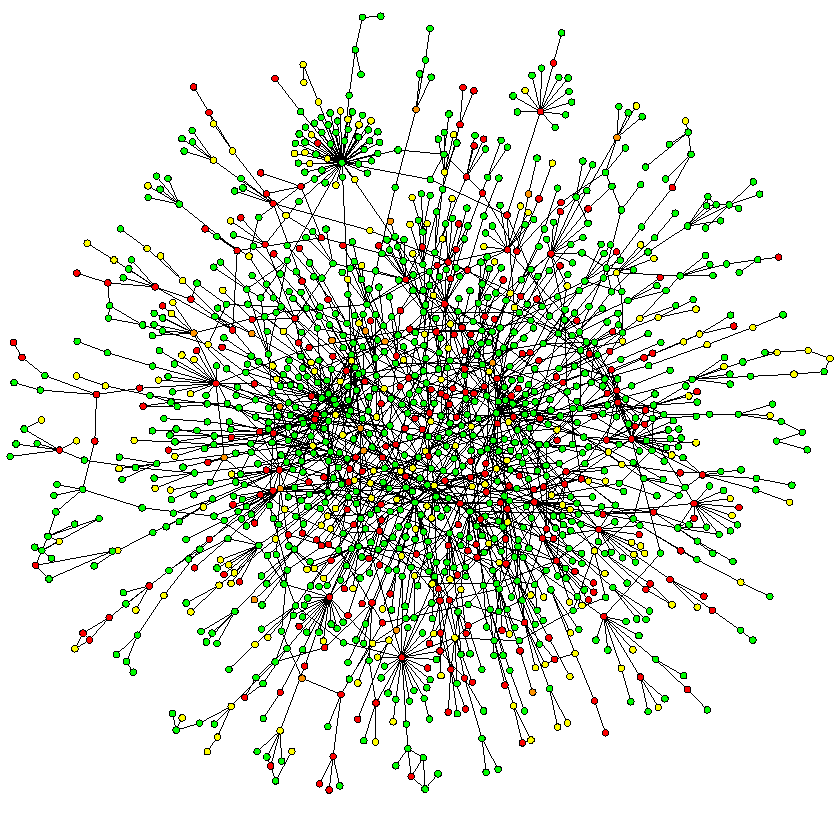
How does one depict the complexity of the mess being presented as the national roll out plan of electronic health records (EHR) via the national health information network (N-HIN) using Health Information Exchanges (HIEs) designed by Regional Health Information Organizations (RHIOs), with the help of regional extension centers (RECs) without Standards (Standards) and with N too many vendors?

Class?  Ideas?  Class?

If this looks dumb, undo-able, unimplementable, uninteroperable–it’s because it is.  your vision is fine.

Remember the idea behind all this is to get your health record from point A to point B, any point B.  It’s that little word ‘any’ that turns the problem into a bit of a bugger.

Find yourself in the picture below, pic a dot, any dot (Point A).  Now, find your doctor, any doctor (Point B).  Now figure out how to get from A to B–it’s okay to use a pen on your monitor the help plot your course.   That was difficult. Now do it for every patient and every doctor in the country.

Now, do you really think the DC RHIO-NHIN plan will work?  If EHR were a Disney park, who’s playing the Mouse?

EHR: the cost savings can be tremendous

shrekthefifth

I was at the beach with my family for the week.  There’s something magical about hanging out at the shore with three children ten and under.  There was so much sand in the house that we could have made a laudable entry in any sand castle contest.

For some reason, there is an unspoken understanding that Dad will unload the car, wash of the toys and hand the beach towels while everyone else showers.  By the time I reached the shower the hot water was long gone and enough grains of sand were embedded in the bar of soap that it felt like I was washing with pumice.  I toweled off from my shower with the only remaining dry towel, a pint-sized piece of linen bearing the likeness of Shrek–standing in your-all-in-all face-to-face with the green faced ogre sort of makes one a little less pompous.

My Shrek fan club was watching SpongeBob for the umpteenth time. I pretended to be interested and made the mistake of asking a question about the show. “I don’t get it,” I offered. “It seems like every show is about the same thing, it has something to do with SpongeBob making Krabby Patties for the Krusty Krab.” To which my youngest replied, “They keep making them until they get it right.”

No excuses. Do it until you get it right.  A single line job description for EHR?  I hope not.  There’s not enough money to do it until you get it right.  There is however, plenty of money to do it right the first time.  I call that the DIRT-FIT principle.  That’s where the saving are.

I’d better go; my kids are eating all of my Twizzlers.

021_18A

Universal Patient Record-can that save EHR?

fermat800Today is the anniversary of the solving of Fermat’s last theorem.  As a long recovering mathematician, these types of thing interest me so I sought a copy of the proof and began reading.  The mathematics for librarians description of the proof is something like this:
  • The Pythagorean theorem states that for a right triangle the sum of the squares of the sides equals the square of the hypotenuse.
  • Fermat stated that the theorem only holds for a coefficient of 2, squaring, and that no other coefficient will work
  • This went unproven until recently

One might have thought that the solution could be solved by brute force using a computer.  How many numbers are there to be dealt with? If you approach the problem this way you’ve got to do it for infinitely many numbers. So, after you’ve done it for one, how much closer have you got? Well, there’s still infinitely many left. After you’ve done it for a thousand numbers, how many, how much closer have you got? Well, there’s still infinitely many left. After you’ve done it for a million, well, there’s still infinitely many left. In fact, you haven’t done very many, have you?  In fact, using this approach, you’ll never finish.  This got me thinking about our EHR system.

I think something has been lost in the confusion about a national EHR system.  After all, that’s the target right, a national system?  We only unleash the power of EHR if we are able to make it work out outside of the provider’s four walls.  Is it possible that perhaps the logic of how we have been viewing developing a solution for the problem is wrong?  I think it is.  Since the outset, the problem has been defined as how do we develop a system that will enable us to get everyone’s health records (let’s call an individual record A) to some arbitrary set of healthcare providers, call them P.  There are some 350 million A’s and for simplicity let’s agree that there are 100,000 P’s.  So now, the system to which everyone is working is the system that will enable all of the A’s to get to any combination of P’s.

See?  Now what happens if we place a few hundred Rhios and health information exchanges (HIEs) in between the A’s and the P’s?  Let’s label them G’s for gatekeepers.  So, in the current framework all the A’s (everybody’s health records) have to pass through all the G’s, make it up to the national network, then back through all the G’s and then sorted through all the P’s to the correct P.

How can we know this design will work for every possibility?  The only way is to test every combination of A’s, G’s and P’s.  It’s a difficult problem.  It becomes more difficult when we acknowledge that there are hundreds of EHR vendors supplying software to all of those P’s.  Many of those P’s will have modified the software, meaning that there are probably thousands of variations of EHR systems.  Oh, and did I mention that all of this is being done without any single set of standards?  That means my stuff will look different from your stuff, and the G’s will have to move different stuff, and from an “IT” perspective the EHRs at the end of the food chain will have to interpret different stuff and then update your stuff with their stuff.  That’s a lot of stuff.

So, if that is where things are, what can be done about it?  My take on a solution is that the problem with this model lies with the word in italics, ‘everyone’.  Every possible patient with every possible need getting to every possible provider.  How to solve this or at least simplify the magnitude of the problem?  One possible solution is to build out the EHR system and the network such that one patient’s record can go to one provider and have that record updated.  Would it not make more sense to build it for a single patient, create a universal patient record (UPR) that can handle all instances?  Do it right once.  Prove that it works and then replicate it instead of building millions of different ones and hoping they work?

021_18A

Could Mashups solve the EHR integration problems?

Silly walks

Silly walks

That number represents the number of different ways to arrange the seventy-five numbers on a BINGO card—five columns of a specific group of fifteen numbers.

I may have mentioned that part of what drives me to write is the need to help me frame ideas for myself.  It serves as a checkpoint before I unlock the gate and let them loose on you.  This idea required a good deal of thought, just to get me comfortable that the premise even made sense.

Here’s what got me thinking about it.  It seems there are three major groupings of things that need to work together precisely in order for EHR to work.  Each time one fails, the network fails.  What are those groupings?

  1. Data
  2. Systems
  3. Transport

The data are Personal Health Records (PHRs), Electronic Medical Records (EMRs), and standards.  There are perhaps hundreds of variations among the elements of that group.  Secondly, there are the systems, the Electronic Health Record (EHR) systems.  Again, hundreds of different systems can house the data.  How many possible combinations are there at this point in the process?  The correct answer is that there are too many.  Finally, there is the issue of transport, getting the data from one system to another system.  Under the present model (the one to which everyone seems to be building) let’s include the Health Information Exchanges (HIEs), the Regional Health Information Organizations (Rhios), and the National Health Information Network (NHIN).

The problem with each of these grouping (data, systems, transport) is that their individual elements are not grouped.  That lack of grouping means that the total number of paths that can be ridden to get a health record from provider A to provider B is much larger than that of the BINGO illustration.

Therefore, for inter-EHR (the transport part of EHR) to have any hope of functioning the groupings need to be fully grouped in such a manner so as to remove the hypergeometric distribution among the elements.

This is the point where some of you may tell me that I am not spending enough time on this planet.  If the prior discussion is at all correct we need to solve the grouping problem.  Here’s where I leave my pay-grade and need your help to see if this dog can hunt.  I was able to clarify the idea for myself by thinking about potatoes–please don’t stop reading, this is not an attempt on my part to be funny.  What happens if you take two potatoes and mash them together?  The two become one, and any individual distinctions are lost.

Is it possible to create mashups of each of these groups such that instead of having billions of billions of permutations, we have just a few?  A mash-up is a Web page or application that integrates complementary elements from two or more sources.  That one sentence used up the entirety of what I know about the topic.  I don’t know enough about it to know if the technology will work with EHR, however that is not my point.  What I am pushing for is that we look at the concept of using mashups.  If the concept is sound, then let’s figure out the technology that would be needed to drive it.  I think a solution along these lines is what is needed to have a working national EHR system.

What do you think?

saint

HIT do-overs

I read a very interesting and well-written post on the Healthcare Blog by MARGALIT GUR-ARIE.

http://www.thehealthcareblog.com/the_health_care_blog/2009/09/what-if-i-had-to-do-hit-all-over-again-.html

It reminds me of the conversation in the movie City Slickers when Billy Crystal tells his friend his life is a do-over. From where I sit, I think a do-over is exactly what’s needed on two fronts. On the provider side, EHR decisions need to be based on what business problems are being addressed and on an ROI, not on what DC may or may not do. On the interoperability or transport side of the record I do not believe much of what is being worked on today will exist in 3-5 years (which further compounds the difficulty of what the providers are doing.) I think Meaningful Use and Certification will cease to exist, and that the structure of hundreds of Rhios and HIEs will cease to exist because they will have failed to work.

saint