Zen Project Management–Rule 1, don’t steal the plants

(I sometimes find it helpful to recite my blogs using different voices, like Neil Diamond.  You?)

Do you ever look back with amazement on how naïve you were in your first job?  You walk in, your head so full of knowledge it feels like it should explode.  You’re just waiting for that first opportunity to release the pearls of wisdom accumulated during all those years of schooling.  I was pretty sure I knew almost everything that needed knowing.

With my newly minted MBA, I worked as the assistant to the CFO of a large petroleum services firm in Fort Worth, Texas.  Lot’s of visibility, lot’s of people watching my every move.

My first day on the job, I was expected to attend a meeting at 7:30 AM.  Overtime.  I brought donuts, knowing how hungry everyone must be because they hadn’t had time to eat breakfast.  As I soon learned, the others in the room had been there since 6 AM for another meeting—they were not impressed by my offer of donuts.  My boss walked me over to an east-facing window an pointed at the orange ball of light floating above the horizon.

“That’s the sun,” he said.  “It’s been up two hours—so have we.  It comes up this time every morning.  Get used to it.”

That went well.  I noted later that five PM had come and gone and nobody made any attempt to rush the doors.  I decided to leave around seven.  As I waited for the elevator I noticed that two very large plants in very attractive pots were being thrown away.  They’d be perfect for my barren apartment.  It took me several trips to get the plants and pots situated in my TR-7 convertible.  Over the next several days I noticed that next to the elevator bays on the other floors were identical plants in identical pots.  What was the likelihood that these were all being thrown away?  Probably zero I surmised–if you steal something without knowing you were stealing, is it really stealing (think Limewire)?

So, my first day on the job I unknowingly stole the company’s plants.  What would day two offer, a walnut credenza, brass lamps?  Gonna’ need a bigger car.

Do you know people like that on your project, those who portend to know everything that don’t?  Plant thieves.  Sometimes they masquerade as program managers, sometimes as vendors.  They hide what they don’t know behind a flurry of meetings, a full calendar, reams of emails.

It’s easier to spot the plant thieves than it is to stop them from adversely affecting your project.  It’s easy to observe, easier to complain about.  What to do about it?  Why are you asking me?  That’s why they pay you the big bucks.
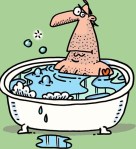
 

Why additional money is not needed to solve your EHR problems

Have you ever done any sort of group problem solving exercise like Outward Bound to help you to think as a team? Suppose there was an exercise for healthcare and IT executives, whose goal was to get the executives to think about how to best deploy can EHR system. To do this they are given a problem and access to ‘technology.’

Here is the scenario and the rules as they are presented to the group. They are given ten dollars. The executives are presented with a bathtub filled with water, and told that the winning team will figure out the best use of money and time to empty the bathtub. Also available to them is a bucket which costs ten dollars and has a hole in it, a four-dollar cup, and a collection of wooden spoons which are free.

Any idea what the right combination is? Is there a best answer? Bucket? Cup and spoons? How would you solve the problem? Sometimes the best answer is so obvious it’s silly. Kind of like call centers? What’s the best use of the available tools? Faced with the option of buying more technology to solve the problem, when was the last time you saw someone refuse the funds?

Figured it out?

Pull the plug from the drain.

In many cases, we already have everything we need to solve the problem, we just need to know how to use it.

Just like Dorothy in the ‘Wizard of Oz.’  She had the ruby slippers the entire time, she just didn’t know how to use them. I think most EHR strategies can be improved without spending requiring millions more in technology.

That’s my story and I’m sticking to it.


How will ACOs impact HIT?

I know it makes you nervous to learn I have been thinking about something as there is no telling what may develop.  Feel free to use a highlighter on your screen if you find anything of interest.

The healthcare large provider business model looks more and more like its designed used to be the woman at kid’s birthday parties who makes animals and things out of balloons.  With the blue balloon she can make a giraffe, a bike from the green balloon, and a hippo from the pink one.

If she’s highly skilled she will build something complex using a number of different balloons.  Let us try to imagine watching her as she sets about to build a riding lawn mower.  With several popped balloons lying at her feet on the carpet she presents us with a green and yellow John Deere mower which used more than a dozen balloons.  Next, disregarding the pacifists at the party, she builds a B-1 bomber.   Her third assignment results in a McMansion with working Jacuzzi.

Each balloon creation is more complex than the preceding.  Being unimpressed I asked her if she could incorporate the design of the bomber into the design of the lawn mower.  The only rule—she was not allowed to pop any of the mower’s balloons.  If she was able to achieve that successfully, she would then have to incorporate the house onto the bomber onto the mower.

Balloons started popping and did not stop until there were none left, making it impossible to even save the mower.

Imagine a hospital’s pre-EHR business model as the lawn mower.  What happens next is that same business model is forced to adapt to EHR—like overlaying the bomber onto the mower.  Along comes accountable care organizations (ACOs).  House-bomber-mower.

This makes for an interesting planning exercise.  If we assume, as many have, that the existing hospital business model has been cobbled together over twenty to thirty years, retrofitting it will be no small task.  The problems we are seeing with many EHRs is that if implemented on top of the old business model, the odds for a failed EHR implementation are at least equal to the odds of a successful implementation.  For many, a “successful” implementation is viewed as one where productivity may be down by as much as twenty percent.

To the retrofitted EHR business model hospitals will soon try to implement the Healthcare IT demands of ACOs.  I recommend you first try these using balloons.  It will look prettier when it breaks; and will be much less expensive.

EHRs and ACOs are devilishly complex, and trying to implement them on a framework designed to support neither means that everything will work poorly.  (I was going to write that everything will work less well than planned, but it occurred to me given some of the plans I have seen that it will all work just as planned.)

I just read an article in a major trade organization stating “accountable care organizations must encourage patients to participate in the prevention of their care.”  That approach seems counter-intuitive to me, but maybe I am missing something.  Then again, it may all work just as planned.

HIT/EHR: A little adult supervision

Among other things, EHR requires adult supervision–kind of like parenting.

My morning was moving along swimmingly.  The kids were almost out the door and I thought I’d get a batch of bread underway before heading out for my run.  I was at the step where you gradually add three cups of flour—I was in a hurry and dumped it all in at once.  This is when the eight-year-old hopped on the counter and turned on the mixer.  He didn’t just turn it on, he turned it ON—power level 10.

If you’ve ever been in a blizzard, you are probably familiar with the term whiteout.   On either side of the mixer sat two of my children, the dog was on the floor.  In an instant the three of them looked like they had been flocked—like the white stuff sprayed on Christmas trees—those of you more politically astute would call them evergreens—to make them look snow-covered.  (I just em-dashed an em-dash, wonder how the AP Style Book likes that.)  So, the point I was going for is that sometimes, adult supervision is required.

What exactly is Health IT, or HIT?  It may be easier asking what HIT isn’t.  One way to look at it is to consider the iPhone.  For the most part the iPhone is a phone, an email client, a camera, a web browser, and an MP3 player.  The other 85,000 things it can be are things that happen to interact with or reside on the device.

In order for us to implement correctly (it sounds better when you spilt the infinitive) HIT and EHR, a little focus on blocking and tackling are in order.  Some write that EHR may be used to help with everything from preventing hip fractures to diagnosing the flu—you know what, so can doctor’s.  There are probably things EHR can be made to do, but that’s not what they were designed to do, not why you want one, and not why Washington wants you to want one.  No Meaningful Use bonus point will be awarded to providers who get ancillary benefits from their EHR especially if they don’t get it to do what it is supposed to do.

EHR, if done correctly, will be the most difficult, expensive, and far reaching project undertaken by a hospital.  It should prove to be at least as complicated as building a new hospital wing.  If it doesn’t, you’ve done something wrong.

EHR is not one of those efforts where one can apply tidbits of knowledge gleaned from bubblegum wrapper MBA advice like “Mongolian Horde Management” and “Everything I needed to know I learned playing dodge ball”.

There’s an expression in football that says when you pass the ball there are three possible outcomes and only one of them is good—a completion.  EHR sort of works the same, except the range of bad outcomes is much larger.

How’s the EHR vendor performing?

Many organizations have a Program Management Office and a Program Steering Committee to oversee all aspects of the EHR.  Typically these include broad objectives like defining the functional and technical requirements, process redesign, change management, software selection, training, and implementation.  Chances are that neither the PMO or the steering committee has ever selected or implemented an EHR.  As such, it can be difficult to know how well the effort is proceeding.  Simply matching deliverables to milestones may be of little value if the deliverables and milestones are wrong.  The program can quickly take on the look and feel of the scene from the movie City Slickers when the guys on horseback are trying to determine where they are.  One of the riders replies, “We don’t know where we’re going, but we’re making really good time.”

One way to provide oversight is to constantly ask the PMO “why.”  Why did we miss that date?  Why are we doing it this way?  Tell me again, why did we select that vendor?  Why didn’t we evaluate more options?  As members of the steering committee you are responsible for being able to provide correct answers to those questions, just as the PMO is responsible for being able to provide them to you.  The PMO will either have substantiated answers, or he or she won’t.  If the PMO isn’t forthcoming with those answers, in effect you have your answer to a more important question, “Is the project in trouble?”  If the steering committee is a rubber stamp, everyone loses.  To be of value, the committee should serve as a board of inquiry.  Use your instincts to judge how the PMO responds.  Is the PMO forthcoming?  Does the PMO have command of the material?  Can the PMO explain the status in plain English?

So, how can you tell how the EHR effort is progressing?  Perhaps this is one way to tell.

A man left his cat with his brother while he went on vacation for a week. When he came back, he called his brother to see when he could pick the cat up. The brother hesitated, then said, “I’m so sorry, but while you were away, the cat died.”

The man was very upset and yelled, “You know, you could have broken the news to me better than that. When I called today, you could have said the cat was on the roof and wouldn’t come down. Then when I called the next day, you could have said that he had fallen off and the vet was working on patching him up. Then when I called the third day, you could have said he had passed away.”

The brother thought about it and apologized.

“So how’s Mom?” asked the man.

“She’s on the roof and won’t come down.”

If you ask the PMO how the project is going and he responds by saying, “The vendor’s on the roof and won’t come down,” it may be time to get a new vendor.


Who was the person who put in our first EHR system?

The first home I bought was in Denver.  Built in 1898, it lacked so many amenities that it seemed better suited as a log cabin.  There was not a single closet, perhaps because that was a time when Americans were more focused on hunting than gathering.  Compared to today’s McMansions, it was doll-house sized.

It needed work—things like electricity, water—did I mention closets?  I stripped seven coats of paint from the stairs.  Hand-built a fireplace mantle and a deck.  One day I arrived home only to find my dog had eaten through the lath and plaster wall of the space which served as my foyer/family room/ living room-cum-hallway.  I discovered the plaster and lathe hid a fabulous brick wall.

My choice was to patch the small hole, or remove the rest of the plaster.  I knew nothing of patching holes, but felt pretty confident about my demolition skills.  Within an hour I had purchased man-tools; two mauls, chisels, and a sledge hammer.  I worked through dinner and through the night.  The only scary moment came as the steel chisel I was using connected to the wiring of two sconces which were embedded in the plaster.  On cold nights I can still feel the tingling in my left shoulder.

As the first rays of dawn carved their way through the frosted beveled glass of the front door, I wondered why I never before had noticed that the glass was frosted.  I wiped two fingers along the frost.  A fine coating of white powder came off the glass leaving two parallel tracks resembling a cross-country ski trail.  I surveyed the room only to see that the air made it look like I was standing inside of a cloud.  The fine white powder was everywhere, covering my Salvation Army sofa, a semi-matching machine-loomed Oriental rug from the Far East (of Nebraska), a two-ton Sony television, and a component stereo system that had consumed most of my earnings.

Bachelor living can be entertaining.  One of my climbing buddies moved in with me.  The idea was I’d keep the rent low, and he’d help me by maintaining the house.  He didn’t help.  I made a list of duties; he didn’t help.  I left the vacuum in the middle of the floor, for two weeks and he walked around it.  I made him move out, and advertised for a female roommate—an idea I now wish I’d marketed.  A girl from church came over to see the place.  I turned my back on her to allow her to view the house with a degree of privacy.  When I returned I found her on her hands and knees cleaning the bathroom.  I was in love.  It was like having a big sister and mother.  She even asked if it was okay if since she was doing her laundry if she did mine at the same time.  Life was oh so good.

Sometimes when one approach isn’t working it’s real easy to try something else.  And sometimes the something else gives you a solution in the form of a water-walker.  Healthcare IT and EHR aren’t ever going to be one of those sometimes.  There will be no water-walkers, no easy do-overs.  There won’t be anyone walking your hallways talking about their first wildly unsuccessful EHR implementation.  Nobody gets to wear an EHR 2.0 team hat.  Those who fail will become the detritus of holiday party conversations.  Who will be the topic of future holiday parties?  I’m just guessing, but I’m betting it will be those who failed to develop a viable Healthcare IT plan, whoever selected the EHR without developing an RFP, the persons who decided Patient Experience Management (PEM) was a waste of money.  The good news is that with all of those people leaving your organization there will be more shrimp for everyone else to eat.

I’d better go.  I just noticed somebody left the vacuum in the middle of the floor so I need to get cracking before my wife advertises for a female roommate.

EHR leadership isn’t always a democracy

Cerealizable.

That’s my new word. I coined it the last time my wife was traveling and I was in charge of breakfast and making sure nobody missed the bus. Cerealizable is what happens when you walk into the kitchen and are confronted with two hungry dogs, three hungry kids, hair that needs brushing, homework assignments that need to be reviewed, and lunches that have to be packed.

Breakfast orders are shouted at me across the room as though I’m their short-order cook; pancakes, French toast, sausage, and who knows what else. What does one do? I was quickly headed down the path of self destruction, too many tasks and not enough taskers. I needed a light at the end of the tunnel and so I created one. I cerealized the problem; simplified it–turned into something I could solve. Go to the pantry, pull out the cardboard cereal boxes, three bowls, three spoons, and the gallon of milk. Check off breakfast.

In case you’re wondering, Cocoa Puffs still turn the milk brown, just like they did thirty years ago. Lunch orders began to be shouted across the bowls of cereal. Ham and cheese, PB&J, tuna–extra mayo, no celery. Once again small beads of perspiration formed quickly on my brow. For a moment I considered calling the school and telling them that all three were sick. That would solve the lunch problem, but it would also mean that the three of them would be home all day–my own private hostage situation. What to do? My coffee remained out of reach, still untouched. That explained the pending headache. Back to lunch. Cerealize it. “Everyone is buying lunch today,” I announced above the roar.

A half hour later, the din had subsided. I made a fresh cup of coffee and collected my thoughts. What had I learned from the exercise? Three things. One, some situations require leadership. Two, three children and one grownup is not time to establish a democracy. There is no Bill of Rights. To quote Mel Brooks, “It’s good to be the king.” Three, break the problem down into bite-sized pieces, don’t try to swallow the elephant whole.

That same approach works just as well with EHR grownups; clinical grownups and IT grownups. Improving the interaction takes leadership. Large, institution-changing projects involve pulling people out of their normal routines and relationships.  Solving problems will not involve a kumbaya moment–Program management is not a democracy. To succeed, the program champion, having created a vision, will have to break it down into bite-sized pieces.


Pigeon Project Management Office (PMO)

I just finished stacking two cords of wood, much like a squirrel getting ready for a long cold winter. My feet were doing the “Boy is it cold dance” in an effort to keep the blood circulating.

As I was picking up the scraps, my eldest picked up a piece and placed it in his backpack. When I asked him what he would do with it he told me he was going to carve it after school. His statement brought back boyhood memories of hours of whittling, an activity done if for no other reason than to get from one minute to the next. Grab a stick and whittle it away until there was nothing left.  What next? Grab another. The weight of the pocketknife felt equally good in my hand as it did in my pocket.

When is the last time the thought of whittling crossed your mind? Probably been a long time. It’s an activity meant for idle minds and hands, or minds that should be idle.

Speaking of idle minds, there are times I find myself questioning what value so and so brings to the party. Do you do that?  “Why is she in this meeting?”  You know who I mean. You’re sitting there trying to get your work done and all of a sudden, some Mensa wannabe with more idle time on their hands than a Lipitor salesman at a BBQ cook-off, makes an aerial assault on your cubicle like a pigeon on a Rodin bronze.  Drops in and changes the rules of the universe, at least your universe.

This happens more often than is documented on large healthcare IT projects.  People set new courses and define program rules that may have nothing whatsoever to do with the project’s charter or scope.  You do have a written charter and scope in the project office, don’t you?  If not, it’s easy to see how new directions and rules can be given a certain specious authority.

What’s the best way to handle this situation? Often these management Mensas are nervous about a lack of visible results and they need to report on something.  They may feel the need to be doing something, something resembling leading.  They don’t mean to interfere, and they believe that their little forays into the world of super PMO (Program Management Officer) will actually add value. You tell me, are they adding value, or are they preventing the team from sticking to the scope? There’s that irritating scope word again.  The next time you see one wandering aimlessly through the rows of cubicles, hand that person a pocketknife and a nice piece of balsa wood.  Although their efforts won’t add any value to what you’re trying to accomplish, at least it will get them out of the way for a little while.

The EHR wore Prada: Stilleto Change Management

I just returned from the Prada show in Milan. Not really—that was the opening line from a piece on NPR. Apparently this year’s runaway hit on the runways has to do with high heels, with the emphasis on the notion of high.

The following comes from the UK Telegraph: The girls looked like rabbits trapped in the headlights; their faces taut and unsmiling, their eyes wide with fear and apprehension. Were they about to undertake a parachute jump? Abseil down a 1,000ft mountain? None of the above. All they were doing was trying to negotiate the catwalk at Prada during this week’s Milan fashion shows in shoes that were virtually impossible to walk in. At least two models tripped and fell on to the concrete floor; others wobbled and stumbled, teetering and tottering, clearly in agony, and all the while their minds were fixated on just one thing: reaching the sanctuary and safety of the backstage area without suffering a similar fate.

According to the NPR reporter, the heels are so high that regular people—women people that is—can’t seem to walk in them without falling. This problem has led to the creation of an entirely new micro-industry. In L.A. and New York, there are classes to teach ladies how to walk in very high heels without hurting themselves. These classes are being offered through dance schools that couldn’t fill their dance classes—they are now booked solid.

Tell me this isn’t the same as trying to walk and chew gum at the same time. Multitasking. Now before I make fun of some thirty year-old that has to relearn how to walk, let us turn our attention back to those dancing—cum—walking schools. From a consultant’s perspective what makes this story interesting is that those businesses saw a need and re-engineered a part of their operation to meet that need, sort of like we’ve been discussing regarding the impact EHR and reform can have on your organization.  With the implementation of EHR, many things will change.  If they don’t require change, you probably wasted your money on the EHR.  What’s important is having a plan to define the change and manage it.  Rework work flows, remove duplicated processes and departments.

Now I’m going to go saw the heels off my wife’s shoes before she hurts herself.


Can you blame providers if they fail Meaningful Use?

I don’t wake up each day planning to be at odds with ninety-eight percent—I’m probably being overly generous assuming two percent of the people are as jaded as me—of the HIT community, maybe I just come by it naturally.

The first time I heard of RECs (regional extension centers) the first thing that came to mind was playgrounds, something akin to what the Police Athletic League might find useful.  Five hundred and ninety-eight million dollars.  They tried 597 and determined it wouldn’t be enough and figured 599 would be too much, but 598 million was just right.  Then Goldilocks made her way over to the porridge—sorry for turning left at the fairy tale ramp.

A large part of the success or failure of reform hinges on the success or failure of EHR.  Accordingly, the government made the egregious decision to manage the process of building and rolling out a national EHR down at the molecular level.  They have involved themselves at the front-end, at the vendor level, and at the back-end.  The more anxious they become, the more money they waste, adding another guise to get the healthcare providers to take their eyes off the ball.  Five hundred ninety-eight million “we’re just here to help you” dollars.

This money could be spent to pay the top EHR vendors to create one set of standards and modify their systems to fit those standards.

Meaningful Use.  Don’t get me started.  How can I fault thee; let me count the ways.  Those tested early for Meaningful Use will be examined less rigorously than those tested later.  This is like the IRS saying that if you file your taxes in February, don’t worry about those silly little math errors.  Healthcare will be the only industry whose software quality assurance check occurs after they pass the fail-safe point, the point of no return.

With good leadership providers should know EHR will pass meaningful use before implementing the system. If they fail to pass Meaningful Use, shame on them.