What is troubling hospitals? What isn’t?

I wrote this as a comment to Barbara Duck’s fine post in her blog, http://ow.ly/3tFPx

Part of the problem, at least in my mind is that many of the large and small provider business models are trapped in what any MBA student would label an 0.2 model. The two biggest adversaries to provider’s success and limiting their ability to change, the two industries constraining the providers’ ability to run a profitable business, pharmaceuticals and the payors, exercise power that comes from their scale.

Add to that complexities brought to bear by other large external influencers—the rule-makers, makes it almost impossible to know what business model to build and under which to operate because providers must build strategies designed to hit unknown and moving targets; reform, regulation, and Medicaid, Medicare. Whatever strategy they design will be ineffective by the time it is implemented.

It is important to note that healthcare providers represent the only industry which does not know the cost of ninety percent of the services they deliver. They do not know what something costs, but they do know what they charge. Even the identical procedure at the same hospital will produce a different bill. How does one run a business suing those pricing models?

You may or may not know that Shakespeare spelled his own name five different ways. While that worked out okay for him, using that as a pricing model—I know this analogy is a stretch—makes no sense.

Compare hospital pricing to McDonald’s who knows how profits will be impacted if they so much as add another pickle to a hamburger.
Nobody can tell you what a tonsillectomy costs, or the profit earned from the procedure. Even for hospital IDNs, the same service will be priced differently, will be charged differently, and will be reimbursed differently.

Through acquisition and mismanagement many hospitals have multiple occurrences of large business processes; to name a few—admissions, IT, HR, payroll, pharmacy.

The time has come to separate the hospital business model into two components; the business of healthcare—how it is run, and the healthcare business—the care component. Care is delivered using a best-process model, whereas some will argue the business of healthcare is often managed no better than a lemonade stand.

There are no measures used by hospitals that allow them to calculate the ROI of a patient or a physician over five or ten years. There is no Patient Equity Management process to reduce patient or physician churn.

Large hospitals have spent more than $100,000,000 to implement failed EHRs—sixty percent of them fail. Hospitals are rushing through their implementations to try to secure minimal ARRA payments. Many hospitals are on EHR 2.0 thinking that by changing their EHR vendor they will have a better chance of succeeding. To that model they hope to incorporate ACOs.

Maybe before they boldly go where no man has gone before, they should pause and come up with a real plan of attack.

Patient Experience Management: Who is your Chief Patient Officer?

(This column is not outsourced to Mexico.)

How many chiefs can you name? C-Levels, not Indians. I found these–COO, CIO, CTO, CMO, CMIO, CEO, CAO, CFO, Chief Purchasing Officer, Chief Network Officer, Chief Engineering Officer, Chief Benefits Officer, Chief Development Officer, Chief Brand Officer, Chief Staff Officer, Chief Health Officer, Chief Legal Officer, Chief Quality Officer.

Besides who gets the corner office, these titles demonstrate a firm’s commitment to those areas of their business, and these positions provide that business sector visibility all the way to the top of the firm. There’s a certain cachet that comes from having your sector of the business headed by a C-Level. Those are the ‘in’ jobs, the jobs to which or to whit one is supposed to aspire. You never see anyone clambering for a B-Level position. B-Level is the repository for all non C-Level jobs.

Remember Thanksgiving dinner when you were a child—apologies to those of who aren’t from the colonies. Anyway, if yours was anything like mine, there were two tables, the nice dining room table for the adults, and the smaller card table for the children, the B-Level guests.

So what does this have to do with patient care? You tell me. Let’s go from the premise that the C-Level positions are an accurate reflection of you firm’s focus. Why are we in business? If you go from the premise it must be because of finance, marketing, IT, Purchasing, or any of a dozen other things. The only thing missing in this view of the firm is the patient. The only entity without a seat at the grownup’s table is the person in the firm responsible for the patient. It seems to me a firm’s very existence, it’s raison d’être, is the patient. If that’s true, when do they get to eat with the grownups?

McKinsey published a study conducted with 1,000 CEOs and COOs to rank their top 5 initiatives over the next five years.  Ninety percent of them ranked Patient Experience Management as either their first or second priority.  The punch line of the study was that they did not know who in their organization “owned” the patient.  How is that for leadership?

If they don’t own the patient, I am willing to bet the patient owns them. If that is the case, Social CRM, S-CRM, will not be doing these executives any favors.


EHR: Children of the Corn

Not in the Stephen King way.  During the late fall, my middle school friends and I would play among the withered corn stalks; capture the flag, building forts, and on occasion being more adventuresome.  On those more adventuresome occasions the adventure included matches.

It went something like this.  We would stand among the seven or eight foot tall sepia colored stalks, and remove several ears of corn, corn that had been allowed to dry on the husk.  We would peal back the leaves on husk, and strip the kernels from the bottom two-thirds of the husk.  The end product would look similar to a WW II German hand grenade—the stripped husk became the handle, the kernels on the top third were the “explosive” part, and provided the weight needed to make the grenade travel when thrown, and the dried leaves were the fuse.

The leaves were lit, closed our eyes, and let it fly.  Then we would rush through the stalks looking for signs of smoke.  By necessity, we were in a hurry.  The object of the game was to locate the grenade among the hundreds of corn stalks before it set the field on fire.  We were successful every time but one—must have been a pretty good throw.

I remember my mother asking me why my corduroy jacket smelled of smoke.  I didn’t have the courage to tell her it was because we were using our jackets to try to beat out the flaming stalks.

Segue, albeit not much of one.  A lot of healthcare providers are also in a hurry to implement EHR.  The fuse is burning away.  The fuse is the timeline to get the ARRA incentives, or at least to avoid the penalties.  That means implementations are being rushed, which in turn means implementations will fail.

If anything can be stated with certainty it is the following; it will cost much more to revise a failed EHR implementation than whatever incentive money may have been received had it worked.  Speed is costly.  So is putting in an EHR that does not do what you need it to do.  There are no business benefits to getting the EHR box on your to-do-list “checked.”

When your haste to implement EHR causes you to fail to meet Meaningful Use, how will you explain to your mother why your jacket smells like smoke?


Why should HIEs be scrapped, and what else might work

“Just because Jimmy’s mom lets him do it does not mean I am going to let you do it.  Would you jump off a cliff if he did?”

This argument is the best one I can make extolling the merits of the Healthcare Information Exchanges (HIEs) and the National Health Information Network (N-HIN).  The strategy behind the HIEs and the N-HIN are somewhere between killing a mosquito with a tank.  As the camel is a horse designed by a committee, so may be the goal of having HIEs serve as the cog of the N-HIN.

Why?  Because I think the architecture needed to make this happen exists in a far simpler form.

For example, let us look at iTunes.  To be transparent, I do not have the knowledge to describe or explain the technical underpinnings.  But what if we look at the business strategy around what makes iTunes work for Apple and its customers, perhaps there is something relevant worth borrowing.

Like physics for librarians, permit me to oversimplify the idea to see if a similar set of underpinnings could work in healthcare.

For purposes of explaining the analogy as a business network, what if we equate the major components thusly?

  • Apple (iTunes)                                  Government

o   HIEs

  • The tunes                                            Patient records
  • The Internet                                      N-HIN
  • Customers                                          Patients

While it is never as simple as it seems, especially given Apple’s success with iTunes, here is the simplified version.

There a millions and millions of songs (patient records).  For Apple, the songs exist digitally—ones and zeroes—and are stored digitally.  No LPs, no tapes, no CD (no paper charts).

Apple never physically touches a single song.  What does Apple do if it doesn’t sell CDs?

  • Apple brokers the entire transaction to its customers
  • The tunes move securely and unaltered from one entity, Apple, to one customer, millions of times
  • Apple secures all parts of the business

o   Nobody has hacked into Apple to steal tunes

o   Nobody has stolen customer information

o   Nobody who does not own the songs has been able to alter their content wheter they are in transit or with their owner

  • In the iTunes business model the iPod is no more important than a toothbrush has to do with Crest’s business model
  • The business model’s success is based upon a new delivery system for music
  • Apple’s business model did not necessitate creating hundreds of disparate and separate distribution systems to link tunes from Apple to its customers.
  • Apple did not create a new way of moving ones and zeroes from virtual point A to millions of virtual Point B’s.
  • Apple was successful using and existing, and inexpensive transportation network, thereby keeping overhead much lower than it would have been

So, if we equate the two paradigms, and buy into the fact that a model such as iTunes—if you prefer you can substitute aspects of financial services, airline ticketing, GPS (On-Star), EBay, and Amazon—in its most basic form, is nothing more than the secure transport of billions of ones and zeros, it is not a big stretch to see how one can argue that the transport of millions of electronic health records may not require a solution as complex as the HIE—N-HIN model.

And if that is true, can a business argument be made to justify building hundreds of HIEs?  I do not believe it can.  The HIEs are designed to act as middlemen.  Their purpose is to hand ones and zeros from one network node to the other, and they way they will do this is by building more nodes.  They will not so much as add a one or a zero to a patient record.

Rule One of engineering a business process is that if a process does not add value to the whole, the process adds cost and complexity without adding any value.  Under the current national EHR rollout, I think HIEs are such a process.

Before discounting this notion, what would be required to make an iTunes’ model work for electronic health records?

How measuring Brittan can improve your EHR success

So, last night I am watching NOVA.  The episode discussed fractal geometry and aired the same time as the Green Bay-New England game.  Admittedly, not a typical Y-chromosome choice, but interesting none-the-less.

A fractal is a fragmented geometric shape that can be split into parts, each of which is a reduced-size copy of the whole.  Simple enough.  Common examples of fractals include the branching of trees, lightning, the branching of blood vessels, and snowflakes.  I am willing to bet I think of many of the ideas on which I ruminate in a fractal manner.

In the seventies the mathematician Benoît Mandelbrot discovered that fractals could be described mathematically.

It turns out that a shoreline is another example of a fractal.  For example, let’s say you wanted to determine the length of the coast of Brittan by measuring it instead of just using Google.  The coastline paradox says the measured length of the coastline depends on the scale of measurement.  The smaller the scale of measurement, the longer the measurement becomes.  Thus, you would get a longer measurement if you measured the coastline with a ruler than with a yardstick.  This paradox can be extrapolated to show that the measured length increases without limit as the unit of measures tends towards zero.  In the first picture, using a 200 km ruler, the coastline measures 2,400 km.

In this photo, using a 50 km ruler, the coastline measures 3,200 km.

I’m not sure why this idea needed to be discovered, it seems a little obvious—more information yields more informed results.

A few years ago I was hired by a firm to report to their board on their vendor selection process.  The firm was about to issue a two-page RFP to two vendors.  I convinced the firm to redo the process.  They ultimately issued an RFP of more than a thousand requirements and selected a vendor who was not on their original list.

Again it seems obvious, but being obvious doesn’t always result in smart behavior.  If you’re getting ready to spend eight to nine figures on and EHR, wouldn’t you like some degree of confidence that you selected the best one for your hospital?

One thing is certain, albeit less obvious, the more due diligence you give EHR, the higher your chances of success will be when you try to build out an ACO business model.


EHR: work plans are necessary but not sufficient

I wonder about things, little things, things I see on Nova or on Bizarre Foods.  Take water, more specifically, ice.  It floats.  The only solid that floats in its liquid state.  Most solids sink, not ice.  For those of you thinking boats float, they’re not considered to be solids—does that make them liquids?
It turns out that as water goes from four degrees centigrade, its densest point, and towards freezing, it becomes less dense and floats.  It’s volume increases by 9%, and part of that 9% is trapped air.  That air, even though you can’t see it, exists between the two H’s and the O.  which takes us to the following.

Have you spent much time studying work plans?  While there are more interesting ways to spend your time, there are times meant for writing them, and times meant for studying them.

Having a work plan can be a little like having a bike; nice, practical for some things, impractical for others.  Like with most things, there are work plans and there are work plans.  Some may not be worth the paper on which they are written.

Just like not everyone can write a book worth reading, not everyone can write a work plan worth implementing.  Lines on paper don’t necessarily yield a project of much value.  Remember how with the ice there are things between the H’s and O’s?  Well, with a lot of healthcare IT and EHR work plans, there are things between the tasks on the work plan, or at least there should be.  Can’t see them either.  Those things?  The missing tasks, the tasks that should have been in the plan, the tasks that would have given the plan a fighting chance to succeed.

Some gaps are good, like with ice.  Others can leave you hanging.


EHR: Should you hire a swim coach?

Swimming with guppies.

Got the new bike, got the new bike shoes, got the uni (uniform-not unitard).  I’ve written about my desire to compete in a triathlon.  Actually, I miswrote.  My desire is not to compete, it’s more accurately a desire not to make a fool of myself during the swim, more specifically not to drown.

The swimming is one of those events where having the coolest outfit doesn’t help, as there are no coolest swimming outfits (men do not let men wear Speedos).  There aren’t enough North Face labels for me to wear to make me look like I know what I’m doing in a pool.

What to do?  Here’s my thinking.  I made a new friend, and as a bonus, she happens to be pretty sharp on the pharma side of healthcare.  She swims—fast.  She swims—a lot.  Did I mention she swims?  Longtime readers know I like to color outside the lines.  Maybe I could hire her to take my place during that part of the race.  Then we get back to the issue of the uni.  One way or another that becomes an issue for one of us.

She offered to teach me.  Lesson one was today.  Lesson two will begin right after the EMTs finish their CPR on me.  Rule one, no matter how cool you think you are, you can’t breathe under water.  That took a few laps to master.  More breathing, stroke, legs.  Lots to learn.

“Let’s get a pool boy to help you not drag your legs,” she suggested.

I have difficulty passing up the opportunity to comment.  She could see I had the broccoli in the headlights look in my eyes.  “You hold it between your legs and it helps you float.”

I scanned the pool.  There we the two of us…and the lifeguard.  “It looks like he’s busy,” I offered somewhat sheepishly.  “Besides, if that’s what it takes, I think we’re both better off if I drag my legs.” (A little un-PC pool humor, but why not, I was already wet and being out swum.

So, what does this have to do with why we’re here?  Here’s the take away.  Sometimes, no matter how smart, no matter how big your ego, you need help.  Sometimes it makes a huge difference to have someone on your side who’s been there, done that, got the T-shirt.

Not with me yet?  A guy (man or woman guy—send me an email and let me know when we can let go of this PC thing and just write) is walking down the road, not watching where he’s going, and he/we/she/it falls into a deep hole.

An engineer walks by.  “Help me,” shouts Hole Person.

The engineer thinks for a moment, writes some ideas on a piece of paper and tosses them into the hole.

Several hours later, a finance guy walks by.  “Help me out (literally)” yells Hole Person.  The CFO tosses down a cheque (I use the Canadian spelling to distinguish it from someone from the Eastern Bloc as it would make no sense to toss another person into the hole.)

Days later, Hole Boy (not the same as Pool Boy in case anyone is still reading) is at the end of his rope.  The work plan failed. The Check bounced.

A consultant passed, saw the man, and hopped into the hole.

“Why did you do that?  Now we’re both stuck.”

The consultant smiled in a Grinch-like fashion—please see prior blog for the segue.  “I’ve been down here before, and I know the way out.”

Kind’ a like a swim coach.

EHR projects have more zeros than you can count.  What if you could hire someone who knew the way out?

I may know someone who can help.


The National Health Information Network explained

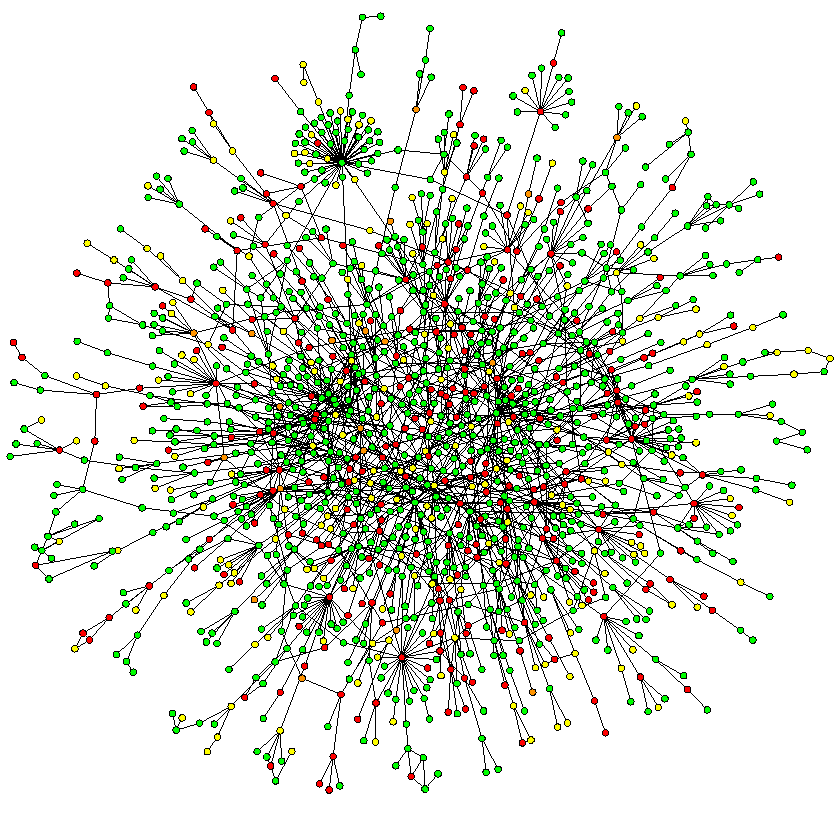
How does one depict the complexity of the mess being presented as the national roll out plan of electronic health records (EHR) via the national health information network (N-HIN) using Health Information Exchanges (HIEs) designed by Regional Health Information Organizations (RHIOs), with the help of regional extension centers (RECs) without Standards (Standards) and with N too many vendors?

Class?  Ideas?  Class?

If this looks dumb, undo-able, unimplementable, uninteroperable–it’s because it is.  your vision is fine.

Remember the idea behind all this is to get your health record from point A to point B, any point B.  It’s that little word ‘any’ that turns the problem into a bit of a bugger.

Find yourself in the picture below, pic a dot, any dot (Point A).  Now, find your doctor, any doctor (Point B).  Now figure out how to get from A to B–it’s okay to use a pen on your monitor the help plot your course.   That was difficult. Now do it for every patient and every doctor in the country.

Now, do you really think the national HIE-NHIN plan will work?  It is complicated enough without adding all those HIEs each developed independently of one another each to their own standards.  Why not simply use the same National Information Network (NIN) we already use–the Internet?


Does ego get in the way of making change an imperative?

My friends who have nicknamed me Dr. Knowledge or the Voice of Reason have seen me on those rare moments when the synapses were firing on all cylinders. There are others who have seen me in my less than knowledgeable moments.

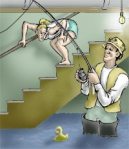
For instance. There was the time I took my three young children to the movies. Upon returning home we heard the calming sound of water flowing; only it wasn’t calming since our home was not built with a stream running through it. After looking in the basement and seeing water streaming through the ceiling, I called our builder’s hot-line. I was furious at them and so told the handyman as he looked at the exposed rafters.

Undaunted, and convinced that the pipes were fine, he proceeded to the first floor to source the leak. I saw water coming through the wall and ceiling of the conservatory and gave him another piece of my mind—something my mother had always cautioned against so as to ensure I still had some left in case I needed it. We headed upstairs, through a bedroom, into my son’s bathroom. By this time we were wading. The sink faucet was in the on position, the drain was in the closed position, and I was in no position to blame the builder.

I learned that my son had been doing a ‘speriment’ with the soap. He told me it was my fault he didn’t turn off the faucet before we left because I told him, “come down stairs right now.” He no longer does ‘speriments’ in the sink and most of the waviness in the wallboard has subsided.

I hate being wrong, especially in front of an audience. Once I have an opinion about something, the planet has to shift on its axis before I’m likely to reconsider. I’ve found that to be true with building strategy to support a business that is undergoing radical change, especially when people are asked to consider not doing something, or are asked to consider doing something differently. There’s way too much, “That’s the way we’ve always done it,” and, “That’s the way corporate told us to do it.” What in your strategy would benefit if someone considered doing something differently?

This week I met with an MD and former hospital CEO who told me he is writing the business strategy for a group of hospitals.  When I queried him about what difficulties he was encountering he mentioned that everyone from the board on down “just does not have a clue.”  (And you thought it was just me.)  The things for which he concluded they do not have a clue are legion, including:

  • they have a budget, not a plan
  • they have never discussed integrating an IT strategy with the business strategy–which is just as well as they do not have an IT strategy
  • the are ready to select a name-brand EHR vendor and to spend close to $100 million, but they did no due diligence as to which vendor to select–seems one of their execs knows one of the vendor’s execs
  • they have more duplicative business processes than Imelda has shoes
  • they are all fired up about moving to an ACO model, but have zero understanding of how an ACO model will fit their organization

One may be successful using this approach to run a lemonade stand.  My guess is that the strategy will require a little tweaking to get it to work for a hospital group.

Warmest regards,

Dr. Knowledge.


Will-o’-the-Wisp Optimism about EHR

Will-o’-the-Wisp Optimism about EHR

Comment by PaulRoemer Dec 14, 2010, 11:36 AM EST


I think many of the definitions of “using” mean the EHR vendor has left the building, and so by default physicians are “using” the system.

If you happen to be one of the many hospitals whose productivity has declined by twenty percent two years after the EHR implementation, that does not constitute use, and it certainly does not constitute meaningful use, at least in any way that is meaningful to the hospital. Practice management systems are still in disarray, and the business processes are probably less effective than before the hospital spent eight or nine figures to get usability below where it had been. That’s not much of an ROI under any standards.

Some CFOs believe they can create an ROI by adding back the incentive money they may or may not receive. They should also figure in what the cost is of such a large productivity loss.

They are then faced with answering the question about how they will implement an ACO model on top of processes that have been made more ineffective due to implementing EHR.

While optimism is nice, it may be very misguided.