Reforming reform

One of the things I’m not understanding is the approach.  I’m a big backer of reform.  The part I’m not getting is why we are trying to boil the ocean, eat the elephant in one bite, or throw long.  Did I miss any cheap metaphors?

I sense many feel the same.  It’s not the reform which doesn’t have the support, it’s the approach.  That nobody is able to to summarize the reform package on a single slide makes people think it’s because they don’t have a good enough grasp of what they are trying to accomplish.  That, plus the idea of a Big Bang theory of reform is what is halting the effort.

Break it down into manageable, explainable pieces.  Demonstrate you can successfully accomplish one peice and you will have support for the next piece.  Do it all at once and fail and reform is done.

saint

The relationship between 2 words: reform and EHR

Part of the reform discussion should include reform that requires and/or will only come about through EHR.

The other part of the discussion should be about reforming EHR.  Neither will work without the other

saint

How large is the reform effort?

dr_evil_one_million_dollarsA trillion dollars.

What does a trillion look like?  A dollar bill is about six inches long.  Stacked end to end, a trillion dollars would go from the earth to the sun, and back, twice.

Healthcare is one fifth of our economy.

One fifth of our GDP is larger than the GDP of five of the G8 countries, including France and the UK.  Would we try to reform the entire economy of the UK?  Would we succeed?

We have about six million miles of paved roads in the US.  How long do you think it would take the government to repave twenty percent of them, 1.2 million miles?  Could they do it?

Maybe we really should have a plan before we write a check.

pastedGraphic.tiff.converted

Public option dead? Let’s lead with a solution


Who Will Lead

Who Will Lead

Dirk Stanley posted this link from the NY Times about the death of the public option.


http://www.nytimes.com/2009/09/13/health/policy/13plan.html?_r=1

Now, we can either bemoan this or we can try to lead.  Here’s my take on how to strat the discussion.

To insure the uninsured we don’t need a public option.  When poor people were denied access to banking and credit, the government did not create a public bank.  It regulated the banking organizations and made it illegal for them to redline the poor.

Can we not regulate the payors in the same fashion, requiring them to insure the uninsured?  Were not Medicaid and Medicare created in part because payors relined the elderly?

The government requires everyone to have automobile insurance, placing the onus on the individual.  Why not flip it?  If the goal of reform is to get people access to healthcare, which under the existing business model implies insurance, require the payors to provide it.  The government can subsidize the payors, or pay it in full, and it can do so without adding to the bureaucracy of further entitlements via a public option.

To me, two other ideas make much more sense, one of which I’ve previously offered.  Large groups of people are without insurance or are under insured.  The government wants them to have access to medical care.  As stated above, the government already created two agencies to address this problem, Medicaid and Medicare.  Why create a third?  Can’t those people be added to the two existing agencies?

The other idea may be the same, but if implemented differently, could streamline the processes and the cost.  Make the cost of the coverage to those groups an offset against whatever tax they would owe.  If it costs ten thousand dollar to insure a family of five, offset it against their income tax obligation.  Net net its’ the same cost whether you collect it and refund it or simply don’t collect it.  Give these families so sort of smart healthcare debit card, the government owns the account, and all healthcare providers can accept it for payment.

Sure, there is unlimited fraud potential, just like there is under any other option.

SaintLogo

A eulogy for universal healthcare

rip1It’s funny how things work when the cameras are on and all are dressed to the nines.  It appeared as though Hillary and Nancy called each other confirming red was the color of the evening–a quick rock, paper, scissors, and Hillary won the right to wear a pants suit.  Congressman Rangel nattily attired with threads he was able to afford by forgetting to pay taxes on income earned from properties he forgot he owned.  (In sotto voice—I digressed again, didn’t I?)

Amid the applause and bravado, nobody, I mean nobody so much as blinked when the president dropped the number of people covered under the public option from forty-six million to a paltry thirty million.

  • Who are those sixteen million?
  • Did the cost of the plan drop by a similar amount?

Universal coverage was pulled from the table as though it had never been on the table.

SaintLogo

Healthcare–0.2 to 2.0, mind the GAP

dog Alex van Klaveren raised a question in his blog, Medicexchange about a point we raised here stating that Healthcare is moving from version 0.2 to 2.0.

My thoughts on this center around differentiating between the business of healthcare and healthcare as a business. That they may not be easily separable makes it difficult. There are many factors which if viewed from the perspective of an MBA student that suggest the as a business (processes, management, use of technology to run the business) it is found lagging when compared to for example to banking and manufacturing. Healthcare is being pushed to catch up quickly, and has little guidance in how to get from A to B, and doesn’t understand how to define the Gap.

We’ve also stated that it’s not about EHR.  So then, what is it about–sorry for the preposition?  It’s about the Gap.  It’s about knowing where you are, defining where you want to be, and being able to articulate a strategy which will get you there.  It’s about change management, and work flow improvement.

My best – Paul

021_18A

Acronym-free EHR–Same Great Taste, Less Confusing

acronymsI raised the following question on Twitter:  Who blieves the current approach (PR, EMR, EHR, Rhio, to NHIN) will actually work in 3, 4, or 5 years?  Will you state why.  I do no think it will.

I raise it here as well.  Can you make an agrument to help me understand what needs to happen for this to possibly work?


  • 400 vendors
  • 300-400 RHIOs–some home made
  • a few hundred standards groups
  • a few hundred thousand instnaces of EHRs
  • 300 million patients


The combinatorics alone of getting my PR up the food chain and back down to the right place should be enough to bring it to the idea to its knees.

Remember that ice-breaker kids play at parties where they sit in a circle?  A phrase is whispered in the ear of one child, and each child in turn whispers the phrase to the person next to them.  By the time the phrase returns to the originator, it sounds nothing like to original.

A colleague whose opinion I respect wrote that I’d get better responses if I explain the acronyms, so that why we’re here.

The offending terms are:

PR–Patient Record

EMR–Electronic Medical Record

EHR–Electronic Health Record

RHIO–Regional Health Information Organization

NHIN–National Health Information Network

Does anyone know of a link to a good healthcare IT/EHR acronym glossary?

My work here today is done.

021_18A

How does the healthcare business mix with the business of healthcare?

Remember when using language correctly while speaking and writing provided a common ground for understanding?  I write what I mean.  Nothing I ever wrote will be used as eleventh grade English Lit class assignment to ferret out my intent.  A few responded to the my discussion questioning if I felt involving business people in reform meant giving them carte blanche to mess in areas where they have no expertise.  I wouldn’t recommend that any more than I would recommend involving its reverse.

I am not a clinician or medical professional, don’t intent to be, don’t play one on TV.  I have not offered, nor will I offer my opinion on anything medical.  There will be no critiquing of who should be seen, what procedure should be performed, how to perform them better, or is entitled to what.  That’s all outside my pay grade.  If I cross that boundary, do us both a favor and take away my crayons.

That said; let met share what I think is being left out of the discussion about EHR and reform, a topic some treat as an unspoken side issue.  It’s almost as though this is the black sheep of reform, the part of the rug we want to sweep under the carpet—how’s that for mixing a metaphor?  There are those who think of healthcare as a business, those who begrudgingly think of it as a business, and those who never will.

Those at both extremes have contributed to healthcare’s present circumstances and an ill-managed rush to change.  Those in the business only camp, instead of making healthcare more effective have opted to make it more efficient, cutting costs by cutting jobs, and services.  The payors have added to the ineffectiveness by managing to the price of their stock instead of the public trust—these need not be mutually exclusive.

Effectiveness is all about quality, efficiency is all about speed.  Poor business leadership has helped some hospitals do a lot of ineffective things very quickly, but not well.  I’ve never met an executive who didn’t know how to cut costs—it doesn’t take a village to raise a cost slasher.  I, like you, have met very few who know how to increase revenues or increase quality.

Then there are those who will never see healthcare as a business, yet some of them hold senior business positions, positions which call upon expertise they do not have or do not find particularly necessary.  Just as business people shouldn’t perform open heart surgery, there are some better suited to medicine than to IT or P&Ls.  Curiously, those words are not mine; they were told to me by healthcare executives, some with MDs and PhDs.

The healthcare business is uniquely intertwined with the healthcare mission.  Should it be subservient?  That is a question better answered by the ethicists than by me.  I conclude that there are ways to make the business better that will make the mission.  That’s what I look to uncover.

Can EHR be used to improve healthcare?  It depends.  If properly planned and executed, yes.  If done simply in the belief that all things automated are better than those that are manual, no.

Think about a hospital you know well.  How many human resource departments does it have?  Registration?  Payroll?  IT?  What else is duplicated?  How many duplicate departments are required?  Can duplication be removed without simultaneously harming the business or clinical side?  If done correctly.

I think much can be done to improve the healthcare business without impeding the business of healthcare.  To me, that is the part of the mission with which reform should come to grips.

saint

A different approach to reform

BurgerStakeholdersTable1

Labor Day cookout.  America, God blesses us.

Five of our neighborhood’s Wisteria Lane wives—wildebeests—pitched a ten-dollar K-Mart tarp to provide a modicum of shade for the BBQ guests—see prior posts to understand the wildebeest reference.  I should have You-Tubed their struggle.  I had less difficulty pitching my tent by myself on side of a volcano at 2 AM at nineteen thousand feet in a blizzard.  To those who would question why I wasn’t helping them it’s because they didn’t seem to be a Y-chromosome friendly group.

American food—burgers, dogs, sausages, beans, chips.  Then there’s the side dishes brought by the neighbors; salads that require a team of forensics to ferret out the ingredients, and cookies that look so goofy that not even the kids will try them.  Oreos, never mess with perfection.

Okay, down to business.  I’m looking for someone to tell me whether this idea makes sense or if it is all wet.

Premise one:  Most of the reason reform being discussed is to solve or improve the healthcare “business model”.  Most of the clinical side is not up for debate, that is, we are not discussing the need to revamp dermatology or pediatrics.

Premise two:  About half of healthcare is government run—the VA, Medicare, Medicaid, and government employee health.

Question one:  Which business model are the reformers trying to address?

  • Private—if a good portion of what’s broken with the healthcare business model can be attributed to the private sector, why are they not leading the discussion?
  • Federal—if some portion of the business model problem lies with the government, and this is the same organization who broke it and are trying to fix it, isn’t that a conflict?
  • Both—why are legislators drafting any portion of this?  What large business problems have any of them resolved?

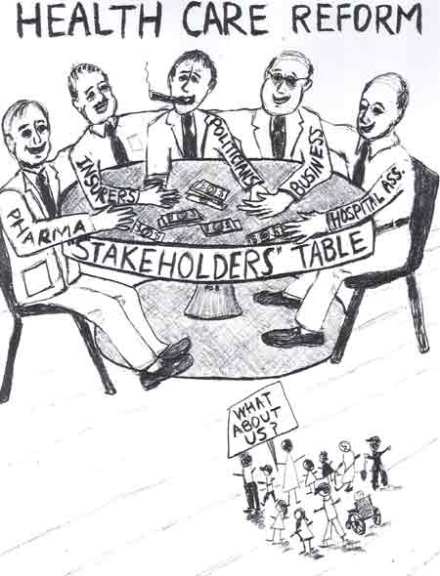
Question two:  Which group of people should be at the forefront of defining what’s broken, how to solve the business problems, determining what it will cost, and how to pay for it?  Pelosi, Ried, et al?  Or a group of business people headed by someone like Jack Welch?

Question three:  Whose plans are Americans more likely to believe, one coming out of DC, or one coming from a non-partisan group of business leaders?

Question four:  How many committees and firms are developing standards?  How many standards committees would a “Jack Welch” led reform effort have?  That’s right, one.

Question five:  Federal led reform requires teams to confirm that billions spent by healthcare providers on electronic health records will yield systems that actually work (certification and meaningful use).  Would a “Jack Welch” led effort require the same, or would they know the systems would work simply because they had one set of standards and a viable plan for interoperability?

Question six:  Who are the reformers?  What are the names and experience of the people who drafted the 1,000 pages?  Why aren’t they on the talk shows?

Question seven:  Who should draft the reform document?

I recommend a bi-partisan committee of business leaders, no current politicians—something akin to the committee which studied the Challenger disaster.  If we’re talking a trillion dollars, let’s invest six months or so to define a plan, one that can be presented to the country—Ross Perot with one of his PowerPoint presentations, then let’s figure out some way for the people to comment and “vote”.

If reform is going to impact everyone, shouldn’t everyone at least understand it and be free to comment? Doesn’t a trillion dollar spend deserve some form of popular vote?  Congress has a favorability rating in twenties. If four in five people have lost confidence in their ability to do anything in everyone’s best interest, are we willing to let them make this decision for all of us?  It’s “We the people”, not “They the elected”.

My closing thought—no charge.  Have you noticed when our elected representatives soapbox this issue, they speak of us in term of, “the citizens” or “Americans”, seemingly excluding or elevating themselves from the fray.  They need help understanding this is a square and rectangle issue, not every rectangle gets to be a square, but every square is a rectangle.  We need the squares to start listening and stop talking.

Be it enacted by the Senate and House of Representatives of the United States of America in Congress assembled offer comment on the Healthcare Reform Act of 2009.  Acknowleding that we do not have a clear plan, hereby turn the task of planning back to the people.

pastedGraphic.tiff.converted

Dumber than a box of hair

fix_02Me again.  Back to school 12-step recovery program.  I feel like I’m on the step ‘square root of negative one’—and to think I used to know what that meant.  It’s like herding cats.  Heard of cats?  Sure, a bunch just got on the school bus.  Sorry, sometimes I have trouble getting all of the synapses to fire in order.

This is dedicated to those moms and dads who spent more years in school that America has been a country.  Each year the start of school sort of hits me in the face, like the ice swimmers in Vladivostok—how could I possibly have spelled that correctly—during their New Year ’s Day plunge in to whatever sea is nearby. My gang often looks at me like I am dumber than a box of hair.

They do not care that when the airlines finally decide to board planes by IQ, that I will be in the front of the line—don’t get pithy with me, for you frequent fliers, don’t tell me you haven’t thought of this.  That I regularly advise—albeit recently a little less regularly that I’d like—industry stalwarts they are uniquely unimpressed.  They have other issues; why do I have to wear socks; a bag of Oreos and a bag of Doritos are two different things for lunch.  And so on.  Sometimes they think I am an idiot.  Sometimes I find myself agreeing with them.

The mind is a terrible thing.  The children look to us provide direction.  Some days we have difficulty just providing matching socks.  Is it that we lost control or that we never had it, control, that is?  My nine-year-old daughter winks, says “Oh daddy” to anything I say, and I melt.  That is sooooooooo unfair.

The great thing is the ability to realize how ill-equipped, how unprepared I am to deal with these short people who moved in when my wife and I didn’t understand the consequences of deciding to stay home that rainy night.  Still with me?  I’m not sure I am either, but perhaps we can find comfort in that I really am working to a point.  My children listen to me in the same way I read email—provide me with a summary statement because the rest is superfluous.

I believe that’s what is missing in the ‘reform debate’.  That’s what they call it on TV, but we all know, there is no debate.  To debate, one must define the issues.  They have failed to do that, and I argue their failure is deliberate.

Next Wednesday should be fun.  Mark my words, they still won’t be able to present it on a single PowerPoint slide.

Austin Powers