
The Physics of EHR

To read and complete this post you may use the following tools; graph paper, compass, protractor, slide ruler, a number two pencil, and a bag of Gummy Bears—from which to snack.  The following problem was on the final exam in my eleventh grade physics class.  Let us give this a shot and then see if we can tie it into anything relevant.

A Rhesus monkey is in the branch of a tree thirty-seven feet above the ground.  The monkey weights eight pounds.  You are hunting in Africa, and are three hundred and twenty yards from the monkey.  You have a bolt-action, reverse-bore (spins the shell counter-clockwise as it leaves the gun barrel) Huntington rifle capable of delivering a projectile at 644 feet per second.  The bullet weighs 45 grams.  The humidity is seventy percent, and the temperature in Scotland is twelve degrees Celsius.

At the exact moment the monkey hears the rifle fire it will jump off the branch and begin to fall.  Using this information, exactly where do you have to aim to make sure you hit the monkey?

I used every piece of information available to try to solve this.  I made graphs and ran calculations until there was no more data left to crunch, computing angles and developing new formulas.  I calculated the curvature of the earth, and the effect Pluto’s gravitational pull had on the bullet.

The one thing that never occurred to me was that since the monkey was falling to the ground, so was the bullet—gravity.  The bullet and the monkey both fall at the same rate because gravity acts on both the same way.  So, where to aim to hit the monkey?  Aim at the monkey.

All of the other information was irrelevant, extraneous.  The funny thing about extraneous information is that it causes us to look at it, to focus on it.  We think it must be important, and so we divert attention and resources to it, even when the right answer is staring us in the eye.

Attempting to implement EHR is a lot like hunting monkeys.  We know what we need to do and yet we are distracted by all of this extraneous information that will hamper our chances of being successful with the EHR.  Two of the most obvious distractions are Meaningful Use and Certification.  The overarching goal of EHR is EHR; one that does what you need it to do.  If the EHR does not do that, everything else has no meaning.


Why we don’t allow horses do medical procedures or EHRs

There are three or four basic rules those of us who write should use, unfortunately I do not know them. For those of my ramblings that seem long, it’s only because I have not had the time that is required to make them shorter. This I fear is one of those. I write to find out what I am thinking; if and why you read remains uncertain. All of us learned to write in elementary school—most then moved on to greater things—I remained trapped with the notion that being able to spell words more than one way may one day be regarded as a talent.

I found it is not a bad idea to get in the habit of writing down my thoughts–it saves me from having to verbally rake others with them. Some of my thoughts require little or no thought from those who read them, for the very simple reason, they made no such equivalent demand upon me when I wrote them. My goal in writing, other than to entertain myself is to create a somewhat humorous context to facilitate thinking. As one who enjoys the written word I understand that no urge is equal to the urge to edit someone else’s thoughts, as several of you have done with mine. It sometimes feels as though the best I can hope for in formulating a series of ideas about a topic is to borrow well from experts, those people whose have already made all the mistakes that can be made in a very narrow field. The need to write and share my opinions requires constantly trying to prove my opinion to an audience who may not be friendly, which is why silence may be better–silence is often the most difficult opinion to refute. Unfortunately, trapped inside every consultant is the urge to write; sometimes that urge is best left trapped inside.

Much of the project management office consulting I do comes from having listened respectfully to very good advice, and then going away and doing the exact opposite. In general there appears to be a lack of strategy concerning EHR, making it like trying to jump a chasm in two leaps—it can’t be done. Without knowing what outcome you want to achieve, any path will take you there. This isn’t because the people in charge don’t see the solution—it is because most people have no familiarity with the scope and magnitude of the problem.

Large information technology projects like EHR are often dominated by two types of people: those who understand what they do not manage, and those who manage what they do not understand. If we are being honest, the end product of project management is making it more and more difficult for people to work effectively. It’s sort of like why we don’t allow horses do medical procedures—it would probably take way too much training. I think that many EHR projects are ineffective because those leading the charge attempt to rely upon reason for answers, thinking, “If we know one then we know two since one and one are two”.

To make the EHR efforts more effective, I humbly suggest we need to learn much more about what constitutes the “and”.

EHR technology makes it easier to do a lot of things, but some of the things it makes easier ought not to be done. The only reason to have an EHR system is to to solve specific business problems within the organization. Getting EHR to do want you want it to is ninety percent mental–the other fifty percent involves voodoo. If you don’t make mistakes during the process, you’re not working hard enough on the problem—and that’s a big mistake. Need I say more? Any complex system that works almost always comes from a simple system that works. The corollary is also true, if the current paper and manual records system didn’t deliver best practices, how can the more evolved ones be expected yield best practices?  EHR alone won’t make you better, it will just make you automated.

Success is a much more likely outcome when one builds upon success. Most EHRs have enough technology to handle anything that comes up, unless a provider forgets that the EHR is just a tool.  It took human error to create the problems we have with our health records processing.  Why then are we so quick to think that technology will fix them?

Misery not only loves company, it insists on it. That is why having a competent project management office (PMO) plays such a dominant role in the success or failure of the EHR. When the circumstances turn extraordinary, as they are in today’s economy, extraordinary measures are required. Plan, take time to deliberate, and when the time for action has arrived, stop thinking and get after it. The important thing to remember in deciding what action to take is not to search for new data points but to discover new ways to think about the ones you have. The direction of am EHR strategy may have limits, but perhaps it says more about the limits of imagination and common sense instead of the limits of what is possible. And remember this basic rule, when assessing common sense and imagination, always round up.

I’m not always disgruntled about that which I write, but I’m often far from gruntled. As graduate student I aspired to a stable job, I craved factual certainty and the respect of my peers—so I became a consultant. I soon learned that this is like wanting to be a vegetarian so you can work with animals. The only job I was fit for was consulting. This notion rested on my belief that I was not suited to work nine to five, and that consulting wasn’t quite like working. One of the nice things about consulting is that putting forth absurd ideas is not always a handicap. The good news is that consultants, when addressing things outside of their expertise are just as dumb as the next guy. I’ve always believed that being honest with my clients is the best policy—does that mean that if I chose to be dishonest I would be using second best policy? Oscar Wilde said, “If you want to tell people the truth, make them laugh, otherwise they’ll kill you.” That’s my hope with these little musings. Remember, we’re all in this alone.

The preceding was a pilfering of quotations.
 

CIO shift, happens–or shift happens

Another comment of mine to Barbara Quack’s post; http://ducknetweb.blogspot.com/2010/12/cio-confidence-in-meaningful-use-drops.html#comment-form

I think you hit the nail on the head.  I think a lot of this can be attributed to the fact that stuff rolls down hill and that shift happens.

In healthcare, as in every significant industry, part of the problem seems to come from the fact that CIOs are often considered to be part of the C-suite in name only.  There are several notable exceptions to this observation, CIOs who drive business strategy instead of merely implementing the business strategy that was developed in the “real” C-suite.  Many C-suiters perceive the real role of the CIO is to apply technology to accomplish what they (the C-suite) want done.

Many executives, CFOs, CMOs, COOs, and CEOs regard the position of CIO such that the “C” (chief) and “O” (officer) are honorariums; officers in name only, officers with commensurately sized offices located on the third floor or in an offsite location.  Responsibility often without authority.

I think the issue of Meaningful Use is a clear example of how the practice works.  I worked with a large group of hospitals whose CIO had a detailed IT strategy and plan—projects, ROIs, resources, and capital.  His plan was tied to the business plan which he helped author.

He did EHR and CPOE before EHR was de rigueur.  Then along came Meaningful Use.  Without any understanding of the business issues or consequences associated with meeting Meaningful Use, the C-er’s and the board decided that not meeting Meaningful Use was not up for discussion.  The analysis was thorough, but unimportant.

In a nutshell, the organization which had already implemented EHR and CPOE because of his thought leadership—and long before DC got into the EHR thought leadership business—was instructed to meet Meaningful Use, all else be damned.  The “all else” included whatever it was that eighty percent of his IT staff would have worked on during the next three years.

For the sake of a check, the IT strategy was sacrificed, and the IT strategy’s alignment to the business strategy was sacrificed.  Did they get the check?  Will they pass the Meaningful Use audit?  IT will be blamed if they fail to meet Meaningful Use.  They will be blamed when they fail to deliver all of the other parts of their original plan.  And, they will be blamed if the standards shift in mid-stream.  Why?  Shift happens.  Responsibility often without authority.

“Memo from the CFO: How’s that whole ICD-10 initiative coming?  Holler if I can do anything.”

And guess what’s coming around the corner?  The new hot topic to roll down hill will be the decision that comes out something like this; “Memo from the CEO: The board decided we need to be seen as an Accountable Care Organization by the end of 2012.  Holler if I can do anything.”

Information Technology—IT.  “That must be where we keep all the technology in case we need it.”  Just send out a request and one of those technology guys will put it in for us.

There is only one thing that will stop this train from making the office of the CIO the bucket into which the downhill water is running.  Lead.  Plan.  Instead of planning for what technology and IT resources you need to deliver to meet their orders, draft a healthcare strategy instead of an IT strategy.  Bring forth a business plan addressing business problems that uses technology as a solution to solve the problems.

Define what is needed, on top of what you already need, to meet ICD-10.

Define what is needed, on top of what you already need, to make ACOs viable.

If you wait to respond to their IT orders, it will be too late.

What is troubling hospitals? What isn’t?

I wrote this as a comment to Barbara Duck’s fine post in her blog, http://ow.ly/3tFPx

Part of the problem, at least in my mind is that many of the large and small provider business models are trapped in what any MBA student would label an 0.2 model. The two biggest adversaries to provider’s success and limiting their ability to change, the two industries constraining the providers’ ability to run a profitable business, pharmaceuticals and the payors, exercise power that comes from their scale.

Add to that complexities brought to bear by other large external influencers—the rule-makers, makes it almost impossible to know what business model to build and under which to operate because providers must build strategies designed to hit unknown and moving targets; reform, regulation, and Medicaid, Medicare. Whatever strategy they design will be ineffective by the time it is implemented.

It is important to note that healthcare providers represent the only industry which does not know the cost of ninety percent of the services they deliver. They do not know what something costs, but they do know what they charge. Even the identical procedure at the same hospital will produce a different bill. How does one run a business suing those pricing models?

You may or may not know that Shakespeare spelled his own name five different ways. While that worked out okay for him, using that as a pricing model—I know this analogy is a stretch—makes no sense.

Compare hospital pricing to McDonald’s who knows how profits will be impacted if they so much as add another pickle to a hamburger.
Nobody can tell you what a tonsillectomy costs, or the profit earned from the procedure. Even for hospital IDNs, the same service will be priced differently, will be charged differently, and will be reimbursed differently.

Through acquisition and mismanagement many hospitals have multiple occurrences of large business processes; to name a few—admissions, IT, HR, payroll, pharmacy.

The time has come to separate the hospital business model into two components; the business of healthcare—how it is run, and the healthcare business—the care component. Care is delivered using a best-process model, whereas some will argue the business of healthcare is often managed no better than a lemonade stand.

There are no measures used by hospitals that allow them to calculate the ROI of a patient or a physician over five or ten years. There is no Patient Equity Management process to reduce patient or physician churn.

Large hospitals have spent more than $100,000,000 to implement failed EHRs—sixty percent of them fail. Hospitals are rushing through their implementations to try to secure minimal ARRA payments. Many hospitals are on EHR 2.0 thinking that by changing their EHR vendor they will have a better chance of succeeding. To that model they hope to incorporate ACOs.

Maybe before they boldly go where no man has gone before, they should pause and come up with a real plan of attack.

EHR: Children of the Corn

Not in the Stephen King way.  During the late fall, my middle school friends and I would play among the withered corn stalks; capture the flag, building forts, and on occasion being more adventuresome.  On those more adventuresome occasions the adventure included matches.

It went something like this.  We would stand among the seven or eight foot tall sepia colored stalks, and remove several ears of corn, corn that had been allowed to dry on the husk.  We would peal back the leaves on husk, and strip the kernels from the bottom two-thirds of the husk.  The end product would look similar to a WW II German hand grenade—the stripped husk became the handle, the kernels on the top third were the “explosive” part, and provided the weight needed to make the grenade travel when thrown, and the dried leaves were the fuse.

The leaves were lit, closed our eyes, and let it fly.  Then we would rush through the stalks looking for signs of smoke.  By necessity, we were in a hurry.  The object of the game was to locate the grenade among the hundreds of corn stalks before it set the field on fire.  We were successful every time but one—must have been a pretty good throw.

I remember my mother asking me why my corduroy jacket smelled of smoke.  I didn’t have the courage to tell her it was because we were using our jackets to try to beat out the flaming stalks.

Segue, albeit not much of one.  A lot of healthcare providers are also in a hurry to implement EHR.  The fuse is burning away.  The fuse is the timeline to get the ARRA incentives, or at least to avoid the penalties.  That means implementations are being rushed, which in turn means implementations will fail.

If anything can be stated with certainty it is the following; it will cost much more to revise a failed EHR implementation than whatever incentive money may have been received had it worked.  Speed is costly.  So is putting in an EHR that does not do what you need it to do.  There are no business benefits to getting the EHR box on your to-do-list “checked.”

When your haste to implement EHR causes you to fail to meet Meaningful Use, how will you explain to your mother why your jacket smells like smoke?


Why should HIEs be scrapped, and what else might work

“Just because Jimmy’s mom lets him do it does not mean I am going to let you do it.  Would you jump off a cliff if he did?”

This argument is the best one I can make extolling the merits of the Healthcare Information Exchanges (HIEs) and the National Health Information Network (N-HIN).  The strategy behind the HIEs and the N-HIN are somewhere between killing a mosquito with a tank.  As the camel is a horse designed by a committee, so may be the goal of having HIEs serve as the cog of the N-HIN.

Why?  Because I think the architecture needed to make this happen exists in a far simpler form.

For example, let us look at iTunes.  To be transparent, I do not have the knowledge to describe or explain the technical underpinnings.  But what if we look at the business strategy around what makes iTunes work for Apple and its customers, perhaps there is something relevant worth borrowing.

Like physics for librarians, permit me to oversimplify the idea to see if a similar set of underpinnings could work in healthcare.

For purposes of explaining the analogy as a business network, what if we equate the major components thusly?

  • Apple (iTunes)                                  Government

o   HIEs

  • The tunes                                            Patient records
  • The Internet                                      N-HIN
  • Customers                                          Patients

While it is never as simple as it seems, especially given Apple’s success with iTunes, here is the simplified version.

There a millions and millions of songs (patient records).  For Apple, the songs exist digitally—ones and zeroes—and are stored digitally.  No LPs, no tapes, no CD (no paper charts).

Apple never physically touches a single song.  What does Apple do if it doesn’t sell CDs?

  • Apple brokers the entire transaction to its customers
  • The tunes move securely and unaltered from one entity, Apple, to one customer, millions of times
  • Apple secures all parts of the business

o   Nobody has hacked into Apple to steal tunes

o   Nobody has stolen customer information

o   Nobody who does not own the songs has been able to alter their content wheter they are in transit or with their owner

  • In the iTunes business model the iPod is no more important than a toothbrush has to do with Crest’s business model
  • The business model’s success is based upon a new delivery system for music
  • Apple’s business model did not necessitate creating hundreds of disparate and separate distribution systems to link tunes from Apple to its customers.
  • Apple did not create a new way of moving ones and zeroes from virtual point A to millions of virtual Point B’s.
  • Apple was successful using and existing, and inexpensive transportation network, thereby keeping overhead much lower than it would have been

So, if we equate the two paradigms, and buy into the fact that a model such as iTunes—if you prefer you can substitute aspects of financial services, airline ticketing, GPS (On-Star), EBay, and Amazon—in its most basic form, is nothing more than the secure transport of billions of ones and zeros, it is not a big stretch to see how one can argue that the transport of millions of electronic health records may not require a solution as complex as the HIE—N-HIN model.

And if that is true, can a business argument be made to justify building hundreds of HIEs?  I do not believe it can.  The HIEs are designed to act as middlemen.  Their purpose is to hand ones and zeros from one network node to the other, and they way they will do this is by building more nodes.  They will not so much as add a one or a zero to a patient record.

Rule One of engineering a business process is that if a process does not add value to the whole, the process adds cost and complexity without adding any value.  Under the current national EHR rollout, I think HIEs are such a process.

Before discounting this notion, what would be required to make an iTunes’ model work for electronic health records?

Does ego get in the way of making change an imperative?

My friends who have nicknamed me Dr. Knowledge or the Voice of Reason have seen me on those rare moments when the synapses were firing on all cylinders. There are others who have seen me in my less than knowledgeable moments.

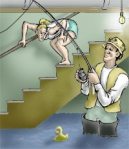
For instance. There was the time I took my three young children to the movies. Upon returning home we heard the calming sound of water flowing; only it wasn’t calming since our home was not built with a stream running through it. After looking in the basement and seeing water streaming through the ceiling, I called our builder’s hot-line. I was furious at them and so told the handyman as he looked at the exposed rafters.

Undaunted, and convinced that the pipes were fine, he proceeded to the first floor to source the leak. I saw water coming through the wall and ceiling of the conservatory and gave him another piece of my mind—something my mother had always cautioned against so as to ensure I still had some left in case I needed it. We headed upstairs, through a bedroom, into my son’s bathroom. By this time we were wading. The sink faucet was in the on position, the drain was in the closed position, and I was in no position to blame the builder.

I learned that my son had been doing a ‘speriment’ with the soap. He told me it was my fault he didn’t turn off the faucet before we left because I told him, “come down stairs right now.” He no longer does ‘speriments’ in the sink and most of the waviness in the wallboard has subsided.

I hate being wrong, especially in front of an audience. Once I have an opinion about something, the planet has to shift on its axis before I’m likely to reconsider. I’ve found that to be true with building strategy to support a business that is undergoing radical change, especially when people are asked to consider not doing something, or are asked to consider doing something differently. There’s way too much, “That’s the way we’ve always done it,” and, “That’s the way corporate told us to do it.” What in your strategy would benefit if someone considered doing something differently?

This week I met with an MD and former hospital CEO who told me he is writing the business strategy for a group of hospitals.  When I queried him about what difficulties he was encountering he mentioned that everyone from the board on down “just does not have a clue.”  (And you thought it was just me.)  The things for which he concluded they do not have a clue are legion, including:

  • they have a budget, not a plan
  • they have never discussed integrating an IT strategy with the business strategy–which is just as well as they do not have an IT strategy
  • the are ready to select a name-brand EHR vendor and to spend close to $100 million, but they did no due diligence as to which vendor to select–seems one of their execs knows one of the vendor’s execs
  • they have more duplicative business processes than Imelda has shoes
  • they are all fired up about moving to an ACO model, but have zero understanding of how an ACO model will fit their organization

One may be successful using this approach to run a lemonade stand.  My guess is that the strategy will require a little tweaking to get it to work for a hospital group.

Warmest regards,

Dr. Knowledge.


Relative (Non) Value Units (RVUs)

Below is my lastest post in HealthSystemCIO.com.

http://healthsystemcio.com/2010/12/01/relative-non-value-units/

This issue has been troubling me ever since a doctor told me her hospital was implementing it.  It is good to know that there are no patents on bad business ideas—that way everybody gets a chance to use them.  Sometimes bad ideas come with misnomer labels that suggest they are less evil—Meaningful Use is a good example of a misnomer idea, but that is not the topic of today’s discussion.

Permit me to illustrate this idea with an identical policy in another industry, one that I believe will hit home for many.  Think back to the last time a cable television technician came to your home to perform some piece of work; moving or adding an outlet, installing cable or internet.  (Before I started practicing medicine on-line, I spent many years consulting to the cable industry about how to improve their operations using the tools of IT.  I often rode with the technicians to observe how they did their work.)

During these times I noticed jobs when the technician did not have the time needed to complete the work described on the work order.  Rarely did the technician have time to complete any add-on work—work requested by the customer while the tech was at their home.

What really interested me was the answer to my question of ‘why’?  It comes down to the following.  When the technician leaves the service bay in the morning, the tech has a list of work orders that must be completed by the end of the day.  Each work order is worth a fixed number of points, and the technician is evaluated and paid in relation to the number of points earned.

Let’s say the tech is to install a new wall outlet; five points and 30 minutes may be assigned to that work order.  The tech arrives at the home only to learn the outlet is to be installed on an interior wall and the cable will have to by threaded through the wall via the attic; a sixty minute job.  If the tech stays to complete the work, it will only yield five points and delay his entire schedule by thirty minutes.

Either way, the process fails, and the customer is failed.  The tech will return tomorrow at double the cost to the company, but he will now be allocated 60 minutes for the work.  There is always time to do the work over, and never time to do it right.

This business process suggests the next customer is always valued more highly than the present customer.  This is why when you are being helped by a clerk in a store and the phone rings the clerk will stop servicing you—a paying customer—to service someone who merely wants to chat.

The process? Relative Value Units (RVUs), and it’s another misnomer.  An argument can be made to show RVUs have little or no relative value, but entire hospitals run on these, and IT builds systems to assign, track, and report on RVUs.  Is there a way for IT to demonstrate or report the impracticality of running a business in this manner?


Why is implementing EHR like getting kids to eat broccoli?

Do you ever wonder if perhaps you are the only person who was never photographed with one of the Kennedys?  That got me thinking about our presidents.  NPR interviewed the person who spent eighty hours interviewing Clinton during the eight years during which he was allowed to park freely anywhere in DC.  See how this is already starting to come together?

The interviewer mentioned that Clinton described the Lewinski episode as a distraction.  I also employed several descriptors of that affairs—and yes, the pun is intentional—but I must have overlooked calling it a distraction.  People on both sides of the aisle called the episode a stupid thing.  Perhaps we should define the term ‘stupid thing’—doing long division and forgetting to carry the one is ‘a stupid thing’; mixing a red sock with a load of whites is ‘a stupid thing’.  Sometimes politics can have us all screaming infidelities.

When I share my thoughts about these things, some look at me like they are staring at an unlabeled can of food and trying to guess the contents.  Perhaps objectivity is only for the truly unimaginative.

Here comes the segue.  All of that thinking about presidents got me to thinking about Mr. Obama, reform, and EHR.  A lot of the original economic reform discussion had to do with TARP monies being tossed at the banks.  It was almost like a reverse bank holdup as the feds made the banks take money.

Which now takes us to healthcare reform and EHR.  ARRA money and states like New York providing a stimulus to the stimulus.  What is so distasteful about EHR that it makes governments offer money to get providers to implement it?  How might we illustrate this?

Let’s say I offer my children a choice of two things to eat; broccoli and chocolate cake.  What happens?  My kids make a bee-line for the cake.  The broccoli requires an incentive to get any takers.  My children are prepared to suffer untold penalties instead of eating the broccoli.  There may be some financial incentive which will entice them to eat broccoli, but it will be pricey.  Telling them it’s good for them, or that they have to eat it makes no difference to short people—they need to be bribed.

Telling healthcare providers EHR is good for them, or that they have to do it makes no difference to tall people—they want to be bribed.  What does this signify?  What is it about EHR that requires incentives and some foreign force majeure to get the discussion underway?  It’s not as though the healthcare providers don’t want to do things that will improve their business.  What is it they know that we don’t?  What other than money would make them run towards EHR rather than away from it?

You don’t suppose it has something to do with broccoli, do you?

For those who enjoy Dana Carvey, here’s a link to his song about chopping broccoli.

http://www.youtube.com/watch?v=gO57XRDDodk


EHR: How important is due diligence?

What was your first car?  Mine was a 60’ something Corvair–$300.  Four doors, black vinyl bench seating that required hours of hand-stitching to hide the slash marks made by the serial killer who was the prior owner, an AM and a radio, push-button transmission located on the dash.  Maroon-ish.  Fifty miles to the quart of oil—I carried a case of oil in the trunk.  One bonus feature was the smoke screen it provided to help me elude potential terrorists.

I am far from mechanically inclined.  In high school I failed the ASVAB, Armed Services Vocational Aptitude Battery—the put the round peg in the round hole test.  Just to understand how un-complex the Corvair was, I, who hardly knows how to work the radio in a new car, rebuilt the Corvair’s alternator—must not have had many working parts.  Due the the excessive amount of rusting I could see the street from the driver’s side foot well.

However, it had one thing going for it; turning the key often made it go—at least for the first three or four months.  Serves me right.  The guy selling the car pitched it as a date-mobile, alluding to the bench front seat.  Not wanting to look stupid, I bought it.  Pretty poor due diligence.  An impulse purchase to meet what I felt was a social imperative—a lean, mean, dating machine.

The last time I made a good impulse purchase was an ice cream sandwich on a hundred degree day.  Most of my other impulse decisions could have used some good data.  The lack of good data falls on one person, me.

How good is the data you have for deciding to implement an EHR?  In selecting an EHR?  Did you perform the necessary due diligence?  How do you know?  Gathering good data is tedious, and it can lack intellectual stimulation.  I think it affects the same side of our brain as when our better half asks us to stop and ask someone for directions; we like being impulsive, and have built a career based on having made decisions on good hunches.

The difference between you buying and EHR and me buying a clunker is that when I learned I’d made a poor decision I was able to buy a different car.  You can’t do that with an EHR that has more zeros in the price tag than the Dallas Cowboys front line.  Plenty of hospitals are on EHR 2.0–they also happen to be on CIO 2.0. while CIO 1.0 is out shopping for a Corvair.