How measuring Brittan can improve your EHR success

So, last night I am watching NOVA.  The episode discussed fractal geometry and aired the same time as the Green Bay-New England game.  Admittedly, not a typical Y-chromosome choice, but interesting none-the-less.

A fractal is a fragmented geometric shape that can be split into parts, each of which is a reduced-size copy of the whole.  Simple enough.  Common examples of fractals include the branching of trees, lightning, the branching of blood vessels, and snowflakes.  I am willing to bet I think of many of the ideas on which I ruminate in a fractal manner.

In the seventies the mathematician Benoît Mandelbrot discovered that fractals could be described mathematically.

It turns out that a shoreline is another example of a fractal.  For example, let’s say you wanted to determine the length of the coast of Brittan by measuring it instead of just using Google.  The coastline paradox says the measured length of the coastline depends on the scale of measurement.  The smaller the scale of measurement, the longer the measurement becomes.  Thus, you would get a longer measurement if you measured the coastline with a ruler than with a yardstick.  This paradox can be extrapolated to show that the measured length increases without limit as the unit of measures tends towards zero.  In the first picture, using a 200 km ruler, the coastline measures 2,400 km.

In this photo, using a 50 km ruler, the coastline measures 3,200 km.

I’m not sure why this idea needed to be discovered, it seems a little obvious—more information yields more informed results.

A few years ago I was hired by a firm to report to their board on their vendor selection process.  The firm was about to issue a two-page RFP to two vendors.  I convinced the firm to redo the process.  They ultimately issued an RFP of more than a thousand requirements and selected a vendor who was not on their original list.

Again it seems obvious, but being obvious doesn’t always result in smart behavior.  If you’re getting ready to spend eight to nine figures on and EHR, wouldn’t you like some degree of confidence that you selected the best one for your hospital?

One thing is certain, albeit less obvious, the more due diligence you give EHR, the higher your chances of success will be when you try to build out an ACO business model.

 

EHR: work plans are necessary but not sufficient

I wonder about things, little things, things I see on Nova or on Bizarre Foods.  Take water, more specifically, ice.  It floats.  The only solid that floats in its liquid state.  Most solids sink, not ice.  For those of you thinking boats float, they’re not considered to be solids—does that make them liquids?
It turns out that as water goes from four degrees centigrade, its densest point, and towards freezing, it becomes less dense and floats.  It’s volume increases by 9%, and part of that 9% is trapped air.  That air, even though you can’t see it, exists between the two H’s and the O.  which takes us to the following.

Have you spent much time studying work plans?  While there are more interesting ways to spend your time, there are times meant for writing them, and times meant for studying them.

Having a work plan can be a little like having a bike; nice, practical for some things, impractical for others.  Like with most things, there are work plans and there are work plans.  Some may not be worth the paper on which they are written.

Just like not everyone can write a book worth reading, not everyone can write a work plan worth implementing.  Lines on paper don’t necessarily yield a project of much value.  Remember how with the ice there are things between the H’s and O’s?  Well, with a lot of healthcare IT and EHR work plans, there are things between the tasks on the work plan, or at least there should be.  Can’t see them either.  Those things?  The missing tasks, the tasks that should have been in the plan, the tasks that would have given the plan a fighting chance to succeed.

Some gaps are good, like with ice.  Others can leave you hanging.


EHR: Should you hire a swim coach?

Swimming with guppies.

Got the new bike, got the new bike shoes, got the uni (uniform-not unitard).  I’ve written about my desire to compete in a triathlon.  Actually, I miswrote.  My desire is not to compete, it’s more accurately a desire not to make a fool of myself during the swim, more specifically not to drown.

The swimming is one of those events where having the coolest outfit doesn’t help, as there are no coolest swimming outfits (men do not let men wear Speedos).  There aren’t enough North Face labels for me to wear to make me look like I know what I’m doing in a pool.

What to do?  Here’s my thinking.  I made a new friend, and as a bonus, she happens to be pretty sharp on the pharma side of healthcare.  She swims—fast.  She swims—a lot.  Did I mention she swims?  Longtime readers know I like to color outside the lines.  Maybe I could hire her to take my place during that part of the race.  Then we get back to the issue of the uni.  One way or another that becomes an issue for one of us.

She offered to teach me.  Lesson one was today.  Lesson two will begin right after the EMTs finish their CPR on me.  Rule one, no matter how cool you think you are, you can’t breathe under water.  That took a few laps to master.  More breathing, stroke, legs.  Lots to learn.

“Let’s get a pool boy to help you not drag your legs,” she suggested.

I have difficulty passing up the opportunity to comment.  She could see I had the broccoli in the headlights look in my eyes.  “You hold it between your legs and it helps you float.”

I scanned the pool.  There we the two of us…and the lifeguard.  “It looks like he’s busy,” I offered somewhat sheepishly.  “Besides, if that’s what it takes, I think we’re both better off if I drag my legs.” (A little un-PC pool humor, but why not, I was already wet and being out swum.

So, what does this have to do with why we’re here?  Here’s the take away.  Sometimes, no matter how smart, no matter how big your ego, you need help.  Sometimes it makes a huge difference to have someone on your side who’s been there, done that, got the T-shirt.

Not with me yet?  A guy (man or woman guy—send me an email and let me know when we can let go of this PC thing and just write) is walking down the road, not watching where he’s going, and he/we/she/it falls into a deep hole.

An engineer walks by.  “Help me,” shouts Hole Person.

The engineer thinks for a moment, writes some ideas on a piece of paper and tosses them into the hole.

Several hours later, a finance guy walks by.  “Help me out (literally)” yells Hole Person.  The CFO tosses down a cheque (I use the Canadian spelling to distinguish it from someone from the Eastern Bloc as it would make no sense to toss another person into the hole.)

Days later, Hole Boy (not the same as Pool Boy in case anyone is still reading) is at the end of his rope.  The work plan failed. The Check bounced.

A consultant passed, saw the man, and hopped into the hole.

“Why did you do that?  Now we’re both stuck.”

The consultant smiled in a Grinch-like fashion—please see prior blog for the segue.  “I’ve been down here before, and I know the way out.”

Kind’ a like a swim coach.

EHR projects have more zeros than you can count.  What if you could hire someone who knew the way out?

I may know someone who can help.


The National Health Information Network explained

How does one depict the complexity of the mess being presented as the national roll out plan of electronic health records (EHR) via the national health information network (N-HIN) using Health Information Exchanges (HIEs) designed by Regional Health Information Organizations (RHIOs), with the help of regional extension centers (RECs) without Standards (Standards) and with N too many vendors?

Class?  Ideas?  Class?

If this looks dumb, undo-able, unimplementable, uninteroperable–it’s because it is.  your vision is fine.

Remember the idea behind all this is to get your health record from point A to point B, any point B.  It’s that little word ‘any’ that turns the problem into a bit of a bugger.

Find yourself in the picture below, pic a dot, any dot (Point A).  Now, find your doctor, any doctor (Point B).  Now figure out how to get from A to B–it’s okay to use a pen on your monitor the help plot your course.   That was difficult. Now do it for every patient and every doctor in the country.

Now, do you really think the national HIE-NHIN plan will work?  It is complicated enough without adding all those HIEs each developed independently of one another each to their own standards.  Why not simply use the same National Information Network (NIN) we already use–the Internet?


Does ego get in the way of making change an imperative?

My friends who have nicknamed me Dr. Knowledge or the Voice of Reason have seen me on those rare moments when the synapses were firing on all cylinders. There are others who have seen me in my less than knowledgeable moments.
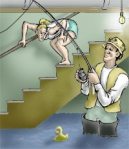
For instance. There was the time I took my three young children to the movies. Upon returning home we heard the calming sound of water flowing; only it wasn’t calming since our home was not built with a stream running through it. After looking in the basement and seeing water streaming through the ceiling, I called our builder’s hot-line. I was furious at them and so told the handyman as he looked at the exposed rafters.

Undaunted, and convinced that the pipes were fine, he proceeded to the first floor to source the leak. I saw water coming through the wall and ceiling of the conservatory and gave him another piece of my mind—something my mother had always cautioned against so as to ensure I still had some left in case I needed it. We headed upstairs, through a bedroom, into my son’s bathroom. By this time we were wading. The sink faucet was in the on position, the drain was in the closed position, and I was in no position to blame the builder.

I learned that my son had been doing a ‘speriment’ with the soap. He told me it was my fault he didn’t turn off the faucet before we left because I told him, “come down stairs right now.” He no longer does ‘speriments’ in the sink and most of the waviness in the wallboard has subsided.

I hate being wrong, especially in front of an audience. Once I have an opinion about something, the planet has to shift on its axis before I’m likely to reconsider. I’ve found that to be true with building strategy to support a business that is undergoing radical change, especially when people are asked to consider not doing something, or are asked to consider doing something differently. There’s way too much, “That’s the way we’ve always done it,” and, “That’s the way corporate told us to do it.” What in your strategy would benefit if someone considered doing something differently?

This week I met with an MD and former hospital CEO who told me he is writing the business strategy for a group of hospitals.  When I queried him about what difficulties he was encountering he mentioned that everyone from the board on down “just does not have a clue.”  (And you thought it was just me.)  The things for which he concluded they do not have a clue are legion, including:

  • they have a budget, not a plan
  • they have never discussed integrating an IT strategy with the business strategy–which is just as well as they do not have an IT strategy
  • the are ready to select a name-brand EHR vendor and to spend close to $100 million, but they did no due diligence as to which vendor to select–seems one of their execs knows one of the vendor’s execs
  • they have more duplicative business processes than Imelda has shoes
  • they are all fired up about moving to an ACO model, but have zero understanding of how an ACO model will fit their organization

One may be successful using this approach to run a lemonade stand.  My guess is that the strategy will require a little tweaking to get it to work for a hospital group.

Warmest regards,

Dr. Knowledge.


Will-o’-the-Wisp Optimism about EHR

Will-o’-the-Wisp Optimism about EHR

Comment by PaulRoemer Dec 14, 2010, 11:36 AM EST


I think many of the definitions of “using” mean the EHR vendor has left the building, and so by default physicians are “using” the system.

If you happen to be one of the many hospitals whose productivity has declined by twenty percent two years after the EHR implementation, that does not constitute use, and it certainly does not constitute meaningful use, at least in any way that is meaningful to the hospital. Practice management systems are still in disarray, and the business processes are probably less effective than before the hospital spent eight or nine figures to get usability below where it had been. That’s not much of an ROI under any standards.

Some CFOs believe they can create an ROI by adding back the incentive money they may or may not receive. They should also figure in what the cost is of such a large productivity loss.

They are then faced with answering the question about how they will implement an ACO model on top of processes that have been made more ineffective due to implementing EHR.

While optimism is nice, it may be very misguided.


What can the ONC learn from the 80% of hospitals who are not on board with EHR?

The ONC’s State of the Union Message will be delivered this week over a two-day period.  Rather than attend, I have decided to wait until the operatic version of the meeting is available on YouTube.  Mind you, I am convinced of the good intentions of their efforts, but to write I am skeptical of their results would be unfair in that my optimism would have to increase substantially for me to reach skeptical.

I am disappointed to report Chicken Little’s “The sky is falling” keynote presentation at the ONC event has been omitted from the agenda in favor of continuing to get others to believe that not only is Meaningful Use is meaningful, but also relevant.  I am not being intentionally trite, in fact, just the opposite.

The question unanswered by the ONC is does their stick and garrote approach make it relevant from a business perspective?  Its only relevance seems to be that without complying, hospitals’ revenues will decline.  Why will those revenues decline?  Is it because the hospitals made a poor business decision, lost patients to a competitor, or could not manage their expenses?  Of course not.  Their revenues will decline for one reason, and one reason alone—the ONC will give them less money for services they perform.

There are almost two-thousand hospitals in the US.  What percentage of them will complete EHR in time to reap their full incentive payment?  I think we can agree with a high degree of confidence that the number will be less than 20%–I’m guessing it will be closer to ten percent.  How many of those will then re-implement a certified version of EHR?  And then, what percentage of the remainder will pass the Meaningful Use audit?  You can probably fit all of those hospitals CEOs in a Hyundai mini-van.

If these figures are close to accurate, one might thing the issues at the forefront of the ONC’s efforts ought to be working with the other 80-90%.  They have tried to add that focus through incentive payments.  When that didn’t take the ONC created the Regional Extension Centers (RECs).  What percentage of the majority of hospitals is benefiting from using the RECs?  Will hospitals and doctors be able to link to the HIEs and into the N-HIN?  Me thinks not.

I have begun to think Mark Twain’s story Tom Sawyer may have been prescient when viewed in the light of EHR and Meaningful Use.  In particular is the part where Tom gets others to whitewash the fence.  Is it possible the ONC’s vision is limited to equipping people with giant paintbrushes who are, sadly short of a giant pot of paint?

Is their existing plan one which is executable?  Just because they have a plan, if most of the country’s hospitals have not bought into it, does not that simply make it a plan in name only?  Even if they buy into it does not, in and of itself make it viable.

If eighty percent of the hospitals are not on board, what can be learned from their lack of response?  Is it due simply to a lack of effort, as some would have us believe, or is there something more to it?  I think the lack of response by the majority of hospitals should lead us to conclude that something important about the strategy is lacking, to conclude that something is amiss.  If someone asked me—and just to give you comfort, nobody has—my conclusion is that more would be gained by the ONC holding a two-day listening session instead of a two-day speaking session.

Can eighty percent of the hospitals have no message worth hearing?


Why additional money is not needed to solve your EHR problems

Have you ever done any sort of group problem solving exercise like Outward Bound to help you to think as a team? Suppose there was an exercise for healthcare and IT executives, whose goal was to get the executives to think about how to best deploy can EHR system. To do this they are given a problem and access to ‘technology.’

Here is the scenario and the rules as they are presented to the group. They are given ten dollars. The executives are presented with a bathtub filled with water, and told that the winning team will figure out the best use of money and time to empty the bathtub. Also available to them is a bucket which costs ten dollars and has a hole in it, a four-dollar cup, and a collection of wooden spoons which are free.

Any idea what the right combination is? Is there a best answer? Bucket? Cup and spoons? How would you solve the problem? Sometimes the best answer is so obvious it’s silly. Kind of like call centers? What’s the best use of the available tools? Faced with the option of buying more technology to solve the problem, when was the last time you saw someone refuse the funds?

Figured it out?

Pull the plug from the drain.

In many cases, we already have everything we need to solve the problem, we just need to know how to use it.

Just like Dorothy in the ‘Wizard of Oz.’  She had the ruby slippers the entire time, she just didn’t know how to use them. I think most EHR strategies can be improved without spending requiring millions more in technology.

That’s my story and I’m sticking to it.


How will ACOs impact HIT?

I know it makes you nervous to learn I have been thinking about something as there is no telling what may develop.  Feel free to use a highlighter on your screen if you find anything of interest.

The healthcare large provider business model looks more and more like its designed used to be the woman at kid’s birthday parties who makes animals and things out of balloons.  With the blue balloon she can make a giraffe, a bike from the green balloon, and a hippo from the pink one.

If she’s highly skilled she will build something complex using a number of different balloons.  Let us try to imagine watching her as she sets about to build a riding lawn mower.  With several popped balloons lying at her feet on the carpet she presents us with a green and yellow John Deere mower which used more than a dozen balloons.  Next, disregarding the pacifists at the party, she builds a B-1 bomber.   Her third assignment results in a McMansion with working Jacuzzi.

Each balloon creation is more complex than the preceding.  Being unimpressed I asked her if she could incorporate the design of the bomber into the design of the lawn mower.  The only rule—she was not allowed to pop any of the mower’s balloons.  If she was able to achieve that successfully, she would then have to incorporate the house onto the bomber onto the mower.

Balloons started popping and did not stop until there were none left, making it impossible to even save the mower.

Imagine a hospital’s pre-EHR business model as the lawn mower.  What happens next is that same business model is forced to adapt to EHR—like overlaying the bomber onto the mower.  Along comes accountable care organizations (ACOs).  House-bomber-mower.

This makes for an interesting planning exercise.  If we assume, as many have, that the existing hospital business model has been cobbled together over twenty to thirty years, retrofitting it will be no small task.  The problems we are seeing with many EHRs is that if implemented on top of the old business model, the odds for a failed EHR implementation are at least equal to the odds of a successful implementation.  For many, a “successful” implementation is viewed as one where productivity may be down by as much as twenty percent.

To the retrofitted EHR business model hospitals will soon try to implement the Healthcare IT demands of ACOs.  I recommend you first try these using balloons.  It will look prettier when it breaks; and will be much less expensive.

EHRs and ACOs are devilishly complex, and trying to implement them on a framework designed to support neither means that everything will work poorly.  (I was going to write that everything will work less well than planned, but it occurred to me given some of the plans I have seen that it will all work just as planned.)

I just read an article in a major trade organization stating “accountable care organizations must encourage patients to participate in the prevention of their care.”  That approach seems counter-intuitive to me, but maybe I am missing something.  Then again, it may all work just as planned.

EHR Incentive Payments: The line forms at the rear

Three AM.  A night not fit for man nor beast.  Billowing fog roiled out of the steam grates all but obscuring vast sections of the town.

I arrived early to secure my place in line—my first tail-gate party since leaving college.  The trunk of my car was loaded with my gear as I eased to the curb along Independence Avenue.  Orange traffic cones and blockades were scattered along the street in anticipation of the crowds.  The traffic officer checked my permit and directed me to my parking spot.

“We are anticipating a huge crowd,” he said.  “It looks like you are the first to arrive.”

“You look like you have done this before,” I remarked.

“Pretty much every day.  Ain’t a day goes by when the feds aren’t giving away truck loads of money for one thing or another.”

I unloaded my car—lawn chair, iPad, boom box, sleeping bag, and enough Starbucks to ensure I would need to use the Port-a-Potty well before the doors opened at eight AM.

I had expected the line to be wrapped around the block several times.  “Where are the others I asked?”

“I am not sure.  Dr. B. told us to expect to be overwhelmed,” responded the officer as he blew on this hands, and did the “my feet are freezing dance” on the pavement.

Sitting there for two hours I was undisturbed until two vans pulled alongside.  A warmly-dressed woman wearing a Mayo North Face jacket set up camp next to me.  “You look cold,” she said.  “In Minnesota, weather like this reminds us of spring.”

Disembarking from a big pretty white van with red stripes, curtains in the windows that looked like a big Tylenol was a man wearing shorts, flip-flops, with his hair tied back in a pony tail.  All he carried was a skate board.  “Rex Kramer,” he said as he extended his tanned hand to shake mine.  “You can call me ‘Dude’.  I’m from Kaiser.”  (As though the skate board and shorts were not a dead giveaway.)

“Where are the others?” I inquired.

Dude Kaiser and Spring Mayo looked at me like I had just told them I had implemented EHR on my MP3 player.  “Nobody else is coming,” quipped Spring.

“Surely, you jest.”

“I jest you not…and please don’t call me Shirley.”

I was worried for a moment whether she would ask me if I liked movies about gladiators.  Instead I asked, “Nervous?”

“Yes.”

“First time?”

“No.  I’ve been nervous before.”  She slapped me back to reality and causing me to drop my poor imitation of Ted Striker.

Dude gave me his take on the EHR rebate situation.  “Nobody else is coming because nobody else can collect.”  I looked into his blue eyes with a stare of my own that suggested I was the deer that had just been run over by the pair of headlights to which everyone always references.

“When you factor in all of the critical success factors about EHR, certification, the RECs, HIEs, CPOE, and the N-HIN, a lack of standards, and interoperability, one thing is always overlooked.  And that one thing takes precedence over all the others.  KM.”

“And just what is KM?”

“Kaiser Money—any number that is followed by nine zeros.  It took us a long time to decide between spending that kind of cha-ching.  I tried to get them to buy a country from South America, but got no takers.”

“How much will you get for your investment?” I inquired.

I could see him doing the calculations in his head as he applied another coat of Hawaiian Tropic to his skin hoping the glow of the moon might enhance his tan. “Well, it’s difficult to say with any degree of certainty.  But when all is said and done, I estimate we’ll see somewhere between one-ten point four and one-ten point five.”

“Million?”

“No silly, dollars. By the way, you ever been to a Turkish prison?”

(Leslie Nielsen, you will be missed.)