Certification may be of zero value to the healthcare provider

EHR: Impact on DR Patient Relationship

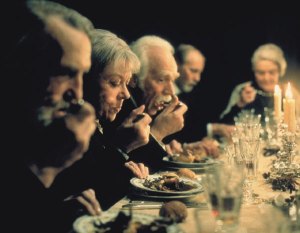
feastI’m a fan of foreign films, but since I don’t speak the language for me to really enjoy the movie, the visual story must be really compelling.  I also love to cook, not from recipes, but creatively, making it up as I go along.  Fortunately for purposes of this blog, there is a film which does both—Babette’s Feast.

The Danish film is set in France in the early eighteen hundreds.  The story centers around a group of pious sisters who receive a visitor who offers to spend her lottery winnings by preparing a feast for them.  The visitor, Babette, happens to be a very skilled chef.  There are those who may think the movie’s plot has more to do with the interplay among the participants.  However, as I am not a professional movie critic, we can skip the interplay and fast forward to the parts I find most relevant, the feast.

(This paragraph comes from Wikipedia.)  The sisters agree to accept Babette’s meal, and her offer to pay for the creation of a “real French dinner”. She leaves the island for a few days in order to return to Paris, as she must personally arrange for supplies to be sent to Jutland. The ingredients are plentiful, sumptuous and exotic, and their arrival causes much discussion amongst the clan. As the various never-before-seen ingredients arrive, and preparations commence, the sisters begin to worry that the meal will be, at best, a great sin of sensual luxury, and at worst some form of devilry or witchcraft. In a hasty conference, the sisters and the congregation agree to eat the meal, but to forego any pleasure in it, and to make no mention of the food during the entire dinner.  The last and most relevant part of the film is the preparation and the serving of an extraordinary banquet of royal dimensions, lavishly deployed in the unpainted austerity of the sisters’ rustic home.

The denouement—I thought it appropriate to use a French word—is whether or not the piety of the guests will prevent them from participating in the feast. It wouldn’t have made for much of a movie if the guests never came and the food sat there getting cold, but what if?  What if there was all of this preparation and no guests?  What if she prepared the feast, and in her haste forgot all about the guests?  Indeed.

Has anyone felt that something is missing in the discussion on EHR?  There’s plenty of talk of Washington and payors.  ARRA and money.  Stimulus and penalties.  Where are the guests?  Are we all responsible for not inviting the EHR dialog to include the patients?  I know it’s there, tucked away somewhere.

We’ve discussed on several occasions the notion that EHR should not be about the EHR.  It should be about the users and the patients.  Nevertheless, how is it being viewed by those groups?  Is it seen as a success?

Let’s make it a little more personal—my recent trip to my cardiologist at a superb teaching hospital in Philadelphia, Pennsylvania.  I usually get about an hour with the doctor—face time—clinical, examination.  Important time to a heart patient, eye contact that communicates you are doing all the right things, your test scores are all off the charts in the right direction, and you are healthier today than most people twenty years younger than you who haven’t had a heart attack.

That’s the real reason I go for the annual checkup, not to find out what I should be doing—I know I’m doing those things, not to find out if I am sick because I know I’m not.  I am there to reap the comfort that comes from having this specific person tell me things that help me believe that if I continue to play an active part in my recovery I will be there to raise my children.

During my last visit, we had about ten to fifteen minutes of eye contact, and the rest of the hour was spent with me watching him enter data into the EHR system.  It wouldn’t have been his choice, and it wasn’t mine.  Other than the first ten minutes, my entire checkup could have been done on WebEx.

I wonder if they offer an EHR?

 Paul Roemer Business Card

Certification & Meaningulful Use

Doctor cartoon bad funny silly goodHere’s a comment I made to John’s Blog, http://www.emrandhipaa.com/emr-and-hipaa/2009/09/12/preliminary-arra-certified-and-cchit-certified/.  Any time I need details,this blog is my first stop.

My 2 takeaways are the phrase to “justify meaningful use”, and the question about whether anyone should worry about any of this. Meaning no slight to those working on this, I think that with each new bit of information on Cert & Meaningful Use, the less likely it is that either will be relevant.

A word to healthcare providers who are implementing EHR. Do not use these benchmarks as your guidelines. Do not use ARRA as a business reason to implement an EHR. If you make an EHR decision as though Washington played no role in the decision, and make your selection of an EHR based on your actual business requirements, Certification and Meaningful Use will not matter. I believe we will learn that the only test that will matter is interoperability. The sooner we learn that under the present framework interoperability can’t happen, the sooner we will get to a solution that will work.

Here’s my take away.  Meaningful Use has no meaningful use.

livepreview.aspx

What can be learned from a predecessor

advice1With all the efforts underway with EHR, it’s only natural that some efforts will have problems, and those leading the efforts may be replaced.

If you’re the new EHR lead, how do you know what to do tomorrow?  You walk in to your new office; a withered Ficus tree is leaning awkwardly against the far wall, vestiges of a spider’s web dangle from a dead leaf.

You place your yellowed coffee mug on the worn desk, change out of your sneakers, and after rubbing your feet, slip on a pair of black Bruno Magli pumps.  The feel of the supple leather relaxes you.

You spot the three envelopes that are stacked neatly on the credenza.  A hand-written note on Crane stationary reads, “If there is an emergency, open the first envelope”.  You place the three envelops in your YSL attaché case, and go about trying to salvage the implementation. 

Three weeks pass.  Things are not going well.  You are summoned to meet with the hospital’s COO.  After checking your makeup, you retrieve the first envelope and read it.  “Blame me,” it reads.  You were going to do that anyway.

Two more months.  The vendor has become a sepsis in the lifeblood of the organization—pretty good word for a math major.  You are summoned to meet with the CEO.  After checking your makeup, you bang you first on your desk, tipping over your coffee, and spilling it all over your Dolce & Gabbana suit.  You don’t have time to change.  You retrieve the second envelope and read it.  “Blame the budget,” it reads.  You were going to do that anyway.

Six months.  Deadlines missed.  Staff quit.  Vendor staff doubles.  Vendor output cut by half.

You are summoned before the board.  You no long check your makeup—you haven’t worn makeup since the day you publically went mano y mano with the head of the cardiology department inside the surgical theater, demanding to see his updated work flows.  You still haven’t been able to get the blood off of your Hermès scarf that he used as a towel.  You are dressed in a pair of faded jeans and your son’s black AC/DC T-shirt, the one with the skull on the back.  You don’t care.

As you reach in the desk drawer for the third envelope, you realize you haven’t had a manicure in four months.  You feel like a disenfranchised U.S Postal employee.  You have become the poster child for the human genome project run amuck.  Somebody is going to lose their DNA today.

You open the third envelope.  “Prepare three envelopes,” it reads.  You were going to do that anyway.

My Best – Paul

Austin Powers

A different approach to reform

BurgerStakeholdersTable1

Labor Day cookout.  America, God blesses us.

Five of our neighborhood’s Wisteria Lane wives—wildebeests—pitched a ten-dollar K-Mart tarp to provide a modicum of shade for the BBQ guests—see prior posts to understand the wildebeest reference.  I should have You-Tubed their struggle.  I had less difficulty pitching my tent by myself on side of a volcano at 2 AM at nineteen thousand feet in a blizzard.  To those who would question why I wasn’t helping them it’s because they didn’t seem to be a Y-chromosome friendly group.

American food—burgers, dogs, sausages, beans, chips.  Then there’s the side dishes brought by the neighbors; salads that require a team of forensics to ferret out the ingredients, and cookies that look so goofy that not even the kids will try them.  Oreos, never mess with perfection.

Okay, down to business.  I’m looking for someone to tell me whether this idea makes sense or if it is all wet.

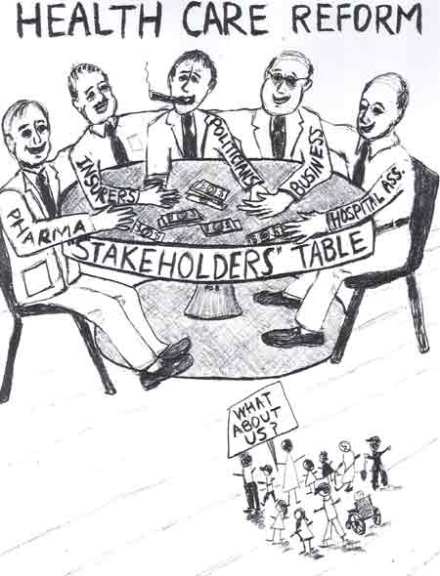
Premise one:  Most of the reason reform being discussed is to solve or improve the healthcare “business model”.  Most of the clinical side is not up for debate, that is, we are not discussing the need to revamp dermatology or pediatrics.

Premise two:  About half of healthcare is government run—the VA, Medicare, Medicaid, and government employee health.

Question one:  Which business model are the reformers trying to address?

  • Private—if a good portion of what’s broken with the healthcare business model can be attributed to the private sector, why are they not leading the discussion?
  • Federal—if some portion of the business model problem lies with the government, and this is the same organization who broke it and are trying to fix it, isn’t that a conflict?
  • Both—why are legislators drafting any portion of this?  What large business problems have any of them resolved?

Question two:  Which group of people should be at the forefront of defining what’s broken, how to solve the business problems, determining what it will cost, and how to pay for it?  Pelosi, Ried, et al?  Or a group of business people headed by someone like Jack Welch?

Question three:  Whose plans are Americans more likely to believe, one coming out of DC, or one coming from a non-partisan group of business leaders?

Question four:  How many committees and firms are developing standards?  How many standards committees would a “Jack Welch” led reform effort have?  That’s right, one.

Question five:  Federal led reform requires teams to confirm that billions spent by healthcare providers on electronic health records will yield systems that actually work (certification and meaningful use).  Would a “Jack Welch” led effort require the same, or would they know the systems would work simply because they had one set of standards and a viable plan for interoperability?

Question six:  Who are the reformers?  What are the names and experience of the people who drafted the 1,000 pages?  Why aren’t they on the talk shows?

Question seven:  Who should draft the reform document?

I recommend a bi-partisan committee of business leaders, no current politicians—something akin to the committee which studied the Challenger disaster.  If we’re talking a trillion dollars, let’s invest six months or so to define a plan, one that can be presented to the country—Ross Perot with one of his PowerPoint presentations, then let’s figure out some way for the people to comment and “vote”.

If reform is going to impact everyone, shouldn’t everyone at least understand it and be free to comment? Doesn’t a trillion dollar spend deserve some form of popular vote?  Congress has a favorability rating in twenties. If four in five people have lost confidence in their ability to do anything in everyone’s best interest, are we willing to let them make this decision for all of us?  It’s “We the people”, not “They the elected”.

My closing thought—no charge.  Have you noticed when our elected representatives soapbox this issue, they speak of us in term of, “the citizens” or “Americans”, seemingly excluding or elevating themselves from the fray.  They need help understanding this is a square and rectangle issue, not every rectangle gets to be a square, but every square is a rectangle.  We need the squares to start listening and stop talking.

Be it enacted by the Senate and House of Representatives of the United States of America in Congress assembled offer comment on the Healthcare Reform Act of 2009.  Acknowleding that we do not have a clear plan, hereby turn the task of planning back to the people.

pastedGraphic.tiff.converted

EHR Strategy, a call to action

EHR Strategy, What I Do & How I Can Improve Your Efforts

Several people have told me that I need to come right out and state the role I play in the Electronic Healthcare Records (EHR) space, and how my consulting firm will add value to your efforts.  Spell out your services, and state a call to action.  This writing will address that topic, and will be the only time I use your time to try to sell you on me.  If you’ll bear with me for a few minutes, I will explain why I write with such self-assurance that most organizations (Hospitals, clinics, IPAs, and providers) have the wrong EHR Strategy—or no recognizable strategy—and my equally self-assured belief that working together we will mitigate that problem.

Here are the facts around EHR:

  • Most large EHR projects have a high probability of failing—the larger the project, the higher the probability
  • Large EHRs may cost more than a new hospital wing—a number of people know of one truly outstanding hospital who spent more than $300,000,000 on their EHR
  • Hospitals are much more knowledgeable about the requirements of a hospital wing and what it will do for them than they are about their EHR strategy
  • All healthcare providers who have entered the EHR space have done so trying to hit the trifecta of moving Gossamer targets;
    • Certification
    • Meaningful use
    • Interoperability
    • Hundreds of vendors who have their own agenda at heart
    • So many individual, disparate, committees are working on standards…do we need to even go there?  Doesn’t each committee create its own standards—if so, where is the standardization?
    • If one removes DC from the loop, many providers can’t articulate the business problem they want the EHR to solve, nor can they articulate an ROI
    • Providers have budgets without requirements, budgets without any knowledge of what an EHR system should cost
    • An EHR should have a greater impact on patients, providers, and payors than any other single program, yet who is in charge?  What skill set to they have to do this?
    • Most providers do not have a plan, a qualified planner, a decider.  Who is reviewing and approving the plan?  What makes them credible?

Those are the reasons we are here.  Our job is to reposition those facts such that they improve your chances of being successful with your EHR selection and implementation.

You know what?  It’s not about the EHR.  It never should be.  The EHR system only accounts for about 20% of the projects success or failure.  It’s code.  The other 80% comes down to planning, conversion, change management, training, user acceptance (patient, doctors, nurses, and administrators), and workflow improvement.

You know what?  It’s about breaking down kingdoms between intra-hospital departments.

It’s about knowing that you can walk into the EHR war room and know that somebody is the decider.  That somebody is able to say, “This is what we are going to do first, second, and third, because that’s the only way we can improve your chances of having a successful EHR program.

That’s what we do.  Most people, given the opportunity, will fail 100% of the time performing open-heart surgery.  A mere handful will avert failing.  Most people will fail 100% of the time who are leading an EHR program will fail.  A mere handful will not.

We are the ERHPMO (Program Management Office).  We are your advocate in managing the EHR vendor to benefit you.  Needless to say, most vendors do not like having us on board.  We are vendor neutral, provider advocates.

We are the anti-Accenture business model.  We do not back up the bus and drop off the children.  We will not try to put 30 people on your project.  You do that—clinicians, and IT.  We pull up in a Prius, drop off a few grownups who’ve been there, done that, got the T-shirt.

We work hand in hand with Hospitals, IPAs, clinical providers, and doctors to help you successfully address some or all of the following;

  • understand the EHR landscape
  • create your EHR strategy, in-house versus SaaS
  • eliminate wasteful redundant costs via shared services analyses
  • define your requirements
  • issue an RFP
  • evaluate vendors
  • negotiate contracts with the vendors
  • plan and execute the change management
  • rationalize your EHR with other which may exist within your walls
  • define and rebuild workflows
  • develop and execute a training program for user acceptance

This is not the time to experiment, or hope you get it right.  To minimize the probability of failure, this is the time to bring in the adults.

That’s what we do.  Sorry for the sales pitch.  Please let me know how we can help.

paulroemer@healthcareitstrategy.com

021_18A

At what point do we decide this will not work?

We haven't tried this approach yet

We haven't tried this approach yet

What is your natural reaction when you are faced with something that you know doesn’t make sense?  Most people respond with silence, or they join the majority, whatever the issue.  I’ve never been good at being most people–the shoes are too tight.

For your edification and consideration.

State CIOs Get ‘To-Do’ List

HDM Breaking News, August 25, 2009

The National Association of State Chief Information Officers has published a report giving guidance to CIOs as their states implement health information technology provisions of the HITECH Act within American Recovery and Reinvestment Act.

The act requires state leadership in two primary areas: oversight for the planning and deployment of health information exchanges and management of the Medicaid incentive payments for meaningful use of electronic health records, the report notes.

“The passage of the HITECH Act essentially merged health policy with technology policy across state government and state CIOs must play a key role in HIE development and implementation,” according to the report.

The report includes a list of upcoming deadlines for specific federal regulatory actions, including those most affecting states and their CIOs. The report also details four broad areas where CIOs can have a major impact on HIE initiatives: planning, governance, financing/sustainability and policy.

“The HITECH Act placed a significant amount of new responsibilities on states in regards to state oversight for HIE and the planning and implementation grants for preparing for HIE,” the report states. “During this initial planning period, state CIOs must secure a seat at the table to establish themselves as key stakeholders and also to recognize strengths and identify weaker points that require resolution within their own offices relating to statewide HIT/HIE planning. They must ask themselves what they, with their unique enterprise view, can do to support and contribute to each of these areas.”

That was simple.  I’m thinking that if we can tie the IRS into this system of HIE, HITECH, ARRA, Rhoi, CIO, MOUSE we may be on to something useful.  Did you ever think that acronyms are used as a means of obfuscation, or to hide the identities of the people making these decisions?  I am much more likly to lend my avatar to a group of State This & Thats than I am to have someone write, Paul Roemer is the brainchild behind this I^(*&^%%!.  I like committees of three, especially when the other two don’t know for what time I scheduled the meeting.

English 101.  The desk is hard, the task is difficult, and the task described above is impossible or at least out of the realm of mortals.  Does someone think checking off the items on the list will easily allow my doctor to follow me on business or vacation across the country?  We are all smarter than that and we need to stand up and lead.  The time to follow has ended.

MyHero

Be very afraid

white_high_heelsI remember two things from my lone sociology class in college.  Somebody name Emile Durkheim—given that I cut almost every lecture, I continue to amaze myself that I spelled his name correctly—he did something about suicide rates, and one thing about inherent fear—we are born with knowledge of two types of fear; heights and loud noises.  I was born with a third, the fear that comes from thinking that one day I might slip out the door wearing white shoes after Labor day—see how timely this is?

There’s been a common thread for the last few days among the social media-ites—sometimes you are forced to make up a word or two.  The thread of which I write is fear, a fear that started in anticipation, and has been building since last week.  Muculent palms, jitters, slight schizophrenia.  The anticipation of the voices, “And he did hear a sound rising over the snow. It started in low… then it started to grow.”  Sorry for the Grinch reference, I’m trying to work through this.

It starts with notifications; emails, letters.  Doctor’s name and phone number.  Emergency contact information.  Write it three times in case we lose the first two.  Then comes the demand for tools—don’t dare go to sleep without completing this; pencils, scissors, crayons…Backpacks.  Lunch boxes.  I can’t wake them up.  They open one, look at me, and roll over.  They say things like, “This is what all the kids are wearing.”  They look you in the eye and lie, “I brushed my teeth.”  “If you don’t fill out the forms I can’t go back tomorrow.”

They fail to recognize that we have multiple degrees.  And if they did realize it, they would not care.  You may be a big shot between 8 and 5, but right now you’re just dad, and why don’t we have any fruit roll-ups for my lunch.

So, how was your day?  For me the voices have subsided, but the sweaty palms will return just prior to the school buses.

I look at healthcare reform and EHR and think, the only thing to fear is reform itself.

I’ve been asking friends for their input about our conversations here, and somebody whose opinion I value highly suggested I write what my audience wants to hear.  I can’t do that—that’s what the other bloggers do—feel good, but this, but that, cheerleaders.

This is difficult, at least if you want it to work.  There’s no shame in asking for help.

drevil

Conversations with a Wildebeest

my neighbors

my neighbors

Today’s narrative follows directly from yesterday’s tale of the wildebeest, so it may be helpful to revisit to prior post.  Suffice it to say that the Neiman’s set wasn’t thrilled to learned I  compared them to our cloven friends.

One rule of the Kalahari is that the pursuer must approach the prey stealthily. Picture if you will a David Attenborough looking and sounding chap, more suitably attired to attend a formal tea than a desert trek, inching towards that same Baobab tree we discussed in a prior narration. Bands of perspiration rim his pith helmet, darkening it. He pats his forehead with a freshly pressed linen handkerchief and returns it to the breast pocket of his Khaki shirt. The wildebeest have moved from the shade of the tree to the nearby watering hole. While some stand guard, he notices that a few at a time quench their thirst. For protection the youngest of the wildebeest ensconce themselves in the middle of the circle. The narrator moves the boom of his microphone towards the herd.

“Did you see the Greatest Looser last night?”  Inquired the group’s leader.

“I TIVO’d it.”

“Can I come over and watch it with you?” asked a third as she quenched her thirst with a half-caf, mocha frappachino iced latte. “I totally spaced.”

The circle of soccer moms seemed to tighten as they saw me approach. “Still blogging?” coyly asked the wildebeest—cum soccer mom–wearing the Lilly Pulitzer capris.

All wildebeest aside, here’s the deal. I want to have a conversation with you. I need your help. Here’s my premise. Somewhere along the way we lost our edge, our hunger for excellence. There was a big push twenty years ago, a lot of attention was paid to the topic, and a lot of people cleaned up writing books and giving seminars. I want your help in understanding what brought about the loss of excellence and what can be done to turn it around. I’d like to learn what you’ve seen and heard. You don’t have to name the organization. I won’t name names, yours or the organization. You can send me a message, a private email, or post it for everyone.

Some ideas for comments include but aren’t limited to:

1. What’s broken
2. Why isn’t it being fixed
3. Where does the breakdown for excellence occur
4. Why patients leave
5. What makes them mad
6. Why do they hate a given provider
7. Do patients think they matter
8. Who has the power to solve the problems
9. Do providers want to be excellent business people
10. Is excellence profitable
11. What 3-5 things can a provider do to get on the right path
Thanks in advance.

How does this impact EHR?  It has everything to do with it.  If you only remember one thing, let it be this: It’s not about the EHR.  The EHR is a vehicle.  It can either be a vehicle for change, or it can be used to hamper change.  All the EHR really does it automate certain things.  It’s easier to automated inefficient and ineffective things than it is to automate efficient and effective things.  Why?  Because the bulk of the work lies in making them efficient and effective.  That’s where the change management and workflow efforts come into play.

My best- Pauleddiesmal

The wildebeest postulate

wildThe Kalahari; vast, silent, deadly. The end of the rainy season, the mid-day heat surpasses a hundred and twenty. One of the varieties of waterfowl, most notably the flame red flamingo that nested in the great salt pans in Botswana, has begun its annual migration. In the muck of one of the fresh-water pools that had almost completely evaporated, writhes a squirming black mass of underdeveloped tadpoles. A lone Baobab tree pokes skyward from the middle of the barren savanna. In its shade, standing shoulder to shoulder and facing out, a herd of wildebeest surveys the landscape for predators.  Sir David Attenborough and PBS can’t be far away.

Some things never change. I make my way across the freshly laid macadam to meet the school bus. Fifty feet in front of me is a young silver maple tree, the tips of its green leaves yielding only the slightest hint of the fall colors that are hidden deep within. The late afternoon sun casts a slender shadow across the sodded common area. One by one they come—soccer moms; big moms, little moms, moms who climb on rocks, fat moms, skinny moms, even moms with chicken pox—sorry, I couldn’t stop myself—as they will every day at this same time, seeking protection in its shade. My neighbors.  It’s only seventy-five today, yet they seek protection from the nonexistent heat, a habit born no doubt from bygone sweltering summer days. A ritual. An inability to change. In a few weeks the leaves will fall, yet they will remain in the shadow of what once was, standing shoulder to shoulder facing out, looking for the bus. A herd. Just like wildebeest.

The kids debus–I just made that word, hand me their backpacks, lunch boxes, and hundreds of forms for me to complete.  I look like a Sherpa making my way home from K-2.

I shared this perspective with the moms, and have halted most of my bleeding. I can state with some degree of certainty that they were not impressed with being compared to wildebeest. So here we go, buckle up. By now you’re thinking, “There must be a pony in here somewhere.” Some things never change; it’s not for lack of interest, but for lack of a changer. For real change to occur someone needs to be the changer, otherwise it’s just a bunch of people standing shoulder to shoulder looking busy. How are you addressing the change that must occur for EHR to be of any value?  EHR is not about the EHR, it’s about moving from a 0.2 business model to 2.0.  Someone who sees the vision of what is is—sorry, too Clintonian—must lead.  Be change.

One of the great traits of wildebeest is that they are great followers.

sing4