The EHR Deception

As I was walking through the store, I spilled the coffee on the floor…

Two pounds of Sumatra espresso beans; dark roast.  I set the grinder to the finest setting, and without batting an eye, I dumped the two pounds of beans into the one-pound grinder hopper—should have batted an eye.  For those who may be wondering, coffee beans sound similar to hail hitting a window as they spill on to the floor.

The tool I was using did not have the capacity to do what I needed it to do.  So not only was the job not done, I had created quite a mess for myself.

This is a lot like EHR and ICD-10 only without the aroma—trying to complete a two-pound task with a one-pound tool—under scoping the problem.  Implementing the application accounts for about fifty percent of what needs to be done for either solution to be effective.

What is in the other pound, what bits are consistently underestimated?

  • Planning (with a capital P)
  • Process alignment, elimination, and optimization
  • Change management
  • Training

Here’s another thing I learned at the store.  If one pound of coffee costs twelve dollars, how much does two pounds of coffee cost?  That is right; the second pound also costs twelve dollars.  So, if EHR costs twelve million several times over to implement, doing all the other related tasks should also be budgeted for about the same amount.

Sometimes it is better to just stick with drinking tea.


What people at HIMSS were afraid to say

One image of HIMSS that will not escape my mind is the movie Capricorn One—one of OJ’s non-slasher films.  For those who have not seen it, the movie centers on the first manned trip to Mars.  A NASA Mars mission won’t work, and its funding is endangered, so feds decide to fake it just this once. But then they have to keep the secret…

The astronauts are pulled off the ship just before launch by shadowy government types and whisked off to a film studio in the desert.  The space vehicle has a major defect which NASA just daren’t admit. At the studio, over a course of months, the astronauts are forced to act out the journey and the landing to trick the world into believing they have made the trip.

Upon the return trip to Earth, the empty spacecraft unexpectedly burns up due to a faulty heat shield during reentry. The captive astronauts realize that officials can never release them as it would expose the government’s elaborate hoax.

I think much of what I saw at the show was healthcare’s version of Capricorn One.  Nothing deliberately misleading, or meant as a cover-up or a hoax.  Rather more like highlighting a single grain of sand and trying to get others to believe the grain of sand in an entire beach.

The sets for interoperability and HIEs served as the Martian landscape, minus any red dust.  There was a wall behind the stage from where the presentation interoperability was shown.  I was tempted to sneak behind it to see if I could find the Wizard, the one pulling all the nobs and using the smoke and mirrors to such great effect.  It was an attempt to make believers, to make people believe the national healthcare network is coming together, to make us believe it is working today and that it is coming soon to a theater near you.

After all, it must be real; we saw it.  People wearing hats and shirts emblazoned with interoperability were telling us this was so, and they would not lie to you.

The big-wigs, and former big-wigs—kudos to Dr. B. for all his hard work—were at the show for everyone to see, and to add a smidgen of credibility to the message.  They would not say this was going to happen if it were not—Toto, say this ain’t true.

The public relations were perfect, a little too perfect if you asked me.  Everyone was on message.  If you live in Oz and go to bed tonight believing all is right with the world, stop reading now.  If what you wanted from HIMSS was a warm and fuzzy feeling that everything is under control and that someone really has a plan to make everything work you probably loved it.

Here is the truth as this reporter saw it.  This is not for the squeamish, and some of it may be offensive to children under thirteen or C-suiters over forty.  In the general sessions nobody dared speak to the fact that:

  • Most large EHR implementations are failing.
  • Meaningful Use isn’t, and most hospitals will fail to meet it.
  • Hospital productivity is falling faster than are the Cubs chances of winning a pennant.
  • Most hospitals changed their business model to chase the check
  • Most providers will not see a nickel of the ARRA money—the check is not in the mail and it may never be.

The future as they see it is not here, and may never be, at least until someone comes up with a viable plan.  Indeed, CMS and the ONC have altered the future, but it ain’t what it used to be.  People speak to the need to disrupt healthcare.  Disrupt it is exactly what they have done.  The question is what will it cost to undo the disruption once reason reenters the equation?  What then is the future for many hospitals?

  • Hospitals on the whole will lose more much more money due to failing to be ready for ICD-10 than they will ever have seen through the ARRA lottery.
  • It make take years to recover the productivity loses from EHR and the recoup those revenues.
  • Hospitals spending money to design their systems to tie them into the mythical HIE/N-HIN beast will spend millions redesigning them to adapt to the real interconnect solution.
  • The real interconnect solution will be built bottom-up, from patients and their primary care physicians.
  • Standardized EMRs will reside in the cloud and patients will use the next generation of smart devices.  And like it or not, the winners will be Apple, Google, and Microsoft, not the ONC and CMS.  Why?  Because that is who real people go to to buy technology and applications.  A doctor still does not know which EHR to buy or how to make it work.  Give that same doctor a chance to buy a solution on a device like an iPad and the line of customers will circle the block.

And when doctors are not seeing patients they can use the device to listen to Celine Dion.  This goes to show you there are flaws with every idea, even some of mine.


Poken: How to push the EMR to the cloud

For those wondering if the fact that I have not written recently is a result of me having mellowed or having found the world more to my liking, not true.  I have been busy earning minus points as I tried to get it sorted in those wide open spaces of my mind.  It is difficult for me to find much comfort in sleep when I think all the leftist gremlins are in cahoots—I see two masons shaking hands and I think conspiracy.

Now, before this begins to read like I wandered too far from the republican rest home, I note that some of my best friends actually know democrats; so I am not as close-minded, or perhaps clothes-minded, as I would like to be.

Some are slow to adapt ideas to a changing world, aimlessly swatting new ideas away with a no-pest-strip as though they were plague carrying mosquitos.  Their thoughts, frozen in time, move so slowly they have been overtaken by a skateboard—and that skateboard was under someone’s arm.  These are the same individuals whose ability to play outside of the comfort of their own sandbox has not been seen since the internet was powered by steam.  It is a little like being a dinosaur while those around you are still floundering in the primordial bisque, still trying to wrap their synapses around the cold ideas distilled in the anecdote.

That is not to suggest that others do not think.  I am sure they have dozens of thoughts scribbled on the inside of their head, but those thoughts are erased each time they play with their hair—brains not big enough to swing a cat in without giving it a minor concussion.  There are fomenting alchemies of thought nuggets, but never quite enough to turn base metals into gold.  Sometimes, when the lighting is just right, you can see their curve of illogic thought arching overhead like static electricity.

In normal prose, I tend to be few of words.  I can get through entire days uttering no more than ‘uh-huh,’ a condition to which I attribute having exited the womb not fully-formed.  Writing is different than the spoken word.  For one thing it is infinitely easier and more pleasingly voyeuristic, for it can more entertaining to write about venomous ideas, not enough to kill my prey, simply to stun it.

Where then do ideas originate?  They are not like sex in a packet where all you have to do is add water.  The lack of thinking has led us to a tragic age most refuse to take tragically.  Thought patterns are aborted before they germinate, as though the thinker was taking intellectual contraceptives.  But believe it or not, I often find myself hoisted high on the petard of my own self-induced mesanic naivetés.  When a spark of a thought enters my mind, I rarely let it go quietly into that good night.  Instead I tear at it like Henry VIII coming off a forced diet—I know I mixed the metaphor, but I liked it.

I know rarely how my mind moves me from thoughts A to B.  Today proved no different.  Take the Poken.  This device is the newest technological mind-nibblet—a tiny jump-drive device about the size of prune whose purpose in life is to help two individuals sync their personal contacts by pok-in’ their respective Pokens.

You have got to hand it to them, for it sounds like it could be more entertaining than syncing one’s Blackberry.  If I understand correctly the concept, if my Poken pokes your Poken the Pokii mate—Pokii may or may not be the correct form of the plural, but it will have to do for now.  Once the mating process has ended, and before mine finishes its cigarette, I have your contact information and you have mine.

This could be an interesting way to swap business contacts, but as I live in the land of the Jabberwocky my mind does not work that way.  “Then he got an idea, an awful idea. The Grinch got a wonderful, awful idea.”

I jested about the Poken a few days ago, and then I thought about how this device could be made to work in healthcare.  The Poken is a communication device, sending and receiving secure requests to the cloud to permit one to access and update contact information.  Not much of a healthcare offering doing that, but what if?  What if instead of letting me share my contact information with someone I select, it, or something like it, allowed me to share my personal health record with my physician?  What if my physician was able to update my health record using a similar device?

The EMR and PMR applications would be in the cloud.  The Poken would provide the “handshake.”  One fully functional EMR.  The rest is history.  Thanks for playing along.


Nietzsche on HIT Strategy

The problem with being a consultant is not everyone wants their responses packaged in the same manner I tend to deliver them.  I communicate best visually, pictorially.

Asked what I want for dinner, I respond with a 3-D bar graph.  Forty-five percent of me wants pasta, thirty percent wants roast beef—a year over year increase of seven percent, but not a statistically significant sample size—and one hundred and twelve percent of me wants whatever she is willing to cook—which means I do not have to cook.

There are two kinds of consultants and, I am the other kind.  ‘Nuff said.  On a side note, as I keep telling the police, I am not the person responsible for holding giraffe fights in the linen section of Neiman Marcus.  Nor am I the guy with the collection of taxidermist-stuffed German World War II soldiers in my basement.

When one reviews the value of a healthcare IT strategy—if your organization does not have one click (http://www.disney.com) and you will be taken to a site to make more valuable use of your time—in order for it to be worth more than graffiti on an overpass (plebian) the plan must have a plan.  It also helps if the strategy at least pretends to be strategic.

The stigmata of most strategic plans is they are neither strategic nor plans.

If there is one thing a strategy should be able to address it is to be able to answer why, to be able to answer what benefit the execution of said strategy will deliver.

More than fifty percent of hospitals will not have a written IT strategic plan.

More than half that do have strategic plans will not pass the value test.

Let us suppose for a moment a hospital has what they believe to be a real HIT strategic plan.  Does that document contain answers to the following questions?

  • Implement XYZ EHR.  Why?  Why XYZ?  What benefits will the hospital receive?  Few if any will formalize benefits ahead of time because they can be held accountable when those benefits are not delivered.  Is it safer to simply check the box for having “completed” the implementation?
  • Meet Meaningful Use.  Ditto.
  • Accountable Care Organization.  Ditto.
  • ICD-10.  Ditto.
  • Family Experience Management.  Ditto.

Maybe Nietzsche knew more about IT strategy than he has been credited.  “All things are subject to interpretation.  Whichever interpretation prevails at a given time is a function of power, not truth.”


EHR Failure Factors–step away from the computer

There are days when it doesn’t pay to be a  serial malingerer, and when it does, the work is only part time, but I hear the benefits may be improving as I think I heard somebody mention healthcare is being reformed.
I don’t know if you are aware of it, but there are actually people who have taken an Alfred E. Newman, “What, me worry” attitude towards EHR.  For the youngsters in the crowd, Alfred was the poster child for Mad Magazine, not Mad Med.

Just to be contrarian for a moment–as though that’s out of character for me–most providers have no need to fear–does this happen to you?  You are writing aloud, trying to make a point, and the one thing that pops into your mind after, ‘there’s no need to fear’ is “Underdog is here.”

Anyway, since many providers haven’t begun the process, or even begun to understand the process, there is still time for them to lessen the risk of failure from an EHR perspective.  Many don’t want to talk about it, the risk of failure.

Here’s another data set worth a look (The Chaos Report).  They went a little PC on us calling them ‘Impaired” factors.  EHR impairment.  Step away from the computer if you are impaired, and take away your friend’s logon if they are.  These are failure factors.

Project Impaired Factors % of  the Responses
1. Incomplete Requirements 13.1%
2. Lack of User Involvement 12.4%
3. Lack of Resources 10.6%
4. Unrealistic Expectations 9.9%
5. Lack of Executive Support 9.3%
6. Changing Requirements & Specifications 8.7%
7. Lack of Planning 8.1%
8. Didn’t Need It Any Longer 7.5%
9. Lack of IT Management 6.2%
10. Technology Illiteracy 4.3%
11. Other 9.9%

My take on this is with overall “failures” so high, several respondents could have replied to “all of the above.”  Also of note is that these failure reasons differ from the ones listed previously.

Who knows, maybe if we multiply them by minus one we can call them success factors.


Healthleaders Media: E-Health Systems: For Love or Money?

The following are the comments I posted to Gienna’s article, http://ow.ly/3FWTP

Nicely written Gienna.  My concerns from the get go regarding Meaningful Use (MU) and Certification are:

  • Is Meaningful Use meaningful
  • If so, to whom


My answer to both questions is it is meaningful, on paper, to the ONC and CMS.  It is meaningful with the respect that it does one thing.


  • Meaningful Use changes the course of a healthcare provider’s business strategy from whatever internal course it was pursuing to one having a national focus.

If you do not believe me, look at your resource plan for meeting MU.  Some hospitals are having to redirect more than fifty percent of their IT resources away from whatever they were doing for the hospital to meet the MU requirements.

The article reports several sets of numbers which I think are at best misleading.  I think those hospitals who meet MU will do so much later than are being reported.  Few will make it in time to capture the full EHR “rebate”.  As such, the pool of available money to go back to hospitals is overstated, as are the number of hospitals who will receive it.

There is a broad chasm between those who expect to receive money and the amount they expect to receive, and how much will paid be paid to how many.

Now, with respect to whether any of this is meaningful; how many hospitals would have been willing to sacrifice their business strategy and spend millions of dollars to try to meet such a gossamer directive if this was tied to any other directive originating out of Washington?

Let us take something so outlandish as to be silly just to try to illustrate the point; paining your hospital pink.  If Washington offered similar sums of money and if one had to spend similar resources to earn it, would a hospital’s executive team approve the expenditure?  What is the business reason that makes MU so different?

The other issue I have with their optimistic MU adoption forecasts is the following.  Meeting MU is binary.  That is, there are no points for getting close.  A hospital which meets ninety-five percent of the criteria receives the same rebate as a hospital which meets none of the criteria.  Zero.  Using their own figures, if hospitals meet it by 2016, all they will have done is spent millions to receive zero payout.

As you calculate the ROI for EHR/MU be sure to include the following:

  • Will your EHR implementation be successful?  The latest figures I have seen suggest that your odds of having a successful implementation of EHR are less than one in two.
  • If you are “successful” will you meet it in time to potentially qualify for the full amount—if not, decrease what you expect to receive.
  • Will you complete the requirements to your satisfaction—if not, multiply your expected payout by a number less than one?
  • Will you pass the MU audit?  Some will not.  That is why there is an audit.  If you do not pass, you can reapply at a later date, but you will no longer be entitled to the full amount.  Again, multiply your expected payout by a number less than one.

And, here’s the kicker.  Here is the calculation most hospitals have overlooked.  How much has your productivity dropped since you implemented EHR?  A heads up for hospitals who have not completed their implementation—a large number of hospitals have spent in excess of a hundred million dollars only to see their productivity still twenty percent below what it was without EHR.

What does such a productivity loss do to your ROI calculation?  There is no language from ONC and CMS stating that such a productivity loss is meaningful.


EHR: The Migratory Patterns of Coconuts

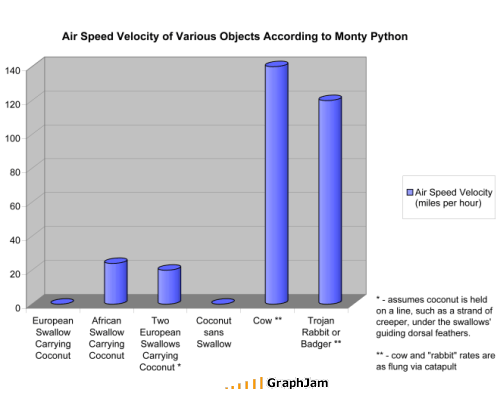
Are you suggesting coconuts migrate? (Not at all, but a swallow could grip it by its husk.)

Sometimes I get reactions from my clients which suggest that my ideas have people questioning if I just fell out of the stupid tree and hit every branch on the way down, especially when what we’re discussing seems to move from the theoretical and towards the heretical. However, there was a presentation I made to one of my clients where I had the entire room believing that i might as well have been suggesting that coconuts migrate.

Allow me to set the stage. I presented to the CIO of one of the largest providers in Europe a vision for what their IT strategy should be. This was an 0.2 firm requiring a 2.0 solution.  As you can guess, it was fairly easy to suggest that better alternatives were available to them, but if you’re a member of the Flat Earth Socitey you’re not going to believe anything until someone is able to literally change your perspective.

During my presentation I wrote on the white board that I would help them choose between three alternatives. At this point, a British colleague and good friend, came to the front of the room—uninvited, removed the marker from my hand, erased the word ‘between’, and penned the word ‘amongst’. “We choose between two things, and amongst three or more,” he said with a grin and then returned to his seat. I suggested that since English was not the native language of our client that his point was probably lost on them, to which he stated that his point was directed at me whose native language was supposed to be English. God save the queen. He also tried to make the point on more than one occasion that the American War of Aggression with England did not end in 1783 with a victory for America, but with a British retreat.

Anyway, we were choosing between three alternatives, at least I was. After about ten minutes of explaining what could be achieved and how it might be structured, I was interrupted again, this time by the CIO. He too took my marker, concluding that I was a coconut. It took me about thirty minutes to convince him that everything I’d presented was not only achievable, but already operational in a number of their competitors.

So, as we head down the EHR path with our Project Management Executive, the person who will be spearheading the internal effort to affect change, we must find a way to make sure the executive is properly equipped. For starters, the executive needs to have, and to be able to communicate a vision, a vision for the change, for how it will impact the organization, and an ability to communicate it.


EHR, the wisdom of crowds

According to National Geographic, a single ant or bee isn’t smart, but their colonies are. The study of swarm intelligence is providing insights that can help humans manage complex systems. The ability of animal groups—such as this flock of starlings—to shift shape as one, even when they have no leader, reflects the genius of collective behavior—something scientists are now tapping to solve human problems.  Two monumental achievements happened this week; someone from MIT developed a mathematical model that mimics the seemingly random behavior of a flight of starlings, and I reached the halfway point in counting backwards from infinity–the number–infinity/2.

Swarm theory. The wisdom of crowds. Contrast that with the ignorance of many to listen to those crowds. In the eighties it took Coca-Cola many months before they heard what the crowd was saying about New Coke. Where does healthcare EHR fit with all of this? I’ll argue that the authors of the public option felt that wisdom.  If you remember the movie Network, towards the end of the movie the anchorman–in this case it was a man, not an anchor person–besides, in the eighties, nobody felt the need it add he/she or it as some morphed politically correct collection of pronouns.  Whoops, I digress.  Where were we?  Oh yes, the anchor-person.  He/she or it went to the window and exhorted everyone to yell, “I’m mad as hell, and I’m not going to take it anymore.”  Pretty soon, his entire audience had followed his lead.

So, starting today, I begin my search for starlings.  A group whose collective wisdom may be able to help shape the healthcare EHR debate.  The requirements for membership is a willingness to leave the path shaped by so few and trodden by so many, to come to a fork in the road and take it. Fly in a new flock.  A flock that says before we get five years down the road and discover that we have created such an unbelievable mess that not only can we not use it, but that we have to write-off the entire effort and redo it, let us at least evaluate whether a strategic change is warranted.  The mess does not lie at the provider level.  It lies in the belief that hundreds of sets of different standards can be married to hundreds of different applications, and then to hundreds of different Rhios.

Where are the starlings headed?  Great question, as it is not sufficient simply to say, “you’re going the wrong way”.  I will write about some of my ideas on that later today.  Please share yours.

Now, when somebody asks you why you strayed from the pack, it would be good to offer a reasoned response.  It’s important to be able to stay on message.  Reform couldn’t do that and look where it is. Here’s a bullet points you can write on a little card, print, laminate, and keep in your wallet if you are challenged.

  • Different standards
  • Different vendors
  • Different Rhios
  • No EHR Czar

Different Standards + Different Vendors + Different Rhios + No Decider = Failure

You know this, I know this.

To know whether your ready to fly in a new direction, ask yourself this question.  Do you believe that under the present framework you will be able to walk into any ER in the country and know with certainty that they can quickly and accurately retrieve all the medical information they need about you?  If you do, keep drinking the Kool Aid.  If your a starling, come fly with us and get the word out.  Now return your seat backs and tray tables to their upright and most uncomfortable positions.


EHR and HIT positions available

Thanks to those of you who have been faithful readers for so long.

If you know of any skilled EHR or HIT professionals looking for interesting opportunities with a great firm, please forward them this link.  Openings include;

  • EPIC
  • McKesson
  • NextGen
  • Meditech
  • Management Consulting
  • Allscripts
  • Cerner
  • Eclipsys
  • SeeBeyond
  • Cloverleaf

http://www.santarosaconsulting.com/Consultant/JoinOurTeam.aspx

Thanks for your help.

Informatics, Is There Really an Impact?

I posted the following to a post on the HIMSS Blog titled, Informatics, Is There Really an Impact?.  http://blog.himss.org/2010/09/16/informatics-%E2%80%93-is-there-really-an%C2%A0impact/#comment-434 What do you think?

I think there is an impact, but for all but a few the impact of informatics is not positive. It is however, exactly the one for which they planned—albeit not deliberately. I think the evidence supports the reasons for the abject pickle in which providers find themselves comes from the fact that most failures can be traced back to the very beginning of a provider’s efforts to implement EHR.

To compound matters, as these same providers look to implement Accountable Care Organizations (ACOs) to their existing business models, they will find themselves pickling their entire informatics effort.

A hospital CEO recently confided to me that his peers could not be less qualified when it comes to the skills needed to select an EHR system. He stated EHR decisions are being made based on what others have done, on conversations had at a trade show, or on a pitch from a vendor.

Now, before we start slamming the vendors and their products—as I can be fond of doing—I do not think most EHR failures have as much to do with the vendors as they have to do with the providers. Very little documented rigor exists when it comes to selecting an EHR vendor. In fact, I would wager many large providers issued a more detailed request for proposal (RFP) to select their cafeteria vendor than they did for the EHR.

I am a firm believer that if you cannot find something on Google, the reason you cannot find it is that it does not exist. Googling EHR RFP does not offer anything useful. Is that perhaps because there are not many providers who have developed a meaty EHR RFP?

There are a number of providers who are on version 2.0 for the EHR. They are doing so under the mistaken belief that the problems they encountered with version 1.0 had to do with the software. Looking at the large provider EHR landscape, there are providers who are switching from vendor A to vendor B. Now, if that was the only thing going on, one might find cause to blame vendor A. Unfortunately, other providers, some in the same town are switching from vendor B to vendor A which sort of leads one to suspect that perhaps the software is not the problem.

An argument can be made that if a provider selects its EHR from among the leading 5-7 vendors, they should have about an equal chance of having a successful implementation. At some providers, vendor A is working reasonably well. At other providers, vendor B is working reasonably well.

Of course, as the evidence supports, providers have about an equal chance of having an unsuccessful EHR implementation. Some providers are trying to make the argument that after implementing EHR—and spending an excess of one hundred million dollars—having a productivity loss of around twenty percent does not mean their EHR implementation failed.

I think one can state categorically that if your productivity drops twenty percent, your implementation failed. I think that if your EHR plan at the outset predicted a twenty percent productivity drop, your EHR project would never have been approved.

So, why the mess? If a provider ran a disaster recovery project on what went wrong, the most likely answers would come down to many of the items you listed in your post; a lack of requirements, poor planning, and a morbid lack of time and resources directed to process alignment and change management. Why is this the case? I think it is because the target providers are trying to hit has more to do with meeting Meaningful Use than with implementing an EHR that will meet their needs.

Two years from now when providers reassess informatics in light of the failure of ACOs, it will likely come down to these same issues. There is plenty of time to get these issues right. But then again, there is always plenty of time to do it twice.