This won’t solve all of your problems, but it’s a good start–sort of like 1,000 lawyers on the bottom of the ocean.
www.nophonetrees.com
Who knows, perhaps your organization is included.

This won’t solve all of your problems, but it’s a good start–sort of like 1,000 lawyers on the bottom of the ocean.
www.nophonetrees.com
Who knows, perhaps your organization is included.
The hand-written note, scrawled in the best penmanship of my nine-year-old daughter, lay next to the plate of sugar cookies and the warm glass of milk. It was eleven PM. Three kids lay in their sleeping bags, asleep on the floor of the play room—cameras ready to capture images of the annual intruder.
Illuminated by the glimmering lights from the tree, I scanned her note. Two pages. Itemized. Fifty-three lines, fifty-three items. Requests. The letter begins, “Dear Santa. I wrote this list today. I know you already got my letter. These are other things you could give me. Please leave them under the tree with the rest of my presents.”
There are a number of ways to view her letter. It certainly is cute—it’s probably cuter if you’re not her parents. You know what occurred to me at 11 PM as I stood there in my slippers eating the cookies and drinking the warm milk to reinforce the message to my children that Santa exists? Two words. Scope Change. Plain and simple.
Weeks of thoughtful planning, buying, and wrapping possibly shattered by the scratchings of a number 2 pencil.
Make no mistake; this will happen to you on your EHR project. Scope change. Where will it come from? Users, vendors, the CFO, reform. Most projects fear change. Change is feared because the project team never quite got their arms around the original scope. Most change means more dollars and more time.
Scope change can be healthy. Why? I bet most EHR projects are under-scoped. Did you read that correctly? Yes. I bet if an independent party assessed your scope document and work-plan you will find you are under scope in these three areas:
If that’s the case, you will have spent tens of millions of dollars building something slightly more functional than a rather intricate Xerox machine.

 My friends who have nicknamed me Dr. Knowledge or the Voice of Reason have seen me on those rare moments when the synapses were firing on all cylinders. There are others who have seen me in my less than knowledgeable moments.
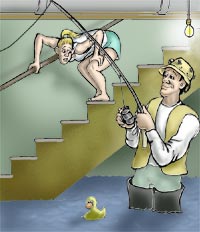
For instance. There was the time I took my three young children to the movies. Upon returning home we heard the calming sound of water flowing; only it wasn’t calming since our home was not built with a stream running through it. After looking in the basement and seeing water streaming through the ceiling, I called our builder’s hot-line. I was furious at them and so told the handyman as he looked at the exposed rafters.
Undaunted, and convinced that the pipes were fine, he proceeded to the first floor to source the leak. I saw water coming through the wall and ceiling of the conservatory and gave him another piece of my mind—something my mother had always cautioned against so as to ensure I still had some left in case I needed it. We headed upstairs, through a bedroom, into my son’s bathroom. By this time we were wading. The sink faucet was in the on position, the drain was in the closed position, and I was in no position to blame the builder.
I learned that my son had been doing a ‘speriment with the soap. He told me it was my fault he didn’t turn off the faucet before we left because I told him, “come down stairs right now.” He no longer does ‘speriments in the sink and most of the waviness in the wallboard has subsided.
I hate being wrong, especially in front of an audience. Once I have an opinion about something, the planet has to shift on its axis before I’m likely to reconsider. I’ve found that to be true with building strategy to support a business that is undergoing radical change, especially when people are asked to consider not doing something, or are asked to consider doing something differently. There’s way too much, “That’s the way we’ve always done it,” and, “That’s the way corporate told us to do it.” What in your strategy would benefit if someone considered doing something differently?


This presentation was delivered 12.10.09 in NJ.
http://www.slideshare.net/paulroemer/em-rgemcy-medicine-event-121009-joint-ppt-final

Did you know there’s a hospital in the US whose web site gets 2,000,000 hits a month?
Did you know that same hospital tracks how patients made the decision to use their services?
Did you know that more than $2,400,000 dollars in fees came about as a direct result of the web site?
I’d bet the ROI on that exceeds everything else in the hospital.


Remember as kids trying to see how many bumble bees you could catch in a jar before you panicked and they all got lose? You couldn’t get the top all the way on and all of a sudden dozens of bees exited the jar as you raced across the field of clover. That’s how patients are. You try and catch as many as you can, but once they get out it’s over. So, here we go again. Social networking. We’ll get there in a moment.
For those old enough to remember the seventies, what are you able to recall about high school? If you’re like me, much of it’s selective. The web seems to be changing some of that. Classmates.com. Facebook. Ever notice how there are no rules? Anyone can get to anyone else. Unhindered. Uninvited.
There are those who never grew up, and there are those who never grew older–there’s a difference. Sometimes it’s a good thing. Like for instance trading emails with the girl in the red velvet dress, the one with whom you first slow danced in the ninth grade.
Then there’s the other side to the social networking coin. A darker side. Unless you happened to be among the minutia of students who gambolled care freely down the crowded halls during those four years believing that the school year book should only contain your picture, graduating high school gave you your out, gave you permission to euphemistically bury the bourgeoisie who needed burying. People who, when you were eighteen wouldn’t put you out if you were on fire, the very people who probably set you ablaze, now knock digitally on your facebook door asking to befriend you. Did I miss something here? The part where my fabebook-buddy-wannabe says, “Now that we’re grownup, forget I was a jerk in high school, ignore the fact that I was dumber than a bowl of mice”—sounds like I may have missed one or two of my twelve-step meetings. Recovery is progressing well—really.
Just because a hospital is paranoid doesn’t mean their customers don’t hate them. Poltergeists. The undead. The kind of customers you’d hope you’d never hear from. And yet, those are the very ones who bother to write about their experience. They Twitter, and blog, and YouTube your organization. Don’t take my word for it. Run a search and see what you find. More is being said about you than you are saying about yourself. That means you are losing the social media turf war, you don’t control the high ground or the conversation.
Patients come back and haunt deliberately. Their haunts are reflected in lower satidfaction, fewer repeat visits, and higher churn. Isn’t technology great?

Does anyone remember how many of each type of animal God told Moses to put on the ark? Are you sure? For those who missed it, Noah built the Ark, Charlton Heston built the stone tablets.
One word can make the difference between right and wrong, especially if the question is big enough. Who is asking the questions that are shaping your firm’s EHR strategy? Do you know the name of the person? What question are they asking? Is it the right one?


 Pale Rhino Consulting